The pain didn’t knock. It kicked the door down.
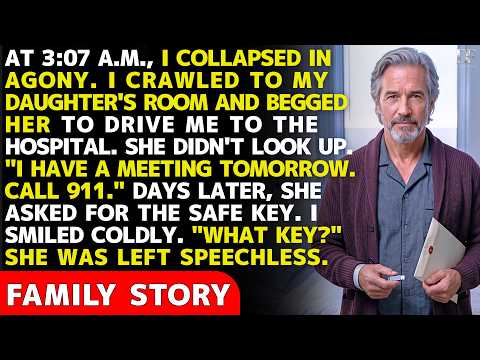
At 3:07 a.m., Walter Hayes, a 65-year-old retired watchmaker, woke to a twisting blade in his abdomen. He collapsed onto the hardwood floor, his legs useless, his shirt soaked with sweat. Forty years of listening to the heartbeat of clocks had taught him what a failing mechanism sounded like. Now, flat on his back, he understood with terrible clarity that the failing mechanism was him.
He dragged himself down the hallway, elbows burning against the carpet, each movement a fresh wave of agony. He reached his daughter’s door and knocked. “Emily, I need help.”
The door opened three inches. Emily stood in the gap, her expression carrying the particular irritation of someone whose sleep had been interrupted by something they considered unnecessary. She looked down at her father—soaked in sweat, one hand pressed to his abdomen—and sighed.
“Dad, what is it?”
“Something is wrong. I think something is seriously wrong. I need you to drive me to the hospital.”
She rubbed her eyes. “I have an early meeting tomorrow. A really important one. Just call 911. They’ll come faster than I could drive you anyway.”
“Emily, please.”
“Call 911. That’s literally what they’re there for.”
The door closed. The lock turned—a small, quiet click that seemed louder than anything Walter had ever heard. He had built that door. Painted it twice. Stood on the other side a thousand times to say good night. Now he pressed his back against the wall and breathed.
He crawled back to his bedroom, misdialed twice, and finally reached a dispatcher named Christine. She kept him talking, her voice professionally calm, as he dragged himself to the front door to unlock it. Four minutes. He knew because Christine counted with him.
Then he heard her—Rosa Navarro, his 70-year-old neighbor from across the street, wearing her blue cotton housecoat and brown slip-on shoes, arthritis screaming in both knees as she dropped beside him.
“I’ve got you, Walter. Look at me.”
She climbed into the ambulance without asking permission. “I’m his family,” she said simply. The paramedic nodded and stepped aside.
As the stretcher rolled toward the doors, Walter turned his head. Emily’s bedroom curtain shifted. A shadow stood behind the glass. A phone screen lit up, casting a pale blue glow across his daughter’s face as she looked down at the ambulance in the driveway.
She was taking a picture.
He told himself he had imagined it. The pain was severe. People did strange things when they were frightened. Surely Emily was frightened. Surely she was standing at that window because she was scared for him and didn’t know what to do.
He almost believed it.
At Milbrook Regional, Dr. Patricia Owens pressed two fingers into his abdomen, watched his face, and straightened up immediately. “Abdominal aortic aneurysm. It’s ruptured. We need to move him to the OR right now.”
She looked down at him. “Mr. Hayes, your aorta has torn. If we don’t repair it surgically in the next few minutes, you will not survive. Do you understand what I’m telling you?”
“Yes. I understand.”
He grabbed her wrist. “My neighbor came with me. Rosa. She’s alone. Will someone please make sure she’s not just left sitting by herself?”
Something shifted in Dr. Owens’s expression. “I’ll make sure of it. You have my word.”
They took him through double doors, and the ceiling lights became a long, unbroken stripe of white. He thought about Margaret, his wife, and the pocket watch she had given him on their 20th anniversary—a restored 1887 Waltham with an inscription inside: Every second with you. He kept it in the safe. He had looked at it just yesterday morning.
Let it still be there when I get home, he thought. Please, just let it still be there.
Someone placed a mask over his face and told him to count backward from 10. He got to seven.
In the waiting room, Rosa sat in a plastic chair for six hours and fourteen minutes. She did not eat. She did not sleep. When Dr. Owens finally came through the doors at 9:47 a.m., Rosa was on her feet before the doctor had taken three steps.
“He made it,” Dr. Owens said. “The repair was successful. He lost more blood than we would have liked, and recovery is going to be slow, but he made it.”
Rosa pressed one hand over her mouth. Her shoulders shook. She cried the way people cry when they have been holding something unbearable for hours and someone finally gives them permission to put it down.
Seven days later, Walter came home. Emily walked out to greet him, smiling wide and warm, and said, “Welcome home, Dad. I made chicken soup from scratch the way Mom used to.”
He looked at her and said nothing.
Because what she didn’t know was that he had already started watching long before she thought to look.
He let her hug him. He let her guide him to the couch, let her ladle soup into Margaret’s good china, let her sit beside him with that bright, attentive smile and ask whether the ride had tired him out. He answered in the flat, careful voice of a man conserving something. “A little. I’ll lie down after this.”
Jason hovered near the window, hands in his pockets, wearing the easy grin of a salesman mid-close. “Good to have you back, Walter. You had us scared.”
“Did I.”
Walter ate three spoonfuls and set the bowl down. Then he walked—slowly, one hand braced on the wall—to his bedroom and stood in the doorway. The dresser drawers were not quite closed. The second one from the top had a corner of fabric caught in it. His folders had been replaced, but not in the order he kept them. Forty years of organizing things with the precision of a man who understood that a misplaced part could stop a clock entirely. He noticed the difference immediately.
He crossed to the safe. Closed and locked as it should be—but the dial was set to a different number than the one he always left it on. And the shelf where Margaret’s watch had lived for six years, where he had set it every evening and wound it every morning, was empty.
He walked back to the kitchen. “Emily. Margaret’s pocket watch. It’s not in the safe.”
She turned from the stove with a wooden spoon still in her hand, and her expression arranged itself into something concerned and slightly sheepish. “Oh, Dad. We were worried about burglars while you were in the hospital. You know how the Hendersons got broken into last spring. We moved some of your things to keep them safe.”
Jason appeared in the doorway, nodding. “Just being cautious. Everything’s fine. We’ll get it all back in order.”
“Of course,” Walter said. “That makes sense. Where did you put it? The watch especially. I’d like to know it’s somewhere safe.”
“In one of the storage boxes in the garage,” Emily said without missing a beat. “All labeled. We can go through it together whenever you feel up to it.”
“Of course.” He smiled at them both. Then he said he was tired and went to lie down.
He did not sleep. He lay on top of the covers with his shoes still on, listening to the television come on in the living room, to Jason’s voice on the phone—low and unhurried, the voice of a man who believed everything was going according to plan.
Then he got up quietly, opened his laptop on the desk, and navigated to the cloud account linked to the doorbell camera he had installed eighteen months ago after the Henderson break-in.
The footage was organized by date. He found the folder for the night he had been taken to the hospital. His hand trembled so badly that he had to steady his right with his left before he could click play.
The timestamp on the first clip read 3:22 a.m.
Clear enough to see Emily come through the front door with a key. Clear enough to see Jason behind her, pulling on a pair of latex gloves—the way you see people do in hospitals, except they were not in a hospital, and there was no medical reason for gloves at 3:20 in the morning.
Emily went straight to the bedroom hallway. No pause in the living room. No looking around. No hesitation of someone entering a space they did not know. She knew exactly where she was going.
He watched the timestamp in the corner of the screen. 3:22. 3:31. 3:48. 4:09. 4:27. They were inside his bedroom for over an hour.
He closed the laptop and sat with both hands pressed flat against the desk, breathing carefully through his nose the way Dr. Owens had told him to when the pain got bad. The pain right now had nothing to do with his abdomen.
Then his eye caught something he had not noticed when he came in. The old iPad—the one he had replaced two years ago and left on the shelf because he could never quite throw away something that still technically worked—had been moved. It sat upright against the wall, plugged into the charger cable that usually served his phone, as though someone had knocked it over and stood it back up without thinking.
He picked it up. The screen was dark. He pressed the home button, expecting nothing. The Apple logo appeared. Then the lock screen. He entered the six-digit code Margaret had set up for him years ago—their anniversary, a date he would never forget—and the screen unlocked.
And then the notifications started coming.
They arrived in a cascade, one after another, the way water comes through a dam when the dam finally gives way. Message after message after message, all from an iMessage thread between Emily and Jason, all loading in sequence from oldest to newest—weeks and months of conversation the iPad had never received because it had been sitting powered off on a shelf.
He sat down on the edge of the bed and read.
Most of it was ordinary—complaints about traffic, questions about dinner. Then the thread shifted. Three months before the surgery: “Dad’s been talking about updating the will. We need to move faster.” Later: “After the surgery, he’ll be too weak to question anything.”
And then the message that made him set the iPad down and press both hands over his face: “If he doesn’t make it through the surgery, everything becomes so much simpler.” Emily’s reply, four minutes later: “I know. Either way, we’ll be fine.”
He read every message twice, the way he used to read technical manuals where a single misread instruction could damage something irreplaceable. Then he made coffee, rinsed the cup, dried it, and put it back in the cabinet.
At his desk he found the card for Margaret Sullivan, an estate attorney he’d met once at a dinner party three years ago. He set it open on the desk and did not call her until morning.
He was a man who had spent forty years learning that the most important skill in any repair was not speed. It was the ability to wait.
And Walter Hayes could wait.
If you were Walter, would you have confronted Emily that first night—or would you have stayed silent and gathered evidence? Tell me in the comments.
Report this article
Select a reason for reporting:






