It was 2:30 AM when Sergeant John Stephens saw the shapes sprinting out of the darkness. They were so close that his telescopic sight was useless—nothing but empty sky filled the lens. He grabbed the radio and requested something no crew had ever done in combat: lower the howitzer barrel to horizontal and fire it like a rifle. The reply came in three words. Fire when ready.
By the end of that night, two North Vietnamese regiments would be shattered by guns whose crews were never meant to see the attackers—let alone stop them at point-blank range.
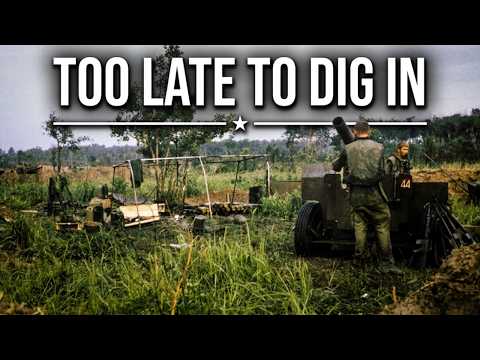
A week earlier, the war had shifted again. Saigon was under attack for the second time that year. The Tet Offensive had been repelled in January, city by city. Now, in early May, a new wave of NVA and Viet Cong units was surging toward the capital from the north and east, through the same jungle corridors and rubber plantations that had funneled men and supplies south for years.
Allied staff officers had chosen a name for the response weeks earlier: Operation Toan Thang—Total Victory. A joint effort of American, South Vietnamese, Australian, New Zealand, and Thai forces, it involved roughly 70,000 troops. The 1st Australian Task Force had been part of it since late April.
The order issued to the task force in the second week of May was blunt. Establish a fire support base quickly somewhere along the infiltration routes northeast of Saigon, near the Benoa Pass and Route 13, to put artillery on the ground. On the path the enemy needed to cross.
Brigadier Ronald Hughes, the task force commander, chose an open, barren piece of ground near a junction of two side roads about 40 kilometers from Saigon and gave the order to move on May 12. Helicopters would ferry the guns and infantry throughout the day. Simple on paper: a battery of guns on the ground, a battalion around it for protection, and fortified positions ready to fire by nightfall.
Speed was the heart of the plan, and the plan was not reckless. Every day that fire base sat empty on the map was a day the enemy used that ground for free. Compared to the alternatives, the incomplete base seemed the safest bet. What the plan could not account for was how much time could be lost once the actual work began.
The men building it that evening would have called it a patrol base for fire support, not just a fire base. The word “patrol” carried weight in Australian military doctrine. This site was supposed to be a hub from which a battalion launched aggressive patrols, not a static fortress waiting to be found behind barbed wire. That difference in philosophy—aggressive patrolling instead of passive perimeter defense—stopped mattering when the enemy found the site before the patrols found them that night.
Written doctrine for one kind of fight does not always hold up against a different kind. The Australian guns were not the only ones entering that corridor. Alongside Battery 102 were guns from the wider 12th Field Regiment. That week, the regiment also commanded 161 Battery of the Royal New Zealand Artillery and a battery from the 2nd Battalion, 35th Field Artillery of the U.S. Army, all positioned at the same site. Guns from three nations, one fire base established to cover the same stretch of road. Three different gun drills, three chains of command, and one grid reference to fire from.
Most of the men digging that evening had never worked together on this patch of ground. They had to learn to work together fast. Most of the young men moving ammunition from those helicopters were not volunteers in the usual sense. National service. The lottery system that had sent Australian conscripts to Vietnam since 1965 picked birth dates from a barrel in Melbourne. It turned twenty-year-olds into artillerymen and infantrymen, with two years of compulsory service and no say in where they were posted.
A fire base being thrown together on a Sunday in May was not manned by professionals who had chosen this particular risk. It was manned by conscripts doing a job the lottery had forced on them. What they did with that job over the next twelve hours was entirely their own decision.
The airlift fell behind. Helicopters that were supposed to arrive in the morning came in the afternoon, then later still, pushing the whole operation hours behind schedule. Some of the men of the 3rd Battalion, Royal Australian Regiment—the infantry supposed to protect the site—had not arrived when the light began to fade. The last guns of 102 Field Battery, part of the 12th Field Regiment under Lieutenant Colonel John Kelly, arrived only after dark, slung in by helicopter onto ground no one had properly surveyed.
This is not a small detail. Everything that follows depends on it. A fire base normally gets a full day, sometimes two, to dig gun pits, string barbed wire, and lay the guns properly with aiming posts and range cards. This base got a few hours of fading daylight, then nothing.
The men who had spent the day in the air since dawn were digging by torchlight and by feel in ground hardened by the dry season. Most were so exhausted and rushed that they could not dig deeper than knee level before an officer ordered them to stop. To stop the noise of picks on rock from carrying into the darkness. Lieutenant J. J. Smith, commander of 11 Platoon of the 3rd Battalion, ordered his men out beyond the wire that evening on standing patrols with a more specific mission than digging. Listen, watch, and get back inside before the enemy finds you first.
One patrol returned just after dusk, having heard movement they could not identify clearly, close enough to send the report straight to headquarters instead of waiting for the morning report. No one who landed on that clearing on May 12 realized they had been dropped on top of a corridor the 7th Division of the North Vietnamese Army was using that same week to move toward Saigon. No one yet knew how close or how strong the enemy was.
The American battery was supposed to share this ground. The battery from the 2nd Battalion, 35th Field Artillery had not yet arrived. Its 155mm self-propelled howitzers were too heavy to move by helicopter, so they were coming by road and were not due until the next day. Until then, anything that happened at this site would face a base with one battery of medium guns, not the full regiment the plan called for.
The responsibility for dividing that ground between guns, infantry, and mortars that evening fell largely to Major Brian Moore, the regiment’s second-in-command. He was working against a clock that had already cost him most of his daylight. A defensive plan drawn calmly on a map in an hour looks very different from one improvised in the last 90 minutes before dark.
Units were still arriving haphazardly, and no one was yet sure how much ground there would be time to fence. What was built that evening was not the fire base the plan specified. It was the fire base the available daylight allowed. And by dusk, there was no room to argue about the difference.
There was no perimeter fence in the sense a viewer today might imagine. Just a single thin belt of wire laid in haste. Men who already knew where the gaps were could crawl under it easily because they had been watching the site being built that very evening from a hide close enough to count the helicopters. The gun pits that were supposed to be chest-deep were knee-deep or less.
The gap between what a ready fire base looks like and what stood on that ground by dusk on May 12 came down to three things. Depth, wire, and the hours required to finish both. None of that was there when the first shot rang out. Instead, there were six guns not yet laid, an infantry screen spread wider than it could hold, and the rest of a long night to get through.
The ground itself worked against the diggers as much as the clock. The dry season had turned the red soil into something like broken rock rather than dirt for a foot or more down. A pick swung by an exhausted man after ten hours of flying and unloading does not move that kind of ground quickly. Officers walking the perimeter that evening had to make a decision most of them had never made before. Stop digging early, accept shallower pits, and hope the darkness beyond the wire stayed empty.
On the gun line, Major Gavin Andrews, commander of Battery 102, had six guns on the ground, none of them laid, aiming posts barely set, and ammunition still being moved by hand from the last helicopters as the light died completely. A base built to fire quickly in support of other units had not yet fired a single ranging shot in a real fight. It existed on the map before it existed as a defensive position. For a few hours that night, that gap was all that separated an understrength Australian and allied force from a regiment already moving through the darkness to close it.
There was something on the road already. The gunners of Battery 102 were young, most of them conscripts serving their two-year national service. They had trained to crew 105mm howitzers as a six-man team, not to defend a perimeter against a ground assault. Their job was to deliver fire missions requested by infantry elsewhere on the map. Someone else’s job on paper was to keep the enemy from reaching the gun line in the first place.
On the night of May 12–13, that division of labor existed only in the training manuals. The infantry protecting the base were few in number and weaker in their fortifications, spread far wider than the available force could properly defend. The mortar platoon of the 1st Battalion, eighteen men, had barely finished setting their baseplates when the order came to try to get some rest before what morning would bring. And in the opposite direction, the 141st Regiment of the 7th Division of the North Vietnamese Army was advancing. Reinforced with two attached infiltration battalions to approach full regimental strength.
They moved with the confidence of men who had scouted the ground the day before and found exactly what their orders described—a hastily built, unfinished position that would not survive first contact. This was no novice unit stumbling into a fight it did not understand. The 7th Division’s regiments had moved through this ground for years, living off roots and crossing rivers they knew better than any Australian officer’s map. Their reconnaissance was precise, carried out by soldiers who knew exactly what a ready defensive position looked like, and how far this one was from being that.
The orders recovered later described the target in terms almost contemptuous: a hasty position, not a base, unlikely to hold when engaged. No part of that assessment was wrong. Every line of it described the ground as it actually was at last light on May 12.
At Gun Number 4, Sergeant John Stephens and his crew had barely finished laying out the ready rounds within arm’s reach. Along the line in another pit, Sergeant Algy Elgar’s crew was doing the same. Beside each gun were laid six rounds of a type no one at this site had ever fired in combat. “Splinters”—7,200 tungsten flechettes carried in a single anti-personnel round. Think of it not as an artillery shell but as a giant shotgun cartridge designed to fit a 105mm barrel. It had been made specifically for the range bracket no one here had expected to need. And this battery had never put a single one of them down a barrel in combat.
The six-man crews had trained on them, handled them, stored them, and checked them on their manifests. None of them had ever seen what they actually did. If you are loading that gun in the dark, you are working by touch and count, not by sight. Round in, breech closed, hand off the lanyard—because the soldier memorizes the drill in his hands before he needs it under fire. That night, the drill was the only thing standing between six exhausted conscripts and panic.
Most crews had spent the midday hours on the gun line digging instead of resting. Those who got a chance to sleep took it sitting up against the trail of the gun, for lack of any flat, dug ground to lie on. A gun sergeant’s last task before dawn was to check his crew—who still had a magazine, who had eaten something since the helicopters landed, who needed a shake to wake up rather than just being told to move. None of them were thinking about medals during that round. They were counting the hours of darkness left.
At 2:30 AM, the ground stopped being quiet. Mortar and rocket fire came first, crawling across the site in a rough line aimed at pinning the defenders before the infantry closed. Seconds after it began, the first wave of North Vietnamese infantry came out of the darkness at a run, straight at the gun line and the mortar platoon dug in near it. That part of the perimeter was the weakest, and their orders understood that.
At Gun Number 4, the sight designed for engaging targets thousands of yards away was useless against men charging at speed. Sergeant Stephens requested the barrel be lowered to horizontal. The reply came in three words. Fire when ready. The crew depressed the barrel and fired the first Splinter round with a time fuze set at 500 milliseconds. It was the standard setting designed to burst the shell a reasonable distance before releasing the flechettes against a close target like this. “Reasonable” was wrong. The round sailed over the target and burst about 400 meters out among the enemy’s reserves instead of the men at the wire.
There was no time for embarrassment. The crew switched to point-detonating fuses. Now the shell burst the instant it left the muzzle instead of hundreds of meters away, spraying the full load of flechettes into the men directly in front of it. The second round did what the first had failed to do. Before the night was over, Gun Number 4 alone had fired 84 rounds in direct lay, 22 of them launched straight from the muzzle at men close enough to see individually in the flash of the gun.
The mortar platoon’s position was overrun in the first minutes. Five of its eighteen men were killed and eight more wounded. The survivors fought at close quarters with rifles and grenades to hold ground that had never been built to be fought over this way. From Gun Number 5, five Splinter rounds were fired low and flat over the overrun mortar position, one after another. No crew makes that decision easily. Not that close to their own men. They made it anyway because the alternative was watching the position fall entirely. It worked. Enough of the NVA who charged into the mortar pits went down under those five rounds to let the platoon’s survivors hold what ground they had left until first light.
Elsewhere on the perimeter, machine gunners held their positions with no cover at all because there had been no time to build any. Radio traffic that night was cold and clipped in every account that survived. Contact reports were seconds apart. Ammunition ran low at more than one position before the first hour was out. A base built to shoot outward was now fighting not to be overrun from inside its own gun line.
Illumination rounds went up. Tracers crossed in both directions. Three minutes into the attack, then five. A crew reloading with hands that would not stop shaking, and still working. A wounded man dragged behind a gun wheel by a mate who did not stop to check whether the route was safe, because there was no longer time to check. Somewhere along the gun line, a young loader realized the shape moving at the edge of his illum light was not one of his crew. He reacted before the thought finished forming. Thinking longer was not an option available to anyone in that fight.
Beneath every official number from that night lie dozens of decisions like that one. Not a cohesive defensive line, but split-second calls made accurately enough and often enough by exhausted teenagers and barely-grown men that the line as a whole never collapsed even though parts of it nearly did. It did not break. What held it was the ordinary stuff that decides most fights like this. Men doing their jobs after the jobs became unsafe, and continuing to do them anyway.
Sergeant Elgar’s crew kept their gun as ready as Stephens’s, loading and firing in a fight they had never trained for. An artillery crew drilled for months on range estimation and fire discipline proved able to adapt fast when the alternative was being overrun. Ammunition ran short gun by gun, and men carried rounds forward under fire in the open because the ready stock had not been finished in the few hours before dark. Major Andrews ran the battery from close enough to the fighting to make instant decisions rather than wait for events to play out. He had a question in front of him with no clear answer in any training manual. How much of a defense does a battery commander allow his guns to spend on themselves before nothing is left for the fire missions the rest of the base is calling for? He kept both missions going. Guns firing in their own defense, and guns still answering the calls of the infantry platoons holding the wider perimeter. A battery that saves itself and lets the rest of the base fall has not won anything at all.
Above the gun line, the same three-hour countdown applied to the men flying resupply into the site. Ammunition arrived as soon as any gun reported its stock low. Because a gun that runs its ready rack dry is a gap in the perimeter. A gap no amount of courage can plug on its own. The coordination from headquarters, matching aircraft to the guns that needed them most as the situation changed minute by minute, added another job no one had drilled for.
No one on that line planned to be a hero history would remember. The word “hero” gets used too quickly in stories like this, spent before anyone in them has earned it. What held Coral through the early hours of May 13 comes down to a company of exhausted conscripts who collectively refused to leave their guns, and a limited infantry force that refused to let the rest of the perimeter collapse for nearly three hours, until dawn broke and the balance shifted with the arrival of reinforcements. It was not down to one man’s singular act of heroism.
Along the perimeter on both sides of the guns, infantry from Lieutenant Smith’s platoon and the sections around them held with small arms and grenades, while the artillery did the one thing nothing else could do at that range. Machine-gun positions ran dry to the last belt before the light came. No man in that sector of the perimeter had the luxury of thinking about any gun but the one in front of him. Runners carried messages between positions when the radios could not keep up with how fast the situation changed. They moved across open ground through gun flashes, because a report that arrives five minutes late may mean nothing at all.
If you have never stood beside a field gun the moment it fires, the sound alone at that range is enough to knock a man off balance, even when he is expecting it. The men who attacked that position that morning were not expecting it. By about 5:00 AM, as grey light began to show above the treeline, there was no need to interpret what had happened on the ground in front of the gun positions. The attack stopped coming. Fifty-two North Vietnamese dead were counted around the guns and mortar pits in full daylight. One man was taken prisoner. What remained in front of the wire was not going anywhere.
And for the first time since 2:30 that morning, everything at the site stopped firing. Men who had spent three hours certain they would not see the sunrise sat down where they stood, because their legs had finally been given permission to stop. Later that same morning, Major Tony Hammett led D Company of the 1st Battalion forward behind a creeping barrage from Battery 102, walked 150 meters ahead of his men. It was a bayonet assault on what was left of the abandoned enemy positions. A creeping barrage that close is a precise and dangerous operation requiring high coordination in broad daylight with a thoroughly rested battery. At Coral, it was executed by the same crews who had spent the previous three hours fighting for their lives at zero range. Most had been awake since dawn the day before on the gun line they were now firing over. D Company advanced behind their fire. It was the kind of attack a company only mounts with real confidence in the artillery clearing the way. By then, that confidence had been earned through the night, the hard way.
For a few hours that morning, it was easy to believe the worst was over. It was not. The road network the base sat on remained just as important to North Vietnamese planning as it had been the night before. A damaged base recovering from an attack is not a base the enemy simply walks away from. In the days after the 13th, engineers and infantry worked around the clock to fortify the site properly. This time with warning and enough time to do it right. Bunkers went underground. Wire went in deep instead of a single thin belt. Everything May 12 had left no time to do. They spent the days after the 13th putting things right.
On the night of May 15–16, a second attack came, again estimated at full regimental strength, larger than the first. The surviving accounts do not identify with certainty which formation attacked that night. Intelligence at the time again assessed it as regimental-sized force committed against the same ground. This time the attack hit a base that had spent three days turning every lesson of its worst night into concrete and wire and depth. That difference was not luck. It was engineering. Gun pits with overhead protection more than a meter thick instead of bare earth, and wire deep enough to slow an assault for the seconds a defended position actually needs. Weapon pits dug to fighting depth instead of scraped ground an hour before contact. American air support circling that night added another layer entirely. Illumination and airstrikes including napalm broke up the attack before it could close the way the first one had. Forward air controller Roger Wilson, an Australian working those strikes that night, was later awarded the Distinguished Flying Cross.
That second night is part of the Coral story most people who know the base’s name have never heard, because the version usually told stops at sunrise on the 13th. But it did not stop there, and neither did the fighting in that corridor. A second Australian base, Balmoral, was established a few kilometers north on May 24, defended by the 3rd Battalion and a squadron of Centurion tanks, this time from day one. The base was attacked twice on the night of the 26th and again on the 28th. The tank’s main gun fired canister rounds at close range in a far denser pattern than a single howitzer could achieve alone. And by the 28th, the base controlling that corridor had both. The regiment that attacked Balmoral on those two nights has a confirmed name in the records. Unlike Coral’s attacker on the 16th, which has none. It was the 165th Regiment, the 7th Division’s second formation committed to the same attack through the same corridor.
If you have made it this far, you are exactly the person these stories are made for, and there are more coming. Did anyone in your family serve in Vietnam or Korea or the World Wars, or with SASR in any era? Tell me who they were in the comments. These stories stay alive because the people who remember them keep talking about them. And if you want the next story the moment it drops, that is what the subscribe button is for.
Fighting around Coral and Balmoral together ran from May 12 to June 6, twenty-six days. In the words of the Australian War Memorial, it was the largest, most dangerous, and longest battle fought by Australian forces anywhere in the Vietnam War. The last serious attempt by North Vietnamese forces to overrun either base came at Balmoral on May 28. After that night, pressure on that stretch of corridor eased for good, and the task force spent the final week of the battle expanding its reach rather than defending its perimeter. None of it—the reinforcements, the second base, the twenty-six days—would have happened if the gun line at Coral had collapsed on its first night. But it did not collapse.
The cost must be stated honestly, because a story that counts only the other side’s losses does not tell the whole truth. At the base itself on the night of the 13th, nine Australians were killed and twenty-eight wounded. It is a toll that seems incredibly small against three hours of fighting at very close range. And it stayed small because the perimeter never fully collapsed across the twenty-six days at Coral and Balmoral. The official history by Ian McNeill and Ashley Ekins records twenty-five Australians killed and nearly one hundred wounded. The Australian War Memorial’s roll of honor for the battle counts twenty-six dead. Both figures come from sources that took the count seriously. Both cover the same twenty-six days, and the difference between them is one man. The discrepancy is real, and twenty-six is the higher and more recently confirmed of the two. Twenty-five or twenty-six Australians did not die to win a battle that ended the war or even meaningfully shortened it. Coral and Balmoral secured one corridor for one season of one campaign. That is what a fire base buys in reality. Nothing about those twenty-six days makes it greater than that.
On the other side of the wire, the toll was worse. Fifty-two North Vietnamese dead were counted at Coral on the morning of the 13th alone. Across the whole battle, Australian forces claimed more than three hundred enemy killed or probably killed. The task force always offered that as a claim rather than a confirmed count, because body counts after close night fighting are never precise. McNeill and Ekins, writing the official history decades later with access to unit records from both sides, never arrived at a more exact number. What they agree on, and what the memorial records agree on, is the nature of the thing. The heavy losses were concentrated in specific nights against specific regiments out of everything that happened across those twenty-six days.
Casualties were not the only price the battle left behind. Coral’s mortar platoon, destroyed in the first hour of the 13th, had to be rebuilt from scratch before the base could rely on its guns again. The wounded evacuated that first morning went out under fire on helicopters flown by pilots who had no more margin for error than the men on the ground. Flying too high over a contact zone makes the helicopter a prominent target against illumination. Flying too low means flying straight into the kill zone the fighting has already created. None of the pilots who made those runs later described their work as heroic. It was the mission. The same word the gunners used to describe what they did themselves.
Not all of that price fell only on the men killed or directly wounded. Every gunner who kept loading Gun Number 4 through three hours of close fighting carried the physical burden of it long after sunrise. Hands that would not stop shaking for hours. Hearing dulled by firing a howitzer dozens of times at very close range. That particular exhaustion of a body that had been running on adrenaline since 2:00 AM and no longer had anywhere to put the energy. No casualty report counts that cost because there is no line for it. It was present anyway in every man who left the gun line still standing on his feet.
What happened to the units themselves is more telling than any number. The 141st Regiment, broken at Coral on the 13th, and the 165th Regiment, broken at Balmoral on the 26th and 28th, were later assessed as incapable of mounting another major attack in that corridor for months. A regiment is not assessed that way because of one failed patrol. It is assessed that way when two separate assaults run into fire. The defenders were not supposed to be able to reply at that range, and neither regiment came out of it in a fighting state.
Neither side achieved everything it wanted from that corridor that month. The task force did not destroy either regiment outright, and men from both sides who left Coral and Balmoral went on fighting elsewhere in the war for years afterward. What changed materially and for a measurable span of time was which side controlled that corridor. Throughout the fighting at Coral and Balmoral, and for months after it ended, the two regiments relied on to keep pressure on the approaches to Saigon were no longer able to do so. That is a narrower claim than victory in the war, and it is the claim the evidence actually supports. What the two regiments were capable of after Coral and Balmoral was far less than what they had been capable of before either battle began. That part of the record was never in dispute.
The recognition came from the Australian side as it usually does—slowly and on paper, months after the men who had earned it had moved on to other jobs. Sergeant John Stephens and Corporal D. J. Manser of 11 Platoon were awarded Military Medals. Sergeant Algy Elgar of Battery 102 and Major Tony Hammett of D Company were mentioned in dispatches, alongside Lieutenant Smith and several other officers granted the Military Cross for their roles in both battles. The 3rd Battalion, the 1st Battalion, and the armored units that fought at Balmoral later were granted the battle honor “Coral–Balmoral” to carry on their colors. Artillery units in Australian tradition do not carry battle honors that way. Their guns are their colors instead. So Battery 102’s recognition took a different form. Forty years later, in 2008 and on the anniversary of the battle, the Governor-General granted the battery the honorary title it still carries today. 102nd Field Battery “Coral”—the first Australian artillery unit ever to receive an honorary title of its own.
None of that recognition changes what the honors themselves actually describe, which is something smaller and harder to summarize than any citation can manage. A sergeant who asked permission for something no manual covered, and got it. A battery commander who trusted him enough to say yes over the radio in the dark. Gun crews who kept loading a weapon they had never fired this way for as long as it took.
Ask most people about the biggest battle Australia fought in Vietnam, and Long Tan will come up first. Almost every time. Long Tan earned that place in memory. Frankly, one infantry company of just over a hundred men against an estimated two thousand Viet Cong and North Vietnamese troops, with eighteen Australians killed and twenty-four wounded against at least 245 enemy dead in a rubber plantation over an afternoon and evening—its story has never stopped being told. Coral and Balmoral together were larger. More Australians fought there. More died. More were wounded, and the fighting lasted twenty-six days instead of one. That battle never occupied the same place in the country’s memory. Partly because a battle without a single clear day of drama is harder to narrate. Partly because the story people expect from May 1968 begins with the words “poorly sited.” And a story that begins that way seems like it should end in defeat.
It did not end that way. The very haste of the siting, the very shallowness of the pits, the very guns not yet laid when the first mortar round fell, made those crews close enough and low enough to fire directly at the attackers. Every one of them depended entirely on the situation everyone knew was incomplete. Every fact later used against Coral—the delay, the thin wire, the barely dug guns—was also the reason those guns could be leveled and fired straight from their muzzles at men running at them in the dark. The mistake and the solution to the mistake were the same site on the same first night.
None of it was inevitable either. Remove Sergeant Stephens’s crew who refused to abandon Gun Number 4. Remove the rushed but workable planning of Major Moore for a base with little daylight left to build. Remove three days of frantic digging between the 13th and the 16th, and this is an entirely different story with a very different ending. Coral did not hold because it was well built. It held because the men in it decided, individually and then collectively, that it would.
Two regiments moved through that corridor relying on accurate intelligence about the incomplete Australian positions. They were right about the positions. They were wrong about the men standing behind the guns. And by the time the fighting at Coral and Balmoral finally quieted, the intelligence that had sent two regiments forward no longer described two fighting forces at all.
No one planned to fire artillery like a rifle that first night. There was no manual for it, no training, nothing in the curriculum that said a field gun becomes the last line of defense and is fought this way. A company of exhausted conscripts, partly sheltered, managed in about three hours to learn what their gun could do when nothing stood between them and the enemy but the muzzle. They worked it out at one gun position in the dark, after being awake since the previous dawn and having to find the answer before the next round fell. Sergeant Stephens had no plan for it either. He had a battery commander willing to say three words over the radio, and a gun crew that lowered the barrel and kept loading.
That is smaller than a doctrine. It is also, on a night when doctrine ran out early, the only thing that actually held.
There is a version of this that applies far beyond a gun line in 1968. Most people end up, at some point, standing on ground that looks indefensible by any rational measure, unprepared for what is coming, and with no time to fix the parts of the plan that have already gone wrong. The instinct in that moment is to treat the reality as the whole story, and to decide the position is lost because it was not built properly from the start. Coral offers something more specific and more useful than that. The question that actually matters is rarely whether the ground was chosen well. It is what the people standing on it are prepared to do with what they have, in the time they have left to do it.
No one at Coral got to choose the ground, the timeline, or the daylight that ran out hours before it should have. What Sergeant Stephens’s crew chose, in the one window they had to choose anything, was what to do when the plan ran out early and the enemy arrived on schedule. After three weeks at Balmoral, a different battery facing a different regiment did not have to work that answer out from nothing. By then the whole task force knew what a gun could do at close range, because six conscripts on Gun Number 4 had found out first, in the dark, with no manual telling them it was possible.
The site is described as poorly sited by people reading a map afterward. But it is called something else entirely by the two regiments that discovered, exactly three weeks apart, what the men defending it were prepared to do rather than let it fall. They fired with open sights, and two regiments that had expected an easy fight learned at Coral, and then at Balmoral, exactly what that meant.
So here is the question worth asking yourself: when the plan runs out early and the enemy arrives on schedule, what will you do with the ground you are standing on? Tell me in the comments—and if this story moved you, share it with someone who needs to hear it.
Report this article
Select a reason for reporting:






