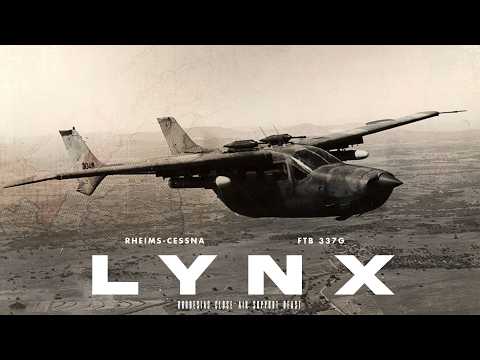
The bush war in Rhodesia was one of the longest and most demanding counter-insurgency conflicts of the Cold War. Facing threats from multiple fronts, the Rhodesian military developed everything from new tactics to modern equipment, all tailored for counter-insurgency warfare in a harsh environment. One of these iconic weapons was the Lynx, a specially modified Cessna Skymaster armed with cannons, rockets, and bombs.
Equipped for combat, it became one of the most important aerial assets available to the Rhodesians, carrying out missions ranging from reconnaissance and communications relay to close air support and interdiction. An affordable and reliable aircraft that proved devastatingly effective.
The Reims Cessna Skymaster first appeared in 1961, characterized by being economical, simple, and safe. The so-called Model 336 was a unique design aimed at the civil market, built around a twin-engine push-pull configuration. The wings were mounted high with most of the fuselage connected to the upper part of the body, giving pilots surprisingly good visibility of their surroundings. Moreover, the push-pull engine setup made it extremely safe. If one engine failed, asymmetric drag was minimal, and the aircraft could safely return to base.
Ideal in theory for battlefield use. It didn’t take long for this idea to take shape. In 1966, the US Air Force first requested a military-spec version of the Skymaster. The specific model was the 337, an improved version that first flew the previous year and was equipped with retractable landing gear.
In collaboration with Cessna, the new aircraft, designated the O-2 Skymaster, first flew in January 1967, and by the end of the year it entered combat service. Cessna took the civilian aircraft and removed the six-seat configuration, providing more space for a small crew. In the back, a large rack for military communications equipment was installed, allowing one crew member to coordinate with various assets simultaneously. Observation windows were cut into the doors, and two large openings were made above the pilot’s head through the ceiling, providing excellent visibility from most angles.
Numerous other smaller modifications were made, including removing the propeller spinner cover, reinforcing the wings, and extending tubes for four weapons hardpoints. Although it was slightly heavier and slower, the final product proved to be a promising modification program—cost-effective and easy to use. The O-2A and O-2B variants, painted in distinctive white, became successful platforms for forward air control and strategic planning operations, which many know about.
What many don’t know is that the O-2, thanks to its weapons hardpoints, was actually combat-ready. The four underwing hardpoints could be loaded with a variety of weapons, from SUU-11 gun pods to rockets, and even dispensers loaded with flares and other mission equipment. In practice, the pods usually contained phosphorus rockets and flare dispensers to help troops and other aircraft. However, in critical conditions, such as friendly troops under attack before help arrived, crews could engage the enemy directly.
Some stories tell of forward air controllers attacking with phosphorus rockets to scare the enemy or simply flying over them to draw fire away from ground forces. If gun pods were installed, crews could direct lethal fire, aided by primitive sights drawn with grease pencils. In practice, this was a dangerous but useful approach, combining the role of forward air controller with the ability to carry defensive weapons when needed.
Although the United States never developed this concept in the O-2, it proved that the basic Skymaster could be used effectively on the battlefield. In 1973, France developed the FTB.337 G multi-role aircraft, a modified version of the latest Super Skymaster models. It featured reinforced wings with extensions and hardpoints, plus a slightly modified cockpit to accommodate weapons use.
In 1975, Rhodesia decided to purchase 18 aircraft in this configuration for No. 4 Squadron. To circumvent arms restrictions imposed on the country, the French assembled the aircraft with multi-role internal components but painted them as civilian aircraft. The aircraft also came equipped with a “Robinson” short takeoff and landing kit, enabling it to operate from dirt runways. Typically, landings and takeoffs could be executed in less than 200 meters at 60 knots. This was crucial not only for short runways but also to assist conventional takeoffs in thin, hot air.
Once assembled, the aircraft were fitted with large internal fuel tanks in 1975 and secretly transported to Rhodesia under the guise of civilian aircraft. Upon arrival, Rhodesia repainted them in non-reflective camouflage without markings and began the second phase of making them combat-ready.
No. 4 Squadron added radio equipment and appropriate military navigation gear, while ammunition stores and empty case collectors were placed in the rear. This was followed by additional electrical extensions to the hardpoints, allowing French SNEB rockets to be fired in bursts, and adding compatibility with a variety of homegrown weapons.
These weapons included small napalm canisters called “Frantan,” and anti-personnel submunitions called the “Alpha” bomb, which bounced upward after hitting the ground before detonating its fragmentation warhead at head height, and a small 80 kg cluster bomb known as the “Mini Golf.” It was a smaller derivative of the 1,000-pound “Golf” bomb used by Rhodesian bombers. Loaded with clusters of fragments or steel rods, it was detonated by a thin one-meter fuse activated just before impact with the ground. In total, each hardpoint was said to be designed to carry a load of about 200 pounds.
Finally, the main weapon modification was the installation of two .303 Browning machine guns on top. They were fed via a belt from ammunition boxes in the rear seat carrying 1,200 rounds. Compared to the O-2, it lacked the special visibility openings, but it was much more modern.
The decision to use it as a light multi-role platform was smart given the few potential issues. The tail booms were susceptible to damage from rough or combat handling, and the rear engine could overheat if left running while stationary for long periods, and due to the high-wing design, the crew had a large blind spot inside their turning circle if they banked steeply. But beyond this, they were dynamic aircraft. Not only could they be deployed from small airstrips, but they were easy to maintain, quick to refuel and rearm, and both slow and agile at the same time, making them a superb platform for supporting ground forces.
Their use in combat soon followed. In 1976, the fleet was modified to include exhaust shields to reduce the heat signature against infrared missile threats, and three more aircraft arrived in 1977. Under No. 4 Squadron, the aircraft quickly earned the nickname “Lynx” and began carrying out a diverse number of missions ranging from forward air control, visual reconnaissance, general close air support, and interdiction. Over time, its list of roles grew.
Its clear advantages in close and sustained battlefield support made it a preferred choice over larger jet aircraft like the Canberra, Vampire, and Hawker Hunter. Shortly after entering service, it began operating closely with ground forces as an asset in “Fireforce” attacks, with No. 4 Squadron integrated into the team structure.
The famous traditional method involved three transport helicopters or “G-cars” loaded with four soldiers each, or so-called “sticks,” who were dropped in three separate blocking positions around the enemy location. A fourth helicopter, an attack helicopter or “K-car,” served as a command post. This was followed by a C-47, which dropped paratroopers to encircle the enemy and begin the closing process. This was considered the first-wave sequence, and it could be followed by a second wave via helicopters or ground convoys.
Although this tactic needs its own video, direct air power quickly proved essential to speeding up the operation. A Lynx was preferred to be present at the mission site. A typical mission would designate a target group within a certain “Fireforce” area. The mission would then begin if it was deemed a sufficient threat. The “K-car” was usually the first to arrive at the site. The commander aboard would then survey the terrain and select landing spots for the transport helicopters and drop zones for the paratroopers.
Usually, the “K-car” operated at this stage in coordination with the Lynx to locate and strike the enemy. This caused maximum damage where the enemy typically gathered and gave the transport aircraft time to land troops while the enemy was distracted. In other cases, the Lynx arrived at the site after the fighting had already begun. In either case, due to its slow speed, the Lynx proved highly efficient.
It was slow enough to spot enemies easily and precise enough to provide air support even while friendly forces were engaged at very close quarters, greatly reducing the risk of friendly fire. Of all the roles it performed, this was likely the one it did best.
The nature of a Fireforce attack meant the contact line moved quickly. For faster jets like the Hunter or Vampire, this usually meant two passes—one for visual identification and another for the strike. In that time, in tight spaces amid dense bush, the line could shift enough to put friendly troops in the line of fire.
The Lynx, by contrast, was slow enough to identify friend and foe with greater accuracy and could execute a low-speed attack without having to leave and return. This meant the crew could keep watching the situation and adapt quickly without losing sight.
Beyond Fireforce, it saw widespread use in other roles. Like the O-2, it performed forward air control with high efficiency, coordinating multiple assets at once and designating targets. It could also fly at high altitude, circling as a command post or radio relay station in mountainous environments. It carried out various reconnaissance roles as well.
In standard visual reconnaissance missions, it flew low to identify threats. Later, it was used in armed reconnaissance along the borders, where it was permitted to engage targets of opportunity. Many other mission types followed, from casualty evacuation and night operations to long-range strike missions, including operations inside neighboring countries to cut off insurgents and hit bases.
As covered in the Rhodesian Bush War video, the Lynx’s response speed meant aircraft stayed on standby to support troops throughout the day. If necessary, this could continue into the night, with crews navigating by compass and clock, then striking targets they could illuminate with flares.
By the end of the bush war, Rhodesian pilots had pushed this aircraft to its absolute limits, yet it proved remarkably reliable throughout the conflict. Over four years, the Lynx became an essential asset of Fireforce units, a familiar sight to soldiers on the ground during contact, a deadly barrier against insurgents crossing Rhodesia’s borders, and a small but helpful aid supporting larger air force aircraft in more ambitious strike missions.
Like other equipment of that era, it was the result of creativity under pressure, and a potent platform reminiscent of the A-1 Skyraider in Vietnam. It is still remembered today as an icon of the Rhodesian Bush War.
What do you think—was the Lynx the unsung hero of Rhodesian air power, or just a stopgap that got lucky? Share your thoughts in the comments below.
Report this article
Select a reason for reporting:






