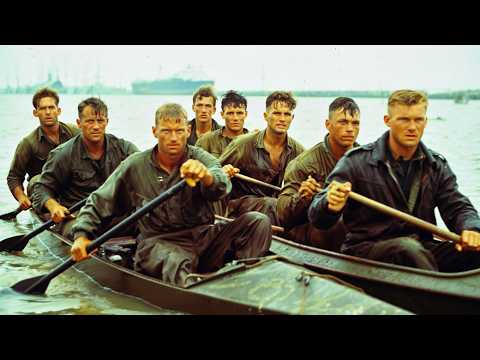
The water was black—not dark, but black, the kind that swallows torchlight and sound and men whole if they let it. And right now, six men in three canvas kayaks were letting it swallow them. They paddled slowly, so slowly that from ten meters away, you would see nothing but shapes on the water: low, flat, organic. Driftwood, maybe. Debris from a bombed wharf. Nothing worth a second look. That was the point.
Each kayak was five meters long, weighed thirty-two kilograms empty, and carried two men, six limpet mines, paddles, water, rations, a compass, a pistol, and enough explosive to rip open the hull of a ten-thousand-ton merchant vessel. The man in the front of the lead kayak had not spoken in forty-seven minutes. His name was not important yet. What was important was what he could see: the silhouette of Japanese shipping, merchant vessels and tankers lined up in the harbor like bottles on a shelf. He dipped his paddle—left side, three inches of blade, no splash—and the man behind him mirrored the stroke. They moved forward one meter. This was going to take a while.
Because what you are about to hear is the most audacious special operation of the Second World War—not the most famous, not the most celebrated, the most audacious. Seven Australians in folding canoes inside one of the most heavily defended harbors on Earth, surrounded by sixty-five thousand Japanese troops, with nothing between them and execution but silence, darkness, and nerve. And every single one of them was going home.
But first, we need to talk about how they got here. Rewind eighteen months, to February 1942. Singapore has fallen—the greatest military disaster in British history. One hundred thirty thousand Allied troops surrendered. The Japanese now control the Malay Peninsula, the Dutch East Indies, and every sea lane from Burma to Borneo. In the chaos of the fall, a small Japanese fishing vessel sits at anchor in Singapore’s harbor. Twenty-one meters long, diesel engine, wooden hull—the kind of boat that moves through these waters without anyone looking twice. A group of retreating Allied personnel commandeer her. They sail south, through Japanese patrols, through minefields, through sheer bloody luck, and they reach Australia. The boat is renamed. She becomes the MV Krait, named after the banded krait, a snake so deadly that by the time you feel the bite, the venom is already in your bloodstream. Remember that name.
Now a man named Ivan Lyon has an idea. Lyon is British-born, but he has been adopted by Australian special operations in every way that matters. He is a major. He has lived in Asia for years. He speaks Malay. He understands the waters, the currents, the patrol patterns, and he has been staring at maps of Singapore Harbor since the day it fell. His idea is insane: sail back to Singapore in a fishing boat, disguised as local fishermen, get close enough to launch canoes, paddle into the harbor, attach explosive charges to Japanese ships, paddle out, sail home. Three thousand nautical miles each way, through waters the Japanese control absolutely, in a twenty-one-meter wooden boat with no armor, no weapons worth mentioning, and a top speed of six and a half knots.
The idea is so insane that it is approved.
Welcome to Z Special Unit. Z Special Unit is Australia’s answer to a question the conventional military would rather not ask: What happens when you need men willing to do things that no reasonable person would volunteer for? The unit draws from across the Australian military and from Allied officers like Lyon who have been folded into Australian operations. They are not commandos by traditional training. They are selected for something else entirely: nerve, adaptability, the ability to operate alone in enemy territory for weeks at a time without support, without communication, without anyone coming to get them if things go wrong. Things can go very wrong.
The mission is designated Operation Jaywick. Fourteen men total. Seven will crew the Krait. Seven will paddle the canoes into Singapore Harbor. Lyon will command overall. Lieutenant Donald Davidson, Royal Navy, will serve as his second and lead one of the canoe teams. The training takes months. The men practice folboat operations—the folboat is a collapsible kayak, canvas over a wooden frame, designed to be assembled and launched in minutes. They practice at night. They practice in currents. They practice approaching the hulls of moored ships and attaching dummy mines by hand while sitting in a boat that weighs thirty-two kilos and has the structural integrity of a wet umbrella. They practice being invisible.
By 1943, the Krait slipped from Exmouth Gulf with fourteen men and a cargo of limpet mines. The voyage north was tedious and tense—Japanese patrol planes passed overhead; each time the crew pulled on sarongs and pretended to fish. “Nobody stopped a wooden boat doing six knots,” Lyon later said. They reached the islands south of Singapore and waited for darkness.
On the night of September 26, six men in three canvas kayaks entered Keppel Harbor. They moved like shadows between hulls, placing mines below the waterline with a soft click of magnets. Sentries smoked and chatted above them, unaware. By 23:30, eighteen mines were deployed on seven ships. The canoeists paddled back through the dark, exhausted but silent.
At 05:00 on September 27, the mines detonated. Seven Japanese merchant vessels were damaged or sunk—39,000 tons of shipping lost in a single night. The Japanese searched for submarines and commandos; they never imagined three folding kayaks. The six men rendezvoused with the Krait and sailed home. All fourteen returned alive.
Operation Jaywick was a perfect raid. But a year later, the same commander, Ivan Lyon, led Operation Rimau—a larger follow-up that ended in disaster. Lyon was killed, and ten captured men were executed weeks before the war ended. The margin between triumph and catastrophe was measured in moments.
Yet Jaywick remains a legend of special operations—not for its destruction, but for its audacity. Six men in canvas boats, armed with nerve and silence, broke the heart of an enemy harbor and vanished. They went anyway, not because they were fearless, but because they acted despite fear.
So when you think of courage, remember three canvas kayaks, thirty-two kilograms each, paddled by Australians into the black water of Singapore Harbor. They did not look back.
What would you have done, sitting in that kayak, with a sentry’s cigarette glowing two meters away? Share your thoughts below.
Report this article
Select a reason for reporting:






