Imagine the moment a man realizes the war he is fighting is not the war he was sent to win. Not a battlefield revelation. Not a bullet that changes everything. Just a quiet morning, a folded piece of paper, and five words delivered without drama, without apology, and without any intention of negotiation. That is your war. Not ours.
Five words that shattered the most powerful military alliance in the Pacific. Five words that American generals were never supposed to hear from the men they considered their most reliable partners in Southeast Asia. Five words that the Pentagon buried so deep in classified archives that it took 40 years, three freedom of information requests, and one retired colonel’s deathbed confession to confirm they were ever spoken at all.
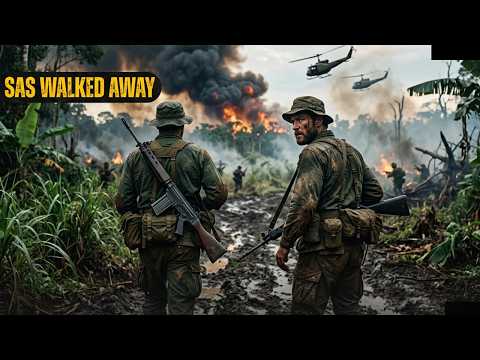
You think you know why the Australians and New Zealanders left Vietnam. You think it was politics. You think it was public pressure. You think it was the same anti-war sentiment that was tearing through every Western nation in 1971. You are wrong.
What actually happened in the jungles of Phuoc Tuy province, in the classified briefing rooms of Nui Dat, and in the silent, furious standoff between Anzac commanders and MACV headquarters, was something far more profound, far more disturbing, and far more consequential than any protest march or parliamentary vote could ever explain. This is the story of what happens when the most effective jungle warfare unit ever deployed in Vietnam decides that winning a war the wrong way is worse than not fighting it at all.
Stay with me. Because by the end of this, you will understand why the most dangerous thing Australia and New Zealand ever did in Vietnam was not the killing. It was the walking away.
To understand the weight of those five words, you have to understand what the Anzac forces had built in Phuoc Tuy province over the previous five years. Major Richard Callaway was a career officer, New Zealand Defence Force, attached to the Australian Task Force at Nui Dat as an intelligence liaison in the final months of 1970. He was 34 years old, precise in his language, deeply skeptical of drama, and constitutionally opposed to anything that smelled like mythology. He had spent 12 years reading intelligence assessments from conflicts across three continents. And he had developed an instinct for separating what was real from what soldiers told themselves to make the real things bearable.
He arrived at Nui Dat expecting to find a competent Allied Force conducting standard counterinsurgency operations in a secondary theater. What he found instead would take him three years, two psychiatric consultations, and one very long conversation with a historian he trusted completely before he could articulate it in language that made sense outside the wire. What he found was a force that had stopped thinking like a military unit entirely. They had started thinking like the jungle itself.
The New Zealand SAS, officially designated V Squadron, was by any conventional measurement a negligible military asset. 40 men. 40. At the peak of American commitment, the United States had 543,000 personnel in Vietnam. The entire New Zealand SAS presence could fit comfortably in a standard American mess hall with chairs left over.
American liaison officers who encountered V Squadron in the field for the first time almost universally recorded the same initial reaction in their reports. Confusion, then dismissal, then a slow and deeply uncomfortable revision of everything they had assumed. The confusion came from the equipment, or rather the absence of it. The dismissal came from the numbers. The revision came from the results. And the results were the kind of numbers that made Pentagon analysts check their arithmetic twice, and then quietly request that the comparison documents be reclassified before anyone in Congress developed an awkward question about return on investment.
The Anzac kill ratio in Phuoc Tuy over the period from 1966 to 1971 was not a military statistic. It was an embarrassment wearing a statistics clothing. And it was only the beginning of what American command did not want examined too closely.
Calloway’s first patrol with the Australian SAS went wrong before it started. And it went wrong in a way that told him everything he needed to know about the gap between what he had been trained to understand and what was actually happening in that province. He had prepared thoroughly. He had reviewed the sector maps, memorized the grid references, studied the known D445 battalion positions, and packed according to the standard New Zealand liaison officer field kit, which was itself considerably lighter than standard American loadout, but still, as he would discover, roughly twice as heavy as anyone else on that patrol considered necessary or even advisable.
The Australian patrol commander, a sergeant named Warren Teague, who had grown up on a cattle station in the Northern Territory, and had the kind of stillness about him that you normally associated with geography rather than people, looked at Callaway’s pack for approximately three seconds before he looked at Callaway himself. He did not speak. He simply turned and walked toward the tree line. Callaway understood from that single look that he was being assessed, that the assessment was not favorable, and that nobody was going to explain why until the jungle itself had finished making the argument.
They moved for six hours that first day and covered a distance that would have taken a standard American platoon perhaps 90 minutes. Not because they were cautious in the conventional military sense of that word. Not because they were afraid. Because Teague and his four men were doing something that had no name in any military manual Callaway had ever studied. Something that he would spend the next three months trying to describe in his intelligence reports and ultimately abandon in favor of a single phrase that his commanding officer found inadequate but could not replace.
They were reading. They were reading the jungle the way a doctor reads a patient, the way a lawyer reads a contract, the way a man who has spent decades in a particular landscape reads every shift of light and shadow and animal behavior and vegetative disturbance as a continuous living document that is always being updated, always being revised, always saying something specific to anyone fluent enough to understand it.
Calloway was not fluent. He understood that within the first hour. By the third hour, he understood that he had never even known such a language existed. And that this ignorance had been invisible to him for his entire professional life, precisely because everyone around him shared it.
The New Zealand contribution to ANZAC operations in Vietnam is the least documented chapter of an already under-documented story. V Squadron’s operational records remain partially classified to this day. And what has been released presents the kind of careful institutional language that conceals more than it reveals. But Calloway’s private correspondence, released by his family following his death in 2019, and the declassified after-action reports of American liaison officers who served alongside both Australian and New Zealand SAS units, together construct a picture that the official histories have spent 50 years declining to paint in full color.
The picture shows two small forces from two small nations operating inside a superpower’s war according to principles so fundamentally different from that superpower’s doctrine that they might as well have been fighting in a parallel universe that occasionally intersected with the American one at the edges, always to the American military’s acute discomfort.
The New Zealanders brought something even the Australians acknowledged as distinctive. Where Australian SAS had refined their jungle doctrine through the Malayan Emergency and the Borneo Confrontation, learning from each campaign, adapting, incorporating indigenous tracking knowledge into formal training, the New Zealand contribution was built on something less institutionalized and therefore, paradoxically, more pure. V Squadron’s operators had been selected not merely for physical capability and psychological endurance, though those thresholds were extraordinary. They had been selected for what the selection board’s classified assessment criteria described only as environmental intelligence. A phrase that the board never bothered to define formally because the men who designed the selection understood that if you had to explain it to someone, that someone did not have it.
It meant the ability to be in a place completely, not to pass through it, not to operate within it, but to become temporarily indistinguishable from it. To slow your nervous system to the rhythm of the surrounding terrain. To stop producing the signals, the sounds, the chemical traces, the behavioral signatures that marked you as a foreign object in a biological system that had been filtering out foreign objects for millions of years.
Of the 40 men who served with V Squadron in Vietnam, every single one of them would later describe the experience of becoming genuinely invisible in the jungle, not as a technique they had mastered, but as a state they entered. A psychological condition as much as a physical one and one that left permanent marks on the men who learned to find it.
Major Callaway encountered his first evidence of what those marks looked like on the third day of his attachment at approximately two in the afternoon. In a section of triple canopy jungle 12 kilometers northeast of the Australian Task Force perimeter, the patrol had stopped. Not the gradual controlled freeze that Callaway had come to recognize as Teague’s standard contact procedure. A complete instantaneous cessation of all movement. So total that the five Australians seemed in the space of half a second to have become part of the landscape.
Calloway froze a fraction of a second later. His body responding to a threat signal his conscious mind had not yet identified. He could hear nothing. He could see nothing. The jungle around him looked exactly as it had looked for the previous six hours. Dense and green and impenetrable and entirely uniformly silent. Then he understood that the silence itself was the signal.
Ten minutes earlier there had been insects. There had been bird calls distant and irregular but present woven into the background noise of the living forest. Now there was nothing. The jungle had gone quiet the way it goes quiet only when something large and wrong has entered it. And every small living thing within earshot has decided simultaneously that becoming invisible is a better option than becoming evidence.
Teague moved so slowly that Calloway initially could not determine whether he was moving at all. He was pointing at something. A direction, an angle through the vegetation. And the four other men were redistributing themselves through the undergrowth with a fluidity that Calloway found viscerally disturbing. Not because it was aggressive, because it was natural. Because they moved like things that belonged in that space. And the contrast with his own body, his own weight and noise and foreign chemical signature was suddenly not a tactical disadvantage, but an existential condition.
He was a city in a wilderness. He was a machine in a living system. He was everything the jungle had evolved over millions of years to detect and reject, and these five men had somehow negotiated a separate arrangement with it. They had agreed to the jungle’s terms. And in doing so, they had become something that the enemy could not see, could not smell, could not hear, and therefore could not prepare for, could not counter, and could not psychologically process when the results of their presence made themselves known.
The NVA unit that passed through their position that afternoon was not a patrol. It was a command element. Seven men, including what post-operation intelligence assessment would identify as a political officer from the 274th Regiment, moving between two cave complexes in the Long Hai Mountains with the casual confidence of men who believed themselves to be in secure territory. They were 11 meters away at closest approach. Calloway could see the individual faces. He could see the wear pattern on the lead soldier’s sandals. He could smell—and this detail appeared in three separate after-action reports as though each officer who recorded it felt compelled to verify that a colleague had experienced the same impossible thing—he could smell rice cooking somewhere nearby, not as a faint background trace, but as a specific directional scent that Teague had apparently been tracking for the past 40 minutes, and that had told him something about the composition and movement schedule of this unit before any of them were visible.
The NVA walked past. They did not slow. They did not scan the undergrowth. They did not feel the five pairs of eyes and the one pair of deeply astonished New Zealand intelligence officer’s eyes that watched every step of their passage. They continued through the forest and were gone, their sounds fading, the insects returning cautiously to their previous conversations. The jungle reknitting itself around their absence as though they had never been there at all.
Teague did not move for seven minutes after the last sound faded. Then he turned and looked at Calloway with an expression that contained no pride, no drama, and no invitation to discussion. It was the expression of a man who had done something so many times that its extraordinariness had become invisible to him. Then he pointed and they continued moving.
Calloway would record in his private journal that night, writing by the faint light of a chemical stick with his hands still not entirely steady, that he had spent 12 years studying military intelligence and had never until that moment understood the difference between gathering information about an enemy and reading the same document the enemy was reading from inside it in real time without the enemy knowing the document was shared.
The relationship between American command and the Anzac forces had never been comfortable, but until 1969 it had been functional. The Australians controlled Phuoc Tuy under their own rules, and the Americans found their results impressive enough to cite in briefings — while finding the methods too philosophically inconvenient to examine.
That arrangement worked because both sides understood what it required. The Americans would not look too carefully at how the Australians achieved their outcomes. The Australians would not make the comparison in any forum where the mathematics might become politically significant.
The man who stopped pretending was Brigadier William Henderson, commanding the First Australian Task Force from August 1969. He did not raise his voice or write inflammatory memoranda. He simply began asking the Americans to explain their metrics.
What was the relationship between ordnance expenditure and enemy capability degradation? What was the body count to prisoner ratio in major sweep operations — and what did that ratio suggest about the quality of intelligence driving them?
The Americans understood immediately what these questions were. They were not requests for information. They were a diagnosis.
MACV’s response was not engagement. It was escalation — pressuring Anzac units into joint operations under American operational control. If the Australians were going to ask questions about American methods, the Americans would make them use American methods, then measure the results.
Calloway was present for one of those joint operations. He would not discuss it specifically for the remaining 49 years of his life. What he would say, carefully, was that watching men trained for absolute silence being ordered to call in positions every 30 minutes on an open frequency was not a military operation. It was a demonstration. Delivered at the cost of three men — two Australian, one New Zealand — and an intelligence asset five years in the building, compromised beyond recovery in 72 hours.
He did not call it a failure. He called it a demonstration. The distinction mattered enormously to a man who thought carefully about words. A failure implies a different outcome was possible within the same framework. A demonstration implies the framework itself was the problem — and that the problem was not accidental.
The New Zealand government’s decision to begin withdrawing V Squadron in late 1970 has been attributed to shifting domestic priorities and Vietnamization. These accounts are not wrong. They are incomplete in the way official accounts are always incomplete when the complete account would require acknowledging that a small allied nation’s leadership looked at the doctrine of the most powerful military on Earth and concluded, quietly and with extraordinary political courage, that participating in it was causing more harm than it prevented.
They did not leave because they were losing. They left because they had understood something American command had not yet permitted itself to understand.
The method was the message. How you fight a war is not a tactical detail separable from why you are fighting it. Men trained to surgical invisibility — to conduct an operation in a village without the village knowing they were there — cannot be asked indefinitely to participate in operations where the village is the target and the civilian cost is the acceptable variable.
This was not politics. This was professional ethics applied to military doctrine, and it arrived at a conclusion five words could contain. They were spoken, according to Calloway’s correspondence, by a New Zealand SAS senior NCO in a briefing room at Nui Dat in the autumn of 1970, in response to an American request for V Squadron participation in a large-scale sweep in a province where Anzac forces had no intelligence network and no relationship with the population.
That’s your war, not ours.
The American officer recorded the exchange in a memorandum classified for 31 years. He described the New Zealander’s tone as respectful and entirely without hostility. He described the silence that followed as the kind of silence that occurs when something true has been said in a place where truth was not expected. He recommended the exchange be treated as a command relationship issue requiring diplomatic resolution.
The diplomatic resolution was never initiated. By the time Allied command could organize itself to address it formally, the New Zealand withdrawal was underway, and the Australians were six months behind them. The question of whether Anzac forces respected American operational authority had been rendered moot by geography.
What was left behind in Phuoc Tuy was not a vacuum. It was a record. Not the kind read at ceremonies, but the operational kind that other militaries study in the silence of their own inadequacy. Because the gap between what those forces accomplished and what the surrounding American operation accomplished — same terrain, same enemy, same years — was not a gap experience or resources could explain.
Two small forces from two small countries had brought something the most technologically advanced military in history did not have and could not buy. Something that could not be manufactured in quantity, scaled to divisional strength, or replicated by any training program unwilling to start from the premise that everything you already know might be the first thing you need to leave behind.
Calloway returned to New Zealand in March 1971 and spent six months writing a 212-page report he submitted through channels and never heard about again. It contained no recommendations for new equipment, no proposals for doctrinal revision. It contained a detailed account of what he had witnessed over 14 months, written with the precise honesty of a man done with institutional performance, writing for the record rather than the career.
He described the smell of the jungle at two in the afternoon. The specific quality of the silence when it changed. The faces of the NVA soldiers 11 meters away who did not know they were being watched. He described the joint operations, and what happened to Anzac methods when subordinated to American timelines and American need for visible, measurable, documented action. He described the briefing room, the five words, and the silence that followed.
In his conclusions he wrote three paragraphs his daughter, releasing the document after his death, called the most honest thing her father ever committed to paper. That the most effective counterinsurgency was not a technique but a relationship — between a force and a landscape and a civilian population, built slowly, patiently, at the cost of comfort and certainty and institutional pride. That this relationship, once built, produced operational intelligence no technology could replicate. And that the decision to withdraw rather than compromise it was not a strategic retreat but a strategic statement.
He wrote that the five words were not insubordination. They were diagnosis. And in his final sentence, that the tragedy was not that the diagnosis was ignored. The tragedy was that it was understood completely by every officer in that room — and ignored anyway. Because the institutional cost of acting on it was higher than the system was designed to bear.
Sergeant Warren Teague left the Army in 1972 and returned to the cattle station where he had grown up, spending four decades reading the land, moving through it on its own terms. A journalist found him in 1998 and asked whether the Anzac withdrawal had been the right decision.
Teague looked at him for a long time. Then he said that the right decision and the available decision are not always the same thing — that the men he served with had always known the difference, and that knowing the difference was, in the end, what the whole thing had been about.
The journalist asked him to clarify. Teague shook his head once and looked back at the land. The interview was over.
The American military would spend the next 30 years selectively absorbing the lessons the Anzac experience demonstrated while avoiding the central conclusion those lessons pointed toward. The techniques were extractable — the tracking methods, the five-man patrol doctrine, the weight discipline, the ambush geometry, the psychological operations built on absence rather than presence. All of it could be codified, refined, passed forward.
The philosophy was not extractable. It required the acknowledgement that the techniques were not the point. They were the visible expression of a prior decision — to understand the environment on its own terms before imposing your terms on it. To make yourself invisible before you made yourself dangerous. To earn the landscape’s silence before you asked it to conceal you.
That decision could not be trained in six weeks or six months. It required the kind of institutional humility that produces results nobody can take credit for. And the American military, like most large and powerful institutions, had been optimized for the production of visible, attributable, measurable success — which is almost the definition of the opposite of what the jungle rewarded.
The words are still in the archive. Released without announcement in 2001 into a document collection that generated no press coverage and no political discussion, because by then there were other wars demanding attention, and the lessons of Vietnam had been declared sufficiently absorbed by the institutions that had failed to absorb them.
Five words in a memorandum, filed by an American officer who recorded them accurately and described the silence honestly. Who understood well enough what had been said to recommend diplomatic resolution — even if he could not recommend the only resolution the words actually required. Not diplomacy but honesty. Not a conversation between commands but between doctrines. Not a negotiation about operational authority, but an acknowledgement that operational authority exercised without operational wisdom is not a military asset but a military liability.
And that the men who walked away from Phuoc Tuy understood this not as a political position but a professional one, carved out of five years in a landscape with no patience for the pretense that firepower and presence and institutional momentum were substitutes for the one thing the jungle always required and always rewarded.
Silence. Complete, earned, inhabited silence. The kind the Viet Cong called ghost work. The kind that left no bodies to count, no reports to file, no medals to award, no legacy that fit in any official record.
The kind that five words were enough to defend. That is your war. Not ours.
So here is the question that has never been answered by any official history: if a small force from a small nation can look at the most powerful military on Earth and say those five words — and be right — what does that say about every war we have chosen to keep fighting since?
Report this article
Select a reason for reporting:






