At 1100 hours on July 25, 1944, the Norman countryside south of Saint-Lô erupted. A wall of dust and fire rose 7,000 yards across the horizon as over 1,500 American heavy bombers, 380 mediums, and 550 fighter-bombers darkened the sky. More than 3,000 tons of high explosives rained down in a single rectangular box, 2,500 yards deep. French farmers said the ground rolled like a ship in heavy weather. Cattle dropped where they stood. Church windows miles away cracked from the overpressure.
Beneath that carpet of bombs lay one of the most respected armored formations in the German army. This was Operation Cobra, the American breakout from Normandy, and the speed at which it unfolded would set the pattern for the next ten months of war in Europe. The German army in the west would suffer a sequence of operational catastrophes whose tempo its own commanders, writing later in American captivity, described as something they had no answer for.
Why, again and again, did German defenses simply crumble when the United States Army applied operational speed against them? The answer is not that American soldiers were braver or that German soldiers had become cowards. The answer lies in the collision of two military systems—one built for the war now being fought, and one that was not.
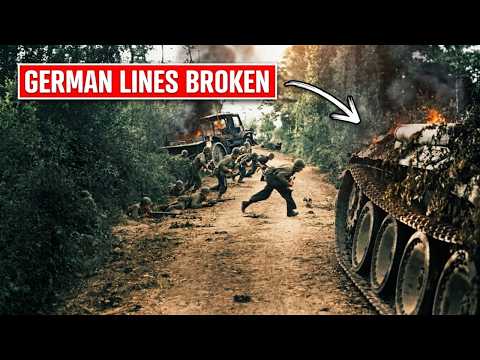
The American army that broke out at Saint-Lô was not the army that had stumbled at Kasserine Pass in February 1943. In eighteen months, it had become an integrated combat machine organized around four mutually reinforcing advantages. The first was a saturation of radio communications down to the squad level. The SCR-300 backpack radio gave every infantry company 41 usable FM channels with a reliable range of three miles. The smaller SCR-536 handy-talkie put a one-mile AM radio in the hands of every platoon leader. American Sherman tanks carried the FM SCR-508 family, allowing tank commanders to talk in clear voice without static. The German army had nothing equivalent at platoon and squad level. The American edge was not in any single piece of hardware—it was in the sheer density of voice communication that ran through every level of every unit.
The second advantage was tactical air power with a direct ground link. Major General Elwood Quesada refined a procedure called armored column cover: a flight of four P-47 Thunderbolts orbited continuously over each leading tank column, with a VHF aircraft radio installed in the lead tank itself. Pilots could talk directly to the tank commander, and targets could be engaged within minutes. The P-47 carried eight .50 caliber machine guns and up to 2,500 pounds of bombs. Combat losses ran at well under one percent per sortie. The Luftwaffe could rarely put a fighter over the Western Front in daylight without losing it.
The third advantage was massed predictive artillery. The fire direction center developed at Fort Sill allowed any battalion within range to mass fire on a single target through one coordinated mission. The time-on-target procedure dispersed batteries so their shells landed simultaneously, denying the enemy any warning. By December 1944, the VT proximity fuse—cleared for ground use on October 25—was bursting high explosive shells thirty to fifty feet above German troops in the open. Patton called it “the funny fuse” and credited it with winning the Battle of the Bulge. In one fire mission against a German battalion in the open, he wrote, 702 soldiers were killed by actual count. Roughly 200,000 VT-fused shells were expended during the Bulge alone.
The fourth advantage was logistical gluttony. The Red Ball Express, a dedicated truck convoy system, deployed nearly 6,000 trucks at its peak and delivered up to 12,500 tons of supplies per day. Over 83 days, it moved more than 400,000 tons. Approximately three-quarters of its truck companies were African-American units from the segregated Quartermaster Service. No German operation in the West had logistics on anything close to this scale. By late 1944, German operations had no operational logistics at all—the trucks did not have the fuel.
These four advantages did not arrive by accident. They were the product of an army that had spent the interwar years quietly building a doctrine for industrialized continental warfare. Lieutenant General Lesley McNair, who would be killed inside the bomb box on the morning of Cobra by short bombs from his own Air Force, had been one of the senior figures shaping American massed fire doctrine. The doctrine that integrated tank, infantry, artillery, and tactical air was codified in Field Manual 100-5, the 1944 edition of the Army’s operations manual. And the Army’s capacity to learn at speed was demonstrated by Sergeant Curtis Culin of the 102nd Cavalry Reconnaissance Squadron, who fashioned a tank-mounted hedgerow cutter from steel cut from German beach obstacles. By the morning of Cobra, eleven days later, roughly three-quarters of the tanks of the 2nd Armored Division carried the device. An idea from a sergeant had been industrialized and fielded in less than a fortnight.
The strategic context was already catastrophic for Berlin. Allied bombing of synthetic fuel plants had begun on May 12, 1944, with the strike on Leuna-Merseburg. German aviation gasoline production collapsed from 175,000 tons in April 1944 to just over 1,000 tons by February 1945. Albert Speer wrote to Hitler on June 30, 1944, that the enemy had succeeded in increasing German losses of aviation gasoline up to 90 percent. Speer himself dated the loss of the war to that May 12 attack. On D-Day, the Allies flew about 14,674 sorties over France. The Luftwaffe managed 319. On the Eastern Front, Operation Bagration destroyed 28 German divisions of Army Group Center inside two months. At the moment Bagration began, 235 German divisions stood in the East against roughly 85 in the West. The Wehrmacht was not concentrating its strength against the Americans—it was being eaten from both sides.
Three changes had converged by the summer of 1944 to make warfare itself a different problem from the one the German army had been built to solve. Strategic bombing of oil and transport had begun starving the German army of the fuel its own panzer doctrine assumed. Allied air superiority had made daylight operational movement nearly suicidal—German troops called the road to Normandy the Jaborenstrecke, the fighter-bomber racetrack. And the radio-linked coordination of American armor with tactical aviation produced something that approximated real-time combined-arms behavior at the column level. German command culture, even where it retained tactical excellence, could no longer match this operational tempo.
For six weeks after the Normandy landings, none of this was visible. The bocage country, with its high earthen banks topped by hedgerows and narrow sunken lanes, favored the defender so completely that American casualties from June 6 through July 24 ran to roughly 125,000 men. The Wehrmacht in Normandy still retained the institutional reflexes that had taken Paris in 1940. German junior officers and non-commissioned officers handled tactical situations with the initiative their training demanded. Mortars were registered, machine gun fields of fire interlocked, and ambushes laid in the lanes. Panzer Lehr Division was commanded by Lieutenant General Fritz Bayerlein, who had served as chief of staff of the German Africa Corps and later as Rommel’s chief of staff at Panzerarmee Afrika. His division held a sector south of Saint-Lô with about 2,200 men in front-line positions out of an authorized strength near 11,000. Its tanks—Mark IV mediums and Panthers—were dug in among the orchards and dairy farms.
But underneath that holding action, the structural cracks ran deep. Hitler, after the failed assassination plot of July 20, 1944, had become so distrustful of his own general staff that the German tradition of mission orders—Auftragstaktik—was being suppressed at every level above battalion. Heinrich Himmler took over the replacement army. National Socialist political officers were attached to formations down to division level. Stand-fast orders, Haltebefehle, signed personally by Hitler, were issued for ground that any competent commander would have abandoned. The American historian Robert Citino has argued that what survived of Auftragstaktik in 1944 survived only at the tactical level. At the operational level—the level at which the war was actually being decided—it had effectively been terminated. And the operational reserves that should have driven a German counterstroke against the Normandy beaches, the Panzer divisions of OB West, were under Hitler’s personal release authority. They had been committed late, piecemeal, in daylight, on roads dominated by Allied air. They had bled accordingly.
This was the situation on the morning of July 25, 1944, when 1,500 heavy bombers came over the bocage south of Saint-Lô. The carpet of bombs that fell across the Panzer Lehr sector was the most concentrated tactical use of strategic bombers in the war up to that point. According to Bayerlein’s later testimony, his front line had been turned into a moonscape—a Mondlandschaft. Modern scholars have shown his casualty claims to be inflated, his self-portrait of an annihilated division serving his post-war reputation more than the historical record. What the surviving records do confirm is severe enough: forward area tank strength dropped to a handful of operational vehicles, several hundred German soldiers were killed in the bombed sector, and the division was no longer capable of holding the line about to be assaulted.
Operation Cobra was executed by VII Corps under Major General J. Lawton Collins, called “Lightning Joe” by the men who served under him. The initial divisions for the breach were the 9th, 4th, and 30th Infantry. The exploitation force was the 1st Infantry Division, the 2nd Armored, and the 3rd Armored. The advance ran from one to two miles a day on the morning of the breakthrough to seven miles a day and more by the end of the week. Coutances fell on July 28. Combat Command B of the 4th Armored Division entered Avranches on the evening of July 30 and secured the town the following day. The bridge at Pontaubault, which would carry every supply truck and tank serving the entire breakout, was seized intact on July 31.
At noon on August 1, 1944, the United States Third Army was activated under Lieutenant General George Patton. Two weeks after activation, no American army in history had advanced so far so fast. From Avranches to the Seine, Third Army covered roughly 400 miles in 26 days. The German commanders in front of Patton, when they tried to mount a coherent defense, found themselves outflanked before they could finish issuing their orders.
The decisive moment of the Normandy campaign came in the second and third weeks of August. The German Seventh Army under SS Obergruppenführer Paul Hausser, together with Heinrich Eberbach’s Panzer Group, was ordered by Hitler personally to mount a counterattack westward toward Avranches. Field Marshal Kluge protested—he saw clearly that the operation could only result in the encirclement of the formations committed to it. Walter Warlimont was sent forward by Hitler in person to enforce compliance. The attack, code-named Lüttich, struck the American First Army at Mortain on August 7, 1944.
American signals intelligence had decrypted the German operational orders through the Ultra program, and Bradley had full warning. The Luftwaffe, promised a thousand fighters in support, never appeared in any meaningful numbers. American tactical aviation, in clear weather, kept the German columns under constant attack across four days, breaking up the timing of the assault and pinning the Panzer columns on roads where they could not maneuver. On Hill 314 above Mortain, forward observers of the American 2nd Battalion, 120th Infantry, cut off behind German lines, called massive corps artillery fire onto the Panzer columns moving below them. Post-war operational research later showed that direct air kills of German tanks at Mortain were a small fraction of wartime claims, with most actual armored kills attributable to ground anti-tank fire, to crews abandoning vehicles for lack of fuel, and to crew demolition of damaged tanks. What the air did was pin the attack and break it apart in time. That was enough.
The failure at Mortain set up the closure of the Falaise pocket. The 15th Corps under Haislip, racing north from the Seine basin, reached Argentan on August 12. To the north, Canadian and Polish forces under Field Marshal Montgomery’s 21st Army Group were closing southward through Falaise. On August 13, Bradley issued his halt order, stopping Patton’s northward push at Argentan. The decision remains controversial—some historians argue the gap was kept open longer than it needed to be, and that thousands of Germans escaped who could otherwise have been bagged. Others note that the Allied formations risked firing into one another in the confusion if their lines of advance had met without coordination.
On the evening of August 19, the Polish 1st Armoured Division under General Stanisław Maczek, holding Hill 262—the feature the Poles called the Maczuga, or Mace—met elements of the American 90th Infantry Division at Chambois. The linkup created a thin Allied seam that German counterattacks would punch through repeatedly over the next 48 hours. The pocket was finally and fully sealed on August 21, 1944, when Canadian armor linked with Polish forces at Coudehard, while the 2nd and 3rd Canadian Infantry Divisions secured Saint-Lambert-sur-Dives.
Modern scholarly estimates converge on roughly 80,000 to 100,000 German troops trapped inside the Falaise pocket. Of these, between 10,000 and 15,000 were killed, between 40,000 and 50,000 were taken prisoner, and an estimated 20,000 to 50,000 escaped eastward through gaps in the Allied lines. About 500 tanks and assault guns were lost inside the pocket along with several hundred artillery pieces. The 12th SS Panzer Division Hitlerjugend lost 94 percent of its armor over the course of the Normandy campaign culminating at Falaise. Hausser took a wound that shattered his jaw and was evacuated lying flat on top of a tank. Eisenhower himself walked the killing ground 48 hours after the pocket was sealed. He wrote later in Crusade in Europe that the battlefield at Falaise was unquestionably one of the greatest killing fields of any of the war areas, and that it was literally possible to walk for hundreds of yards at a time stepping on nothing but dead and decaying flesh.
The German command itself was disintegrating in parallel with the encircled units. Field Marshal Gerd von Rundstedt had already been relieved of command on July 2, 1944, after telling Field Marshal Wilhelm Keitel by telephone: “Make peace, you fools. What else can you do?” Field Marshal Kluge, his successor, took cyanide in his staff car on August 19 on the road from Verdun to Metz after being relieved by Hitler and ordered back to Germany under suspicion of having sought contact with the Allies. He left a letter to Hitler urging him to put an end to a hopeless struggle. Field Marshal Erwin Rommel was forced to swallow cyanide on October 14, 1944, for his peripheral involvement in the July 20 plot. The man who replaced Kluge at both OB West and Army Group B was Field Marshal Walter Model, called by Hitler his “fireman”—a relentless and ideologically committed soldier who would himself shoot himself in a forest east of the Ruhr in April 1945 rather than surrender.
The pursuit from the Seine to the German border in the late summer of 1944 was, in pure terms of speed, the fastest sustained advance any major army had ever made in modern continental war. American forces crossed the Seine on August 19, took Paris on August 25, and reached the German border by mid-September. The advance only stopped because it ran out of gasoline. The Red Ball Express had been improvised precisely to keep the lead divisions moving, and even at 12,500 tons of supplies per day at its peak, it could not feed the appetite of armored columns burning fuel hundreds of miles ahead of any developed port.
When the autumn rains came and the front stabilized along the Siegfried Line, the operational tempo changed. This is the moment in the story where it becomes important to acknowledge that American operational speed did not work everywhere. Two campaigns from this period are generally regarded as the worst the American army fought in Europe. The Hürtgen Forest, where the First and Ninth Armies tried to push through dense pinewoods south of Aachen from September 1944 through the winter, cost the United States Army about 33,000 casualties for negligible operational gain. Charles MacDonald, the official historian of the campaign, who fought there himself as an infantry company commander, called it “a misconceived and basically fruitless battle that should have been avoided.” The American historian Carlo D’Este called it the most ineptly fought series of battles of the war in the west. The 22nd Infantry Regiment of the 4th Infantry Division lost roughly 2,773 casualties in 18 days—about 85 percent of its normal strength—to advance 6,000 yards. Ernest Hemingway, attached to Colonel Lanham’s 22nd Infantry as a war correspondent, reportedly described the Hürtgen as “Passchendaele with tree bursts.”
The Hürtgen, importantly, was not a German victory in any positive sense. It was an American defeat by a battlefield that negated every American advantage. The dense pine canopy made tactical air support nearly impossible. Mud and mines and steep ravines made armor useless. Artillery, when it was used, produced tree bursts that showered shrapnel down onto the attackers as much as the defenders. Radios could not maintain line-of-sight contact through the trees. The forest took away every element of the American operational system, and what remained was something close to First World War infantry combat in the worst possible terrain. Where the American system could not function, the American army did not advance.
The same lesson, in inverse form, was delivered in the opening days of the Battle of the Bulge. On December 16, 1944, the German army launched its last great offensive in the west, an attempt to drive through the Ardennes to seize the port of Antwerp. The Sixth Panzer Army under SS Obergruppenführer Sepp Dietrich and the Fifth Panzer Army under General Hasso von Manteuffel achieved tactical surprise by attacking in winter weather that grounded American tactical aviation, behind a sector of front held by tired and inexperienced American formations spread over roughly 85 miles—far thinner than doctrine recommended. They broke through. The 18th Volksgrenadier Division enveloped two regiments of the new 106th Infantry Division on the Schnee Eifel ridge. Approximately 7,000 American soldiers were taken prisoner, with some scholarly estimates running as high as 8,000 to 9,000. The official army historian Hugh Cole called it the most serious reverse suffered by American arms during the operations of 1944–1945 in the European theater. It remains the largest American mass surrender in the entire European war.
But the German offensive, having achieved its surprise, found that the moment the weather cleared and the American operational system could function again, it had no answer. The shoulders of the breakthrough held at Elsenborn Ridge to the north and at Bastogne to the south. When General Heinrich von Lüttwitz, commanding the 47th Panzer Corps, sent two officers under flag of truce on the morning of December 22 to demand the surrender of Bastogne, the acting commander of the 101st Airborne Division, Brigadier General Anthony McAuliffe, replied with a single word: “Nuts.”
At the Verdun conference of December 19, Patton had pledged to attack the southern shoulder of the bulge within 48 hours—an offer his fellow generals at the meeting found nearly inconceivable. He was as good as his word. Lieutenant Colonel Creighton Abrams, leading the 37th Tank Battalion of the 4th Armored Division, broke through to Bastogne on the afternoon of December 26, about four days after Third Army’s first elements began their attack. The proximity fuse—the “funny fuse” Patton had praised—was destroying German concentrations in the open. By late January 1945, the Germans had been pushed back to their start line. The offensive had cost them roughly 80,000 to 100,000 casualties, including most of the trained armor and infantry they had left.
The war moved into Germany itself in March 1945. The most important single event of that month, and one of the most extraordinary moments in the entire campaign, took place on the afternoon of March 7, 1945, at the small Rhine town of Remagen. At 12:56 in the afternoon, scouts of the 89th Cavalry Reconnaissance Squadron crested a hill north of the town and saw, to their disbelief, that the Ludendorff railway bridge across the Rhine was still standing. Brigadier General William Hoge, commanding Combat Command B of the 9th Armored Division, immediately ordered a task force under Lieutenant Colonel Leonard Engeman to seize it. At approximately 15:50 that afternoon, an understrength platoon of Company A, 27th Armored Infantry Battalion, led by Second Lieutenant Karl Timmermann, assaulted the bridge under fire. Sergeant Alexander Drabik, a former butcher from Holland, Ohio, became the first American soldier to set foot on the eastern bank of the Rhine. Timmermann was the first officer.
The German demolition of the bridge had failed for a set of reasons that condensed the entire problem of German command in the last months of the war. Hitler’s restrictive orders, issued after a premature demolition at the Mülheim bridge in Cologne the previous October, required final fuse attachment to be authorized only when the enemy was within five miles of the bridge. The order was intended to prevent another accident, but in practice it left almost no margin for actually executing the demolition under fire. Sector responsibility had been transferred to 67th Corps under General Otto Hitzfeld, whose adjutant, Major Hans Scheller, did not arrive at the bridge until 11:15 on the morning of the assault with eight men. The total demolition load wired to the bridge ran to about 2,800 kilograms of explosive. Captain Karl Friesenhahn, the bridge engineer, had requested 600 kilograms of military-grade Donarite for the most critical charges. He received only a fraction of his request, with the balance made up of weaker civilian-grade explosive that had not been designed for steel cutting. When Friesenhahn turned the electric detonator key, the firing cable—almost certainly cut by an American round—had been severed. Corporal Anton Faust ran out under fire to ignite the manual fuse. Only one of the charges detonated, lifting the bridge briefly off its piers and dropping it back down. The structure held. American troops were across.
Eisenhower, in Crusade in Europe, later wrote that the news of the intact bridge was one of the great moments of the war for him. Bradley’s exchange with the operations officer at Supreme Headquarters, Major General Harold Bull, captures the operational logic exactly. Bull said, “You are not going anywhere down there at Remagen. It just does not fit into the plan.” Bradley replied, “What the hell you want us to do? Pull back and blow it up.” Eisenhower overruled Bull and authorized the immediate crossing of at least five divisions. By the time the bridge finally collapsed on March 17, 1945, killing 28 American engineers and wounding about 63 more, six divisions and around 125,000 troops with their armor had crossed the Rhine.
Hitler’s response was characteristic. A special court-martial, the Flying Special Court-Martial West, was convened under Lieutenant General Rudolf Huebner. Four officers were executed by shot to the back of the neck on March 13 and 14, 1945, in two villages of the Westerwald: Major Hans Scheller, Lieutenant Karl Heinz Peters of the Luftwaffe, Major Herbert Strobel, and Major August Kraft. Captain Willy Bratige, who had already been captured by the Americans, was sentenced in his absence. Captain Friesenhahn, the bridge engineer, was acquitted.
The end came quickly after Remagen. The Ruhr Pocket, the encirclement of Field Marshal Walter Model’s Army Group B inside the industrial heart of Germany, was closed on April 1, 1945, when the United States Ninth Army linked up with the United States First Army at Lippstadt. About 317,000 German prisoners were taken inside the pocket over the next three weeks. It remains the largest single encirclement in the history of the United States Army. Model himself, having dissolved his army group on April 17 and refused to surrender personally, walked into a wooded area between the Duisburg district of Wedau and the village of Lintorf on April 21, 1945, and shot himself with his own pistol.
American First Army troops met the Soviet 58th Guards Rifle Division, part of Marshal Konev’s First Ukrainian Front, at Torgau on the Elbe on April 25, 1945. Hitler killed himself in the bunker under the Reich Chancellery on April 30. The unconditional surrender of all German armed forces was signed at Reims on May 7, 1945. The total cost in American battle casualties for the European theater of operations from June 1944 to May 1945 was 586,628 men, of whom 135,576 died. The Wehrmacht, by Rüdiger Overmans’ modern statistical study, lost approximately 5.3 million military dead across all theaters across the entire war. More than half of them after July 1944. By V-E Day, Western Allied forces were holding approximately 3.4 million German prisoners. The intake rate had risen from about 10,000 prisoners a day in early March 1945 to 59,000 a day in late April.
Why then did German defenses crumble at this rate when American operational speed was applied against them? The historical answer is not a single cause, but a system of overlapping causes that reinforced one another. Mission orders, the German Auftragstaktik tradition, were suppressed at the operational level by Hitler’s stand-fast directives. The Mortain counterattack was ordered against the explicit protests of the man on the ground, and Hitler’s later suspicion that Kluge had sabotaged the operation deliberately—recorded by his staff officers in the days after Kluge’s suicide—captured the broken trust between the dictator and the institutional army. The senior command had been gutted. Rundstedt was relieved. Kluge took poison. Rommel was forced to suicide. Model would shoot himself. The institutional continuity of German operational thought—the network of generals who had grown up together in the Reichswehr of the 1920s and the early Wehrmacht of the 1930s—was being systematically destroyed by Hitler’s own purges and by the cumulative pressure of defeat.
Air superiority was lost completely. By the autumn of 1944, German operational movement in daylight was, for practical purposes, impossible. Bayerlein later claimed that his Lehr columns on the road to Normandy in early June had lost dozens of half-tracks and self-propelled guns and over a hundred trucks merely on the approach march before they had fired a shot. Modern scholars have shown those particular figures to be inflated, but the operational pattern they describe is real. Daylight movement was paralysis. Reconnaissance was blinded. Supply was severed. Whether the Jabos hit the tanks or not, the German army could not freely move its formations under an Allied sky.
Fuel had collapsed. Panzer divisions in autumn 1944 were immobile, not because Allied shells had hit them, but because the synthetic fuel curve had cratered. The plan for the Bulge offensive explicitly required the capture of American fuel dumps in order to reach the Meuse River—an operational assumption that no competent staff officer would have accepted at any earlier period of the war. SS Standartenführer Joachim Peiper’s lead Kampfgruppe ran out of fuel near La Gleize on December 24, 1944, and his men walked out on foot.
The replacement crisis was structural. The new Volksgrenadier divisions authorized in September 1944 ran six infantry battalions instead of nine. Their actual strength averaged around 8,700 men by November. The Volkssturm levy of September 25, 1944, called up males between 16 and 60 under the authority of Himmler and the Nazi Party Gauleiter. Hitler himself acknowledged in late 1944 that experience in the East had shown that Volkssturm units on their own had little fighting value. The veteran non-commissioned officers and junior officers who had carried out Auftragstaktik at company and battalion level—the cadre that was the literal precondition of mission command—were dying or already dead. Wehrmacht losses on all fronts in summer 1944 ran at 1.2 to 1.5 million casualties.
The chain of command was fragmented. Three parallel command structures ran inside the German armed forces: the Army High Command for the Eastern Front, the Armed Forces High Command under Keitel and Jodl for everything else, and the Waffen SS, which reported through Himmler. Luftwaffe field divisions and paratrooper divisions, even when fighting as ground infantry, reported to Göring’s chain of command. Hitler routinely bypassed all of them and issued orders down to corps and even division level. Static defense consumed forces that could not be replaced. The Festung designations—the fortress orders that Hitler signed for ports along the French coast and along the Rhine—locked more than 200,000 Wehrmacht troops into garrisons holding ports the Allies, having Mulberry Harbors and eventually Antwerp, did not actually need. Lorient and Saint-Nazaire, two of the Atlantic submarine ports, were never taken until the surrender in May 1945. The men inside them spent the entire winter and spring eating their own horses.
The deeper cause underneath all of these specific failures was institutional. The German military tradition of Bewegungskrieg, the war of movement, had been built across two centuries. From the time of Frederick the Great through Helmuth von Moltke, through the Prussian General Staff, to the Panzer divisions of 1940, it had been designed to win short, decisive wars of maneuver against limited continental opponents. By 1944, on a continental scale, against industrialized total-war alliances, that doctrinal model was, in Citino’s word, outmoded. The strategic logic of Bewegungskrieg depended on a quick decision the Wehrmacht could no longer force.
The American army of 1944 ran on different principles. It had become, in the analyses of Peter Mansoor and Michael Doubler, what we would now call a learning organization—an institution that absorbed feedback from the field at speed and pushed corrections back down through its formations. Culin’s hedgerow cutter went from a sergeant’s idea to mass production in eleven days. Quesada’s tank radio innovation moved from concept to combat in weeks. The individual replacement system, much criticized after the war by the journalist S.L.A. Marshall, kept American divisions at high effective strength while their German opponents disintegrated. Robert Rush’s archival study of the Hürtgen Forest, published in 2001, has shown the 22nd Infantry Regiment absorbing 85 percent casualties and still functioning as a unit because the replacement system kept refilling its rifle companies. Marshall’s most famous claim—that only 15 to 25 percent of American infantrymen ever fired their weapons in combat—was demolished by the historian Roger Spiller in the winter 1988 issue of the Royal United Services Institute Journal, in which Spiller showed that Marshall’s underlying field interview data was undocumented and almost certainly fabricated.
The other side of the picture is the post-war German narrative itself. The Foreign Military Studies Program, established by the United States Army Historical Division in the immediate aftermath of the war and brought under the supervision of the former Chief of the Army General Staff, Colonel General Franz Halder, eventually produced approximately 2,500 manuscripts written by captured German officers in American custody. Manteuffel, Mellenthin, Balck, Westphal, Blumentritt, Bayerlein, and Manstein were among the contributors. The narrative they produced was internally consistent: the Wehrmacht had been an apolitical, professionally honorable institution; it had lost only because of Hitler’s interference, Allied numerical superiority, and Russian mass. Halder himself was awarded the United States Army’s Meritorious Civilian Service Award in 1961, having previously received the Knight’s Cross from Hitler in the autumn of 1939. That narrative shaped American military thinking through the early Cold War. The new West German Army, the Bundeswehr, was formally established on November 12, 1955. Its founding officer cadre, by necessity, was drawn almost entirely from former Wehrmacht personnel, since no alternative pool of trained officers existed. As late as 1959, roughly 83 percent of professional Bundeswehr officers, and effectively all of its generals and admirals, were Wehrmacht veterans. The “clean Wehrmacht” thesis—the idea that the German army had fought a hard but honorable war and had been betrayed only by its political leadership—was the working assumption of a generation.
The dismantling of that thesis came in three waves of scholarship. Wolfram Wette’s book Die Wehrmacht, published in 2002 and translated into English in 2006, documented the German army’s deep integration with the racial and ideological war on the Eastern Front. Ronald Smelser and Edward Davies’ The Myth of the Eastern Front, published in 2007, traced the parallels between the post-war Wehrmacht legend and the lost-cause mythology of the American Civil War. David Glantz’s archival reframing of Soviet military performance, in particular his book When Titans Clashed, written with Jonathan House, used Soviet sources to demonstrate that by mid-1943 the Red Army had out-thought and out-fought the Wehrmacht at the operational level. Robert Citino’s trilogy on the German way of war completed the institutional reframing with the explicit conclusion that virtually every flawed German decision of the war had strong supporters among the German officer corps itself. The alibi of Hitler, in other words, was just that: an alibi.
For the historian working with these sources today, the Foreign Military Studies remain a goldmine of operational detail at corps and division level. They are also a contaminated source for motive, blame, and assessment. Every claim in them about why the war was lost has to be tested against the documentary record and against the better archival work that came later.
The geography of the campaign became, almost immediately after the war, the geography of reconciliation. The Marshall Plan rebuilt the country the United States Army had crossed. West Germany joined NATO in May 1955. The Élysée Treaty between Konrad Adenauer and Charles de Gaulle on January 22, 1963, institutionalized Franco-German reconciliation. Walter Model’s son, Hans Georg Model, who would later become a brigadier general in the Bundeswehr himself, recovered his father’s remains in 1955 and reburied them at the Vossenack Military Cemetery in the Hürtgen Forest—the same forest where the United States Army had bled in 1944. The Ludendorff Bridge towers at Remagen became a peace museum, the Friedensmuseum, opened by Mayor Hans Peter Kürzinger on March 7, 1980, the 35th anniversary of the day the bridge was first taken. The Polish Maczuga at Mont Ormel became the Memorial of Mont Ormel.
The American Battle Monuments Commission today maintains overseas cemeteries from the Northwest Europe Campaign at nine principal sites. At Colleville-sur-Mer, above Omaha Beach, the Normandy American Cemetery holds 9,389 graves, with a further 1,557 names on the Walls of the Missing. Three Medal of Honor recipients are buried there, including Brigadier General Theodore Roosevelt Jr., son of the president, who died of a heart attack on July 12, 1944, about five weeks after coming ashore on Utah Beach at the age of 56. The Lorraine American Cemetery at Saint-Avold holds 10,489 graves, the largest American World War II cemetery in Europe. Private First Class Charley Havlat of the 803rd Tank Destroyer Battalion, the last American soldier killed in action in the European Theater on May 7, 1945, near the Czech village of Volary, lies there. The Netherlands American Cemetery at Margraten holds 8,301 graves and is the site of the celebrated Dutch Adopt-a-Grave program, in which every grave and every name on the Walls of the Missing has been continuously maintained by a Dutch family caretaker since 1945. Henri-Chapelle in Belgium holds about 7,900 graves. The Ardennes Cemetery near Neuville-en-Condroz holds about 5,200 graves, 65 percent of them airmen. Épinal in eastern France holds 5,255. The Luxembourg American Cemetery at Hamm holds about 5,070 graves, including General George Patton, who died on December 21, 1945, twelve days after a low-speed automobile collision near Mannheim broke his neck. Patton is the only four-star general buried at any of the battle monuments cemeteries. He was originally buried among his men, in accordance with his own and his wife Beatrice’s stated wishes. The volume of visitors damaging surrounding graves led the Graves Registration Service to relocate him to the head of the cemetery, a decision made in 1946 and executed in 1947. Beatrice afterward objected to any further moves on the grounds that he should rest in peace alongside the men of his army. The Brittany American Cemetery at Saint-James holds about 4,400 graves. The Rhône Cemetery at Draguignan holds 861, the dead of Operation Dragoon.
The 80th anniversary of D-Day, on June 6, 2024, drew approximately 150 to 200 surviving Allied veterans of World War II to Normandy. The youngest were in their 90s. Many were past 100. About two dozen heads of state and government attended. Eleven American veterans and one British veteran, the centenarian Christian Lamb, were awarded the French Legion of Honor at the main ceremony at the Normandy American Cemetery.
These eleven months of campaigning, taken in sequence, do not describe the heroism of one army against the cowardice of another. The German army of 1944 to 1945 fought, in the end, at scale. It accumulated 5 million dead. Its tactical proficiency at company and battalion level remained genuine until the final weeks. What collapsed was not the courage of the soldier in the foxhole. What collapsed was the operational tier above him—the level at which corps and armies translate political objectives into movement on the map. That tier collapsed because the institutional preconditions of the German way of war had been destroyed, in part by the Allied campaign, and in part by the German political leadership itself. There was no fuel. There was no air cover. There were no veteran sergeants left to execute mission orders. There was no coherent chain of command above army level that was permitted to make decisions on its own authority.
The American counterpart—the system built around radio, fighter-bombers, massed predictive artillery, and a logistics tail that put nearly 6,000 trucks on a single dedicated highway—was not a metaphysically superior form of soldiering. It was the appropriate institutional answer to industrialized continental war in the middle of the twentieth century. Where the American system could function, on the open country east of Avranches, in the Rhine Gorge at Remagen, on the Westphalian Plain around Lippstadt, German defenses came apart at a rate the German generals themselves, writing in American captivity in 1946, struggled to explain except by reaching for the alibi of Hitler. Where the American system could not function, in the pine canopy of the Hürtgen Forest, on the snowed-in roads of the Schnee Eifel in the first hours of the Bulge, the Americans paid a heavy price for ground that was, in the end, peripheral to the war’s outcome.
The men buried at Colleville and Hamm and Margraten and Henri-Chapelle were not buried for the speed of their advance. They were buried because, even in a campaign that moved faster than any major continental campaign before it, the dying went on day after day in farmhouses and orchards and forests until the German political leadership signed an unconditional surrender at a schoolhouse in Reims on the morning of May 7, 1945. That is what the surviving German generals could not write down honestly in their post-war manuscripts. The system they had built, brilliant against Poland in 1939 and against France in 1940, could not move fast enough to keep up with the system the Americans had built by the summer of 1944. The result was eleven months of operational catastrophe and the surrender of the Reich.
In the end, the reckoning at Reims was signed by men whose world had been outrun. Colonel General Alfred Jodl, pen in hand on May 7, 1945, admitted to Eisenhower’s staff that he barely knew whether the German people could even grasp the scale of their defeat. The speed that broke them was never a single weapon—it was a system that learned faster than they could adapt.
From the hedgerows of Normandy to the towers of Remagen, the pattern held: where the American machine could breathe, it sprinted; where the terrain choked it, it bled. The difference was never courage. It was the institutional capacity to turn a sergeant’s idea into doctrine in eleven days.
So the question lingers for every generation that studies war: when the next system collides with the next doctrine, which side will have already learned how to move? What do you think—does speed still decide, or has the battlefield changed too much for the lesson to hold?
Report this article
Select a reason for reporting:






