In the spring of 1884, a railroad shovel struck something that rang. Not rock. Not root. Not bone. It was copper, beaten flat, its surface covered in hammer marks the size of a thumb tip. Seventeen feet below the old surface, in a mound in western North Carolina, a mystery began that would echo for over a century.
The Cherokee had a name for that place long before the railroad came. They knew what lay beneath. And when the digging was done, 68 feet down, on a floor of pale clay, lay an ancient suit of armor on its back—63 feet from the crown of its helmet to its heel. It was empty. Not a single bone was found anywhere near it.
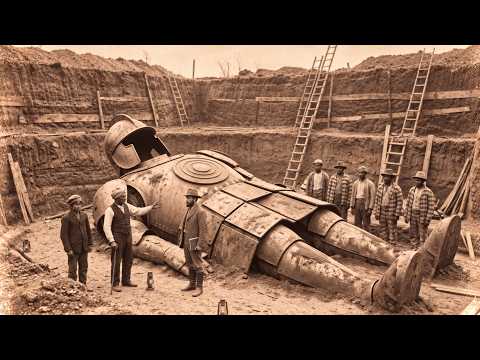
The engineer who measured it, Ansel Watkin Drury, filled 61 pages of his field book with its details. A coat of flat copper plates, each longer than a man, hung together with rings. A disc 9 feet across with seven raised rings on its chest. A helmet six men could stand inside. And wear marks that told a story: rings worn thin in two places, lips rubbed smooth, a patch hammered from the inside. “Made to be put on,” Drury wrote, and underlined it.
But who had worn it? And why was it left in the ground, feet pointing west, with no body inside?
The official record called it a “deposit.” A single sentence in a 700-page report. The Smithsonian sent a young man named Harlan Reese Whitlow for two days. He took four pages of notes, drew a rough plan, and left. He saw water where the armor lay, and he had no time. The report said “sheet copper of unusual extent,” and moved on.
Yet three years later, an old Cherokee man came to the edge of the pit. He stopped ten paces short and asked two questions before he looked down. “Which way do its feet lie?” West, he was told. He lowered his head, not surprised. “The circle on its breast, does it have seven circles inside it?” It did. The disc was under a tarpaulin that morning, but Drury had measured it weeks before.
That old man’s words, passed through his grandson and recorded by an ethnographer named James Mooney, told of tall ones who came from the west, stayed as friends, and went home light. “They laid it in the ground at the forks of the river with its feet toward their home, and they asked one thing of the people, to cover it.” The place had a name: Where they left the coat.
When the old man finally went down the ladders, he walked straight to the chest and laid both palms on the outermost ring. His hands came away green. Then he spoke, and the grandson translated: “They did not die here. They undressed here.” Before he climbed back, he said one more thing. “If you take the coat, leave the hat.”
No one in the pit knew what he meant. The order to remove the copper came in July. The plates were cut free, the rings thrown back into the fill. The helmet and the limb tubes were too wide for a boxcar door, and there was no time to cut them. Drury left them. He wrote the width of a car door, not the old man’s words.
Fifty-nine years later, a survey party looking for graves found a worn copper ring and heard metal ring out at 19 and a half feet in two holes 40 feet apart. The form said “Graves, none.” In the margin, the chief wrote three words in pencil: “Like a bell.” The helmet was never listed, never shipped, never accessioned. It stayed.
Today, the valley is under 200 feet of water. The field book is in an archive. The two copper sheets in the Smithsonian are filed under the wrong state. And the question remains: who lays a coat in the ground and asks for the hat to be kept? The old man knew. And the answer is still waiting, under the lake, under the earth, where the hat was left behind.
The four records have never sat on one table. Drury’s field book in Raleigh, Mooney’s notebooks in Maryland, Kirkland’s form in Georgia, the two copper sheets in Washington. Four hands, four states, four filing systems. No archivist ever wrote a cross-reference. No historian ever laid the compass bearing beside the auger depth. The story did not die because someone killed it. It died because nobody carried it across a room.
But there is a fifth place, and it is not an archive.
Up the Tuckasegee, past the drowned forks, the Eastern Band of Cherokee still lives at Quala. More than ten thousand people. A school that teaches the language. A museum of their own. And in 1996, they bought back the mound of Kituhwa, their mother town, with 309 acres around it. They did not dig it. They bought it to keep it closed.
If anyone today knows the name of the place where the two rivers met, that person is not in a reading room in Raleigh. That person is there, up the river, with the old words still in the family.
Now go back to the pit itself, to the last week of August 1884, and look at what Drury did not write.
He wrote the width of a boxcar door. He wrote the date the pump was drawn. He wrote that water stood on the clay by noon. What he did not write was why he left the helmet and the four tubes and the two shoulder discs pinned beneath the cheek plates. He had a reason, and the reason was not in the order from the general office. The order said the copper was to be taken up and shipped as the property of the company. It did not say which copper. It did not say all of it.
An engineer with one week left and a pump that had to come out could read an order two ways. Drury read it the narrow way. The plates that would fit a door went up on the hoist. The thing that would not fit stayed. He wrote the measurement that justified it, and he did not write the old man’s sentence.
That is not proof. It is a shape in the record where something was left out.
Fifty-nine years later, Raymond Kirkland put his auger down through the fill and heard the sound come back up the rods. He was looking for graves. The form had a box for graves and a box for remarks, and he filled both correctly. But in the margin, outside the printed boxes, he wrote “like a bell.” He did not know what he had struck. He only knew it was not stone, because stone does not ring the way that rang.
Two men, fifty-nine years apart, heard the same note and wrote it down in the only place their forms allowed. Neither ever read the other. The pit was filled in 1884. The fill was still there in 1943. The lake came in 1944 and covered the fill, and the fill is still under the water, and the helmet is still under the fill.
The water did not move it. The railroad did not move it. The authority that moved a thousand graves did not move it, because the form said “Graves, none,” and a form has no place on it for what a man thinks.
So the hat is where it was left. Twenty feet of earth, two hundred feet of water, and a name that only the old people kept.
There is one more thing to lay on the table, and it is not a document. It is a shape in the dirt itself.
When Drury’s men cut down through the mound, they found the soft earth inside a rectangle 90 feet by 40. Outside that rectangle, river cobble. Inside it, garden soil. And eleven feet down, two rows of dark brown lines running the short way, each two feet thick. Logs, rotted to earth, laid side by side and covered. Somebody had opened a pit there before there was ever a mound, roofed it over, and put the whole of it under the ground.
That is not a grave. A grave is dug for a body and closed in a day. This was dug, roofed, and then covered slowly—basket by basket, the old man said, for generations. A roof is built to keep something dry. A roof is built by people who expect to come back.
And the clay floor tells the same story. Drury ran his level along it for 84 feet and found less than an inch of difference from one end to the other. Somebody had trued that floor by hand. You do not true a floor for a thing you are about to forget. You true it for a thing you mean to keep.
Now set the two accounts side by side one last time, and look at what neither one says.
The engineer wrote: feet to the west. The old man asked: which way do its feet lie? The engineer wrote: seven rings. The old man asked: seven? The engineer found no bone. The old man said: nobody died here. The engineer found a clay floor that did not let water through, five feet under the river. The old man’s words for the place: under the river, but dry.
Each of those can be explained alone. Four directions, and one of them is west. Seven is a weighty number to the Cherokee already—seven clans. A man who sold corn to the camp could have carried the news upriver and told it plain. All of that is real.
But all of it came out of the same mouth on the same morning, before the old man had looked down into the pit.
And there is the sentence Drury wrote inside quotation marks and never explained. They did not die here. They undressed here. Not buried. Not killed. Undressed—as a man takes off a coat he means to put on again.
The old man did not ask for the coat to be kept. He asked for the hat. If you take the coat, leave the hat. Nobody in that pit knew what he meant, because taking the coat had not yet entered anyone’s mind. But the order came in July, and the coat went, and the hat stayed.
Drury wrote the width of a boxcar door. He did not write the old man’s sentence. Whether that was caution, or something else, the record does not say. It only shows a shape where a reason was left out.
So the question is not whether the armor was real. The plates were weighed, crated, sold by the pound. The question is what the old man knew that the engineer could only measure.
And the answer, if it survives at all, is not in Raleigh or Washington or Maryland. It is up the river, in a living nation that teaches its own language and keeps its own mounds closed. Somewhere in that family is a grandson’s grandson who heard the story of the tall ones who came from the west and went home light.
The coat is scattered now—some sold as scrap, some shelved under the wrong state, some written down nowhere at all. But the hat is still where it was left. Under twenty feet of earth. Under two hundred feet of water. Waiting for someone to ask the right question.
So the record closes, not with an answer, but with a set of questions that have outlived every man who could have answered them. The coat is gone, scattered into scrap and mislabeled shelves. The hat remains, under the fill, under the lake, exactly where it was left.
The old man asked for the hat, not the coat. He knew what the coat was for, and he knew what the hat was for. One was meant to be worn again. The other was meant to be kept.
Drury wrote the width of a boxcar door. Kirkland wrote “like a bell” in the margin. Mooney wrote “may be a distorted tradition.” Each man left a shape in the record where something was left out. And the water came, and the fill stayed, and the hat stayed with it.
If that order had come to your desk on the 14th of July, 1884, would you have drawn the pump—or would you have left the hat where it lay? Tell us in the comments.
Report this article
Select a reason for reporting:






