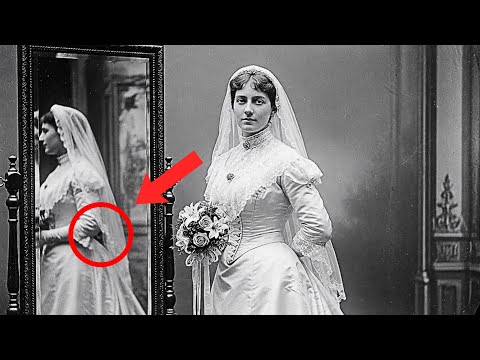
The air in Morgan’s restoration studio was thick with the smell of old paper and chemical solutions. She adjusted her magnifying lamp over the Victorian wedding portrait she’d bought three days earlier at a South End estate auction for just $30. The photograph, dated 1889, showed a young bride in an elaborate white gown standing rigidly before an ornate mirror. Her expression was unreadable in that distinctive way of 19th-century portraits.
Most Victorian wedding portraits were straightforward—bride and groom staring solemnly at the camera. This one was different. The bride stood alone, positioned at an angle that suggested she’d been uncomfortable. Behind her loomed a massive gilt-framed mirror, its surface slightly tarnished with age, even in the original photograph.
Morgan had been restoring daguerreotypes all morning, her eyes tired from the meticulous work. She decided to take a break and examine her newest acquisition more closely.
She switched on her high-power digital microscope—the kind museums used for analyzing historical artifacts—and began scanning the image systematically. The bride’s face came into sharp focus: young, perhaps 22 or 23, with dark eyes that seemed to hold something between resignation and defiance. Her dress was exquisite, layers of silk and lace that spoke of considerable wealth. The studio backdrop showed painted columns and drapery, standard for the period.
Then Morgan moved the microscope to the mirror in the background.
At first, she thought it was a flaw in the photograph—a spot of chemical damage or a scratch on the glass plate. But as she adjusted the focus and increased the magnification, her breath caught in her throat.
There, in the clouded reflection of the mirror, barely visible through the silver nitrate haze of age, was the bride’s back, and her hands. She was holding something.
Morgan’s pulse quickened. She leaned closer, adjusting the light source, enhancing the contrast on her computer screen. The object was small, metallic, catching light in a way that had survived more than a century of photographic degradation.
It looked like a key—ornate, Victorian era, the kind that might open a jewelry box or a small safe.
But why would a bride hide a key behind her back during her wedding portrait? Why would she risk having it captured in the mirror’s reflection?
Morgan sat back in her chair, her mind racing through possibilities. In 15 years of restoring historical photographs, she’d seen countless wedding portraits. She’d never seen anything like this. This wasn’t an accident. The bride had deliberately positioned herself to hide something from the camera while knowing—or perhaps hoping—that the mirror might preserve evidence of what she carried.
Something about this photograph wasn’t just unusual. It was wrong. And Morgan needed to know why.
Morgan spent the rest of that evening photographing every inch of the portrait with her equipment, creating high-resolution digital scans that she could manipulate and enhance. By midnight, she had isolated the reflection in the mirror and used restoration software to remove as much of the age-related distortion as possible.
The result confirmed her initial observation. The bride was definitely holding a key, and from its design, she could just make out decorative scrollwork on the bow. It was likely from the late 1880s.
The next morning, she drove to the auction house in the South End where she’d purchased the photograph. The building was a converted brownstone, its windows displaying an eclectic mix of furniture, paintings, and ephemera. Inside, she found Thomas, the elderly appraiser who’d sold her the portrait.
“Morgan,” he said warmly, looking up from a mahogany desk he was examining. “Don’t tell me you found something wrong with that photograph already?”
“Not wrong exactly,” she said, pulling out her tablet to show him the enhanced images, “but definitely interesting. Do you remember anything about its provenance—where it came from?”
Thomas put on his reading glasses and studied the images, his weathered face creasing with concentration. “That came from the Caldwell estate liquidation. Old family—been in Boston since before the Revolution. The granddaughter was selling off everything after her mother passed. Said she was moving to Arizona, didn’t want to deal with a house full of antiques.”
“Do you have information for her? I might.”
He disappeared into his cluttered office and returned with a folder. “Here. Patricia Caldwell. She left a phone number in case there were questions about any of the items.” He paused, studying Morgan’s face. “You really found something, didn’t you?”
Morgan showed him the enhancement of the mirror’s reflection, pointing out the key. Thomas was quiet for a long moment, then whistled softly.
“In 30 years of doing this, I’ve never seen anything quite like that. You think it means something?”
“I think someone went to considerable trouble to hide that key while also making sure there was a record of it,” Morgan said. “That’s not random. That’s intentional.”
She called Patricia Caldwell that afternoon. The woman answered on the third ring, her voice hoarse and tired.
“I’m sorry,” Patricia said after Morgan explained who she was. “I don’t know anything about individual photographs. That portrait was just part of a massive collection my mother kept in the attic. Family pictures going back generations. I didn’t even look at most of them.”
“Do you know who the bride in the photograph might be?” Morgan asked.
There was a long pause. “If it’s from 1889, that would be around the time my great-great-grandmother got married. Her name was Eleanor, but I don’t know much about her. My mother rarely talked about that side of the family.”
“Eleanor,” Morgan repeated, writing it down. “Do you remember her last name before she married?”
“Whitmore,” Patricia said. “Eleanor Whitmore. She married a man named James, I think. My mother had some of Eleanor’s things in a trunk somewhere, but I sold most of it. I’m sorry I can’t be more help.”
After the call ended, Morgan sat at her desk staring at the name she’d written: Eleanor Whitmore, 1889. It wasn’t much, but it was a start. She opened her laptop and began searching historical records, starting with Boston marriage certificates from 1889.
The Boston Public Library’s genealogy section smelled like old books and floor polish. Morgan had spent the morning navigating digitized records before deciding she needed to examine original documents. A librarian named Sarah, who specialized in 19th-century Boston history, helped her pull microfilm records of marriage licenses and newspaper announcements from 1889.
“Whitmore,” Sarah said, threading film through the reader. “That’s an old Boston name—connected to textile mills if I remember correctly.”
Morgan’s attention sharpened. “Textile mills?”
“Large ones. The Whitmore mills operated in several locations around Massachusetts in the late 1800s. Employed hundreds of workers, mostly immigrants.” Sarah paused as an image appeared on the screen. “Here. October 12th, 1889. Eleanor Catherine Whitmore married James Harrison.”
The newspaper announcement was brief but revealing. It described Eleanor as the only daughter of Gerald Whitmore, prominent industrialist and philanthropist, and mentioned that the wedding took place at Trinity Church with a reception at the Whitmore family estate in Beacon Hill. The groom, James, was identified as a businessman of good standing with connections to banking.
“Can you search for more articles about Gerald Whitmore?” Morgan asked. “Anything from that period?”
Sarah’s fingers flew over the keyboard, pulling up archive newspaper pages. What emerged was a portrait of considerable wealth and influence. Gerald Whitmore owned three textile mills in the Boston area, employed over 800 workers, and sat on the boards of multiple charitable organizations. The society pages frequently mentioned the family, and Eleanor appeared in several photographs at fundraising events and galas.
But as Sarah scrolled through 1890 and 1891, the tone of the articles shifted. In March 1890, a small news item reported labor disputes at one of Whitmore’s mills. In June, there was mention of an investigation into working conditions. By October 1891, the headlines were more explicit: Whitmore Mills Under Scrutiny—Workers Allege Fraud.
Morgan leaned forward, her heart racing. “Can you print all of these?”
The articles painted a disturbing picture. Workers—primarily Irish and Italian immigrants—had complained to authorities about systematic wage theft: hours worked but not paid, deductions for supplies that were never provided, falsified time records. What started as complaints escalated into a formal investigation by the Massachusetts Bureau of Labor Statistics.
Then, in December 1891, came the breakthrough: Industrialist Gerald Whitmore Indicted on Multiple Counts of Fraud—Documentary Evidence Surfaces.
The article was detailed. Anonymous sources had provided investigators with ledgers, correspondence, and financial records proving that Whitmore had been systematically defrauding his workers for at least five years. The evidence was so comprehensive, so meticulously documented, that Whitmore’s lawyers couldn’t dismiss it. He was arrested, tried, and ultimately sentenced to eight years in prison—a shocking outcome for a man of his social standing.
“Anonymous sources,” Morgan whispered, staring at the screen.
She thought of the key in Eleanor’s hand, hidden behind her back on her wedding day in 1889—two years before the investigation began.
Sarah noticed her expression. “You found something?”
Morgan showed her the enhanced photograph on her tablet, pointing out the key in the mirror’s reflection. “What if Eleanor Whitmore was the anonymous source? What if she spent years collecting evidence against her own father?”
Sarah’s eyes widened. “That would explain why the evidence was so thorough. She would have had access to everything—his office, his personal papers, his business records.” She paused. “But why hide a key in a wedding photograph?”
“Maybe it was the only proof she could preserve,” Morgan said. “If anyone ever questioned where the evidence came from—if her role was ever suspected—this photograph would show she had the means. That key opened something, probably a safe or a strongbox where she kept the documents before turning them over.”
“But she was getting married that day,” Sarah said quietly. “To a man her father approved of. Why would she go through with it if she was planning to betray him?”
That was the question Morgan needed to answer.
Morgan returned to the library’s database and searched for James Harrison in conjunction with Eleanor’s name. After 1890, his name vanished from Boston society pages entirely, resurfacing only in a 1923 obituary—a long-time resident of Portland, Maine, who listed Eleanor as his widow but noted she had remained in Boston. They’d lived separately for over thirty years.
This wasn’t the story of a happy marriage. Property records confirmed it: James bought a modest house in Portland in 1891, the year Gerald Whitmore was indicted, while Eleanor kept a Back Bay townhouse transferred to her name alone in 1892.
Then Thomas called. He’d found a collector in Cambridge named Raymond who’d purchased a trunk of Eleanor’s personal effects—including bundles of letters in elegant Victorian script. Morgan met him the following afternoon in his converted carriage house, and her hands trembled as she opened the leather portfolio.
A letter dated August 1889 read: “Father has made his intentions clear. I am to marry James Harrison regardless of my own wishes… James, while not the man I would have chosen, is at least kind and has privately assured me that our marriage need only be one of appearance.”
Another, from September 1889, revealed everything. Eleanor had been copying her father’s ledgers in secret, using a duplicate key to his personal safe. “This wedding photograph next week will be my only record that I possess the means. I will hold the key where father cannot see it, but where the mirror will capture its reflection.”
Morgan sat back, overwhelmed. Eleanor hadn’t been a reluctant bride—she’d been a deliberate spy, using her own wedding day to document her access to evidence. The remaining letters traced two years of methodical collection, culminating in her father’s indictment.
But the story didn’t end there. Patricia Caldwell brought Morgan a walnut box she’d kept for decades: Eleanor’s journal, spanning 1893 to 1920. Its entries revealed a quiet life of service—teaching English to immigrant women, funding rent and medical bills for the families her father had ruined, never seeking credit.
A letter from Antonio Rossi in 1897 made Morgan’s throat tighten: “To my unknown friend, my daughter has been accepted to the teachers college. I do not know your name, but I know you have a good heart.”
Morgan tracked down the descendants—Isabella Rossi, a history professor whose great-grandfather’s grocery store was built on recovered wages; Michael O’Sullivan, a union representative whose great-grandmother had brought her family from Ireland. Together with the Chen Legal Aid Foundation, they built a modest exhibit at the North End Community Center, in the very building that had once housed Antonio’s store.
Patricia brought the actual key—ornate, tarnished, its scrollwork matching the reflection exactly. It rested in a case beside the photograph, beneath a plaque honoring Eleanor Catherine Whitmore, 1867–1954.
Months later, Morgan still kept the portrait on her desk, a reminder that truth is often there, waiting to be seen. History isn’t only made by the powerful and public, but by quiet individuals who make difficult choices and leave small traces for future generations to find.
What hidden story might be waiting in a photograph you’ve already passed by a hundred times—and would you care enough to look?
Report this article
Select a reason for reporting:






