The shells had been falling for hours, and now the Chinese infantry were climbing through the wire. Nineteen-year-old Sergeant Brian Cooper lay in his machine gun bunker on Hill 111, watching the dark slope below him fill with moving shapes. His Vickers guns hammered on fixed lines, but the assault kept coming—wave after wave, nearer with every minute. Beside him, the Hook still held, but Hill 111 was sliding out of his grip.
It was the night of July 24, 1953. The Korean War was supposed to be over. An armistice had been agreed, the signing set for July 27—just days away. But the Chinese 137th Division had other plans. They wanted the Hook, that low, blood-soaked ridge, to carry to the negotiating table. And they were throwing everything they had left to take it.
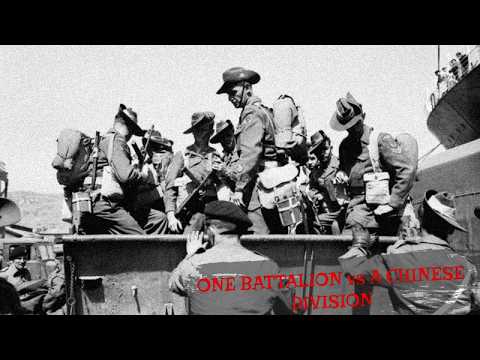
Cooper had done everything by the book. His section of medium machine gunners from the 2nd Battalion, Royal Australian Regiment, had been pushed forward to hold the western approach beside the US Marines. But the forward trenches were gone, the wire breached, and the Chinese were inside the weapon pits—too close for the guns to turn on them. He had one option left, and he knew exactly what it was.
He grabbed the field telephone and called the divisional artillery down onto the very hill he was standing on—with his own gunners still out in the open pits around him. At nineteen, he had a quiet word with the man upstairs, asking that if it came to that, it be quick, and that the guns go easy on his blokes.
The shells came down right where he’d asked. Out in the open, the Chinese had no cover. The barrage tore the assault apart on the forward slope before it could reach the crest. Hill 111 held—but the night was far from over.
By the next evening, the men on the Hook were running on nothing. They’d had no real sleep since the probing started. The shelling never let them finish a repair. And word had reached the trenches that the armistice was barely a day away. There was a particular cruelty in that—fighting for a hilltop with peace already signed and sitting on the calendar.
But the Chinese weren’t done. At a quarter past eleven on the 25th, the last offensive of the entire Korean War began. The 137th Division came once more at Hill 111 and the Marine front, and they came at the contact bunker—the strong point between the two hills that guarded the way up to Hill 121. Everything they had left went into that final push.
They reached the Australian wire, and there they were stopped. The guns put down a weight of fire that nothing on foot could walk through. The waves broke apart in the open ground short of the trenches. 2 RAR held its line through the worst of it and never gave up a yard of ground.
By three in the morning on the 26th, with the slopes below the wire heaped and no sign of a gap anywhere in the Australian line, the Chinese command had seen enough. They called the offensive off. Their division had been broken on the wire, and with the armistice only hours away, there was nothing more to be won by feeding men into the same fire.
The barrage slackened. The surviving infantry pulled back into the dark. Along the Australian line, the firing fell away to the odd round and a long settling quiet. What the men in the trenches didn’t yet know was that the war itself was nearly over—that within a day, the order to cease fire would run down the whole length of the front.
They knew only that the attacks had stopped. And when daylight came on the 26th, the valley below them showed the cost.
The valley floor was carpeted with the dead. Somewhere between two and three thousand Chinese soldiers lay across the approaches to Hill 111, the contact bunker, and the Marine line. Their wounded were estimated past ten thousand—though the true count was never set down and never will be, lost with the division that had spent them.
For the men of 2 RAR climbing out of their bunkers to look at it, the sight below was close to horror. The quiet was almost as hard to bear as the racket had been. The cost on the line that held was set down in the plainest terms: five men gone, twenty-four wounded, and two of the wounded later passed from their injuries. The Marines of the 7th Regiment, holding the heavier and far more exposed ground to the left, had forty-three gone and three hundred and sixteen wounded.
Australians and Americans had held different corners of the same hill. The harder corner had fallen to the Marines, and between them the two forces had broken a whole division.
The weight of guns the Chinese brought against the Hook ran past anything Australians had stood under earlier in the war. By the reckoning of the official history, the artillery thrown at the two Australian battalions at the Samichon outweighed what had come down on them at Maryang San, and the combined power of the American and Commonwealth guns answering it ran higher than anything brought to bear at Kapyong.
The Hook held because the men on it kept more steel in the air than the men climbing the slope could walk through. That had been the lesson of all four battles on the feature. The Australians had taken it to heart well before the 137th Division arrived in front of them.
The truce came the very next morning. At ten o’clock on the 27th of July, the armistice was signed at Panmunjom, and it took effect at ten o’clock that night. When the hour came, the guns along the whole front fell quiet, and the silence that followed ran for miles in every direction—the first true quiet that ground had known in the better part of two years.
The Battle of the Samichon River was over, and with it the last large action Australians would fight in the Korean War. As a battle honor, the Royal Australian Regiment would carry the Samichon away with it for good.
Two days after the guns stopped, men of 2 RAR walked freely across the top of the Hook—the same ground where a man could be taken in a heartbeat only the week before. They carried timber and surplus ammunition down off the hill and handed the heavy armored vests back into company stores. A war correspondent photographed them strolling down the open slope in plain view, on ground no man had crossed upright in daylight for the better part of a year.
The shape of the hill hadn’t changed at all, and yet it had become an ordinary feature again—just a rise of dirt above a river. The Hook was only a hill once more.
Brian Cooper came home in April of 1954. While he’d been away in Korea, a young woman named Margaret had begun writing to him, the way letters from home found their path to lonely soldiers all through that war. They’d become pen friends across the distance, and when he got back to Australia, the two of them married.
He was barely twenty by then, with a Military Medal put away in a drawer for the night he’d spent calling the guns down on his own head, and a wife he had first met by post. He didn’t talk much about the hill.
Decades later, a journalist asked Cooper what he remembered most. He was silent for a long moment. “The quiet,” he said finally. “Not the guns. The quiet after.”
He never visited the Hook again. Margaret said he kept the medal in the drawer, wrapped in cloth, and only took it out once—when their grandson asked about the war.
Cooper died in 2011, aged seventy-seven. At his funeral, an old comrade stood and said simply: “He called the guns on himself. That’s the kind of man he was.”
The Hook is a quiet hill now, grassed over, visited by farmers and the occasional historian. But on July nights, when the wind comes down the Samichon, some say you can still hear the silence that followed the last shot.
What would you have done, crouched in that pit, with the enemy already past your guns and the phone in your hand?
Report this article
Select a reason for reporting:






