Imagine a fighter jet streaking through the heart of London, flying just feet above the Thames. The roar of its engine echoes across Parliament, leaving onlookers in shock. Then, in a jaw-dropping move, the pilot races toward Tower Bridge and, instead of flying over, plunges straight through between its towers. This is no Hollywood stunt but a real-life act of defiance by a Royal Air Force pilot in 1968. What pushed him to risk it all? And how did he pull off one of the most daring aerial maneuvers in aviation history? This is the incredible story behind the Hawker Hunter Tower Bridge incident.
During the 1960s, the UK’s Ministry of Defence had undergone a dramatic transformation. The 1957 Defence White Paper, presented by then-Defence Minister Duncan Sandys, laid out the perceived future of the British military. No branch of the Armed Forces would escape its effects, but the Royal Air Force in particular would be hard hit. The early years of the Cold War had centered on high-altitude bombers delivering nuclear weapons, with fast, agile jet interceptors scrambled to intercept them. The advent of the ballistic missile, however, changed all of that—particularly in the minds of politicians. The result was a general downsizing of the RAF: aircraft numbers reduced, squadrons disbanded, stations mothballed, manpower cut. The knock-on effect on the British aerospace industry was substantial, with projects and aircraft development scrapped or considerably reduced. It was understandable, therefore, that morale in the Royal Air Force was particularly low.
This all came to a head for one RAF pilot in 1968. It was the 50th anniversary of the formation of the Royal Air Force—the world’s oldest air force. But to add to the already bad feeling between the service and the politicians, the Ministry of Defence decided not to celebrate the significant event with any official air displays. Official events were instead limited to a few dinners, parades, and some low-key displays. This didn’t go down well with Flight Lieutenant Alan Pollock. He, along with many others, believed a grand flypast was necessary, as aviation history was traditionally celebrated in the air, not on the ground. He was incredibly disillusioned with the Ministry of Defence’s lack of proper celebrations for this important milestone, especially given his deep love for the RAF.
At the time, Pollock served in the RAF’s Number 1 Squadron, one of its oldest units, flying the single-seat ground-attack jet fighter, the Hawker Hunter FGA.9. He felt responsible for leading the charge in marking the RAF’s anniversary. Frustrated by these changes and what he perceived as government indifference, Pollock decided to stage his own celebratory flyover.
On April 4th, 1968, Pollock departed his home base of RAF West Raynham in Norfolk with three other Hunter pilots to fly to RAF Tangmere in Sussex. Tangmere, the famous World War II fighter station that played a vital role during the Battle of Britain, was due to be mothballed, and Pollock and his wingmen were to provide an air display and attend ceremonial events. They were then scheduled to return to West Raynham the following morning. The following morning, however, he secretly planned to deviate from their return flight route and take a detour over Central London.
Shortly after takeoff, Pollock broke away from his squadron, pretending to experience radio problems and lose contact. He flew low to avoid commercial air traffic, making his way to Heathrow before turning towards Richmond Park, then the River Thames—which he considered the safest path through London and would cause the least trouble. Pollock dropped to 150 feet and, sticking to the center of the river, passed over several bridges, making his way towards Parliament.
As he brought his Hunter around the bend in the river and crossed over Vauxhall Bridge, he saw his target up ahead: the Palace of Westminster and the Houses of Parliament. As Big Ben struck noon, Pollock throttled up his engine and made three loud circular passes around Parliament. He was determined to make his presence and feelings known, especially as MPs inside were ironically discussing noise abatement at the time. Pollock’s low passes over the Houses of Parliament were heard by many, including RAF Spitfire veteran Wilfred Duncan Smith—father of future Conservative Party leader Ian Duncan Smith—who had to point out Pollock’s aircraft to an oblivious official looking skyward, noting that the aircraft was flying below the Ministry of Defence.
After circling Westminster, Pollock saw Downing Street but, without a detailed map, couldn’t pinpoint its location. So instead, he resumed his path over the center of the River Thames and continued east. As he passed the RAF Memorial by Whitehall, he dipped his wings in salute and then continued down the Thames, flying over several of London’s major bridges: Hungerford, Waterloo, Blackfriars, Southwark, and London Bridge.
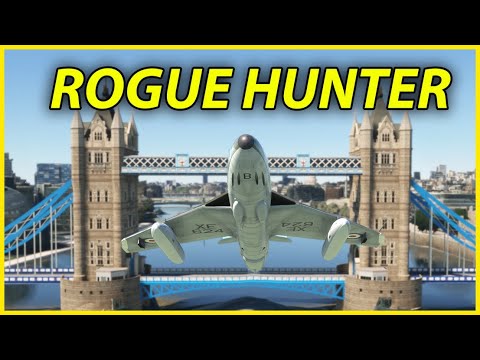
Somewhat unexpectedly, he came face to face with Tower Bridge, which he had forgotten was in his path. With just seconds to react, Pollock impulsively decided to fly through the bridge’s spans—an audacious move requiring quick thinking honed from years of low flying. Although he feared his Hunter jet’s tail fin would strike the bridge, he successfully navigated through, startling a cyclist who fell off his bike. There had been previous incidents of aircraft carrying out this daring feat, but never by a jet aircraft.
Aware that his flying career was likely over, Pollock continued his rebellious streak by turning northeast and heading for RAF Wattisham in East Anglia. Dropping to an altitude of a mere 200 feet, he rolled into inverted flight to perform a low-level pass over the airfield. Not content with that, he continued to RAF Lakenheath and RAF Mildenhall, where he carried out the same extraordinary maneuver. And he wasn’t done yet: onto RAF Marham in Norfolk for one last upturned flypast before reluctantly bringing this once-in-a-lifetime aerial display—and almost certainly his flying career—to an end.
As he landed back at RAF West Raynham, a welcome party was waiting for him, and he was promptly arrested. The aftermath was a mixture of admiration and discipline. Pollock’s unit was transferred to North Africa, leaving him behind to face his charge. He received hundreds of congratulatory letters from members of the public as well as RAF colleagues. British Overseas Airways Corporation even sent him a keg of beer. The political aftermath included an all-party motion of support signed by six MPs, four of whom were former RAF servicemen. To avoid further embarrassment to the government, he was invalided out of the RAF on trumped-up medical grounds and therefore avoided a court-martial.
But the story doesn’t end there. The daring feat and its repercussions would echo through the corridors of power and the annals of aviation history, raising questions about duty, honor, and the price of protest.
In the days that followed, the Ministry of Defence scrambled to contain the fallout. Officially, the incident was described as a navigational error—a convenient fiction that fooled no one. Unofficially, senior officers were furious, not just at Pollock, but at themselves for having allowed morale to sink so low that a decorated pilot felt compelled to make such a statement.
For his part, Pollock remained remarkably calm. “I did it for the Air Force,” he reportedly told his interrogators. “Not against it.” That distinction mattered to the men who knew him. Many of his fellow pilots privately admitted they wished they’d had the nerve to do the same.
The press, meanwhile, had a field day. Newspapers ran breathless accounts of the “rogue pilot” who had buzzed Parliament and threaded his jet through Tower Bridge. Letters poured in from the public—some outraged, but the vast majority cheering. Schoolchildren wrote to Pollock asking for his autograph. One admirer sent him a model of a Hawker Hunter with a note reading: “To the bravest man in the RAF.”
Yet the consequences were real. Pollock’s flying days were over, and he knew it. The medical discharge was a face-saving arrangement for all involved—the RAF avoided the spectacle of a court-martial, and Pollock avoided a formal conviction that might have followed him for life. But it also meant the end of a career he had loved since boyhood.
What few people knew at the time was just how close the stunt had come to catastrophe. In the years afterward, aviation experts studied the Tower Bridge flythrough and concluded that Pollock had cleared the bridge’s upper walkways by a margin measured in feet, not yards. Had he misjudged the approach by even a fraction, the jet would have struck the structure at nearly 400 miles per hour.
His Hunter’s tail fin, he later confessed, was his greatest worry. The bridge’s towers were unforgiving stone, and the gap between them left almost no room for error. “I didn’t think about it until I was through,” he admitted. “Then I thought about it a great deal.”
The incident also had a lasting effect on how the RAF viewed its relationship with the public and its political masters. The 50th anniversary celebrations, initially reduced to a few modest events, were quietly expanded in the months that followed. Senior officers began to speak more openly about the importance of airshows and public engagement. It was as if Pollock’s protest had jolted the establishment into remembering what the Air Force was for—and who it served.
Pollock himself slipped into relative obscurity, but he never regretted his decision. In rare interviews later in life, he spoke of the day with a mixture of pride and wistfulness. “I wanted to remind people that the RAF had a history worth celebrating,” he said. “And for one morning, I think I did.”
The Tower Bridge incident remains a singular moment in aviation history—a tale of defiance, skill, and a pilot’s love for a service he believed had lost its way. And as the years pass, the image of that Hunter jet threading between the towers continues to capture the imagination of all who hear the story.
Alan Pollock passed away in 2017, but his legend only grew with time. Aviation historians now regard the Tower Bridge flythrough as one of the most precise pieces of low-level flying ever performed—an act of protest that was also an act of consummate skill.
His Hunter, long since retired from service, found a new home in a museum. Visitors still pause before it, imagining the roar of its engine echoing off Parliament’s stone walls. “He flew the way he believed an airman should,” one curator noted. “With courage, and with heart.”
In the end, Pollock’s rebellion achieved what years of polite lobbying could not. The RAF learned to celebrate its heritage proudly, and the public learned to look up at the sky with renewed wonder. One man, one jet, one unforgettable morning over London.
Do you think Pollock was a hero, a troublemaker, or something in between? Share your thoughts in the comments below.
Report this article
Select a reason for reporting:






