June 6, 1944, dawned with a series of fragmented reports reaching German command posts in France. Paratroopers spotted inland, communications severed in multiple sectors, naval activity off the Normandy coast. For Field Marshal Gerd von Rundstedt, the immediate problem wasn’t confirming whether this was the main invasion—that became clear within hours. It was determining if there was still time to throw the enemy back before they established an operational logistical port. The answer depended on decisions no longer in his hands.
The German defense in Normandy responded to a structural contradiction that had remained unresolved for months. Field Marshal Erwin Rommel insisted on concentrating armored divisions near the beaches to destroy the invader in the first hours. Berlin favored holding armored reserves in depth for a massive counterattack once the invasion point was identified. The result was a compromise that satisfied no one: static divisions defended the coast without real mobility, while armored formations remained scattered inland, subject to a central authorization system requiring explicit permission for any major movement.
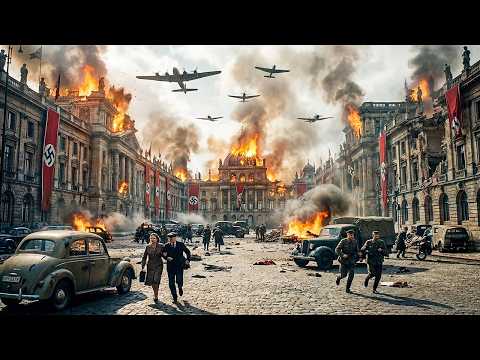
When that permission came on June 6, it was already too late. Allied air forces controlled the skies, and the calculated time for a decisive counterattack had been exhausted. Allied air superiority wasn’t a theoretical concept for German divisional commanders—it was an operational reality that degraded mobility to unsustainable levels. The 12th SS Panzer Division, one of the available formations, received orders to move toward Caen on the morning of June 6. Under normal conditions, it would have arrived within hours. Under constant air attack, it had to disperse, camouflage, and move mainly at night. The division arrived fragmented with mechanical losses and without the concentration needed to break beachheads.
This pattern repeated with every unit that tried to approach the front. The distance between order and actual execution stretched to the point of turning counterattacks into delayed reactions against an enemy already entrenched. For General Friedrich Dollmann, commander of the 7th Army defending Normandy, the first days revealed an impossible equation. Every hour the Allies controlled the beaches increased the density of their forces and equipment on the ground. Every German attempt to concentrate armored forces at a breakthrough point faced an environment where daytime movement equaled an invitation for air attack.
Normandy’s terrain—with its hedgerows, small fields, and narrow roads—provided excellent defensive positions for infantry but turned large-scale tank maneuvers into slow, fragmented operations. The battle became attrition sector by sector, close-quarters fighting in villages and intersections, not the war of movement the Wehrmacht had mastered in previous campaigns. The struggle for Caen illustrated how a seemingly tactical decision could have profound strategic consequences. For Rommel and his subordinates, Caen was more than a city. It was a road hub controlling access to the French interior, a point from which a British offensive could threaten the entire eastern flank of the German deployment.
Command decided to hold it using the best available armored divisions—formations originally intended for mobile counterattacks. The result: units like Panzer Lehr, the 12th SS, and the 21st Panzer became stuck in static defensive fighting around Caen, as buffers against successive British attacks. This fixation had a decisive strategic effect: while Germany’s best reserves were being drained in eastern Normandy to prevent a British breakthrough, pressure accumulated on the American front in the west without facing similar armored resistance.
The problem wasn’t merely tactical—it was logistical in a structural sense. The Allies solved the challenge of supplying the invasion without major ports by creating artificial harbors and continuous landing systems on the beaches. For General Wilhelm von Varbacher, commander of the 25th Army Corps, this meant the enemy could sustain their offensive indefinitely while the Wehrmacht depended on a rail and road network under systematic bombardment. At the tactical level, shortages manifested in critical moments: batteries forced to ration ammunition during enemy artillery preparations, tanks unable to maneuver due to fuel shortages, wounded soldiers evacuated late or not at all. Attrition was no longer a concept—it was the concrete reason behind a position holding one day and collapsing the next.
While Normandy consumed attention in the west, on June 22, 1944, the Red Army launched Operation Bagration against Army Group Center in Belarus. For Field Marshal Ernst Busch, commander of that army group, the blow came with a magnitude that exceeded all expectations. The Soviet attack wasn’t a simple frontal assault—it combined simultaneous breakthroughs across multiple axes, penetrations through overwhelming artillery superiority, and exploitation by mobile forces seeking to dismantle the front’s structure, not merely push it back. In less than two weeks, Army Group Center—the cornerstone of the eastern defensive system—dissolved.
The question was no longer territory. Entire armies were encircled. Command centers fell or were destroyed, and withdrawal turned into dispersal. For the German High Command—the OKW under Wilhelm Keitel and the operations staff under Alfred Jodl—the simultaneous collapse on two fronts triggered an internal competition for resources that no longer existed. In the east, armored divisions were needed to plug Soviet breakthroughs and restore the coherence of the lines. In the west, those same divisions were required for a concentrated counterattack to expel the Allies from Normandy before they consolidated. Every transfer of a formation to one front automatically weakened the other. The decision, when finally made, always arrived too late to change the outcome on either theater.
The dilemma wasn’t theoretical. When the 2nd SS Panzer Division “Das Reich” received orders in mid-June to move from southern France to Normandy, the journey took two weeks—a movement that would have taken days in 1940. Resistance attacks, constant aerial harassment, and the need to travel secondary roads turned the transfer into an exhausting process before combat even began. Meanwhile, in the east, divisions that could have reinforced Army Group Center were pinned in the west, powerless to influence a crisis unfolding thousands of kilometers away. The geography of a two-front war had become an operational trap with no solution.
By late June and through July, the scale of the crisis in the east forced priority to that front. The collapse of Army Group Center threatened vital routes toward East Prussia, exposed Germany’s minor allies in Eastern Europe, and hinted at the possibility of a Soviet advance toward the Vistula before autumn. For Field Marshal Walter Model, sent to stabilize the situation, the mission was to rebuild a front with the remnants of shattered units, improvised reserves, and no capacity for a counterattack in depth. Every kilometer the Red Army advanced consumed railway infrastructure, fortified cities, and positions that had taken years to prepare.
In the west, July became a month of severe attrition with no hope of a decisive breakthrough. Caen fell partially under British and Canadian pressure, but the German front, though exhausted, held. General Hans von Kluge, who replaced Rundstedt as commander-in-chief in the west, understood that the idea of a decisive battle to break the beachhead had faded. The objective now was more modest: delay, inflict losses, and buy time to build a defensive line in the rear. That time never came.
On July 20, the failed assassination attempt against Hitler added another factor of instability. The subsequent purges shook the balance of trust within the High Command, triggered changes in key responsibilities, and reinforced a climate of suspicion at a moment when unity was essential. For commanders like Rommel, seriously wounded days earlier in an air attack, and Kluge, who would fall under suspicion and take his own life in August, this episode had a corrosive effect on tactical freedom of action at the very moment the enemy was forcing them to improvise.
On July 25, after an aerial bombardment that destabilized the western front in Normandy, American forces launched Operation Cobra. The breakthrough wasn’t immediate, but within a few days it became clear that the German line had been shattered in depth. For divisional commanders in the sector, the problem wasn’t merely the enemy’s penetration but the impossibility of rebuilding the front. Armored reserves were tied down at Caen, the command structure had disintegrated, and Allied air superiority turned every attempt at counterattack into a costly and futile exercise.
By the end of July 1944, the German operational map revealed an unavoidable reality. In the west, Normandy ceased to be a battle to contain the invasion and became a struggle to avoid the encirclement of entire armies. In the east, Army Group Center no longer existed as a coherent structure, and the Red Army was approaching the Vistula. The strategic outcome had been decided. What would follow wouldn’t be a defense of the empire, but the management of a collapse whose chapters would unfold over the coming months. Every decision of the German High Command from that moment on wasn’t aimed at changing the final result, but at delaying it—in the increasingly irrational hope that time would produce a crack in the enemy coalition that would never come.
The German defeat in France didn’t begin with an organized withdrawal or a clear strategic decision. It began with a fatal disparity between speed and reality. When Operation Cobra was launched on July 25, 1944, in the American sector of Normandy, the preceding bombardment was devastating but not decisive in itself. What was truly lethal happened in the hours and days that followed, when the German command system proved incapable of responding at the speed demanded by modern warfare dominated by air power.
Field Marshal Günther von Kluge, newly appointed commander-in-chief in the west, recognized almost immediately that the breach was not a minor tactical problem. The German front had been broken not at an insignificant point, but in a sector guarding the exit to open country. The divisions meant to contain the blow—Panzer Lehr and the 2nd Panzer—were not destroyed, but scattered to the point of losing coordinated reaction. Entire units were left without communications, without clear orders, without the ability to regroup in time.
Kluge tried to execute what German doctrine had prescribed for years: a counterattack with armored units to seal the gap before the enemy could exploit it. But in 1944, that doctrinal response collided with insurmountable reality. The available reserves were not concentrated in one place. They lacked enough fuel for deep maneuver. And above all, they could not move by day without being spotted and attacked by Allied aircraft. The counterattack order was issued, but the designated units took more than 24 hours to reach their start points. By then, the front had already ceased to exist as a coherent line.
The problem wasn’t a shortage of soldiers or tanks. It was speed. The German decision-making system—centralized, hierarchical, dependent on high-level approvals—had functioned adequately in 1940 but was fatally slow in 1944. Every hour of delay not only allowed the enemy to advance but doubled their capacity to do so.
For General Paul Hausser, commander of the 7th Army, the situation became critical by late July. His forces were split between two incompatible realities: in the east, they still held off the British and Canadians around Caen; in the west, the Americans advanced with growing freedom. When elements of the U.S. VIII Corps reached Avranches on July 30, the geometry of the front changed entirely. Avranches wasn’t just a city—it was the gateway to Brittany and, more importantly, to the French interior. From that moment, the danger was no longer mere penetration but operational encirclement.
Hausser requested permission to withdraw toward the Seine and save the bulk of his forces. The reply from above was different: launch a counterattack. The attack toward Avranches, designed to cut the Allied bottleneck, was logical on the map but ignored the real conditions of the army meant to execute it. The designated divisions, including elite armored units, were in no position for a sustained offensive. They lacked fuel, were dispersed, and had to assemble under skies completely controlled by the enemy.
The attack launched at Mortain in early August achieved limited initial surprise. For a few hours, some American positions were breached. But at dawn, when the weather improved, Allied air power intervened with overwhelming force. What began as an attempt at recovery turned into a trap. The engaged German divisions were pinned in combat while the enemy maneuvered to encircle them. Germany could still attack, but it could no longer sustain an attack long enough to achieve strategic results. That was the point of no return.
While the best German units fought at Mortain, Allied forces advanced from north and south. Thus the Falaise Pocket formed—not by chance, but as the direct result of a decision made too late and with insufficient means. When Field Marshal Walter Model arrived to take command of the western front in mid-August, he found an army on the verge of disintegration. His diagnosis was immediate: without authorization for a full withdrawal, the army in France would be destroyed. The permission came, but it was too late. The escape corridor shrank to a narrow road, constantly under artillery and air bombardment.
For the trapped forces, withdrawal wasn’t a maneuver—it was an organized flight under fire. Entire columns moved at night, leaving behind tanks, guns, and vehicles that couldn’t move for lack of fuel or because roads were blocked by burning wreckage. Some divisions escaped, but they emerged as shadows of what they had been. The 12th SS Division “Hitler Youth,” which entered Normandy as a full division, exited the pocket with a few hundred men and a handful of working tanks. Panzer Lehr, one of the best divisions in the German Army, ceased to exist as an effective unit.
Most dangerous was the loss of heavy artillery and experienced mid-level commanders. Without them, a division was no more than a name on paper. When the remnants of the German Army crossed the Seine, France was already lost—not because Paris fell, but because the military instrument needed to defend it had been destroyed.
General Dietrich von Choltitz, responsible for the French capital, understood that turning Paris into a battlefield would change nothing. Defending it would consume forces desperately needed to attempt a defensive line further east. His decision to surrender the city intact was a military acknowledgment more than a political act. Time no longer favored Germany.
The catastrophe deepened days later with the Allied landing in southern France. For General Johannes Blaskowitz, responsible for that sector, the situation was hopeless. His forces had already been weakened to reinforce Normandy and now faced a new front with clearly insufficient means. He chose immediate withdrawal to the Rhône Valley, trying to save what could be saved before being caught between Allied armies advancing from north and south. The retreat was continuous and harassed from the air, exhausting his divisions before they even reached the German border.
By the end of summer 1944, the German western front no longer existed as a connected structure. France was lost—not because of a single battle, but because of the gradual destruction of the army meant to defend it. What remained were remnants: names, commanders without sufficient troops, forces lacking the cohesion needed to maneuver. Germany was now withdrawing to its borders, trying to rebuild its defenses with increasingly scarce human and material resources.
And while this happened in the west, the rest of Europe burned. Italy continued to drain divisions that could not be withdrawn without causing immediate collapse. In the east, the Red Army paused only to prepare better. Germany had lost France, but it had not yet made its final decision. That decision—a desperate gamble to change the course of the war with a single blow—was already beginning to take shape.
When the remnants of the German Army reached the western borders of the Reich in September 1944, what arrived wasn’t a defeated army in the traditional sense, but something more alarming: a force still fighting with determination but having lost the capacity to recover. The divisions retained their names, their flags, their official hierarchy. But they no longer possessed the human or material depth that made prolonged war possible.
The central problem wasn’t just the number of men remaining, but the nature of the army Germany had now become. The West Wall—the former Siegfried Line—became the anchor point for this new reality. On the map, it was a vast defensive barrier of bunkers, anti-tank obstacles, and fortified positions. In practice, it was a line manned by incomplete units hastily formed with uneven training and chronic shortages of mobile reserves. The German High Command knew that a fortified line without counterattack capability could not stop a modern offensive. It could only delay it.
The reconstruction of the western front revealed the extent of the German replacement system’s exhaustion. New soldiers were increasingly younger or far too old. Many came from the Luftwaffe and Navy, transferred to infantry because there were no longer enough aircraft or ships to employ them in their original specialties. Airfield technicians, anti-aircraft gunners, and port sailors were formed into infantry battalions with rapid training. They fought with discipline but lacked the experience needed for a war of attrition.
In September, the Allies attempted to hasten the war’s end with a bold maneuver: Operation Market Garden. The plan aimed to cross the Netherlands, seize a series of bridges, and open a direct corridor into Germany’s industrial heart. From the German perspective, the attack was an operational surprise but not a decisive blow. The defense around Arnhem was organized with improvised means and units that happened to be there—resting or reorganizing after Normandy. The German defensive success at Arnhem was real, but misleading. It didn’t represent strategic recovery—it was merely a pause.
The front stabilized temporarily in the north, but Germany gained no new reserves from it, nor enough time to reorganize its army. It gained only a few weeks. Weeks the enemy could afford to lose, and Germany did not know how to exploit.
In the south, the war took on a different character—more brutal and symbolic. Aachen, the first major German city in the Allies’ path, became a symbol of resistance without hope of victory. The defense was fierce, house to house, using old fortifications and improvised positions. For the defenders, it wasn’t about winning but about executing orders and delaying the enemy. For the High Command, Aachen was a calculated sacrifice: time in exchange for destruction. The city fell in October. With it, any illusion of indefinite resistance on the western border dissipated.
The fighting in the cities showed that Germany could still inflict losses but could no longer prevent the enemy’s advance. Every city defended was just another point on the calendar, not a step toward a strategic solution. The same pattern repeated in the Hürtgen Forest. There, the terrain favored the defender. Dense vegetation, rugged terrain, and weather limited Allied advantages in tanks and air power. For Germany, Hürtgen wasn’t a battle to win but a battle to exhaust. Every Allied advance cost time, men, and equipment.
But the structural difference was clear. The Allies could replace their losses. Germany could not. The attrition was mutual, but the outcome was implicit from the start. Meanwhile, on other fronts, the situation continued to deteriorate. Italy kept draining divisions that couldn’t be withdrawn without causing immediate collapse of the front. Holding a barrier in the Apennines was defensively logical but was a strategic luxury Germany could not afford. Yet abandoning Italy meant opening the way to Austria and the southern Reich—an option the political leadership systematically rejected.
In the east, the threat was more acute. The Red Army reached the Vistula line and maintained deep bridgeheads pointing directly at Germany’s industrial heart. The front seemed stable, but this stability was deceptive. It depended on the enemy’s choice to wait—a dangerously flawed assumption.
In this context, the German High Command reached a disturbing conclusion. Passive defense meant certain defeat. There were insufficient resources to wage a war of attrition on all fronts. If Germany wanted to change the war’s course—or at least delay its end—it needed more than resistance. It needed an attack.
And so the idea of the Ardennes offensive was born—not as a traditional military plan, but as a political gamble in military guise. The logic was clear, though desperate: an unexpected attack in the west through a secondary sector might split the Allies, seize key ports, and trigger a political crisis that opened the door to negotiation. It wasn’t about defeating the United States and Britain militarily, but about breaking their will.
The problem was that the plan required conditions Germany no longer controlled. It depended on bad weather to neutralize Allied air power, fuel reserves that no longer existed, and a speed of advance the army could no longer sustain. Yet the decision was made to proceed—not because it was possible, but because there was no better alternative.
The preparations for the offensive revealed the extent of Germany’s final bets. Armored divisions were pulled from other fronts, even from the east, where the Soviet threat was growing. Fuel was stockpiled at the expense of weakening entire sectors. Ammunition was concentrated for a single operation, while simultaneously the Volkssturm—a people’s militia intended to cover basic defensive tasks and free regular troops for the offensive—was created. It was an implicit admission that the Reich no longer had enough trained soldiers to meet its needs.
Within the High Command itself, warnings emerged. Some generals pointed out that concentrating resources in the west left the eastern front dangerously exposed. The Soviet bridgeheads weren’t a future threat—they were an immediate one. But those warnings collided with a political decision already made. The Ardennes offensive wasn’t designed as one option among many, but as the last available option.
By the end of November 1944, as divisions gathered secretly in the Eifel forests, Germany had reached the point of no return. The Reich was already fighting on its own borders. It had lost France. It had lost the strategic initiative and the ability to absorb mistakes. Everything now depended on a single gamble against an enemy superior in numbers and overwhelming in material.
The Ardennes wasn’t a plan to win the war. It was an attempt to change the way the war was lost. And if it failed, there would be no reserves, no time, no room for correction. The winter of 1944-1945 approached as a final opportunity—but it was also a death sentence. Germany was about to risk everything in an offensive that depended, even before it began, on hope more than reality.
Dawn on December 16, 1944, witnessed the moment when the Reich played its last offensive card in the west. After hours of preparation in dead silence, German artillery opened intense fire on scattered American positions along the Ardennes sector. For General Courtney Hodges, commander of the U.S. First Army, the first hours were marked by operational confusion. Reports were fragmentary, communications severed, and it took time to grasp the scale of the attack.
From the perspective of Field Marshal Model, commander of Army Group B and responsible for the operation, the first day confirmed that tactical surprise had been achieved. The American divisions in the sector—mostly newly arrived units or veterans exhausted and sent to a quiet front—were defeated at several points. Dense fog and low visibility neutralized Allied air power, temporarily creating the conditions the plan required: a battlefield where ground mobility and artillery fire became decisive again, as in the 1940 campaigns.
General Sepp Dietrich, commander of the 6th SS Panzer Army on the northern axis, knew his window was narrow. His tank total—the 1st SS “Leibstandarte Adolf Hitler,” the rebuilt 12th “Hitler Youth,” and the 2nd “Das Reich”—approached 500 tanks theoretically, but operational independence depended on reaching Allied fuel depots within the first 48 hours. The plan assumed armored formations would advance along specific axes, bypass initial resistance quickly, and reach the Meuse before the enemy could reorganize reserves.
The political objective was clear: reach Antwerp, cut Allied supply lines, and trigger a crisis that would fracture the enemy coalition or force negotiations. The military objective was more modest but no less difficult: create a deep salient forcing the Allies to divert resources from other fronts and buy time for the Reich.
The terrain imposed immediate constraints. The narrow, winding Ardennes roads, covered in snow and mud, became clogged with vehicle columns. Kampfgruppe Peiper, an elite combat group from the 1st SS Division under Lieutenant Colonel Joachim Peiper, advanced powerfully along the northern axis, searching for fuel and bridges over the Meuse. Peiper achieved a breakthrough of over 40 km in two days, seized small fuel depots, and spread panic in American rear lines. But his advance stopped when key bridges over the Amblève were blown before he could secure them, and when American resistance organized around vital crossings. Without enough fuel to continue and without infantry support to protect his flanks, Peiper became isolated. On December 24, after abandoning his vehicles, he led the survivors of his combat group back to German lines on foot. His breakthrough—the deepest of the entire offensive—changed nothing operationally.
To the south, General Hasso von Manteuffel, commander of the 5th Panzer Army, conducted a more methodical advance but was equally constrained by logistics. His formations—the 2nd Panzer Division, the 116th, and the rebuilt Panzer Lehr—broke through American lines and advanced toward phase objectives. The 2nd Panzer reached Celles, a few kilometers from the Meuse—the closest any German unit came to the strategic objective—but arrived without fuel, without infantry support, and exposed to Allied counterattacks. On December 26, elements of the U.S. 2nd Armored Division destroyed the German spearhead. The division that had come closest to the Meuse lost most of its tanks without crossing the river.
The operational turning point was Bastogne. This small town, a vital road junction at the center of the salient, was encircled on December 20 when elements of the U.S. 101st Airborne entrenched there. For Manteuffel and Model, Bastogne was an immediate problem. As long as it remained in enemy hands, the main roads through the salient stayed closed. German armored divisions were forced to detour through secondary roads, losing time and consuming fuel. Attempts to seize the city through direct assault by the 26th Volksgrenadier Division and elements of the 47th Panzer Corps failed due to organized defense and American artillery fire.
When General George Patton redirected his Third Army from the south and relieved Bastogne on December 26, it became clear the offensive had lost momentum. Improved weather from December 23 onward restored Allied air initiative. American and British tactical aircraft systematically attacked German columns, improvised fuel depots, and road junctions. For German divisional commanders, this meant every daylight movement became a high-risk operation. Units still advancing did so at night, losing coordination and speed. Those attempting to regroup were spotted and attacked.
General Dietrich reported to Field Marshal Model that his SS divisions had exhausted their fuel and ammunition reserves without achieving significant operational objectives. By the end of December, Model understood from his command post that the strategic objectives—the Meuse, Antwerp, and fracturing the coalition—were beyond reach. The offensive turned into a struggle to preserve committed forces and avoid a catastrophe greater than defeat.
In early January 1945, the Allies began systematically reducing the salient from north, south, and west. For the German divisions trapped in the bulge, this meant continuous defensive fighting under increasing pressure. The withdrawal became official on January 8 when Model received permission to pull his forces back to their original start line. The withdrawal operation—conducted under artillery fire, constant air attacks, and the threat of encirclement—cost the Wehrmacht heavily in heavy equipment amassed for the offensive. Tanks that ran out of fuel were blown up by their crews. Artillery that couldn’t be towed was abandoned. Entire columns were stuck on roads blocked by snow and wreckage.
When the front stabilized by the end of January, roughly at the December 15 line, the operational toll was devastating. The numbers reflected the scale of failure. The armored divisions that participated in the offensive—11 divisions in total—lost between 50% and 70% of their operational tanks. Infantry suffered human losses that could not be replaced with personnel of equal quality. More dangerously, the consumption of fuel, ammunition, and equipment drained the Reich’s last strategic reserves in the west.
Field Marshal Keitel, chief of the OKW, reported to Hitler that the material losses in the Ardennes equaled three months of industrial production, at a time when German industry was operating under constant bombardment and raw material shortages. For General Jodl, chief of operations, the strategic result was clear: the German western front no longer possessed enough mobile reserves to launch significant counterattacks. The Wehrmacht’s offensive capability in the west had been exhausted in a gamble that changed neither the political nor military balance.
While the Ardennes bled, the eastern front faced its decisive crisis. On January 12, 1945—four days after Model began withdrawing his forces in the west—the Red Army launched the Vistula-Oder Offensive. General Guderian had warned for weeks that Soviet bridgeheads at Magnuszew, Puławy, and Baranów were massing artillery, armored units, and engineers in quantities indicating a large-scale offensive. His reports reached the Führer’s headquarters, but the reserves that could have reinforced the eastern front were committed in the Ardennes.
When Soviet artillery fire fell on German positions along the Vistula, the defenses—held by incomplete divisions, remnants of formations destroyed in 1944, and Volkssturm battalions—dissolved within hours. General Josef Harpe, commander of Army Group A responsible for the sector, reported that Soviet penetrations had torn his front at multiple points and that he lacked reserves to seal them. Marshal Konev, commander of the 1st Ukrainian Front, exploited the breakthrough with armored armies advancing deep, aiming to encircle fortified cities and cut retreat routes. Within two weeks, the eastern front shifted from the Vistula to the Oder—a distance exceeding 500 kilometers in the central sector. Cities like Warsaw, Łódź, Kraków, and Poznań fell in rapid succession.
For German command, the loss of these cities meant the destruction of vital railway hubs and logistical depots, and the loss of the last defensive depth before reaching the Reich’s own territory. In East Prussia, the Soviet attack from south and east created a gradually tightening encirclement. General Reinhardt, commander of Army Group Center in that sector, tried to maintain a land corridor west but the enemy’s speed made it impossible. By the end of January, East Prussia was isolated by land. German formations deployed there—including veteran divisions like the 5th Panzer—fought in a pocket with no hope of land evacuation. Operation Hannibal, the naval evacuation from Baltic ports like Gdynia, Königsberg, and Pillau, became the only escape route for military and civilians alike. Hundreds of thousands were evacuated aboard warships and civilian transports under constant threat of air and submarine attacks. The sinking of the Wilhelm Gustloff on January 30, with over 9,000 refugees and military personnel dead, embodied the human cost of the collapse in the east.
On the central axis, Soviet advance reached the Oder by the end of January, establishing bridgeheads on the western bank, especially opposite Küstrin. For German command, the Oder was the last major river barrier before Berlin—only 70 kilometers separated the Soviet bridgeheads from the capital. General Gotthard Heinrici, appointed commander of the hastily created Army Group Vistula to defend the Oder, received a heterogeneous mix of forces: remnants of divisions withdrawn from Poland, rebuilt formations of Volkssturm personnel, Hitler Youth units, and improvised battalions of Luftwaffe personnel without aircraft. On the map, Army Group Vistula looked solid. In reality, it lacked mobile reserves, sufficient ammunition for prolonged bombardment, and fuel for defensive maneuvers.
Guderian presented Hitler with a detailed report on January 27. The eastern front urgently needed reinforcements from the west, withdrawal of divisions from secondary fronts like Italy and Norway, and concentration of all available reserves to stabilize the Oder front. The response was partial. Some divisions were transferred from the west, including the 25th Panzer Grenadier Division, but the units that arrived were exhausted from the Ardennes fighting and lacked heavy equipment. The decision to keep large forces in Italy, Norway, and the Balkans reflected the High Command’s loss of strategic clarity. The Reich was defending all fronts simultaneously without sufficient concentration on any.
In Hungary, the German effort to defend the Nagykanizsa oil fields and hold Budapest consumed vital resources without achieving operational results. The relief attacks launched by the 6th SS Army in January after its transfer from the Ardennes failed against organized Soviet defenses. The fall of Budapest on February 13 eliminated the last German stronghold on the middle Danube. The SS divisions that fought there—the 1st Leibstandarte, 12th Hitler Youth, and 2nd Das Reich—were far below their theoretical strength without changing the strategic outcome in the southeast.
While the eastern front temporarily stabilized on the Oder, the Allies in the west regained the initiative with operations to clear the west bank of the Rhine. Operation Veritable, launched by Canadian and British forces in the north on February 8, and Operation Grenade, launched by the U.S. Ninth Army on February 23, placed Field Marshal Model’s Army Group B under continuous pressure. German defenses based on improvised West Wall positions and rebuilt units after the Ardennes offered stiff resistance but lacked counterattack capability. General Kurt von Tippelskirch, commander of the 1st Parachute Army, defended the lower Rhine sector with formations that retained traditional designations but whose actual composition included Volkssturm units, remnants of destroyed divisions, and Luftwaffe battalions untrained for intensive ground combat.
The capture of Cologne by the U.S. First Army on March 7 marked the loss of the last major German city on the west bank of the Rhine. When American forces reached the river, German command had ordered all bridges destroyed to turn the Rhine into a continuous defensive barrier. But at Remagen on March 7, a failure in demolition coordination allowed elements of the U.S. 9th Armored Division to seize the Ludendorff Bridge intact. For Lieutenant General Botsch, responsible for defending the sector, the failure resulted from contradictory orders, shortage of explosives, and the speed of the enemy advance. Subsequent attempts to destroy the bridge using artillery, Me 262 jet bombers, and frogmen failed. When the bridge finally collapsed on March 17 from structural damage, the Americans had already established a solid bridgehead on the eastern bank.
For General Model, the loss of Remagen was more than a tactical failure. It proved the Rhine could no longer be defended as a continuous barrier. The enemy bridgehead on the eastern bank forced command to divert scarce reserves to contain it, weakening other sectors. Field Marshal Kesselring, transferred from Italy to replace Rundstedt as commander-in-chief in the west on March 10, took over a front whose strategic options had shrunk to managing withdrawals and defending sectors with insufficient forces. Local counterattacks he ordered to reduce the Remagen bridgehead collided with Allied artillery and air superiority. The attacking German units, including the 11th Panzer Division and elements of the 9th Panzer, suffered heavy losses without succeeding in restoring the river line.
The massive Allied Rhine crossings between March 22 and 24 completed the breach of the last major geographic barrier before reaching Germany’s depth. Operation Plunder, the British-Canadian 21st Army Group’s crossing at Wesel, was preceded by unprecedented artillery density and supported by airborne drops deep in enemy territory. General Alfred Schlemm, commander of the 1st Parachute Army responsible for the sector, had divisions barely equivalent to battalions in actual strength. The defense disintegrated within hours. To the south, Patton’s Third Army crossing of the Rhine at Oppenheim, executed by tactical surprise on March 22, proved that less-prepared sectors for amphibious attacks could be crossed when defenses lacked counterattack reserves.
By the end of March 1945, the operational map showed the Reich compressed toward its center. In the west, the Allies had established multiple bridgeheads east of the Rhine and begun exploitation in depth. In the east, the front rested on the Oder with Soviet bridgeheads pointing directly at Berlin. The Reich was no longer fighting to regain territory or change the strategic balance. It was fighting to delay the inevitable final collapse and manage how the war would end.
April 1945 began with operational certainty that the Reich faced final disintegration within weeks, not months. In the west, the Allies’ encirclement maneuver around the Ruhr—Germany’s industrial heart—was completed on April 1 when elements of the U.S. First and Ninth Armies met at Lippstadt, closing a pocket containing Field Marshal Model’s Army Group B. For Model, commander of over 300,000 soldiers trapped, the situation offered no viable operational options. Hitler ordered the Ruhr defended as a fortress, turning every city into a stronghold while preserving industrial production as long as possible. But reality on the ground contradicted this order. Steel plants in Essen, chemical factories in Leverkusen, and armament complexes in Dortmund operated with constant stoppages due to shortages of raw materials, electricity, and transport. The Wehrmacht in the Ruhr wasn’t defending an effective industrial base but the remnants of one, as Model organized defense in interlocking sectors using cities like Essen, Dortmund, and Duisburg as resistance centers.
The formations under his command—remnants of panzer divisions, rebuilt infantry units, and Volkssturm battalions—lacked the mobility to break the siege. Attempts to coordinate an exit east failed due to the speed with which the Allies exploited any German movement. Allied artillery and tactical air power turned main roads into death zones. When Model requested permission to evacuate personnel east and surrender the pocket, the reply from Berlin was clear: resist until exhaustion.
The reduction of the pocket proceeded through systematic pressure from all wings. American divisions penetrated urban defenses using a combination of intense artillery bombardment, armored support, and coordinated infantry assaults. By April 18, the pocket had fragmented into isolated pockets without communication between them. Model realized organized resistance had ended, formally dissolved his army group on April 17, and allowed subordinates to surrender or attempt individual escape. On April 21, Model took his own life in a forest near Duisburg. His death symbolized the end of the last major organized German military formation in the west. The surrender of nearly 325,000 German soldiers in the Ruhr between April 18 and 21 eliminated more divisions in a single blow than Germany could reconstitute.
For General Kesselring, the loss of the Ruhr meant no coherent western front remained. German forces still active west of the Elbe—remnants of divisions, local garrisons, and rear units—fought in isolation without central command or shared strategic purpose. Cities like Bremen, Hamburg, and Hanover were declared fortresses but lacked the mobile reserves needed to defend such wide perimeters. Local surrenders multiplied as garrison commanders assessed that prolonged resistance would only increase destruction without changing the outcome.
While the west collapsed, the eastern front faced its final crisis. By mid-April, the Soviet buildup on the Oder reached a density exceeding any previous operation in the war. Marshal Zhukov, commander of the 1st Belorussian Front facing Berlin, and Marshal Konev, commander of the 1st Ukrainian Front to the south, assembled over 2.5 million soldiers, 6,000 tanks, and 40,000 artillery pieces for the final offensive. General Heinrici, commander of Army Group Vistula responsible for defending the Oder, theoretically had 500,000 soldiers organized in the 9th Army facing the Seelow Heights and the 3rd Panzer Army north of Berlin. But these numbers concealed a desperate operational reality. Many divisions consisted of only 2,000 to 3,000 men, lacked sufficient heavy artillery, and depended on rationed ammunition.
On April 16, 1945, at 3 a.m., Soviet artillery fire poured onto German positions along the Oder. The volume of fire—described by survivors as a phenomenon exceeding all previous experience—disrupted forward defenses, destroyed improvised bunkers, and severed communication lines. General Busse, commander of the 9th Army, reported that entire sectors of his front had lost contact with central command and that surviving units were withdrawing toward the Seelow Heights without coherent orders. The German defense at Seelow, a key position dominating the road to Berlin from the east, relied on using elevated terrain to create interlocking fire zones against attackers. On April 16 and 17, Zhukov’s forces suffered heavy losses climbing the heights under German artillery and tank fire from fortified positions. But the disparity in capabilities was decisive. Every destroyed German position was replaced by renewed Soviet fire. Every German counterattack consumed irreplaceable reserves. On April 18, the Seelow Heights fell.
For Heinrici, this meant the last organized barrier before Berlin had been bypassed. The 9th Army began withdrawing west, seeking to avoid the encirclement Soviet tank armies were attempting to complete from north and south. Further south, Marshal Konev exploited his advance, bypassing forward defenses and penetrating deeply. On April 19, Soviet spearheads reached Berlin’s southern suburbs. On April 25, the meeting of Soviet and American forces at Torgau on the Elbe finally divided German territory. The Reich split into isolated regions: Berlin and its surroundings, the northwest under Admiral Dönitz, the south in the process of disintegration, and isolated pockets in East Prussia and northern Czechoslovakia.
The defense of Berlin was organized under the direction of General Helmuth Weidling, appointed city commander on April 23 when Soviet forces were already penetrating the suburbs. Weidling received a force reflecting the final exhaustion of the German military system: remnants of the 56th Panzer Corps, battalions of the Müncheberg Division formed from training personnel, SS battalions, police, Volkssturm, and Hitler Youth units. The city was divided into defense sectors, each under a commander with nominal authority over forces often unknown to him and lacking reliable communications with central command. The defense relied on turning every street into a position, every building into a stronghold, every intersection into a resistance point. But this strategy depended on ammunition, supplies, and reinforcements that no longer existed.
Urban combat effectively began on April 26 when Soviet units from the 3rd Shock Army penetrated the city’s north and forces from the 8th Guards Army advanced from the south. The fighting developed street by street, building by building, with Soviet tanks providing direct fire against fortified positions while infantry systematically assaulted each location. German defenders used ambush tactics, Panzerfaust rockets against isolated tanks, snipers in buildings, and improvised mines, but lacked the capacity for counterattack and retaking ground. Every sector that fell shrank the defensive perimeter and pressed the defenders toward the city center.
On April 28, General Weidling reported that his forces had shrunk to approximately 40,000 effective fighters deployed on a perimeter less than 10 km in diameter centered on the government district. Communications with the Führerbunker were intermittent. The orders that arrived—to defend to the last man and await reinforcements coming from the west—had no basis in operational reality. General Wenck, commander of the 12th Army, theoretically supposed to relieve Berlin from the southwest, reported that his forces—composed of improvised divisions of young recruits and insufficient equipment—were encircled by vastly superior Soviet forces and that any attempt to reach the capital would destroy his army without changing the outcome in Berlin.
On April 30, as Soviet forces fought less than 500 meters from the Reich Chancellery bunker, Hitler took his own life. His political testament named Admiral Dönitz as successor. For Weidling, Hitler’s death didn’t change the immediate military situation. The city remained encircled with insufficient ammunition and no hope of relief, but the order removed the political justification for continuing a fight with no operational meaning. On May 1, Weidling requested permission to attempt a breakout west. Dönitz’s reply was ambiguous, demanding continued resistance while negotiating a general surrender with the Western Allies. On May 2, Weidling ordered resistance stopped and personally surrendered to Soviet command. The Battle of Berlin was over. The cost—estimated at 80,000 German soldiers dead or captured and 150,000 civilians dead—reflected the futility of defending a capital without any possibility of victory or meaningful negotiation.
With Berlin’s fall, the rest of the Reich fragmented into regional collapses. In the north, Admiral Dönitz from his command post in Flensburg near the Danish border tried to maintain an authority that had become symbolic. His stated goal was to prolong resistance in the east while negotiating a partial surrender with the British and Americans, allowing as many German soldiers and civilians as possible to escape Soviet control. This policy created a chaotic operational situation. Some units received orders to continue fighting, others to withdraw west, while still others were told to surrender locally. Unity of command and control dissolved.
In Italy, Army Group C under Field Marshal Kesselring, which had resisted for months on successive defensive lines along the Apennines, conducted secret negotiations culminating in surrender on May 2, effective the same day. Approximately 600,000 German soldiers laid down their arms, ending the last organized front south of the Alps. In northwest Europe, Field Marshal Busch, commander of German forces in Holland, Denmark, and northern Germany, signed the surrender document for Field Marshal Montgomery on May 4. This surrender included all naval, ground, and air forces in those sectors.
In Czechoslovakia, the Prague Uprising on May 5 complicated the situation for Field Marshal Schörner, commander of Army Group Center, withdrawing from Silesia. Schörner tried to keep corridors open west to allow his forces to surrender to the Americans rather than the Soviets. Operational confusion, contradictory orders from Flensburg, local initiatives, and collapsed communications led some formations to reach American lines while others were encircled by Soviet and Czechoslovak forces, and still others simply disintegrated.
The formal surrender document was executed in two stages. On May 7, General Alfred Jodl signed the unconditional surrender at Reims before representatives of the Western Allies, effective at 23:01. On May 8, the Soviet Union insisted on an additional ceremony in Berlin to reflect its role in the German defeat. On May 8, Field Marshal Keitel signed the surrender instrument ratified before Marshal Zhukov and Tedder at Karlshorst. As of 23:01 on May 8, 1945, the German Armed Forces officially ceased combat operations in Europe.
The official surrender didn’t result in an immediate and comprehensive halt to all fighting. Some units in isolated sectors—especially those trying to reach Western lines from the east—continued fighting briefly. Others, cut off from High Command, continued defending their positions until they received delayed orders. Nevertheless, the structure of the Reich as a political and military entity had ceased to exist days before the formal surrender. British forces arrested the Dönitz government on May 23, eliminating the last manifestation of independent German authority.
The final collapse of the Reich wasn’t the result of a single decisive factor but of converging failures accumulated over months. The Ardennes offensive consumed the last offensive reserves in the west without changing the strategic balance. The Soviet January offensive destroyed the defensive depth in the east. The Rhine crossing destroyed the last geographic barrier in the west. The Ruhr pocket eliminated the industrial center, and Berlin signaled the end of the political and symbolic center. Each stage was the logical result of what preceded it, not merely a series of isolated errors.
The Reich ended because it lost the ability not only to choose where to fight but also how to lose. The surrender on May 8 formalized a fait accompli. Germany ceased to exist as an independent actor in its own war weeks before the last shot was fired.
May 8, 1945. Why did Germany surrender twice? On April 30, 1945, Adolf Hitler took his own life in the Führerbunker as Soviet forces fought less than 500 meters away. His death didn’t stop the fighting in Berlin. General Weidling continued directing the defense until May 2, but his death removed the last link holding the German command structure together. What remained of the Reich no longer responded to a coherent political center but to a series of local decisions made by commanders assessing how to manage their own surrender.
Hitler’s death wasn’t the end of the war. It was the formal confirmation that the German command system had ceased to exist as an effective entity days earlier. Hitler’s political testament named Admiral Karl Dönitz as successor. Dönitz established a provisional government in Flensburg near the Danish border, in a small strip of territory not yet occupied by Allied or Soviet forces. But this government lacked real strategic capacity. It didn’t control enough territory to sustain military operations. It had no resources to influence the course of events, and no Allied power recognized it as a legitimate negotiating partner. Its only practical function was transmitting surrender orders and managing the delivery of dispersed German forces.
Dönitz’s priority was clear from the start: prolong resistance in the east for as short a time as possible to allow as many German soldiers and civilians as possible to reach Western lines and surrender to the British or Americans rather than the Soviets. This policy created a situation where some units were ordered to continue fighting while others negotiated local surrenders.
In Berlin, General Weidling realized on May 1 that defending the city had lost all operational meaning. Ammunition was running out, defensive sectors had shrunk to a perimeter of only a few square kilometers, and there was no possibility of external relief. He requested permission to attempt a breakout west with his remaining forces. The Dönitz government’s reply was ambiguous—”maintain resistance while we negotiate a general surrender”—but practically irrelevant. On May 2, Weidling ordered organized resistance stopped and personally surrendered to Soviet command. Berlin’s surrender wasn’t simultaneous across all sectors. Isolated groups continued fighting for hours. Some attempted to break through the encirclement west with almost always fatal results. Resistance didn’t fully stop until the evening of May 2.
The fall of the capital represented the end of the Reich’s symbolic center, but tens of thousands of German soldiers were still fighting on other fronts. Some were unaware of what had happened in Berlin; others were executing orders from local commanders trying to negotiate their own surrender terms.
Regional surrenders began before the official end. In Italy, Army Group C under Field Marshal von Vietinghoff, who had replaced Kesselring, faced an untenable situation by late April. The Allied offensive north of the Po had breached German defenses, and partisan uprisings in northern cities disrupted communication lines. Secret negotiations lasting weeks through Swiss intermediaries culminated on April 29 with the signing of a surrender effective May 2. Approximately 600,000 German soldiers laid down their arms in Italy, ending an entire front before the Reich’s general surrender was signed. From the perspective of the High Command in Flensburg, the Italian surrender was an act of mutiny. Dönitz hadn’t authorized partial surrender but lacked the means to prevent or punish those responsible.
In northwest Europe, the situation developed rapidly after the Ruhr pocket’s collapse. Field Marshal Ernst Busch, commander of German forces in Holland, northern Germany, and Denmark, controlled formations isolated from the rest of the Reich by Allied advances. With no possibility of receiving reinforcements or executing strategic maneuvers, Busch assessed that prolonging resistance would only increase destruction without changing the outcome. On May 4, German representatives signed the surrender of all forces in the northwest before Field Marshal Montgomery—including naval, ground, and air units. This regional surrender allowed a relatively organized transition. German forces handed over their weapons, were assembled in prisoner-of-war camps, and the territory passed under Allied control without the destructive fighting that marked other areas.
Meanwhile, in the east, the situation was radically different. German formations still fighting in Bohemia, Silesia, Austria, and southern Germany executed chaotic retreats west, trying to reach American lines before Soviet forces encircled them. Field Marshal Ferdinand Schörner, commander of Army Group Center, received contradictory orders. From Flensburg, he was instructed to maintain resistance to cover the evacuation of civilians and soldiers west. From the field, his subordinate commanders reported that organized resistance had become impossible and that units were disintegrating into scattered groups seeking individual escape. The withdrawal through Bohemia proceeded under constant pressure from Soviet and Czechoslovak forces, with heavy losses in heavy equipment and gradual disintegration of the command structure.
The Prague Uprising on May 5 further complicated the situation. When the Czech population rose against German occupation, Wehrmacht units passing through the city found themselves trapped between the insurgents and the Red Army advancing from the east. Some German commanders negotiated locally with the insurgents to secure safe passage west, while others fought their way through, and some simply surrendered to Czech forces when they found themselves surrounded. The command structure of Army Group Center disintegrated entirely. Each corps, each division, and often each regiment made its own decisions about when and to whom to surrender. The official order from Dönitz to lay down arms reached many units days late or never at all.
In Courland on the Baltic coast, the army group isolated there since October 1944 continued resistance in a pocket connected to the Reich by no land route. These forces—approximately 180,000 soldiers in May 1945—had fought for months on a front of no strategic value, relying on intermittent sea supply. When surrender orders arrived, many units received them with disbelief. They had spent months fighting in isolation, unaware that the Reich had collapsed entirely. The surrender in Courland proceeded gradually between May 8 and 10, as formations handed over their weapons to Soviet forces surrounding them on all sides.
The official surrender process began with negotiations between the German High Command and the Western Allies. On May 7, General Alfred Jodl, chief of Wehrmacht operations staff and Dönitz’s envoy, signed the document of unconditional surrender of all German Armed Forces at Reims, at General Eisenhower’s headquarters. The document stipulated cessation of hostilities at 23:01 on May 8. From Jodl’s perspective, the signing was a formal acknowledgment of complete defeat. No resources remained to continue the war. Territory was occupied and the military structure had disintegrated. However, the Reims signing created a political complication. The Soviet Union argued that the surrender should be ratified in Berlin, the occupied capital, with explicit Soviet participation in the official ceremony.
On May 8, in the early morning, a second surrender ceremony was held at Karlshorst in Berlin. Field Marshal Wilhelm Keitel, chief of the OKW, signed the surrender document before Marshal Georgy Zhukov, representing the Soviets, and Marshal Arthur Tedder, representing the Western Allies. This second signing changed nothing in the surrender terms. It was identical to Reims but satisfied the Soviet political demand that the German defeat be formalized on territory conquered by the Red Army.
For German soldiers on the ground, the difference between Reims and Berlin was irrelevant. What mattered was when lay-down-arms orders would arrive and how that order would be implemented in their own sector. The cessation of hostilities was effectively unequal. In the west, where communications functioned better and surrender to Western forces was considered less threatening, the halt in fighting was relatively organized. German units handed over weapons at designated points, were registered, and transferred to prisoner-of-war camps. In the east, the situation was far more chaotic. Many German units continued fighting after 23:01 on May 8—not out of deliberate disobedience, but because orders hadn’t arrived or because they were trying to reach the west before surrendering. Formations moving through Czechoslovakia encountered Soviet and Czechoslovak forces on May 9 and 10. The last organized fighting in some sectors of Bohemia was recorded until May 11, when remnants of Army Group Center finally laid down their arms after reaching positions where they could surrender to American forces.
The Dönitz provisional government in Flensburg continued to operate nominally until May 23, when British forces arrested its members and dissolved the structure. During those two weeks, the government focused on transmitting surrender orders, managing refugee evacuation, and negotiating secondary terms with the Allies. But it lacked real authority. It controlled no territory, possessed no significant military forces, and wasn’t recognized as a sovereign entity. Its existence was briefly tolerated because it facilitated the organized transmission of surrender orders. But once that process was complete, it became useless. The arrest of Dönitz and his associates marked the official disappearance of the last trace of independent German authority.
On May 8, 1945, Germany’s fate was legally formalized. Germany had ceased to exist as an independent actor in its own war weeks before the last shot was fired. What followed was an occupation of territory, not a defeat of a functioning state.
And yet, the question remains: was May 8 truly the end—or merely the moment Germany’s collapse became official? If the Reich had already ceased to function as a sovereign state weeks earlier, what does that make the surrender ceremony—a conclusion, or a formality masking a deeper truth about how nations actually die?
Report this article
Select a reason for reporting:






