They were the faces that defined an era—lit to perfection, tailored to within an inch of their lives, and sold to the world as gods and goddesses. But the golden glow of Hollywood’s Golden Age hid a darker truth: the bodies that made these stars immortal were as fragile as the celluloid they were printed on. And for some of the biggest names in cinema history, time, addiction, and heartbreak exacted a toll so shocking it left audiences breathless.
Marlon Brando, the man who ripped open his shirt as Stanley Kowalski and made a generation swoon, ballooned to over 300 pounds. Elizabeth Taylor, the violet-eyed Cleopatra, became tabloid fodder for her dress size. Orson Welles, the genius behind Citizen Kane, grew so large he needed two chairs at a restaurant table. Their transformations weren’t just physical—they were public spectacles, humiliations, and in some cases, career killers.
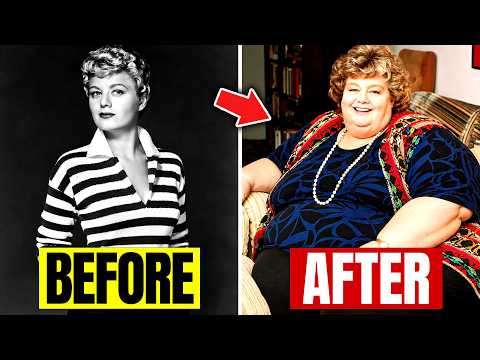
Hollywood was built on beauty, but it was sustained by illusion. When the illusion cracked, the industry turned its back. Leading men like Robert Taylor and Glenn Ford watched roles evaporate as their waistlines expanded. Dean Martin’s effortless cool became a lumbering swagger. And Peter Lorre, once a gaunt, terrifying presence in M, became a swollen shadow of himself, his body ravaged by morphine and a thyroid condition.
But not everyone crumbled under the weight of time. Shelley Winters turned her 200-pound frame into an Oscar-winning second act. “I’m not overweight. I’m just undertall,” she quipped to Johnny Carson, proving that talent could outshine any scale. And Elizabeth Taylor, mocked relentlessly by the tabloids, built a billion-dollar perfume empire, silencing critics with cold, hard cash.
Yet the most tragic story belongs to the one who changed acting forever. Marlon Brando arrived on the set of Apocalypse Now weighing nearly 300 pounds, forcing director Francis Ford Coppola to shoot him in shadows and close-ups. By the 1990s, Brando was over 350 pounds, a recluse on Mulholland Drive, eating compulsively, hiding from a world that had once worshipped his body. Friends described a man filling a void that couldn’t be filled—a void carved by personal tragedies too painful to name.
“He refused to apologize for it,” one friend recalled. “He refused to diet for roles. He just… retreated.”
When Brando died in 2004, the world mourned the loss of a genius, but few could reconcile the image of the bloated man in a muumuu with the lean, magnetic rebel who had dared the world to look away. They were the same person. That was the part nobody could accept.
The Golden Age sold physical perfection as surely as it sold tickets. But the bodies behind the image were human—and the gap between the fantasy and the reality eventually showed, no matter how good the lighting was. What happened to these stars wasn’t just a cautionary tale about weight. It was a mirror held up to an industry that devoured its own, then discarded them when they no longer fit the frame.
And that mirror didn’t stop reflecting when the studio lights went out. It followed these stars into their final years, into the talk-show couches and the comeback attempts and the quiet rooms where the phone stopped ringing.
Consider Bing Crosby, the crooner who once looked like he’d never worried about anything in his life. By the 1970s, his face had filled out, his midsection had widened, and the casual elegance of his younger years had quietly vanished. He never addressed it publicly. He just kept singing and hoped nobody looked too closely. Compare a photograph from Road to Morocco in 1942 to his final Christmas special in 1977, and the transformation is startling—a reminder that even the most effortless-seeming stars were aging in plain sight.
Then there was Burt Lancaster, the circus acrobat whose body had been as much a part of his performances as his face. In From Here to Eternity, he rolled in the surf with Deborah Kerr in the most famous kiss in movie history, looking like he could have competed in the Olympics. By Field of Dreams in 1989, a year before the stroke that ended his career, the acrobat’s body was gone—replaced by something that looked more like a retired lineman. Lancaster never pretended the change didn’t happen. He kept acting, kept commanding scenes, and let the performances speak louder than the waistline.
Some stars met the change with defiance. Robert Mitchum, when asked about his ballooning frame in the 1980s, reportedly said he’d earned every pound. “I’ve got two acting styles,” he once told an interviewer. “With or without a horse.” He wasn’t about to start counting calories in his seventies. He died in 1997, roughly sixty pounds heavier than the man who’d stalked his way through Out of the Past, and never treated the weight gain as a scandal worth discussing.
But behind the humor and the defiance, there were quieter tragedies. Rod Steiger, the Oscar winner for In the Heat of the Night, battled a depression he called a black dog that followed him everywhere. The medication and the immobility took their toll, and the weight climbed. When the depression lifted, the weight stayed. He spent his final years fighting two battles at once—one with his mind, one with his body—and losing both. He died in 2002 at seventy-seven, a lean method actor from the 1950s buried under decades of struggle.
Raymond Burr, the beloved Perry Mason, grew progressively larger across four decades of television. The production worked around his size with careful framing and strategic wardrobe, but there was only so much the camera could hide. He died in 1993 from liver cancer, private about his health to the end. And Mickey Rooney, just five foot two, saw every pound turn into a visible transformation. At that height, thirty extra pounds read like fifty. Photographs of the young Andy Hardy next to the elderly Rooney looked like two completely different human beings.
What united these stories wasn’t just the weight. It was the silence that surrounded it—the industry’s polite refusal to acknowledge what audiences could see with their own eyes. Studios framed these stars from the shoulders up, put them in chairs, cast them for name recognition rather than physical presence. The Golden Age had sold bodies as carefully as it sold stories, and when those bodies changed, the machine simply adjusted the camera angle.
The machine adjusted the camera angle, but it never adjusted its expectations. And for the women on this list, the scrutiny was sharper, crueler, and far more public. Betty Grable’s legs had been insured by Lloyd’s of London for a million dollars—the most requested photograph in the United States military during World War II. By the early 1960s, the pin-up queen carried considerably more weight than the image on every barracks wall. She handled it with humor, once joking that the legs were still insured even if nobody wanted to photograph them anymore. She died of lung cancer in 1973 at fifty-six, the most famous pair of legs in America having carried a very different body by the end.
Tony Curtis, once so beautiful he was convincing as a woman in Some Like It Hot, described aging in Hollywood as watching yourself disappear in slow motion. The chiseled face softened, the body that had driven audiences wild in the 1950s vanished, and he redirected his grief onto canvas, producing abstract paintings that were the opposite of the careful image management that had defined his career. When he appeared publicly alongside his daughter Jamie Lee Curtis in his later years, the contrast was jarring enough to make it hard to believe they shared the same bloodline, let alone the same face.
And then there was Victor Mature, the biblical strongman who played Samson and gladiators, who retired into a life of golf and poolside lounging and gained enormous amounts of weight with cheerful indifference. When asked about his physique late in life, he reportedly shrugged and said acting had never been that important to him to begin with. He died in 1999 at eighty-six, having spent his final three decades looking nothing like the man who’d thrown chariots across the screen.
But the story that haunts the Golden Age more than any other is the one that unfolded in plain sight, on magazine covers and late-night monologues, in a body that the whole world felt entitled to judge. Elizabeth Taylor was, by common consensus, the most beautiful woman in the world for the better part of two decades. The violet eyes, the perfect bone structure, the body that launched a thousand tabloid covers. Then the tabloids turned on her. Starting in the late 1970s, her weight became the most covered story in celebrity journalism—every pound photographed, cataloged, and printed with headlines designed to humiliate.
No actress in Hollywood history had her body scrutinized as publicly or as cruelly. She lost weight, gained it back, lost it again. She checked into the Betty Ford Center in the mid-1980s, initially for substance abuse, and the stay also addressed her weight. She emerged slimmer and launched a perfume empire—Passion in 1987, White Diamonds in 1991. White Diamonds alone generated over a billion dollars in sales across three decades. The woman the tabloids mocked for gaining weight made more money from a perfume bottle than most of her critics would see in a lifetime.
She never pretended it didn’t bother her. But she also never let it define her. She married eight times, raised millions for AIDS research through amfAR and her own foundation, and remained a global icon well into her seventies. When she died in 2011 at seventy-nine, the same tabloids that had spent decades mocking her scrambled to write tributes calling her the greatest beauty of the twentieth century. They were right. They just couldn’t bring themselves to say it while she was alive and didn’t fit the image they wanted her to maintain.
Orson Welles, meanwhile, had become a different kind of spectacle entirely. The boy wonder who directed Citizen Kane at twenty-five—lean, sharp-featured, blazing with intensity—reportedly weighed over 350 pounds at his heaviest. He never stopped working. He directed, he acted, he narrated, and he did wine commercials that became more famous than some of his later films. A blooper reel of Welles slurring his way through Paul Masson spots became one of the most passed-around VHS tapes in Hollywood. The man who’d been called the greatest creative mind in cinema was now best known for selling cheap wine while barely fitting in the chair.
Yet he kept directing. He poured his own money into projects the studios wouldn’t touch, taking any acting job that paid so he could keep chasing the films no one else believed in. He died in 1985 at seventy, found at his desk with a typewriter in his lap, still working on a script. The boy wonder who made a film about a man destroyed by his own appetites had become that man. The weight was just the most visible part of something far bigger.
That was the pattern, wasn’t it? Broderick Crawford, an Oscar winner for All the King’s Men, drank and ate his way into a body so enormous that younger audiences couldn’t believe he’d ever been anything else. He spent his final decade in a chair, framed from the shoulders up. Dean Martin let his effortless cool thicken into something closer to a lumber, and never seemed to care. Clark Gable, the king himself, died of a heart attack days after finishing The Misfits, his body finally betraying him after a lifetime of smoking and drinking.
Hollywood sold perfection, but it never promised permanence. The same camera that made these stars immortal also recorded every inch they gained, every role they lost, every year they couldn’t outrun. Some fought back. Some surrendered. Some, like Shelley Winters, turned the wreckage into a second act nobody saw coming.
And that’s the part worth remembering. The Golden Age didn’t end when the bodies changed. It ended when the industry decided those bodies were no longer worth lighting. But the people inside them kept living, kept working, kept refusing to disappear quietly. What does it say about us that we only mourned them once the frame went dark?
Report this article
Select a reason for reporting:






