The air raid sirens wailed twice a night, at 8:00 and again at 11:00, their shrill cry slicing through the bitter Berlin winter. By the end of January 1945, the capital of the Third Reich was a city on the edge of madness—a place where fear had become a constant companion, and hope was a luxury no one could afford.
Refugees pouring in from the east brought stories that turned the blood to ice: mass rapes, summary executions, entire villages put to the torch. The Red Army was advancing relentlessly, and the Eastern Front was collapsing. Panic spread like wildfire, and even the most loyal Nazis began to whisper doubts. “The Soviets will only execute officers and SS men,” soldiers told themselves, clinging to a desperate hope. But deep down, everyone knew the truth: no one was safe.
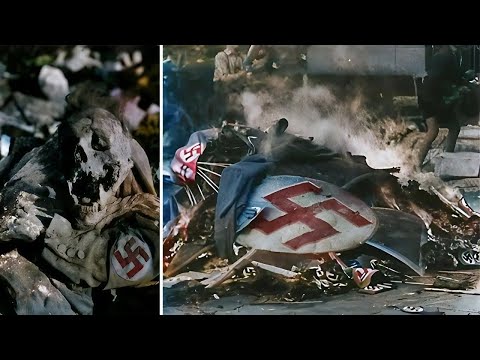
In this atmosphere of impending doom, Berliners found unlikely sources of information. Railway workers, better informed than the high command itself, spread rumors of enemy movements. More and more citizens risked their lives to listen to BBC broadcasts, knowing that a single report to the Gestapo could send them to a concentration camp. The Propaganda Ministry, under Joseph Goebbels, continued to churn out its relentless optimism—“We will win because we must win”—but for many, the slogan only deepened their despair.
Goebbels himself seemed to thrive on the chaos. He appeared at public events, inspected Volkssturm ranks, and delivered fiery speeches, reinforcing his image as the active leader while Hitler remained a distant, almost ghostly figure. The Führer’s last radio address on January 30th, commemorating the 12th anniversary of the Nazi regime, left listeners cold. His voice, once so commanding, now sounded muted and unrecognizable. Rumors swirled that he was dead or captured, and the regime never clarified his whereabouts.
For those desperate to flee Berlin, escape was fraught with danger. Goebbels had warned that leaving without authorization would be treated as treason. Only those with a safe conduct pass—granted solely for essential work outside the city—could leave legally. Even then, colleagues whispered, “Don’t come back. Stay where you’re going.” Most people fantasized about finding refuge in some remote village where farms still had food. Others considered false documents, making foreign diplomats unexpectedly popular.
But the most feared threat was the wave of executions ordered by Heinrich Himmler and carried out by the SS. On January 23rd, as Soviet forces crossed the eastern borders of the Reich, several opponents involved in the July 20th plot were executed at Plötzensee. Among them were Count Helmuth James von Moltke, Johannes Popitz, and Erwin Planck, son of the famous physicist Max Planck. The message was clear: dissent would not be tolerated.
In places like Breslau, the tragedy reached unbearable levels. With the Red Army’s tanks approaching, the city plunged into panic. Men not yet enlisted were mobilized into the Volkssturm, leaving their families behind. Mothers, driven by desperation, fled on foot with their children in their arms, carrying backpacks with powdered milk, blankets, and thermoses. But the reality was devastating. Hardly any vehicles were running, and most had to walk along snow-covered roads. Exhausted, they abandoned baby carriages and carried their children directly, the freezing wind turning the milk in their thermoses into icy liquid. Many suffered frostbite on their breasts as they tried to breastfeed in sheds or behind walls. A young mother wrote to her own mother: “My child died of hypothermia. Other women wept while holding the lifeless bodies of their babies.”
Along the roads were silent figures—mothers sitting in the snow with small children around them, trembling, not knowing whether their mother was still alive or had died from exhaustion and cold. In such extreme conditions, the difference between fainting and dying became imperceptible. This was no evacuation. It was the beginning of a calvary.
As the Red Army advanced, the fury of revenge swept away everything in its path. From Königsberg to Vienna, Soviet troops advanced, intoxicated by a mixture of victory, revenge, and hatred. For millions of Soviet soldiers, this was a campaign of personal justice—a retaliation for the razed villages, murdered brothers, and burned cities. But that justice soon turned into indiscriminate cruelty. Mass rapes were not limited to Berlin; they occurred in nearly every German city and village occupied by the Soviets. In Silesia, Pomerania, and East Prussia, atrocities were recorded that today are barely mentioned in school textbooks. In many villages, not a single woman remained unviolated. Collective rape became a symbolic and systematic punishment, acknowledged even by high-ranking Soviet commanders, yet allowed by Moscow. Stalin’s conquest had to be imprinted on the bodies of its citizens.
But it wasn’t only women who suffered. German civilian men, the elderly, and teenagers were summarily executed without trial or deported eastward to forced labor camps. Children were killed alongside their parents or left orphaned, abandoned in orphanages without identity or homeland. Families were dissolved between columns of smoke and columns of soldiers.
In East Prussia, hell took the form of an exodus. Coastal cities like Pillau and Danzig filled with refugees trying to board ships heading west, fleeing the Red Army. But many did not succeed. Trains were bombed, ships were sunk, roads were blocked by ice or corpses. Some froze to death; others were shot by Soviet soldiers. Those who survived did so with mutilated souls.
In the West, the Allied occupation was different, though not free from violence. American, British, and French forces found a country in ruins, and while treatment was less brutal than in the east, revenge was not absent. Internment camps were established for Germans accused of collaboration or mere Nazi sympathy. In many cases, without trial or evidence, they were denied food, medical assistance, and human dignity. One of the darkest episodes was that of the Rheinwiesenlager camps, which we will discuss later.
In France, the situation was even more humiliating for some Germans. Colonial troops from sub-Saharan Africa, integrated into the French army, were deliberately deployed in German areas to punish the population. Numerous testimonies describe rapes, looting, and abuse. In Stuttgart and other cities, hundreds of women were attacked, and French authorities rarely intervened. The Allied doctrine assumed that the German people had to be re-educated from scratch, which included press censorship, school indoctrination, and the removal of symbols. But it also meant collective humiliation. German children were forced to watch films about the concentration camps. Entire populations were forced to bury the corpses of Holocaust victims. All of this was aimed at instilling a perpetual sense of guilt.
But the line between justice and revenge is fragile. In many towns in southern Germany, American soldiers organized forced parades of civilians past mass graves. In others, they placed signs that read, “Here died the true Germans.” The psychology of the defeated was not rebuilt; it was demolished. Women who had been raped found no understanding. They were stigmatized, called collaborators, or simply ignored by their neighbors. Many fell into silence, unable to verbalize the trauma. Men who returned from the front or from the camps found neither home nor honor. They were ghosts in a country in ruins.
And yet the machinery of revenge did not stop. Beyond the decisions of governments, rage was embedded in the hearts of the peoples. The postwar violence was the dark echo of Nazi violence, a repetition without redemption. Across the continent, Germans were now the universal enemy—even those who had been persecuted by the Nazis, even the children born in 1945. The notion of justice became confused with that of collective punishment. What began as liberation ended for many as a perpetual condemnation.
This is the story of a forgotten chapter of World War II—a chapter where the victors wrote the history, and the defeated were left to bury their dead in silence. It is a story that begins in the frozen streets of Berlin and ends in the mass graves of East Prussia, a story of suffering that the world has chosen to forget.
Along the Rhine River, between April and September 1945, the Western Allies—primarily under American command—established a network of internment camps known as the Rheinwiesenlager, or Rhine Meadow camps. More than one million unarmed German soldiers were gathered in these improvised enclosures: young recruits, elderly men mobilized in the final stages of the conflict, and simple auxiliaries. The term used by Allied authorities to classify them was deliberately ambiguous—Disarmed Enemy Forces—a category that excluded them from the protection granted by the Geneva Convention to prisoners of war.
Without that legal protection, the prisoners became non-persons. The camps were nothing more than open fields enclosed with barbed wire. There were no barracks, no latrines, no kitchens. There was no shelter from the rain or sun. In some camps such as Remagen, Sinzig, Andernach, or Bad Kreuznach, up to 200,000 men were crammed together in inhuman conditions. Food rations were scarce—sometimes a single piece of bread had to be shared among four or five people. The water, when available, came from contaminated rivers. The sick died without medical attention. Bodies were thrown into mass graves dug by the prisoners themselves.
Many tried to survive by digging holes in the ground to shelter from the cold or the rain. Diarrhea, typhus, and malnutrition wreaked havoc. The International Red Cross was denied access to these camps for months, and German humanitarian organizations were banned. Information was censored, cameras were forbidden. The world was to believe that the war had ended and that justice prevailed.
The exact number of deaths remains a subject of debate. Official American sources acknowledged more than 3,000 documented deaths, but later investigations, such as those by Canadian journalist James Bacque, estimated that between 50,000 and 90,000 prisoners may have died in these camps due to deliberately negligent conditions. In his controversial book Other Losses, Bacque accused General Dwight D. Eisenhower of having designed a systematic policy of slow extermination through starvation and exposure. Although many historians have questioned Bacque’s exact numbers, few deny the scale of the suffering.
American war correspondent Marguerite Higgins, after visiting the Andernach camp, wrote: “I saw young men with sunken eyes covered in mud, too weak to stand. They crawled like animals without hope. One of them was only 15 years old. He had lost 20 kilos in 3 weeks.” In the Andernach camp, a young German woman named Erica, who lived near the perimeter, reported that village women tried to throw bread over the fences, only to see American guards stomp on it or throw it back with insults. According to her testimony, “They were not Nazis. They were not criminals. They were our brothers, our fathers, our sons. They were treated like vermin.”
German women who tried to help the prisoners were sometimes arrested for collaboration with the enemy. No one was to show compassion for the defeated. Collective punishment was part of the new moral order. In some cases, even African-American soldiers designated as guards were ordered to treat the prisoners especially harshly. The symbolism was no accident—it was about inverting the racial narrative of Nazism, even at the cost of new humiliations.
When the camps were finally dismantled at the end of 1945, the survivors emerged as specters. Many returned to towns already destroyed or emptied, to families dead or missing. Some never spoke again of what they had lived through. Others died in the years that followed, unable to rebuild a life on the foundations of hatred and humiliation. Silence was the final shroud.
In the official history of World War II, the Rheinwiesenlager occupy a footnote. The victorious narrative prefers to remember the crimes of Nazism, but not the punishments without trial suffered by the defeated. Documents about these camps remained classified for decades. Only over time did they begin to surface, brought to light by independent historians and testimonies rescued from oblivion.
The year 1945 did not only mark the end of the war—it also marked the end of a millennia-old history: that of the Germans settled in Eastern Europe, in territories such as East Prussia, Silesia, the Sudetenland, and regions of Poland, Czechoslovakia, Hungary, Romania, and the Balkans. A presence that in some cases dated back to the Holy Roman Empire vanished almost overnight, erased by revenge, politics, and chaos.
Between 12 and 14 million ethnic Germans—known as Volksdeutsche, or simply the displaced—were expelled from their homes between 1945 and 1950. The process was not an orderly evacuation, much less a voluntary migration. It was a covert ethnic cleansing justified under the logic of collective punishment. The order was not improvised; it was discussed at Yalta and formalized at the Potsdam Conference, where the victorious powers agreed on what was supposed to be the orderly and humane transfer of German populations outside the new borders of Poland, Czechoslovakia, and other neighboring countries. But nothing was orderly, and certainly nothing was humane.
In East Prussia, the winter of 1944–45 became an apocalyptic exodus. Millions fled the Red Army through ice, snow, and fire. Wagon caravans were easy targets for Soviet planes. Refugee columns of women, the elderly, and children marched between corpses—some frozen standing like tragic statues along the road. A young refugee wrote: “We walked over bodies. Some children cried from hunger. Others didn’t cry anymore. They had surrendered to the silence of death.”
The sea became a tomb for a wandering nation. On January 30, 1945, the Wilhelm Gustloff—overloaded with over 10,000 refugees—was torpedoed by a Soviet submarine. It sank in less than 50 minutes. Over 9,000 died. Other ships, the Goya and Steuben, met the same fate. Bodies washed ashore for months, clutching frozen dolls or embracing dead siblings.
After the war, expulsions intensified. Germans were torn from their homes, locked in transit camps, and loaded onto trains no different from Nazi extermination transports. In Czechoslovakia, the Beneš decrees legalized total dispossession. In Yugoslavia, tens of thousands died in camps like Gakowo. Between 500,000 and 2 million perished. Entire villages disappeared. Centuries-old churches were closed. Unique dialects were forgotten.
In postwar Germany, the displaced became known as Heimatvertriebene—the banished from their homeland. For years, their tragedy was taboo. Only decades later did Germany begin to acknowledge their suffering. Monuments were erected, but memory came too late. Many had already died.
And yet, from the rubble, something stirred. The Trümmerfrauen—the women of the ruins—cleared the debris stone by stone. They rebuilt a nation with their bare hands, in silence, without applause or statues. Their greatest monument is the country they helped raise from ashes.
But the scars remain. In the neighborhoods where women once cleared rubble, there are now cafés and galleries. In the squares where monuments were erased, there are memorial plaques. And in the minds of its citizens, identity remains a puzzle—built stone by stone from trauma.
Because one can still visit the concentration camps where the greatest genocide in human history was carried out. But we must also recognize that innocence paid for the guilty—and that memory must include all victims, not just those the powerful wish to highlight.
Was the suffering of millions of German civilians after 1945 a just punishment for Nazi crimes, or a forgotten tragedy that history has chosen to silence?
Report this article
Select a reason for reporting:






