There is a place in the cockpit of a Mitsubishi Zero that no one in Japan wanted to talk about. It sits directly behind the pilot’s head. In the spring of 1942, that cockpit was the best seat in the Pacific. The Zero could out-turn anything the Allies had, fly farther than any single-engine fighter on Earth, and Allied commanders repeated the same warning in their tactical bulletins: Do not dogfight it. If you try to maneuver, you die.
And yet, behind that pilot’s head, there is no steel. No plate, no armor, not even an inch. The fuel tanks packed into the wings and belly lack any rubber lining—nothing to seal a bullet hole before the fuel finds a spark. The most elegant fighter ever built is also one of the most flammable machines ever sent into combat.
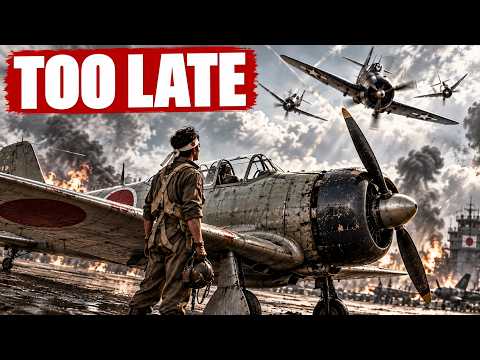
This was no oversight. It was no shortage of resources. A quiet young engineer in Nagoya made that decision on purpose, with his pen on the drafting board, years before the war reached Pearl Harbor. He knew exactly what he was giving up. What he could not know was how many young men would be strapped into that seat when the bill came due.
Climb into the Zero and the first thing you notice is how small it is. The cockpit fits a man the way a shoe fits a foot. Your shoulders touch the sides, your knees sit high, and the control stick rises between them—slender, delicate, moving with a lightness no American pilot who ever flew it could quite believe. Touch it and the plane responds instantly. Not a moment later. Instantly.
Veteran Japanese pilots describe the feeling exactly as their enemies later did: less like flying the plane and more like wearing it. Look forward through the glass and you see the cowling, the blur of the propeller, the two small cannon barrels set in the wings. Look left and right and you see the wings themselves—long, slim, impossibly clean, almost nothing protruding. Now turn your head and look behind you.
There is a headrest. There is a frame. There is air. Behind that, a fuel tank. Behind that, another. The self-sealing rubber tanks that were standard in almost every Allied fighter ever built are simply not there. The fuel sits in thin metal containers wrapped around the pilot, and when a bullet punches through, the fuel pours out and keeps pouring until it finds something to burn.
In the spring of 1942, none of that mattered, because in the spring of 1942, almost nothing could touch this machine. To understand how that plane came to exist, you have to go back to 1937 and a specification document most engineers in Japan considered an absurd joke.
The Imperial Japanese Navy wanted a new carrier fighter, and it wanted everything. It wanted range to escort bombers across distances no fighter in the world had ever escorted. It wanted maneuverability tight enough to out-turn any existing enemy plane. It wanted real speed above 300 miles per hour. It wanted heavy cannon armament, not just machine guns. It wanted the whole aircraft to fold to fit a carrier elevator. And it wanted all of that from an engine that was, by any honest measure, mediocre.
Japanese aircraft engines of that era lagged far behind the West. The Navy was demanding a fighter that would outperform the world while handing its designer an engine that did not outperform anything. Nakajima, one of Japan’s two great aircraft companies, studied the requirements, ran the numbers, and concluded the plane the Navy described could not be built. Nakajima withdrew from the competition.
That left Mitsubishi alone. And at Mitsubishi, it left the problem to a 34-year-old chief designer named Jiro Horikoshi. Horikoshi was not a warrior. He was a small, sickly, intensely withdrawn man who had studied aeronautical engineering at Tokyo Imperial University and thought about aircraft the way some people think about music. He had toured aircraft factories in Germany and the United States as a young engineer and come home with a very clear sense of how far behind his country was.
He did not believe Japan could out-produce America. He believed Japan might out-design it in one narrow field. He looked at the impossible specification and saw the same numbers Nakajima had seen. Then he saw the one door Nakajima had walked past without turning its head.
If the engine could not be made much stronger, the aircraft would have to be made impossibly light.
What followed was not ordinary engineering. It was closer to obsession. Horikoshi and his team hunted excess weight the way a surgeon hunts infection. They obtained a new aluminum alloy from Sumitomo—a super duralumin that was lighter and stronger than anything the Allies were using. They built the main wing spar from it. The alloy had a certain stiffness. It was brittle. It corroded. It had to be coated and handled with care. They used it anyway.
They designed the wing as one continuous structure running straight through the center of the fuselage, eliminating the heavy joints where a conventional wing is bolted to the airframe. That saved weight. It also meant the aircraft could never be broken down into simple sections. In a clean factory that was wonderful. In a repair shed in the middle of a jungle later in the war, it would be a curse.
They drilled holes everywhere—in the ribs, the frames, the struts, the fittings, anywhere there was metal that was not doing an essential job. Every part was examined and asked to justify its own mass. Fasteners were counted. Structures were shaved until the calculations said they were on the verge of failure, then left that way.
Then Horikoshi made the two decisions that would define everything that followed, and everything you are about to hear. He deleted the armor plate that would have protected the pilot. He deleted the self-sealing lining for the fuel tanks. That double deletion saved hundreds of pounds—hundreds of pounds in an aircraft that weighed under 4,000 pounds empty.
And that saved weight did not evaporate. It went straight into the two qualities the Navy had demanded most fiercely. It went into range. It went into maneuverability. The result was a wing loading so low it seemed to belong to a glider. At combat speeds, it could turn tighter than any other fighter in the sky. With a drop tank slung beneath its belly, it could fly farther than any single-engine fighter then in existence anywhere on Earth.
On paper, it was a masterpiece. In the air, it was more than that. It was a masterpiece that worked. But remember what had been sacrificed to get it.
The armor plate and self-sealing tanks were not luxuries. They were not comfort items. They were the difference between a pilot surviving a burst of fire and a pilot burning alive in his seat. Horikoshi had designed a plane to win the fight before it was ever hit, and it offered nothing to protect the man inside on the day someone succeeded in hitting it.
For a while, that bargain looked like pure genius. The Zero scored its first kills over China. On September 13, 1940, a formation of Zeros escorting bombers over Chongqing met Chinese fighters and tore them apart. Over the Chinese campaign that followed, Japanese pilots claimed nearly 100 enemy aircraft destroyed with almost no losses in air combat. Those are claims, not independently confirmed kills, and wartime claims are always inflated. But the shock was real. Chinese pilots who survived those encounters reported a fighter that could do what fighters were not supposed to do.
Then came December 7, 1941, and the Zero appeared on a far larger stage. It swept over Pearl Harbor. It swept over the Philippines, running escort missions across distances American commanders had thought physically impossible for a fighter, which is exactly why so many aircraft were caught on the ground when it arrived. It swept over Malaya, the Dutch East Indies, Java, helping to destroy Allied air power so thoroughly that entire squadrons simply vanished.
For roughly the first six months of the Pacific War, the Zero was nearly invincible. And around it grew a legend. Allied pilots began to talk as if the Japanese had cracked the code of air combat, as if this small fighter with the red circles on its wings could not be beaten by anything.
The men flying it were exceptional, too. Pre-war Japanese Navy pilots came out of a training program so brutal it eliminated the vast majority of candidates before they ever reached an operational unit. Many of the survivors had already fought in China. They were, at that moment, among the best fighter pilots in the world, and they knew it.
By 1942, Allied commands were rushing uniform instructions to every squadron that might face it. The instructions were not complicated, and they did not need to be. Never get into a close-in dogfight with a Zero. Do not try to out-turn it under any circumstances. If it gets behind you and you try to turn with it, you are already dead.
And yet, even at the height of its dominance, flying the Zero carried a quiet dread. Not of the enemy, but of something built into the plane’s greatest strength.
That magnificent range meant astonishingly long missions—hundreds of miles over open ocean and hundreds more to get back. Six hours in a cramped seat, sometimes eight, alone, with no autopilot, no radar, and radios so unreliable many pilots stopped trusting them. Navigating over featureless water meant relying on a compass, a watch, and dead reckoning—a polite term for educated guessing.
A pilot might arrive over the target with fuel for a few minutes of combat, fight for his life, then face the long flight home on what remained. Many Zeros never returned from missions on which they were not even hit once. Their tanks ran dry. They missed the heading to a small carrier in a vast ocean. They flew the wrong direction for four hours and found only water in every direction.
The plane’s wonderful range was, for the man in the seat, a slow and exhausting form of danger. And beneath all of it was always the knowledge of what was around him and what was not.
There is a detail here that is constantly misreported, and the truth is stranger than the myth. Japanese naval pilots were issued parachutes. The parachutes existed, but many pilots left them behind or sat on them without strapping in, because the harnesses were bulky in an already tiny cockpit, because the straps restricted movement, and because there was a widespread, deeply held feeling that bailing out over enemy territory meant capture, and capture meant shame.
So here is the picture. A plane built with nothing behind the pilot to stop a bullet, fuel tanks that leaked and burned, and a man who in many cases chose not to wear the one thing that might save him. Every Allied pilot who survived an encounter with a Zero and made it back to base said something similar in his report. It was extremely hard to get into your gunsights. But once you did—once you put rounds into it—it came apart or caught fire almost immediately.
Sooner or later, the enemy was going to figure out exactly how to do that. They were closer than anyone in Japan imagined.
The first crack in the Zero did not come from a laboratory. It did not come from a captured aircraft or a piece of clever technology. It came from a naval officer sitting alone at his kitchen table at night, running calculations he did not like the answer to. His name was John Smith Thach, and everyone called him Jimmy.
Born in Pine Bluff, Arkansas, in 1905, which made him thirty-seven years old in the summer of 1942. Thirty-seven. That is an advanced age for a fighter pilot. He had flown nearly everything the Navy owned. He had a reputation as a gunnery expert, a man who thought about shooting the way an accountant thinks about columns, and he had a habit that made him unusual among fighter pilots. He took intelligence reports seriously.
In late 1941, before the war reached America, a report crossed his desk describing a new Japanese carrier fighter. The numbers in it were so good that many officers dismissed them as exaggeration or propaganda. Thach did not dismiss them. He assumed they were true, and then he sat down and worked out what that would mean if they were.
It meant that his own plane, the Grumman Wildcat, could not win. The Wildcat was tougher, a better gun platform, but it was slower to climb and could not maneuver the way the report described. In a traditional fight, one on one, turning circle against turning circle, the Wildcat pilot loses. Not sometimes. Every time.
According to his own account, Thach worked the problem at home in the evenings, placing small objects on the table to represent aircraft, moving them around until he found a solution. And what he found was not a better plane. It was a better arrangement of two ordinary ones.
The idea was simple to the point of being insulting. Two Wildcats fly side by side, with a wide gap between them. The moment an enemy fighter latches onto one of them, that pilot turns hard toward his wingman. The wingman turns hard toward him. The two planes cross. And now the pursuing fighter, which was locked onto the tail of the first Wildcat, is flying straight into the guns of the second.
It gave up everything a fighter pilot is taught to want. It gave up the turning fight. It gave up the initiative. It required a man under fire to fly predictably toward his friend instead of doing what his instincts screamed at him to do. It required absolute trust between two pilots who might be seconds from death. And it worked.
On June 4, 1942, over the empty water near Midway, Thach led a handful of Wildcats from the Yorktown into a swarm of Zeros that outnumbered them badly. He and his men wove the interlocking maneuver, and the Zeros—six months undefeated—slid into gunfire they never saw coming and fell into the sea.
Here is the part almost every telling of this story gets wrong. The antidote to the Zero was invented before the Americans knew anything about its insides. No one had taken one apart. No one had flown one. The tactic that began to break the spell came from a report, a kitchen table, and a middle-aged officer willing to believe bad news. It was not technology that first beat the Zero. It was discipline.
Understand what that asked of the men who flew it. The weave only works if the hunted man keeps his nerve—a Zero closing behind him, guns flashing, every cell screaming at him to dive away, which is exactly what would kill him. Instead he must turn steady and clear toward a friend he can see over his left shoulder, hold it, and count, trusting the other man is doing the same.
But technology was coming, and it arrived in the strangest way imaginable on that very same day. Two thousand miles north of Midway, in the gray cold of the Aleutians, the Japanese ran a separate operation against Dutch Harbor. Among the aircraft launched from the carrier Ryujo on June 4 was a Zero flown by a petty officer named Tadayoshi Koga. He was nineteen years old.
Think about that for a moment. Nineteen. By American reckoning, a kid who would have graduated high school the year before, flying one of the most advanced fighters in the world over the North Pacific in weather that kills experienced men regularly. During the attack, something struck his plane—most likely a single rifle-caliber bullet from the ground, hitting an oil line. That was all. One bullet in one line, in a plane with no armor at all.
Oil began streaming back over the fuselage, and Koga watched his engine temperature climb toward the point of seizure. He had a decision to make, and the Japanese had a standing order for it. A pilot who could not return was supposed to destroy his aircraft rather than let it fall into enemy hands. Some pilots did exactly that, steering their machines into the sea or a hillside on purpose.
Koga looked down and saw what appeared to be a flat green field on Akutan Island. He decided to land, survive, and wait for a submarine to retrieve him—the arrangement the Navy had made for exactly this situation. The field was not a field. It was marshland, soft and saturated and spongy, looking from the air like solid pasture but turning to wet clay the moment anything touched it.
He came down with his landing gear extended, which is what you do on a runway but precisely what you must never do on soft ground. The main wheels dug in. The tail rose. The plane flipped completely onto its back in an instant, and the nineteen-year-old boy was killed in the cockpit instantly.
The Zero settled upside down in the mud. Its wings were intact. Its fuselage was intact. Its engine was intact. It did not burn. For five weeks it lay there under the Aleutian rain while the war burned elsewhere. It is worth imagining, because it is one of the strangest images of the entire Pacific War. One of the most secret aircraft in the world, lying on its back in a marsh on an island inhabited only by birds and weather.
The submarine that was supposed to come for its pilot found nothing to take. Wind blew off the water and moved the grass around the wingtips. Rain filled the cockpit and ran out again. The red circles on the wings faded slightly. No one in Japan knew where it was. No one in America knew it existed.
On July 10, 1942, a U.S. Navy patrol plane was flying a routine track over Akutan when the clouds parted for a moment. A crewman looked down and saw something upside down on the ground with a red circle on it. What happened next was one of the great intelligence windfalls of the Pacific air war.
A recovery team went in and pulled the plane out of the marsh. It was crated, shipped to the Naval Air Station in San Diego, and rebuilt. Damaged parts were repaired or replaced. The engine was restored. And on September 20, 1942, a Navy test pilot named Eddie Sanders climbed into the cockpit of a Japanese Zero on American soil and took off.
He flew it twenty-four times in twenty-five days. There is something almost eerie in the reports from those flights. American pilots who had spent a year hearing about this machine as a kind of ghost story now had the chance to sit inside it, smell its unfamiliar cockpit, read gauges marked in a language they did not understand, and feel in their hands what their friends had been dying to.
And the reports came back loaded with genuine admiration. They said it was a delight to fly—light, honest, beautifully balanced. It did what you asked before you finished asking. Then they took it up alongside American fighters and flew it against them again and again until every advantage and every weakness had a number attached.
And the plane gave up every secret it had. The test results confirmed the legend on one side and shattered it on the other. Yes, it was superb at low and medium speed. Yes, it could out-turn anything the Americans had. Yes, its climb was magnificent.
But there were numbers on the other side of the ledger that no Japanese pilot had ever disclosed to his enemy. Above roughly 300 miles per hour, the Zero’s controls began to stiffen badly. The same lightness that made it charming at slow speed turned against it as air pressure built. Push it faster, and the stick that had felt like an extension of your arm began to feel like it was set in concrete.
Its roll rate at high speed was poor, and noticeably worse to the right than to the left. That is extremely precise information, and in the middle of a fight, it is worth more than almost anything else you could know about an enemy plane. It means there is a direction he cannot follow you in.
It could not keep up with a heavy American fighter in a dive. The Americans had known this generally. Now they knew exactly where the line was. And there was something else. A small mechanical detail with vicious consequences. The Zero’s engine used a float-type carburetor. If you pushed the nose down suddenly into negative gravity, the fuel flow cut out and the engine coughed. The American fighter, with a different fuel system, could simply push the stick forward and go.
A Zero pilot in pursuit had to roll first, then pull, which took time. In combat, time means distance, and distance means life. Put all of this together, and the Americans now had a recipe written in plain language, one that could be handed to a nineteen-year-old lieutenant fresh out of flight school.
Never get into a turning fight. Dive on it from above. Hit it in one fast pass and keep going. Drag it into a dive it cannot match. Roll away in the direction it cannot follow, and never fly alone. Deny the Zero the slow maneuvering fight it was built to win, and it loses the fight.
The greatest fighter in the Pacific was undone by a boy who misjudged a marsh for a field. And while that plane was being crated across the Pacific toward California, six thousand miles away, a Japanese pilot was about to prove with his own body exactly what those missing armor plates cost.
On August 7, 1942, U.S. Marines landed on an island in the Solomons that no one in America had heard of before that week—Guadalcanal. The Japanese response came from Rabaul, and Rabaul was more than 500 nautical miles away. That is a distance only the Zero could even attempt, which is why the Japanese believed they could contest the island.
But 500 nautical miles out means 500 nautical miles back, and it means arriving over the battlefield already exhausted with fuel gauges winding down for hours. Imagine what that mission actually felt like before a single shot was fired. You take off from a strip cut out of the jungle in heat already brutal at dawn. You climb and you sit. The cockpit glass becomes an oven at low altitude and a refrigerator at high altitude, and you experience both on the same flight.
Your legs go numb. Your back stiffens. There is nowhere to move. Below you is water and more water, and sometimes an island that looks like every other island. You watch the fuel gauge the whole way and run calculations in your head, and the calculations are never comforting.
By the time the target appears, you have been strapped into a small metal seat for nearly four hours. Your reaction time is not what it was on the runway. Your eyes are tired, and now you must fight the best pilots the United States can put in the air, with a fuel state that gives you minutes, not hours, before you must break off and begin the whole ordeal again on the way home.
Among the pilots who launched that morning was a man named Saburo Sakai. Sakai was twenty-five years old. He came from a family with samurai roots but fallen so far that his father’s death left them genuinely poor. He had failed entrance to a prestigious school and joined the Navy as an ordinary seaman, then worked his way into flight training through sheer stubbornness.
By the summer of 1942, he was one of the finest fighter pilots in the Imperial Japanese Navy, and he knew it, and it showed. He was also, like many of the best pilots, superstitious, high-strung, and utterly confident in his eyes. His eyesight was famous. He could spot aircraft at distances others could not, and he built his reputation on seeing first.
That morning, after hours of flying and fighting over the landing beaches, he spotted a formation of aircraft below and ahead of him. He identified them as enemy fighters. They were not fighters. They were Douglas SBD Dauntless dive bombers, U.S. Navy, and the Dauntless has something a fighter does not. It has a second crewman sitting behind the pilot, aiming machine guns backward.
Sakai approached them directly from the rear. It is the classic fighter approach, the killing position, the place every pilot dreams of. But against a formation of dive bombers with rear gunners, it is the worst place in the sky. The gunners saw him coming and fired all at once.
What a concentrated burst from multiple rear guns does to an unarmored plane is not complicated. The rounds punched through the windscreen and the gunsight. Metal and glass fragments buried themselves in his head. He lost one eye instantly and forever. The left side of his body stopped responding. The Zero flipped and began to fall.
He regained consciousness somewhere in the descent, his hand still on the stick, blood running into his good eye and freezing on his face in the cold air at that altitude. And he made the calculation every wounded pilot makes. He was half blind. He was partly paralyzed. He was more than 500 nautical miles from any friendly territory over open water, in a plane he could barely feel.
What followed was nearly five hours of flying. He flew mostly on instinct, because he could not read his instruments clearly and could not fully trust the hand that was supposed to be flying the plane. He fought to stay conscious, losing the fight and regaining it. He wiped blood from his face, and it came back. The cold at altitude was the only thing keeping him awake, so he stayed high, which cost him fuel he did not have.
More than once, by his own later account, he decided to end it. The simplest thing in the world was to push the nose down into the Pacific. No one would ever know. He was, for practical purposes, already gone. But he did not do it.
After hours, a strip of coastline appeared before his one good eye. He landed at Rabaul, and when they pulled him from the cockpit, there was so much dried blood inside the plane that the men on the ground thought they were recovering a corpse. He survived. He lost the sight in that eye for the rest of his life. And he came back to fly with one eye later in the war.
Now notice something in that story, because it is the whole argument of this video embodied in one man. A plate of steel behind that seat would not have changed the fragments that came through the windscreen, but it is the same design philosophy, the same pen, the same decision. There was nothing in that plane to protect him. There was nothing to absorb any shock. The machine’s only answer to danger was do not get hit, and on the day it got hit, the machine had nothing left to offer.
And the man who put him in that position was not a famous American fighter pilot. It was a young enlisted gunner sitting in the back of a bomber, doing his job, firing at a shape that came out of the sun. The best fighter pilots in the world were being killed by aircrew whose names no one would ever know.
That was 1942. The war was still, in most respects, Japan’s war. Then came 1943, and the Americans stopped fighting the war Japan had planned. Two aircraft in particular arrived—the Vought F4U Corsair with its huge bent wings, reaching the Solomons early in the year, and the Grumman F6F Hellcat, which entered combat that autumn and finished the war as the most successful carrier fighter in history.
They were everything the Zero was not. They were heavy. They were fast. They had engines producing nearly twice the power of the Zero’s, meaning they could climb or dive away, simply overpowering the fight instead of maneuvering through it. And they were protected. Armor plate behind the pilot, self-sealing fuel tanks, bullet-resistant glass. Everything Horikoshi had deleted from his drawings to save weight, the Americans put back and found the horsepower to carry.
The result was a matchup that went in only one direction. A Zero could put cannon shells into a Hellcat and watch it keep flying. A Hellcat could put a two-second burst of heavy machine-gun fire into a Zero and watch it come apart or turn into a fireball.
And now came the bill, paid in the only currency that truly mattered. Japan was not just losing aircraft. Aircraft can be built. Japan was losing the men who flew them, and losing them at a rate no training system on Earth could match.
Every time a Zero caught fire, the odds were very good that the man inside never got out. No armor to absorb the first hit. Fuel burning in a confined space. A canopy that had to be pulled back by hand while the plane was out of control. And in many cases, no parachute worn at all.
The pre-war pilots, the ones who had survived a training program that rejected almost everyone, who had fought their battles over China, the irreplaceable core of Japanese naval aviation, were shot out of the sky one by one at Midway, over Guadalcanal, and through the long grinding months in the Solomons, where the missions never stopped and the distances never got shorter.
Each one of them represented years of training and hundreds of flight hours that could not be replaced quickly. The Americans were losing men too. But behind the Americans was a training system producing pilots by the thousands in safe skies over Texas and Florida, with instructors pulled from combat specifically to pass on what they knew. Behind the Japanese was a system designed to produce a small number of elite, and it had never been asked to replace them all.
There is a story that gets repeated constantly about all this, and it needs correcting, because the truth is colder and more damning than the myth. The story goes that the Americans built the Hellcat after studying the Zero captured in the Aleutians. That they designed the Zero killer based on its secrets. That is not what happened.
The Hellcat had already been ordered and had flown its first flight in June 1942. Weeks before anyone found Koga’s Zero in the marsh. The captured Zero contributed to American tactics and training. But it did not create the plane that destroyed it. Which means the Americans never needed the Zero’s secrets to beat it. They only had to stop accepting its fight on its own terms.
The Zero was not entirely rigid. That is a myth too, and it is worth being fair about it. Mitsubishi improved it. The wings were clipped and squared off. The wing skin was thickened so the plane could dive harder safely. The exhaust was redesigned into individual stacks to extract a small extra thrust from the engine. The cannon were improved and the ammunition load increased. By 1943, the Model 52 was a far better fighter than the one that swept Pearl Harbor.
But it was fighting aircraft that had improved far more, far faster, from a much higher starting point. The Zero evolved in inches. Its enemies evolved in yards. And the one thing Mitsubishi could never fix was the handicap that had crippled the design from day one: the engine. Japan never produced the engine the airframe deserved, and without it, every improvement had to be paid for in weight the plane could not afford.
But by 1944, the plane was no longer the main problem. The main problem was that the men were gone. On June 19 and 20, 1944, the Japanese fleet made its greatest effort in the Philippine Sea. On paper, it was supposed to be a massive force. Nine carriers, hundreds of aircraft, and a plan that exploited the Zero’s famous range to strike the American fleet from farther away than the Americans could reply.
But the men who launched that morning were boys. The veterans were dead. All Japan had left were young men rushed through a training system hollowed out by fuel shortages and the loss of the instructors who were supposed to teach them. Many had a fraction of the flight hours their predecessors had enjoyed. Some had never landed on a moving carrier deck except in perfect conditions.
They were sent against an American fleet with radar directing every interception, fighter directors vectoring squadrons onto them from fifty miles away, proximity-fused anti-aircraft shells that did not need a direct hit, and Hellcats flown by pilots with 600 hours and a tactical manual written in blood in 1942.
It was not a battle. It was arithmetic. Imagine it from inside one of those cockpits. You are perhaps nineteen years old. You have flown fewer hours in your entire life than the man coming to kill you has flown this year alone. You have been in the air for hours already, and the formation you launched with is steadily shrinking as men keep dropping out of position and vanishing.
Then the horizon ahead fills with dark shapes that are already above you, turning in, and in the exact position your instructors would have warned you about if they were still alive. You do the only thing you know how to do. You turn hard, because everyone in Japan has been told for four years that maneuver is your way to survive. And the American does not turn with you. He does not even think about it.
He drops through your formation in one pass, fires for two seconds, and is below you before you finish the maneuver you were taught. And behind you the sky fills with burning aluminum, and there is nothing you can do about it. Then comes the next one. And there are hundreds of them.
Over those two days, the Japanese lost nearly 600 aircraft, about 400 of them from carriers and another 200 from land bases. The mobile fleet had begun the operation with roughly 430 carrier aircraft. When it ended, it had about 35 left. The Americans lost about 130 aircraft in total, and a large portion of those were not shot down at all. They got lost at night on the return flight, running out of fuel in the dark after a strike launched from very far away.
The American pilots, watching planes fall from the sky in numbers that no longer felt like combat, gave it a name that has stuck for 80 years: the Great Marianas Turkey Shoot. Some of them did not feel proud of what happened afterward. Many described a strange, sickening realization in the middle of the battle—that the men they were killing could not fly well, that their maneuvers were textbook and slow and wrong, that they were not fighting an air force but slaughtering a group of teenagers in obsolete planes.
Here is the cruelest part of the whole story. The fighter that had dominated the Pacific in 1942 was still, in 1944, capable of hurting the enemy if placed in the right hands. The problem was that there were almost no right hands left. Japan had spent its irreplaceable pilots defending a design philosophy that guaranteed those pilots would die whenever the design was wrong. The fighter had eaten the men who flew it. Then children had to fly it.
And then, finally, they fixed it. In September 1944, the first versions of a new model rolled off the production lines. It carried an 8mm steel plate behind the pilot’s seat. It carried a 55mm armored glass panel behind his headrest. It carried a self-sealing fuel tank mounted behind the cockpit. Item by item, the Imperial Japanese Navy was ordering back into the plane the very things its designer had deleted in 1937.
But nothing was added to the engine. So the plane simply became heavier. Its climb suffered. Its acceleration suffered. Its maneuverability suffered. It lost the one advantage that had ever made it exceptional. And the protection it gained was nowhere near enough to save a pilot from the guns of a Hellcat. They were right the second time. But they were seven years and an entire generation of pilots too late.
By then, the Navy had already found another use for the plane. On October 25, 1944, off the Philippines, the first organized special attack unit carried out its mission. The unit was called Shikishima. It was led by a young lieutenant named Yukio Seki, a recently married man and a distinguished pilot who, according to multiple accounts, did not volunteer eagerly, and said privately that Japan was finished if it had to use its best pilots this way.
The aircraft they flew were Zeros with a 250-kilogram bomb bolted to the belly. One of them struck the escort carrier USS St. Lo, and the ship burned and sank. Read that sequence again slowly, because it is the entire arc of the story compressed into four years.
A plane designed with no protection behind the pilot because the designer believed it would never be hit. A plane whose pilots often left their parachutes behind because they did not intend to be captured. A plane that burned so easily it consumed the finest elite of pilots in the world. And in the end, a plane whose only remaining purpose was to carry a young man into the side of a ship on a flight with no planned return.
The machine built to let its pilot maneuver now existed only to help him die on schedule. And this was not one bad decision by one engineer. It was a disease that ran through everything Japan sent to war. Submarines built for decisive fleet battles instead of long campaigns. Carriers with poor damage control. Bombers with no protection. Aircrews with no meaningful rescue system. A doctrine obsessed with the brilliant first strike, and unprepared to spend weight or steel or thought on keeping its men alive if the war ran long.
The Zero was designed to win a short war brilliantly. It was never built to survive a long one, and that is exactly what happened. The two men at the heart of this story lived to see the end of it.
Jiro Horikoshi survived the war. He kept working. He taught and wrote about the plane that made his name famous. What comes through in those writings is not triumph. It is something much closer to grief. He wrote of engineers who did everything they could for a country whose leaders were steering it toward a catastrophe the engineers saw coming and could not stop. He had built the best fighter in the world for a war his country could not win. He died in 1982.
Saburo Sakai survived too. He remained blind in his right eye for the remaining 58 years of his life. He flew again with one eye. He was still flying at the end of the war, and afterward he did something that many of his countrymen and many of his former enemies found hard to forgive. He talked.
He met American veterans, including men who had tried to kill him. He swore never to take a life, even an insect’s. And for decades he told anyone who would listen that there was no glory in what he had done. That he had watched a generation of the finest young men he ever knew thrown into the fire by men who never intended to be inside that plane. He died in 2000 after a dinner at a U.S. naval air base in Japan, sitting with American officers.
So go back one last time and sit in that cockpit in the spring of 1942. The stick is light in your hand. The engine runs smooth. The ocean is enormous and blue and empty in every direction. You are flying the best fighter on the face of the earth, and nothing in the sky can catch you, and you know it. And for a few months, that feeling was the truest thing in your life.
The terrifying truth of the Zero was never the enemy in front of you. It was the empty space behind your head, and the fact that a man at a desk, years earlier, sat with a pen and decided that empty space was worth more than filled space. That your speed mattered more than your survival. That there was always another pilot to take your place. And for a while, that was true. Then it wasn’t.
If you could sit across from Jiro Horikoshi in 1937, knowing what you know now—the men, the fire, the empty seat behind every pilot’s head—would you still sign the drawing?
Report this article
Select a reason for reporting:






