Dr. Elena Vasquez had spent twenty years restoring historical photographs, but she had never seen anything quite like this. It was a humid August morning in 2024, and she sat in her studio in Cambridge, Massachusetts, examining a photograph that had been brought to her by the Boston Historical Society. The image, dated 1901, showed the wealthy Thornton family of Beacon Hill posing in their elaborate garden. The photograph was a masterpiece of early 20th-century portraiture. The Thornton family stood arranged on their manicured lawn, the patriarch Richard Thornton in the center, his wife Catherine beside him, their three daughters in white laced dresses, and a young boy of perhaps five years old standing between the parents. Behind them rose their impressive brownstone mansion, and carefully trimmed hedges framed the composition.
Elena had been hired to digitally restore the photograph, which had suffered water damage and fading over the decades. She scanned the image at extremely high resolution, then began the painstaking work of removing stains, adjusting contrast, and sharpening details that time had blurred. It was during this process, while working on the background elements, that she noticed something unusual. In the deep shadows beneath a large oak tree at the edge of the frame, there appeared to be a figure—someone the original viewers of the photograph would likely have overlooked or dismissed as a shadow or garden ornament.
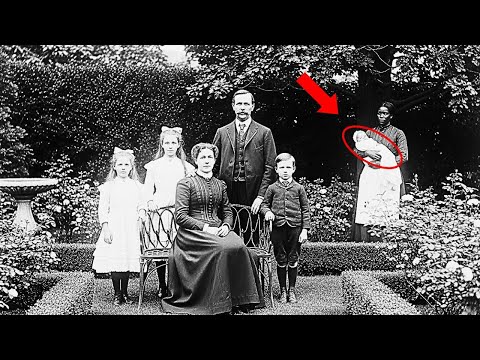
Elena increased the magnification and applied advanced digital enhancement techniques, carefully brightening the shadowed area while preserving detail. Her breath caught as the figure became clear. It was a woman—a Black woman—dressed in simple domestic servant’s clothing. She stood partially concealed behind the tree trunk, but her posture and position were deliberate, not accidental. Most remarkably, she was holding an infant wrapped in white cloth.
The woman’s face, now visible thanks to digital enhancement, showed an expression Elena found difficult to read—sadness mixed with something else. Pride, perhaps, or defiance. Elena sat back from her computer screen, her mind racing. The presence of a Black domestic worker in a wealthy white family’s photograph wouldn’t normally be surprising. Many such photographs from that era included servants, usually positioned at the edges or background to indicate the family’s prosperity. But there was something about this woman’s placement that seemed intentional yet hidden, and something about the way she held that infant that suggested this was more than a simple inclusion of household staff.
Elena zoomed in on the baby in the woman’s arms. The infant’s features were difficult to distinguish, but the child appeared quite light-skinned. She then examined the young boy standing with the Thornton family. He looked to be about five years old, with light brown hair and features that matched the family patriarch’s. A theory began forming in Elena’s mind, one that made her heart race. She pulled up the original work order from the historical society. The photograph had been donated by the Thornton family descendants as part of a larger collection documenting prominent Boston families. The accompanying documentation identified the people in the main group: Richard Thornton, his wife Catherine, their daughters Margaret, Elizabeth, and Anne, and their nephew James, whose parents had supposedly died in a cholera outbreak, leaving him orphaned. But there was no mention of the woman in the shadows, no mention of the infant she held.
Elena spent the rest of the day researching the Thornton family. Richard Thornton had been a successful textile merchant, one of Boston’s wealthiest men in the early 1900s. His family had been prominent in Boston society, attending the right churches, hosting elaborate parties, serving on charitable boards. Catherine came from old Boston money, her lineage traceable to colonial times. The family had employed numerous domestic servants, as was customary for households of their status. Elena found census records listing several Black servants working in the Thornton household in 1900 and 1910. But identifying which woman appeared in the photograph would require more investigation.
As evening fell, Elena printed a high-resolution copy of the enhanced photograph and pinned it to her wall. She couldn’t stop looking at that woman in the shadows, at the baby in her arms, at the expression on her face that seemed to Elena like someone trying to claim something that had been taken from her, even if only through the medium of a photograph. Something important had happened in this family, something that had been deliberately hidden in plain sight for over a century—and Elena was determined to uncover the truth.
The next morning, Elena contacted the Boston Historical Society, speaking with the curator who had sent her the photograph. Dr. Patricia Chen listened carefully as Elena described what she had discovered in the enhanced image. “I’ve examined hundreds of photographs from this period,” Elena explained, “and the positioning of this woman feels intentional. She’s not casually in the background. She’s been carefully placed where she would be visible but easily overlooked, especially in a print of lower quality than the original.” Patricia was intrigued. “The Thornton family donated this collection only six months ago. The current family members claimed they were simply clearing out an old estate and thought the historical society might want the materials. They didn’t express any particular interest in the contents. Do you think there’s a story here worth investigating?” “I’m certain of it,” Elena replied. “But I’ll need access to more records—employment documents, birth certificates, anything that might identify the woman in the photograph and the infant she’s holding.”
Patricia agreed to help. Together, they began searching through the Thornton family papers that had been donated along with the photographs. There were business ledgers, social correspondence, property records, and household account books spanning from 1890 to 1920. In a household account book from 1901, they found regular payments to several domestic servants, including a notation: “Clara Washington, Cook and Housemaid, $8 per month plus room.” The entry began in 1899 and continued through 1902, when it abruptly stopped with a single word written in the margin: “Dismissed.” Elena felt a surge of recognition. Clara Washington. She photographed the page, noting the dates carefully. If Clara had been dismissed in 1902, and if she was the woman in the 1901 photograph, then something significant must have happened in that household.
They continued searching and found something even more revealing in a collection of personal letters. A letter from Catherine Thornton to her sister in Philadelphia, dated March 1901, contained a passage that made Elena’s hands tremble. “We have taken in Richard’s nephew James, as you know, following the tragic loss of his parents. The boy is adjusting well to our household, though the circumstances of his arrival have been complicated by unfortunate rumors. I assure you, these rumors are entirely without foundation. James is our blood relation, and we are providing him the upbringing his station deserves. We have had to make certain household adjustments to ensure propriety is maintained.” The letter was carefully worded, but Elena could read between the lines. Rumors, household adjustments, the defensive assertion that James was a blood relation—this was a family managing a scandal.
Patricia discovered another crucial piece of evidence in the birth records at Boston City Hall. There was indeed a James Thornton, born in February 1896, listed as the son of Richard Thornton’s deceased brother. But when Patricia requested the death certificates for James’s supposed parents, she found something strange. They had died in 1898, not 1896. If James had been born in 1896, he would have been two years old when his parents died—not a newborn orphan, as the family story suggested.
“This doesn’t make sense,” Patricia said, spreading the documents across the table. “The timeline is wrong. And look at this—James’s birth certificate lists his place of birth as Boston, but the parents supposedly lived in New York at the time. Why would the mother have come to Boston to give birth?”
Elena studied the birth certificate more carefully. Something about it looked odd. The handwriting seemed slightly different from other certificates from the same period, and there was a notation in the margin that had been partially obscured. Amended record.
“Oh—this birth certificate was altered,” Elena said quietly. “Someone changed the original information.” They sat in silence, the implications settling over them. A child born in 1896, raised as the nephew of the Thornton family, a birth certificate that had been amended, household servants dismissed, and a photograph showing a Black woman holding an infant while positioned in the shadows of the family garden. The pieces were beginning to form a picture, though not yet a complete one.
Elena needed to find out more about Clara Washington—the woman who had worked in the Thornton household and then been abruptly dismissed. She needed to trace what had happened to James Thornton after 1901, and she needed to understand why this family had gone to such elaborate lengths to obscure the truth. Elena spent the next week tracking down every record she could find related to Clara Washington. The search proved challenging. Washington was a common surname among Black Bostonians, and Clara had left few traces in official records. But Elena was persistent, and gradually a picture began to emerge.
Clara Washington had been born in Virginia in 1875, the daughter of formerly enslaved people who had moved north after the Civil War. She arrived in Boston in 1897, seeking work as a domestic servant. By 1899, she was employed by the Thornton family, working as both cook and housemaid in their Beacon Hill mansion. Elena found Clara listed in the 1900 census, residing at the Thornton address. The census described her as single, Negro, age 25, occupation domestic servant. But there was a handwritten note in the margin of the census form that Elena almost missed: Infant daughter, not enumerated. This notation was unusual and suggested the census taker had been uncertain how to categorize a child in the household.
The breakthrough came when Elena discovered birth records at Boston Lying-In Hospital, an institution that had provided maternity care to both wealthy and poor women in the early 1900s. Among the records from February 1896 was an entry for Clara Washington, Negro, age 21, delivered of a male infant. The father’s name was listed as unknown. But there was more. Attached to the hospital record was a note from the attending physician: Patient employed by R. Thornton family. Infant to remain with mother and Thornton household per family arrangement. Fee paid by R. Thornton.
Elena’s theory was solidifying. Clara had given birth to a son in February 1896 while working for the Thornton family. Richard Thornton had paid the hospital fees, and somehow this infant had been transformed into James Thornton, the orphaned nephew. She needed to find out what had happened to Clara after her dismissal in 1902. Using city directories and church records, Elena traced Clara’s movements after she left the Thornton household. She found Clara listed as residing in a boarding house in Boston’s South End in 1903, working as a laundress. But the trail went cold after that year. No census entries, no employment records, no death certificate.
Then Patricia made a discovery that changed everything. In the archives of the African Methodist Episcopal Church in Boston, she found a baptismal record from 1896 for James Washington, son of Clara Washington. The baptism had taken place just weeks after the hospital birth record, and it clearly identified the child’s surname as Washington, not Thornton. The church records also contained something else—a letter from Clara to the church pastor, dated 1902. Patricia photographed the letter and sent it to Elena immediately.
Elena read Clara’s words with growing emotion. “Reverend Williams, I write to you in desperation, not knowing where else to turn. You baptized my son James six years ago, and I have raised him with love despite the difficult circumstances of his birth. His father, a man of prominent standing, who I will not name, provided support for us while demanding absolute secrecy about his paternity. Now that man’s wife has determined that my presence in their household is no longer acceptable. She has insisted I be dismissed, and worse, she has told me that James will remain with them, to be raised as their own kin. She says I am unfit to mother him, that he deserves better than a life with a colored laundress. She has offered me money to go quietly, to never speak of James’s true parentage, to never attempt to see him again.”
Elena wiped tears from her eyes and read on. “Reverend, he is my son. I carried him, birthed him, nursed him, raised him for six years, but I have no legal standing. I am a Negro woman with no family, no resources, no power. The Thorntons have everything—wealth, position, legal counsel. If I fight them, they will destroy me and possibly harm James in the process. If I accept their terms, I lose my child, but perhaps secure him a life of opportunity I could never provide. I do not know what to do. I pray for guidance, for strength, for some way to do right by my son, even as my heart breaks.”
The letter was dated October 1902, just around the time Clara had been dismissed from the Thornton household. Clara had faced an impossible choice: fight for her son and likely lose while damaging his future prospects, or walk away and let him be raised in privilege and comfort, never knowing his true mother. The photograph from 1901 took on new meaning. Now that image showed Clara standing in the shadows holding an infant—but which infant? Could there have been another child? Or was the photograph misdated?
Elena returned to the enhanced image and magnified the infant in Clara’s arms. The baby was only months old—far too young to be five-year-old James. “There were two children,” she whispered. “Clara had another baby.”
Hospital records confirmed it: in March 1901, Clara delivered a daughter, fees again paid by R. Thornton. By September, the infant had been surrendered to the Boston Home for Colored Children, adopted away to New York, records sealed.
Patricia found the final piece—Clara’s letter to her pastor, begging for guidance after being told to leave and never return. “He is my son,” Clara had written. “I carried him, birthed him, nursed him. But I have no legal standing.” She chose silence to give James a future.
That photograph was her quiet defiance—a mother refusing to be erased entirely, standing in the shadows with her daughter, insisting on being seen.
James grew up to become a civil rights attorney; his lost sister’s granddaughter, decades later, recognized her own copy of the cropped image. The descendants reunited, and Clara finally had a headstone reading: Beloved mother.
What would you have done, standing in Clara’s shoes—fight, or let go?
Report this article
Select a reason for reporting:






