The spring of 1944 held a grim, unspoken promise across the free world. The shores of fortress Europe had to be breached. In the crowded coastal towns of southern England, the greatest amphibious armada in human history was quietly gathering strength.
Through meticulously restored and colorized archival footage, the immense logistical nightmare of Operation Overlord is laid bare. From untested sailors learning to navigate flat-bottomed landing craft in Chesapeake Bay to the tense, agonizing days spent waiting aboard transports in the English Channel, the human element of this massive endeavor is striking.
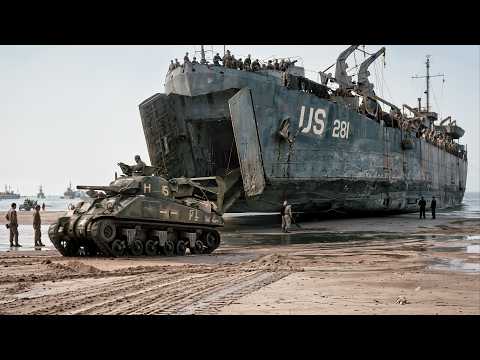
When the massive fleet finally moved out into the channel, stretching from one end of the horizon to the other, the reality of their destination set in. They were heading into the teeth of the German defenses, toward beaches littered with mined triangles built by forced labor, entirely dependent on the protective steel of their landing craft and the courage of the men beside them.
June 9th, 1944. Allied troops in Normandy have moved inland. The work of the US Navy and Coast Guard and the combined Allied sea forces has been done. Work not without a price in men and material.
It all began many months earlier. In Chesapeake Bay and other sections of the American coast, untested sailors and soldiers learned the task of getting from ship to shore. But that time, the shore was a friendly one.
Then, with part of their training finished, they left the United States. Late in the winter and all through the spring, the great convoys moved eastward across the Atlantic. Aboard all the transports, life was the same. The troops relaxed and waited for the voyage to end.
All along the coasts of Great Britain that spring, the training went on. Navy and Coast Guard landing barges practiced landing operations day and night. Meanwhile, the larger landing craft, LSTs and LCIs, carried on their maneuvers, learning to land at a given spot at a certain time.
Through all the days of preparation, Allied planes, thousands of them, continued to soften enemy defenses and communications in daily raids.
Off the southern coast of England, thousands of ships from all Allied nations are preparing for the invasion signal. Navy and Coastguard crews make last-minute preparations. When the K rations come aboard, everyone knows that D-Day is drawing near.
Somewhere in Southern England, troops embark on LCVP to be ferried to the waiting transports offshore. June 5th, the LCIs are loaded. The next time these men step ashore will be on an enemy beach. There’s only a little time left to relax.
And the bombing attacks of the Air Force are intensified. Now, the raids are continuous. At ports of embarkation, the troops prepare themselves for their greatest battle.
A Coast Guard officer briefs his men, and all along the coast, sailors receive their final instructions. At last, the ships leave the coastal waters and move out into the channel. The slow LSTs loaded with heavy equipment, the transports loaded with men. Fast warships screen the mighty invasion fleet from enemy raiders.
At 15:30, a Coast Guard flotilla of LCIs leaves, loaded with engineers, medical corpsmen, and infantry. D-Day approaches, and the ships are in their assigned positions. Or some of them, like the Coast Guard manned transport Chase, it is the fourth invasion in European waters. The only planes overhead are friendly.
From the 83-ft Coast Guard rescue boats to the Navy’s powerful battle wagons, the invasion fleet is moving towards France. And below decks, officers study the maps that mark the invasion beachheads on the coast of Normandy.
Some of the landing barges are stopped by concrete obstacles built far out in the water by the enemy. Offshore, the larger landing craft approach the beachhead slowly. Aboard the LCIs, the troops prepare to land. The beach is still empty and the crossfire of German guns still rakes the shore.
Out of enemy firing range, the LSTs wait to move in until the beaches are cleared. The arrival of motorized equipment marks the end of the first phase of the landing. The LCIs, their first loads of men now on the beaches, go out to the transports to ferry more troops inshore.
Still waiting beyond gun range, the LSTs unload supplies on smaller LCTs. Heavier equipment is transferred to giant rhino ferries, flat-bottomed barges that will land it ashore. And reinforcements arrive, thousands of men.
Defeated and disarmed, the first German soldiers captured in France wait until someone has time to evacuate them. Out in the channel, the rescue boats of the Coast Guard are looking for survivors and aiding damaged vessels. And the hospital ships are waiting for the wounded.
Another Coast Guard manned LCI badly crippled could not reach the shore and its wounded are removed. The beach is firmly in Allied hands now and the vast extent of the operation is visible. Silent evidence of the fierce battle is apparent everywhere. But in a few days, many of the damaged ships will be afloat again.
Now more and more troops move inland to push the enemy back. And the LSTs land their cargoes on the beach. Barges built especially for the Normandy operations are left on the shore to be unloaded.
During the daytime, there are only Allied planes in the air. But at night, German bombers harass the beachhead and drop mines offshore. Out of sunken blockships, artificial harbors have been built. Until a port is won from the enemy, these must handle all Allied shipping.
Bad weather came after the fighting on the beaches was over. The heavy storm left a trail of damaged ships. Once again, the landing barges moved out into the channel. This time, loaded with German prisoners. In England, prisoners board a Coast Guard transport.
And ships which have carried thousands of American soldiers overseas, now return westward with a different cargo. With men who were beaten and captured in Normandy.
Of course, the one place that intrigued me was my first trip to London and the House of Parliament and Big Ben. Now, these pictures, you must remember, are more than a quarter of a century old.
The thing that amused and entertained our boys who were stationed all over England was Westminster Abbey. And there were quite a few Americans who came there to see the sights and see Westminster Abbey. And these are the scenes that I wanted to photograph on one Sunday afternoon.
Another area that intrigued me was Marble Arch. Marble Arch on one Sunday afternoon was full of people. You must remember that London was being bombed almost every night in this particular time. And I was photographing these speakers that were addressing the crowds.
Every speaker was speaking on a different subject, but the police stood around and watched. And as long as there were no arguments, not any strong arguments, nobody was hurt. And we the people in the audience were arguing back with the speakers. But these were just typical shots of how we passed the time waiting for D-Day.
Most of the children who lived in England, or a great many I should say, were sent out of the city. But a lot of them had to remain behind. But in spite of a war, they managed to find entertainment.
I was rather surprised to see these children drinking out of community drinking cups that were chained to the fountain. And I’d like to make candid shots of these children, so they didn’t notice me. But every once in a while they did. But this youngster is taking a cool drink on a beautiful Sunday afternoon.
And we discovered that St. Paul’s Cathedral had been hit several times, but not badly damaged. And of course, one of the other attractions was Buckingham Palace and the gates, which were protected by British troops, not in the bearskin hats, which they wore in peacetime, but in full war uniform. And this is the way they paraded up and down. They weren’t performing for the camera, but they were actually doing their duty.
But you notice the barrage balloons in the background. London had barrage balloons all over the area. And it was said that if it wasn’t for the barrage balloons with all the equipment that was being brought into the country, that the islands would sink into the sea, but the barrage balloons, they said, was holding it up.
You must remember, too, that food was pretty scarce in London at this time and it was being brought in whatever way they could and being unloaded. But it isn’t often you get a bright day like this in the spring in London and this was an opportunity to show what the soldiers were doing while they were waiting for the invasion.
This is Fleet Street. Discovered this Irish policeman guarding the street and we saw considerable damage in the area. But soon we were down on the south coast of England where we met some of the other correspondents who were scheduled to cross the channel with us. And you’ll probably recognize some of the old-timers who covered the war at that particular time.
I was given a shovel to defend myself and it proved to be a valuable instrument. And here we see Larry LeSueur of CBS. Larry LeSueur was covering the war for us. CBS and so was Weertenbecker on the left, Jack Thompson of the Chicago Tribune, Ernie Pyle here.
And this is a close-up of Jack Thompson. And this is O’Reilly, Larry O’Reilly of the Associated Press. This is Weertenbecker and we’re saying our farewells because we were expected to meet again in Paris.
Here on the left we see Clark Lee of INS and Bill Stoneman who came from Chicago from the Daily News. And several other correspondents were being boarded on a military truck to be taken to the south coast and we went through small British towns and life was going on as usual. The people were in the marketplace buying food and as though nothing was going on. But after 150-mile ride, that’s how we felt riding in an army vehicle.
We found Plymouth was pretty badly damaged. A lot of the buildings were completely destroyed, but this was found all over the area. Soon, we were approaching the dock area and we found these American jeeps ready to be boarded aboard landing craft and you notice the bars that are attached to their bumpers. And they’re designed to cut wires that the Germans had a habit of putting across the road that would sometimes cut off the head of the drivers.
We weren’t allowed to wander around the area by ourselves. Each crossroad point was under guard of both an American and a British soldier. And if they wanted to see what you had in your bedroll, you had to show it to them. But this is the care that was taken that the secret of the invasion be kept as long as it could.
These are the two men, Wes Haynes and Pete Carroll, who were with me and we went aboard an LCI number five. Pete Carroll here came from Boston and he was a photographer for the Associated Press. And we tried to keep our mind off what was coming and we knew it was going to be a short time before we would be on board.
We had our first taste of K rations, which didn’t taste bad if you were hungry. And we also were able to see the beautiful countryside in that area. And these are the sort of shots I wanted to bring home to show my family and friends. Pete Carroll was using some of his film to make a few shots himself.
And soon, we were down at the docks. And there we found units of the 101st Airborne Division carrying everything they could carry by hand boarding landing craft that were so heavily laden they had to be pushed off the docks by trucks as you see in this manner. And these men were being taken out to larger craft and boarded for the invasion.
And here we see several units carrying grenades, bazookas. They didn’t have an opportunity to load this aboard jeeps that were not fully available at this particular moment. We were aboard a fleet of LCIs and here is shown with the commander of the invasion group in the center and the captain on the right, rather the captain of our ship, Lieutenant Patton, was in command of the LCI number five, and we found out that he participated in several invasions in the Mediterranean area. And we felt rather confident that he knew what he was doing.
But we stayed aboard this ship for almost five days. This is the commander of the squadron. I remember Lieutenant Patton’s name well because we were with him for so long. Wes Haynes was trying to get ready for the trip into Paris. I think he was premature.
And these are units of the 101st Airborne Division that board our landing craft amusing themselves, and I don’t have to tell you who this man is imitating. He was a Notre Dame football player at one time, and I was told later on that he was killed in the action.
Of course every ship had a mascot, and ours was no different, but the boys provided for their mascot’s welfare with the making of a life preserver just like the ones that they wore themselves.
And then one afternoon, Lieutenant Patton briefed the crew and told them that we would be sailing that afternoon. And they let out a cheer because this is the job they were waiting for. They wanted to get it done and go home.
And here we see the LCI number four with the commander moving out into the channel. And this was a tremendous sight to see ships from one end of the horizon to the other. Ships of all kinds. They tell me there was well over a thousand ships.
But even so, we thought this was just another exercise. As we continued on, we felt that we’d be turned around, go back and try again another day. But when we continued on into the night, we knew it was a real thing.
At one time, we had a bit of a scare. They said there was a submarine in the area and one of the DE boats threw some bombs into the channel. And they exploded, but we never saw any attack at all.
Here are some scenes actually taken close to the beach where the ships made a right angle turn and headed for the area where we would land. And of course, we were on the alert for any kind of attack, even airplane attacks. Fortunately, our Air Force did their job well.
This particular scene of these men going to shore was taken by an automatic camera aboard a British landing craft, and they were the first men to land. The reason that was taken by an automatic camera was because they wanted to have a record of what happened should the landing fail.
But here are some scenes landing on the Utah beach, and this is the way we went ashore. You notice the men didn’t dash ashore after being aboard a landing craft for five solid days. They just walked slowly and cautiously, fearful of bombs and mines that were sown in the area.
We all stayed on the beach the first night and lived in a foxhole. And soon we showed some of the first prisoners taken in the area late the first day who were captured close to the beach and were sent back to England because there was no room to keep them there.
Although it kept me very busy for eight solid days, I used up all the film I had and decided to go back to France to get some more and probably to get a bath. I hadn’t had my clothes off during that entire time.
But my second crossing of the channel was made on an LST and this time with units of the third Army division that was sorely needed because they were bringing over more tanks and vehicles to carry us in the direction of Cherbourg because we needed a port badly.
Soon the French people came back into the city and gave us a warm welcome. And here is the first official ceremony held in France when General Collins presented the tricolor flag made out of parachute cloth to the mayor of Cherbourg.
But the troops began to move in the opposite direction to attack the enemy on the Saint-Lô line. And we were passing through the city of Valognes. And of course it was completely destroyed. The Germans tried to make a stand here and wherever they did try to make a stand, we had to knock them out and in so doing destroy the city.
One of the highlights of our trip across France was Mont Saint Michel. And here we met some of the other correspondents. This is Bob Capa of Time magazine. And Bob Capa was eventually killed. He was covering the war in Indochina when the French was fighting.
But at Mont Saint Michel, we found the Poulard Hotel run by Madame Poulard. And the reason we liked the place is she served some delicious omelets for which she was famous. And a lot of the correspondents gathered here to fight the war from this point because we were closer to the front line than we were at our main bases.
Soon we found ourselves in Rambouillet. Rambouillet was 52 km from Paris and was the headquarters for all the correspondents that came there. We see Ernie Pyle again on the left and George Stevens, the Hollywood director, myself and of course Pete Carroll.
It was shortly after these pictures were taken that Ernie Pyle decided to return back to the States and then went to the Pacific where he was killed.
But practically every correspondent turned out to try to get into the city of Paris. But we found that General Eisenhower had given permission to the Second French Army Division to take the city of Paris because the important thing was to destroy the enemy and they didn’t consider Paris as a target.
We were glad to see Paris because it was a city of great beauty and we were amazed at the way the people turned out. And these are some of the shots taken on the first day of liberation. I just didn’t nearly get enough of these shots because there was too much to do.
And soon General de Gaulle came into the city and paraded down the Champs-Élysées. And here he is taking the salute and receiving some flowers from a French girl. It must be remembered that de Gaulle was not well known at this time and very few people could listen to the radio reports that told about his work in England prior to crossing the channel.
And here’s de Gaulle parading and suddenly firing opened up from forces that were left behind and they thought from the FFI and some of the fascists that were still in the city trying to panic the people. But if you stuck your head out a window, you were bound to lose it. And this went on continuously for several hours.
In fact I was in the middle of this thing and these are shots that I took of people lying flat on the ground. They’d get under our car. We couldn’t move the car while they were trying to get the people to stop shooting by raising white flags. But it went on continuously and although it was small arm fire, de Gaulle just stood his ground.
But this is the way the streets of Paris looked on the day of liberation. They did catch some of these people who were responsible for the shooting. At least they told us that. And unfortunately, they beat them to death right on the spot. It was a rather ugly sight to see, but somehow it was the war of nerves.
Soon the people of Paris were out parading again along the Champs-Élysées with their new-found liberty. We discovered that the Eiffel Tower, which was reported destroyed and used for arms, was still intact. And soon I managed to get permission to go up into the Eiffel Tower and see what it looked like from up above.
But there was much to be done, and even though Paris looked beautiful, conditions were very poor. The railroads were practically destroyed. There was no way of bringing in food. In fact, when we were coming down the road, we saw large trucks waiting to get into the city loaded with all kinds of foodstuffs to support the city, which was in dire need not only of food but of coal because at this time it was getting pretty cold.
But we had to move on and soon I had to leave Paris and found myself in the countryside beyond Paris and went into Belgium. Where I managed to get into Brussels. And shortly after leaving Paris I was in an area called the Ardennes. And the reason I took some of these shots of the countryside because the weather was turning cold and the trees were turning their fall colors.
And this is the town of Houffalize, which was completely destroyed on the breakthrough that occurred and the attack on Bastogne. I was in Bastogne just a few days before the breakthrough and was fortunate enough to get out of there not knowing about the attack, but I did think that this was a place that the enemy could hide troops and they did.
These are units of the 3rd Armored Division that were fighting the enemy and we managed to get some shots of them as they were being entertained by German children. We had a tremendous reception all the way across France, but when we got to Germany, the reception was not there. All the homes in the German area had white flags in front of them as an indication, of course, of surrender.
We found the Siegfried Line, as it was called, or the dragon’s teeth, which were built again by slave labor, I’m told, and they were not a fortification against our tanks because our bulldozers took dirt and pushed it over the top of them and rode right over the top.
The war was moving rather rapidly at some points in Germany and soon I found myself in the town of Aachen. Aachen was under fire when these pictures were taken. That’s the reason the scenes are devoid of people. There were mortar shells passing over our heads all the time and the enemy was holding the center of the city as we were making these shots.
Well, after Aachen I was invited to fly home and this is something I was glad to be able to do because here we see some of the cemeteries that were built on the Normandy beaches above the beaches and these are scenes of Berlin showing the tremendous damage that occurred in the city. The bombings were intense and very little of Berlin was left standing.
Wars don’t seem to prove very much except to destroy property and kill people. And we sometimes think that maybe one day we’ll learn how to avoid wars, and perhaps we’ve made wars so deadly that we’ll have to avoid them in the long run to stay alive.
Here we see some shots of what I call what the next war might look like, and this is the explosion of the atomic bomb in New Mexico. And I always like to feel when I show these pictures that perhaps it’ll remind people that we ought to remember what World War II was like and that World War III would be much worse.
But I like to repeat what one scientist aptly put it when he said the atomic bomb is here to stay. The question is, are we? And that brings us to the end of our film, and thank you very much.
The pictures have lasted. They’re beginning to fade, I’m afraid. And I guess in time I fortunately have a print of it and try to keep them fresh as long as I can. They’re remarkable, I think.
These were shot, of course, at moments of relaxation. I did many thousands of feet of 35mm which were used in theatrical release. But you needed four hands to operate two cameras. You must have had the guard here to film, didn’t you? Pretty close to it.
I took along a limited amount of film. But the Signal Corps, whenever film was out of date, would not want to use it. If it was one day past the dateline, they destroy it. And I managed to get some of it and it proved to be perfectly usable and I was able to get it. Some of the film was processed in England and one roll that was very green was used and it was lost for a while and then I had it processed and the color didn’t come out as well.
But they tell me that this is some of the few pictures that were made in color of the invasion. But the idea was to bring back pictures of some friends who are no longer with us anymore.
We appreciate very much. Thank you very much, gentlemen. I appreciate your kind attention. Thank you.
Now, looking back at these fading frames, what do you think we owe to the men who carried those cameras into the surf—and to the ones who never came home?
Report this article
Select a reason for reporting:






