Dr. Amanda Foster had spent fifteen years studying the dead. Not in a morbid sense—she was a historian of Victorian photography, an expert in the hauntingly beautiful practice of postmortem portraits. But nothing in her years of research prepared her for the photograph she found in a dusty corner of Williamson’s Antique Emporium.
It was an albumen print, mounted on thick cardboard, the kind produced by the finest studios of the 1890s. Two young women posed in a well-appointed parlor, their Victorian gowns rich with velvet and lace. The photographer’s mark read Hartwell & Son Fine Photography, Boston, 1890. On the back, in faded ink: “My dearest daughters, Margaret and Elizabeth. Forever in my heart, Mother.”
At first glance, it was a typical sister portrait. Margaret, the elder, sat in a carved chair, hands folded, her smile serene and her eyes bright with life. Elizabeth stood beside her, one hand resting on Margaret’s shoulder, her smile equally gentle. But something in the composition troubled Foster’s trained eye.
Elizabeth’s posture was rigid—unnaturally so. Her left arm hung at her side in a way that seemed almost mechanical. And her eyes, though open and facing the camera, held a peculiar glassy quality. They didn’t engage. They didn’t see.
Foster’s heart quickened. She recognized the subtle signs: the lighting that fell differently on Elizabeth’s face, the careful arrangement of her necklace, the shallow depth of field that blurred the background. This was no ordinary portrait. This was a memorial photograph—and Elizabeth was dead.
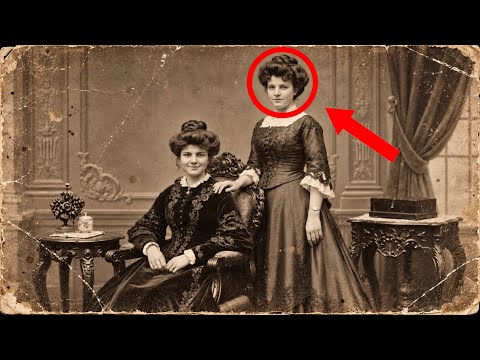
The discovery would challenge everything Foster thought she knew about Victorian mourning practices. She had studied countless postmortem portraits, but never one so masterfully executed. The deceased subject appeared so lifelike that she had initially fooled an expert. How many other photographs like this existed, hiding in plain sight?
Foster began her investigation with the studio records of Hartwell & Son, preserved in the Massachusetts Historical Society. Founded in 1875 by Samuel Hartwell, the studio had built a reputation for sensitive and skillful memorial photography. Samuel’s son, Thomas, joined in 1885, bringing technical innovations that made their postmortem images remarkably lifelike.
The studio’s appointment ledger for October 1890 contained an entry that made Foster’s pulse race: “Whitman family. Memorial portrait. Miss Elizabeth and Miss Margaret. Special arrangements. Extended session required. Father’s request for natural appearance.”
Thomas Hartwell’s personal journal provided the details. Elizabeth had died of consumption three days before the session. Her father, Dr. Jonathan Whitman, a respected Boston physician, had insisted on a final portrait with his surviving daughter. “Miss Elizabeth’s complexion was restored using theatrical cosmetics and careful lighting. Her eyes were positioned using glass supports. Her hair was arranged to match recent photographs.”
Hartwell had noted his concerns: “While the family’s grief is understandable, I question whether creating such a realistic memorial image serves their healing process. Miss Margaret appeared deeply distressed throughout the session.”
The session had lasted over three hours—far longer than typical. Margaret had needed frequent breaks to compose herself. The final image required multiple exposures to achieve the natural lighting effects Dr. Whitman demanded.
Foster’s research revealed a family shattered by loss. Dr. Whitman’s wife had died in childbirth in 1885, leaving him to raise Margaret and Elizabeth alone. He had dedicated himself to their education and happiness. But when Elizabeth fell ill with tuberculosis in early 1890, his medical expertise proved powerless.
“As a physician, I recognize the progression of consumption,” he had written in his journal. “Yet as a father, I refuse to accept the inevitable outcome.”
Margaret had served as Elizabeth’s primary caregiver, sacrificing her own social life to nurse her sister. Their bond had deepened during the illness. Elizabeth’s death on October 12th, 1890, devastated them both.
But the most disturbing discovery came when Foster located Margaret’s personal diary, preserved by her descendants in Concord. The entries from October 1890 provided an intimate account of the session—and revealed the psychological toll it had taken.
“Father has commissioned Mr. Hartwell to create a final portrait of Elizabeth and myself together,” Margaret had written on October 13th. “He believes this image will provide comfort and preserve our sisterly bond. But I confess to feeling disturbed by the prospect of posing with dear Elizabeth in her current state.”
The preparation had been agonizing. “Elizabeth’s appearance required extensive restoration. Father worked alongside Mr. Hartwell’s assistant to arrange her features and apply cosmetics. Watching this process felt like a violation of her peaceful rest.”
The session itself was torture. “Mr. Hartwell required numerous adjustments. Each time I was asked to place my hand on Elizabeth’s shoulder or adjust my smile, I felt I was participating in an elaborate deception.”
Margaret had spoken to her dead sister throughout the session, hoping for a response she knew would never come. “The effort required to smile naturally while Elizabeth lay still beside me was exhausting beyond description.”
Afterward, she could not sleep for days. “I was haunted by dreams where Elizabeth appeared alive in the photographs, but remained silent and unresponsive.”
Foster had uncovered a story of love, grief, and the dangerous power of a photograph to blur the line between life and death. But this was only the beginning. The portrait’s technical secrets—and the family’s tragic aftermath—would reveal even darker truths.
Foster returned to the Hartwell archive with a new question burning in her mind: if Thomas Hartwell had harbored such doubts about the Whitman commission, why had he completed it at all? The answer, she discovered, lay buried in a bundle of correspondence that had never been catalogued.
In a letter dated October 20th, 1890, Dr. Jonathan Whitman had written to Hartwell with unmistakable authority. “I understand your reservations, Mr. Hartwell, but I must remind you that I have referred no fewer than eleven patients to your studio for memorial work this year alone. I trust our professional relationship will continue to our mutual benefit.”
Foster set the letter down slowly. There it was—not grief alone, but leverage. The grieving father had pressured the photographer with the weight of future business, and Hartwell, however troubled, had complied.
But the archive held another surprise. Among Hartwell’s later papers, Foster found a second ledger—a private one, kept apart from the official studio records. Its entries were sparse, almost coded, but one line from March 1891 stopped her cold: “Whitman plate—retouched again at family’s request. Third alteration this year. I have declined further work on this image.”
Retouched. Again. Foster’s mind raced. The photograph she had purchased at Williamson’s Emporium—was it the original plate, or one of the altered prints? She pulled her own copy from its protective sleeve and studied Elizabeth’s face under magnification.
The conservation lab had already flagged the retouching around Elizabeth’s eyes. But now Foster noticed something else: faint inconsistencies in the emulsion along Elizabeth’s jawline, subtle enough to escape normal viewing but unmistakable under raking light. Someone had continued to refine this image long after the session ended—perhaps for years.
To understand why, Foster turned to Margaret’s later diary entries, written after she had fled to Vermont. In a passage from 1894, Margaret described a visit home that confirmed her worst fears.
“Father has hung the portrait in the parlor where Elizabeth once played piano. He has commissioned an artist to paint a companion piece—an imagined scene of Elizabeth at the keyboard, though no such photograph ever existed. When I objected, he replied that I did not understand what it meant to lose a child.”
The companion painting. Foster searched the Whitman descendants’ collection and found it—a small oil, unsigned, depicting a young woman at a piano, her face unmistakably Elizabeth’s. But the hands on the keys were wrong. They had been copied from Margaret’s hands, not Elizabeth’s.
The father had not merely preserved his dead daughter’s image. He had begun assembling a composite of both daughters, a ghost built from whatever fragments he could gather.
Foster sat back, the weight of the discovery pressing on her. The photograph had been only the first act. Dr. Whitman had spent years constructing an elaborate fiction of continued family life—and the studio, the painter, perhaps others, had helped him build it.
She reached for her notebook and wrote a single line: “The portrait was never the end of the story. It was the foundation of a house of illusions.”
There was one name left to pursue—the artist who had painted the companion piece. If that person could be identified, the full extent of Dr. Whitman’s memorial project might finally come to light.
Foster’s search for the artist led her to the Boston Athenaeum’s obscure collection of local painters. A small, unsigned oil of a young woman at a piano matched the companion piece exactly—and the curator’s note identified the artist as **Clara Hastings, a portraitist who had studied with Thomas Hartwell’s assistant.**
Hastings’s own diary, tucked inside a sketchbook, revealed the final piece of the puzzle. **“Dr. Whitman asked me to paint his daughter as she might have been at the piano. He provided the memorial photograph and insisted I use Margaret’s hands. He said Elizabeth’s own hands had been too wasted by illness to remember.”**
Foster felt a chill. The father had not only preserved an illusion—he had begun to replace his dead daughter’s body with pieces of the living one. **“I felt I was painting a ghost who did not know she was dead,”** Hastings had written.
Margaret’s later diary entries confirmed the toll. By 1896, she had stopped visiting Boston altogether. **“Father writes that Elizabeth played the piano for him last evening. I no longer know whether he means the painting or his memory. I fear the two have become the same.”**
Dr. Whitman died in 1898, alone in the Beacon Hill house, the memorial portrait still hanging in the parlor. His will left the photograph and the companion painting to Margaret—who, according to family letters, **burned the painting and locked the photograph in a trunk, never to be displayed again.**
Foster closed the file. The portrait she had found in the antique shop must have been one of the retouched copies, separated from the family after Margaret’s death. Its beauty was undeniable—and so was its harm.
She thought of Elizabeth, who had died at nineteen, and Margaret, who had spent a lifetime fleeing her image. And she thought of Dr. Whitman, whose love had built a prison of silver and oil.
“The photograph was never a memorial,” Foster wrote in her final report. “It was a refusal—a refusal to let the dead be dead.”
The Whitman portrait now sits in a museum case, labeled as both masterpiece and warning. Foster visits it sometimes, studying Elizabeth’s glassy eyes and Margaret’s strained smile. She wonders what the sisters would say if they could speak.
And she wonders about the countless other photographs still hidden in attics and antique shops—images that fool us into thinking the dead are still with us. How many of them are waiting to be found? And when we find them, will we know whether to cherish them or let them go?
Report this article
Select a reason for reporting:






