In October 1946, Master Sergeant John Clarence Woods had every reason to feel a grim satisfaction. He was about to become the most infamous executioner in history, tasked with hanging twelve of the most monstrous men the world had ever known. But Woods harbored a dark secret: he had never conducted an execution in his life. His claim of experience was a blatant lie, yet the U.S. Army didn’t care. They needed a hangman, and Woods was eager to oblige. What followed was not just a series of executions—it was a carefully orchestrated act of retribution.
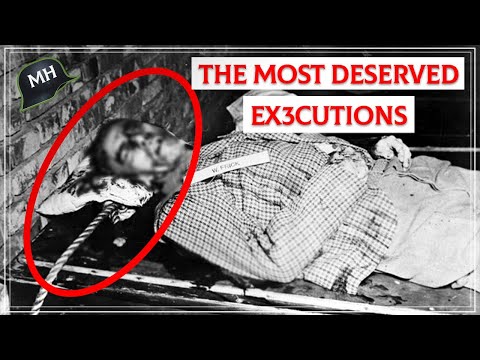
Woods was determined to make the Nazi leaders pay for their crimes, not just with their lives, but with their final moments. He devised a cruel twist: the ropes would be too short, ensuring a slow, agonizing death by strangulation rather than a quick snap of the neck. This was his personal vendetta, his way of delivering justice on behalf of millions.
The first to face the gallows was Joachim von Ribbentrop, Hitler’s foreign minister. Arrogant to the end, he refused to renounce his loyalty to the Führer. “Even now, if Hitler appeared in my cell and gave me an order, I would comply without hesitation,” he had once said. As the noose tightened, his last words were a plea for Germany’s future: “God protect Germany and guard my soul.” But there was no divine protection in that prison yard—only the cold efficiency of Woods’s trapdoor.
Next came Wilhelm Keitel, the commander of the German Armed Forces. He had argued that he was bound by his oath to obey Hitler, even when orders were illegal. His request for a firing squad was denied; hanging was the fate of war criminals. “I ask Almighty God to have mercy on the Germans,” he declared. “More than two million of our soldiers marched to their death for their country, and now it is my turn.” But Keitel’s size made the trapdoor too small, and he struck his head as he fell, bleeding and strangling simultaneously—a gruesome end that Woods observed with satisfaction.
Ernst Kaltenbrunner, the SS officer who lamented that the Nuremberg trials were conducted by amateurs, followed. Then Alfred Rosenberg, the chief ideologue of Nazism, who offered only a curt “No” when asked for last words. Hans Frank, the governor of Poland, was the only one who seemed genuinely remorseful. He had voluntarily surrendered his diaries, which provided damning evidence against him. At the gallows, he smiled and thanked his captors for their decency. “I am relieved that I can pay for my crimes,” he said, asking God to have mercy on his soul.
Wilhelm Frick, Hitler’s minister of the Interior, was the most nervous of all. He tripped on the gallows steps and seemed on the verge of fainting. Then came the final batch: Julius Streicher, Fritz Sauckel, Alfred Jodl, and Arthur Seyss-Inquart. Streicher, the rabid anti-Semite, was the most defiant. As he was led to the scaffold, he shouted “Heil Hitler!” and cursed the Jews. With the hood over his face, he managed to cry out, “You will all be hanged by the Bolsheviks!” Before the noose tightened, he murmured, “Adele, my dear wife.” The trapdoor opened, and Streicher kicked in the air, slowly suffocating—exactly as Woods had planned.
The bodies were cremated and their ashes scattered in a river to prevent any grave from becoming a shrine for neo-Nazis. Thus ended one of the most significant executions in history. But the story doesn’t end here. Sergeant Woods’s deception and his cruel method raise troubling questions about justice and revenge. Was he a hero or a villain? And what of the other condemned men—how did they meet their ends? The full account reveals even more shocking details.
But the story of that night in Nuremberg is far more complex than a simple tale of vengeance. The men who walked to the gallows were not the only ones marked by the war. The executioner himself, John Clarence Woods, was a man whose entire career was built on a lie. And his lie would soon unravel in the most public way imaginable.
As the final body was cut down and the prison yard fell silent, Woods retreated to a small office to file his report. His hands, according to later testimony from guards, were shaking. Not from remorse—but from the sheer adrenaline of what he had done. He had killed twelve men in less than two hours, and he had done it his way. “They got what they deserved,” he reportedly muttered to a fellow sergeant. But the Army was already asking questions.
Just days after the executions, a journalist from the Chicago Tribune began digging into Woods’s background. The story that emerged was damning. Not only had Woods never worked as an executioner in Texas or Oklahoma, but his entire military record was mediocre at best. He had been a butcher in San Antonio before the war, and his only brush with the law was a court-martial for being absent without leave. “The man who hanged the Nazis was a fraud,” the headline read.
But the Army had no intention of punishing him. They had used him, and now they would protect him. A public scandal would only embarrass the United States at a time when the world was watching. So Woods was quietly transferred to a desk job in the Philippines, far from the press and the courts. He was never disciplined, never questioned under oath. The Army simply erased him from the narrative.
What the Army didn’t erase, however, was the physical evidence of Woods’s incompetence. The autopsy reports from the twelve executed men told a chilling story. Several of them had died not from a broken neck, but from slow asphyxiation. The rope marks on their necks were deep and jagged, indicating prolonged strangulation. One medical examiner noted that the suffering of at least three men had been “unnecessarily prolonged.” The Army suppressed these reports for decades.
Meanwhile, the world moved on. The Nuremberg trials continued with lesser figures, but the main event was over. The ashes of the executed men were dumped into the Isar River, just as the transcript says, to prevent any shrine from being built. But the river flows through Munich, and within weeks, neo-Nazi groups were already using the site as a rallying point. “They may have scattered the ashes,” one pamphlet read, “but the spirit of the Reich lives on.”
And what of Woods himself? He returned to the United States in 1947, expecting a hero’s welcome. Instead, he found a nation that had already forgotten him. The executions were a footnote in history books, and his name was rarely mentioned. He tried to sell his story to Hollywood, but no studio would touch it. “You’re a hangman, not a hero,” one producer allegedly told him. Woods died in 1950, at the age of 39, from a heart attack. His obituary in the local paper made no mention of Nuremberg.
But the questions linger. Did John Clarence Woods commit a crime by deliberately botching the executions? International law experts have debated this for years. Some argue that he violated the defendants’ right to a humane death, however paradoxical that sounds. Others say that the men he killed had forfeited any claim to dignity. “Justice was served,” one historian wrote, “but it was ugly justice, delivered by an ugly man.”
The story of the Nuremberg hangings is not just about the Nazis who died. It’s about the men who killed them—and the system that allowed a butcher from Texas to become the instrument of the world’s wrath. As we dig deeper into the transcripts and testimonies, a new figure emerges: the prison chaplain who heard the condemned men’s final confessions. His diary, discovered only recently, reveals what the Nazis said when they thought no one was listening. And what they revealed will change everything you thought you knew about that night.
The chaplain’s name was Henry Gerecke, a Lutheran minister from St. Louis who had volunteered to serve as spiritual counsel to the condemned. Unlike Woods, Gerecke had no illusions about his role. He had spent months with these men, praying with them, listening to their confessions, and watching them wrestle with the enormity of what they had done. His diary, written in cramped handwriting on prison stationery, offers a window into the souls of men who were about to die.
According to Gerecke, the most surprising convert was Joachim von Ribbentrop. The same man who had defiantly declared his loyalty to Hitler just moments before the noose tightened had spent his final hours in a state of near-collapse. “He wept like a child,” Gerecke wrote. “He kept saying, ‘I didn’t know about the camps. I didn’t know.’ But then he would stop and stare at the wall, and I could see he was lying to himself.”
Wilhelm Keitel, by contrast, remained stiff and military to the very end. He asked Gerecke to read him the 51st Psalm—the one where David begs God to blot out his transgressions. “He didn’t ask for forgiveness,” Gerecke noted. “He asked for understanding. He wanted to be told that following orders was enough.” The chaplain refused to give him that comfort.
But the most chilling entry concerns Julius Streicher. The rabid anti-Semite had refused all spiritual counsel for weeks, mocking Gerecke as a “Jew-lover” and a “weakling.” Then, on the night before his execution, Streicher suddenly demanded to see the chaplain. When Gerecke arrived, Streicher grabbed his arm with surprising strength. “Pastor,” he whispered, “do you think the Jews will forgive me?” Gerecke was stunned. He asked Streicher what he meant. The old Nazi’s eyes darted around the cell. “I saw them,” he said. “In my dreams. All of them. They were standing in a line, and they were waiting for me.”
Gerecke wrote that he told Streicher that forgiveness was between him and God, but that he should pray for the strength to face the truth. Streicher nodded, then began to sob. The next morning, he was shouting “Heil Hitler” and cursing the Jews as he walked to the gallows. “It was as if the devil had taken him back,” Gerecke wrote. “The man who wept in my arms last night was gone. In his place was the monster the world had seen.”
Hans Frank, the governor of Poland, was the only one who seemed to find genuine peace. He spent his final night writing letters to his family and praying with Gerecke. “I have seen the photographs,” Frank told the chaplain. “I cannot deny them. I cannot explain them. I can only say that I am sorry.” Gerecke believed him. “He was the only one who truly repented,” the chaplain later told investigators. “The others were afraid of death. Frank was afraid of what he had done.”
Gerecke’s diary also revealed something about Woods himself. The executioner had approached the chaplain the day before the hangings and asked if he could pray with him. Gerecke was surprised—Woods had shown no interest in religion before. “He asked me if I thought God would forgive him for what he was about to do,” Gerecke wrote. “I told him that God forgives those who are truly sorry. He looked at me and said, ‘I’m not sorry. I’m just scared.'”
That confession, buried in a chaplain’s diary for over seventy years, paints a different picture of John Clarence Woods. He was not a cold-blooded avenger. He was a frightened man who had lied his way into a job he couldn’t handle, and who had then taken out his fear on the men he was supposed to execute. “He was as much a victim of the war as anyone,” Gerecke wrote. “A victim of his own lies.”
But the story doesn’t end with the hangman’s fear. In the months after the executions, Gerecke was called to testify before a military review board investigating the conduct of the Nuremberg proceedings. The board had heard rumors of the botched hangings and wanted to know the truth. Gerecke, a man of God, faced a terrible choice: tell the truth and destroy the reputation of the American military, or lie and protect the men who had won the war.
He chose the truth. “I told them what I had seen,” he wrote. “I told them about the short ropes and the slow deaths. I told them about Woods’s confession. I told them everything.” The board listened in stunned silence. Then they thanked him for his honesty—and buried his testimony. The report was classified for fifty years.
When it was finally released in 1996, it caused a sensation. The New York Times ran a front-page story under the headline “NUREMBERG HANGINGS WERE BOTCHED, SECRET REPORT SAYS.” Historians scrambled to revise their accounts. The story of the twelve Nazis who died at Nuremberg had been told a thousand times, but never like this.
The report confirmed what Gerecke had seen: Woods’s short ropes had turned justice into torture. Yet no charges were ever filed. The Army closed ranks, and Woods died three years later, a forgotten man with a guilty conscience.
Gerecke never spoke publicly about his testimony. He returned to his ministry in St. Louis, haunted by the screams he had heard through the prison walls. “I prayed for them all,” he wrote near the end of his diary. “The Nazis. The executioner. Even myself.”
The Nuremberg gallows are gone now, but the questions remain. Was Woods a war criminal in his own right, or just a broken man given too much power? And does justice lose its meaning when it becomes indistinguishable from revenge?
What do you think—should Sergeant Woods have faced a court-martial for what he did? Share your thoughts below.
Report this article
Select a reason for reporting:






