The sun was warm on the afternoon of June 10, 1944, as the villagers of Oradour-sur-Glane went about their ordinary lives. Children played in the streets, the bakery was busy, and the café hummed with conversation. No one could have imagined that within hours, this peaceful community would be wiped from the face of the earth.
Then, at precisely 1:45 PM, the sound of engines broke the stillness. A convoy of German vehicles rolled into the village square, and heavily armed SS troops poured out, sealing off every exit. The villagers were ordered to assemble on the fairground for an identity check. They complied, unaware that they were about to become victims of one of the most horrific atrocities of World War II.
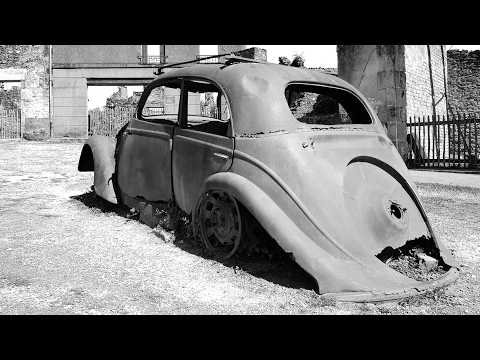
For nearly 80 years, the ruins of Oradour-sur-Glane have stood as a silent witness to the brutality of the SS. In just a few hours, 643 men, women, and children were murdered, and every home was reduced to ashes. Today, the charred remains of the village serve as a powerful memorial, a place where time has stood still since that fateful day.
But how did this happen? Why was this quiet village targeted? The answer lies in the chaotic days following the D-Day landings, when the SS Panzer Division Das Reich was ordered to race north to Normandy. Along the way, they left a trail of destruction and terror, and Oradour-sur-Glane would become their most infamous crime.
As the SS troops moved through the village, they separated the men from the women and children. The women and children were herded into the church, while the men were taken to various barns and garages. The villagers had no idea what was about to happen. They waited in fear, listening to the sounds of soldiers searching their homes, occasionally hearing gunshots in the distance.
Then, at around 4 PM, the church was filled with a suffocating black smoke. Women and children screamed in terror, rushing to escape. But there was no escape. The SS opened fire, and grenades were thrown. In the chaos, a few managed to flee through a shattered window, but most were killed or burned alive.
Meanwhile, the men were gunned down in cold blood. Machine guns rattled, and the wounded were shot where they lay. In a matter of minutes, the massacre was over. The SS then looted the village and set it ablaze, leaving nothing but smoldering ruins.
When the sun rose the next morning, the full horror became clear. The few survivors emerged from hiding to find their families dead and their homes destroyed. The village of Oradour-sur-Glane had been annihilated.
The world would soon learn of the atrocity, but justice would prove elusive. The SS commander, Adolf Diekmann, was killed in action shortly after, and many of the perpetrators never faced trial. The survivors were left to rebuild their lives, but the memory of that day would haunt them forever.
In the years that followed, Oradour-sur-Glane was never rebuilt. Instead, it was preserved as a permanent memorial, a stark reminder of the horrors of war. Today, visitors can walk through the ruins, where everyday objects—a sewing machine, a bicycle, a child’s pram—remain exactly where they were left, frozen in time.
But the story of Oradour-sur-Glane is not just about one village. It is a story of countless communities across Europe that suffered similar fates during World War II. And it is a story that must never be forgotten.
As you walk through the ruins, one word is inscribed at the entrance: Souviens-toi—Remember. And that is exactly what we must do.
Yet the story of that day does not end with the flames. In the weeks that followed, the survivors began the agonizing work of identifying the dead, a task made nearly impossible by the fire and the sheer scale of the slaughter. Of the 643 victims, only 52 would ever be formally identified. The rest were buried in a mass grave, their names recorded on the memorial that now stands where the church once held the village’s women and children.
Among the survivors was a young man named Roger Godfrin, the seven-year-old boy who had fled through a classroom window and played dead in the woods as SS troops fired at him. He would carry the memory of that afternoon for the rest of his life, eventually becoming one of the most vocal witnesses to the massacre. He was the only child from his school to survive.
Another survivor, Madame Marguerite Rouffanche, who had escaped through the shattered church window and been shot five times, spent a year in hospital recovering from her physical wounds. She testified at the 1953 Bordeaux trial, her voice steady as she described the smoke, the screaming, and the children who had sought refuge behind the altar. She never fully recovered from what she had witnessed.
The trial itself became a source of bitter controversy. Twenty-one men stood accused, but fourteen of them were Alsatians who had been conscripted into the SS against their will. The court convicted twenty and sentenced two to death, but every conviction was eventually reduced, and by 1958 all were free. For the survivors of Oradour, justice had been denied.
One man, Heinz Barth, a platoon commander in Otto Khan’s third company, was later tried separately and became the only officer convicted for his role in the massacre. He served fourteen years. None of the senior commanders who bore ultimate responsibility ever faced a court for Oradour.
In the decades that followed, the ruins were left untouched. President Charles de Gaulle declared Oradour a village martyr and ordered that the site be preserved exactly as it was found. A new village was built nearby, but the old one remained frozen in time.
Today, visitors walk the same streets that the SS sealed off that afternoon. They pass the burned-out shells of the bakery, the garage, and the church where so many died. And they read the single word inscribed at the entrance: Souviens-toi—Remember.
But the ruins alone cannot tell the whole story. To understand what Oradour-sur-Glane was before that June afternoon, we must reconstruct the village as it stood in 1944—not as a memorial, but as a living community. Using hundreds of period photographs, aerial reconnaissance imagery, and eyewitness accounts, historians have been able to recreate the town street by street, building by building.
Picture the main road as it ran toward Limoges, the tram line threading through the center of village life. On the left stood the Hôtel Avril, and opposite it the wine store where villagers gathered in the evenings. Further down, outside Monsieur Bouchoule’s workshop, the village fuel pump stood like a sentinel—one of the few signs that this rural community was connected to the wider world.
Turn left past the pharmacy and the village green opens up, where children played and markets were held. Set back on the right was the girls’ school, where headmistress Madame Binet taught 106 children. Two doors down, Michel Desourteaux’s garage, and then the butcher and the baker’s shop—the ordinary commerce of ordinary lives.
Past the Lord family home and the Lord barn, the old cemetery came into view, and beyond it the village well, where generations had drawn water. At the edge of the village, a small school had been established for the refugee children from Alsace-Lorraine. And facing the trees that lined the River Glane stood Monsieur Bouchoule’s barn—one of the six places where the men of Oradour would be taken to die.
Rising above it all was the thirteenth-century Church of Saint-Martin, its spire the centerpiece of village life. Within its ancient walls, more than four hundred women and children would be herded that afternoon, believing they were being protected.
To understand why the SS came to Oradour, we must follow the Das Reich Division back to its staging grounds in the south of France. By June 1944, the division was rebuilding after months of brutal fighting on the Eastern Front. Among its ranks were hundreds of conscripted Alsatians—French-speaking men swept into the SS against their will—alongside hardened veterans and committed Nazis.
The division was organized into several fighting formations: the 2nd SS Panzer Regiment, the 3rd Panzer Grenadier Regiment Deutschland, and the 4th Panzer Grenadier Regiment Der Führer, commanded by SS-Obersturmbannführer Sylvester Stadler. Under Stadler, the 1st Battalion was led by SS-Sturmbannführer Adolf Diekmann—a twenty-nine-year-old die-hard Nazi who had joined the party in 1933 and been badly wounded in France in 1940.
Diekmann’s command included four infantry companies, among them the 3rd Company under Hauptsturmführer Otto Khan. It was these men who would earn infamy at Oradour.
On June 7, the Allies were consolidating their beachheads in Normandy, landing tens of thousands of men and vehicles each day. General Heinz Lammerding, commanding the Das Reich, received orders to move his division north without delay. The obvious route was by rail—450 miles in as little as three days—but that plan had already been sabotaged.
In April 1944, a sixteen-year-old girl and her school friends, working with the Special Operations Executive’s Pimento Network, had broken into the Montauban rail yard at night. Armed with an abrasive compound, they seized the axle bearings of more than ninety flatcars designed to transport the Das Reich. It was an act of quiet heroism that doubtless saved many lives in Normandy.
With rail travel impossible, the division turned to the roads. Armor was mechanically unreliable, and a 450-mile journey would cause enormous delay and attrition. But road it had to be. At 8 AM on June 8, the leading elements of a 1,400-vehicle convoy set out from Montauban.
It wasn’t long before they encountered trouble. The French Resistance, emboldened by news of the landings, harassed the Das Reich every step of the way. At Cahors, the division split into two columns, with the Der Führer regiment leading the westernmost route. Resistance ambushes at Groléjac, Cazac, and Rouffiac inflicted losses and serious delay.
By June 9, the journey had become a nightmare. An order was issued to break the spirit of the population by making examples. That same day, troops of the Das Reich reconnaissance battalion entered Tulle, where the German garrison was under attack from a strong force of French Resistance.
With their heavy weaponry, the SS shattered the lightly armed Maquis and rounded up all male residents. Ninety-nine men were hanged throughout the streets of the town, the slaughter stopping only when the supply of rope was exhausted.
Worse was to come. Two incidents on June 9 are key to understanding what followed. First, a German officer named Karl Gerlach, searching for billets ahead of his approaching troops, was captured by the Resistance near the town of Nieul. He would escape a few hours later—but his driver was not so fortunate. Gerlach later reported—and this remains a major point of contention—that during his captivity he was briefly held in Oradour-sur-Glane.
Secondly, upon returning to his headquarters in Limoges, the Der Führer regiment’s 3rd Battalion commander, Helmut Kämpfe, was also ambushed and captured by the Resistance near the village of Sauviat-sur-Vige. Kämpfe was a personal friend of Adolf Diekmann.
It is likely—though not certain—that the information provided by the escaped Gerlach, along with news of Kämpfe’s capture and vague reports by collaborators of a captured officer being held in a nearby village, all set against the backdrop of frustration and delay, led Diekmann to set out with his 3rd Company in the direction of Oradour-sur-Glane.
For the residents of Oradour, June 10 began like any other Saturday. The bakery was busy, Madame Milot’s café hummed with conversation, and the village children sat in their classrooms. The first sign of what was to come was the sound of an approaching convoy at around 1:45 PM.
Nearly 200 heavily armed SS troops descended on the village. Within minutes, every road in and out was blocked. Mayor Paul Desourteaux was informed that an identity check would be conducted, and all inhabitants were ordered to assemble on the fairground. In truth, no papers were ever examined.
The women and children were herded into the church. The men were taken to six barns and garages across the village. At around 4 PM, a suffocating black smoke filled the church, and the SS opened fire. Women and children scrambled for the shattered windows, but most were cut down. In the barns, machine guns rattled as the men were executed in cold blood.
By evening, the SS had looted the village and set it ablaze. When the sun rose on June 11, 643 men, women, and children were dead. Of the more than 400 who died in the church, only one woman—Marguerite Rouffanche—survived, having been shot five times as she fled.
The world would soon learn of the atrocity, but justice proved elusive. Diekmann was killed in action weeks later, and the 1953 Bordeaux trial ended with all convictions reduced or overturned. None of the senior commanders ever faced a court for Oradour.
Today, the ruins remain exactly as they were found—a sewing machine, a bicycle, a child’s pram, frozen in time. At the entrance, a simple stone bears one word: Souviens-toi—Remember.
But the story of Oradour is not just about one village. Across Europe, hundreds of communities suffered similar fates, their memories lost to time. The ruins stand as a warning, and the word at the entrance is a plea.
As you walk through the ashes of Oradour-sur-Glane, the question lingers: how many other forgotten villages deserve to be remembered—and will we ever learn the lessons their ruins still whisper?
Report this article
Select a reason for reporting:






