The mud was the first thing he remembered. Thick, gray, clinging to his boots like the war itself. Private Emmett Crowe, a 23-year-old mechanic from South Boston, stood at a checkpoint on the Elbe River in April 1945, watching the human tide of refugees surge past him. He fixed trucks. He followed orders. He never wanted to be a hero.
Then a hand clamped around his arm—fingers digging in like claws—and a voice, cracked with terror, whispered five words that would shatter his life: “Don’t let them take me.”
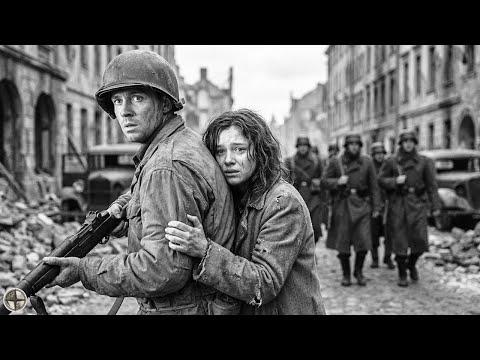
Behind her, a Soviet major was already walking toward them, his hand resting on his pistol. His eyes burned with cold satisfaction. He had found his prey. The woman’s name was Analise Vogler, a German nurse who had spent four years treating wounded soldiers. Now she was running from the Soviet advance, clutching forged papers and a prayer. But Major Arkady Stelnikov had recognized her. Under the Yalta agreement, Allied forces were obligated to hand over German military personnel to Soviet custody. Everyone knew what that meant: interrogation, labor camps, a slow death in Siberian ice.
Emmett had three seconds to decide. Follow orders and hand her over to certain death—or lie to his commanding officers, commit treason, and become a hunted deserter.
He covered her shaking hands with his own. “She’s coming with me, sir. I need to question her. She claims to have intelligence on remaining German positions.” The words were pure invention. He was a mechanic, not an interrogator. But he said them anyway, his voice steadier than the terror coiling in his gut.
Stelnikov’s eyes narrowed. “This woman is German military personnel. She belongs in Soviet custody for war crimes investigation.”
“And if she has intelligence that could save American lives, I need to extract that information first.” Emmett was making everything up as the words left his mouth. The Soviet major studied him with cold calculation, then spoke through clenched teeth: “Your superiors will hear of this, private. You are making a very serious mistake.” He turned and walked away, already scanning the crowd for easier prey.
That night, Emmett lay in his bunk, staring at the canvas ceiling. Twenty yards away, hidden behind stacks of spare tires in the motorpool, Analise Vogler curled between jerry cans, barely visible in the shadows. He had given her his canteen and two K-ration bars. He had promised to return at dawn. Now, unable to sleep, he understood the full weight of what he had done. He had lied to a Soviet officer. He had lied to his own sergeant. He had hidden enemy military personnel on an American base. Any single one of these crimes meant court-martial. All three together might mean a firing squad.
Dawn arrived too quickly. Emmett pulled on his uniform with trembling hands and walked through camp trying to look normal. He found Analise exactly where he had left her. When she heard his footsteps, she sat up fast, eyes wide with fear—then recognized him and sagged with relief.
“I thought maybe you would not come,” she whispered in broken English. “I thought maybe you would decide it is too dangerous.”
Emmett knelt down, checking they were alone. “I promised, didn’t I?” He handed her fresh water and his own breakfast rations. She took them with shaking hands. Then she asked the question he had been dreading: “What happens now? You cannot hide me forever.”
He pulled out a wrinkled map stolen from the headquarters tent. “We’re going to make some up.” For the next forty-five minutes, crouched in a hiding spot that smelled of motor oil and canvas, they constructed the most elaborate lie of both their lives. He showed her positions on the map; she told him which ones were real, which units had passed through, which details would sound believable. He asked questions an interrogator might ask; she practiced answers that mixed truth with invention.
But the real danger hadn’t even started. At 0900 hours, Emmett was summoned to Lieutenant Prescott Halloway’s tent. Halloway was a West Point graduate who ran everything by regulation. “Major Stelnikov filed a formal complaint this morning,” he said, not looking up from his paperwork. “He claims you obstructed Soviet authority and detained a German military nurse without authorization. He claims this woman is wanted for war crimes.”
Emmett’s heart dropped into his boots. War crimes? That was new information. That changed everything.
“Sir, the woman claimed she had intelligence on Wehrmacht positions and supply locations in the Torgau sector. I secured her for S2 interrogation according to standard procedure.”
Halloway finally looked up, his eyes hard as granite. “According to what standard procedure exactly? You’re a mechanic, Crow. Not intelligence. Not an interrogator. What made you think you had authority to detain anyone?”
Emmett scrambled for an answer that would hold. “Sir, during the Bulge, we were briefed that any potential intelligence source should be secured immediately. German medical personnel often have detailed knowledge of unit movements and casualty figures. I thought—”
“You thought.” Halloway’s voice was flat and cold. “Do you know what Major Stelnikov claims this woman actually did?”
“No, sir.”
“He says she was assigned to a Wehrmacht hospital that performed medical experiments on Soviet prisoners. He says she’s wanted for questioning about crimes against humanity.”
The words hit Emmett like a punch to the chest. He thought about Analise’s scarred hands, her exhausted face, the way she had begged him not to let them take her. Was it possible? Had he protected someone who had done terrible things? No. He had looked into her eyes. He had seen fear, not guilt. And even if Stelnikov’s accusations contained some truth, Emmett doubted the Soviets wanted her for legitimate justice. They wanted revenge. They wanted someone to punish for four years of brutal warfare.
“Sir, with respect, she claims she helped American prisoners of war. That should be verified before we hand her to anyone.”
Halloway studied him for a long, uncomfortable moment. “You believe her story?”
“Yes, sir. I do.”
Another lie. Emmett wasn’t sure what he believed anymore. He only knew that handing her over felt wrong in a way he couldn’t explain.
Halloway sighed heavily. “Here’s what’s going to happen. You’re going to deliver this woman to Captain Stretch at S2 this afternoon. Intelligence will interrogate her properly. If she has legitimate information, we’ll process it through official channels. If she doesn’t—or if Stelnikov’s allegations have any merit—she goes to Soviet custody immediately. Clear?”
“Yes, sir.”
“Dismissed.”
Emmett left the tent feeling like a man standing on thin ice, hearing cracks spread beneath his feet with every step. He had maybe four hours before S2 expected delivery of a prisoner. A prisoner he had hidden in the motorpool. A prisoner he had filled with rehearsed lies that wouldn’t survive professional interrogation.
Back at the motorpool, he found Analise sitting exactly where he had left her, knees pulled to her chest, eyes huge with waiting. “We have a problem,” he said without any gentle introduction. “They’re claiming you committed war crimes. Medical experiments on Soviet prisoners.”
Her face drained of all color. “No. Never. That is a lie. I treated wounded—German and Allied. I never harmed anyone. I tried to save lives. That was my only purpose.”
“I believe you. But Stelnikov is pushing hard. He wants you badly. And S2 expects me to deliver you to Captain Stretch in four hours for proper interrogation.”
Analise started shaking. Her whole body trembled with a fear she could no longer control. “If they give me to the Soviets, I will not survive interrogation. They will not care about truth. They will make me confess to anything. They will break me until I say whatever they want me to say.”
Emmett knelt in front of her. “Then we don’t let them take you.”
“How? You said yourself you cannot hide me forever.”
“I know what I said. But I’m figuring something out.” He had no idea what, but saying the words out loud made them feel almost possible.
Analise looked at him with eyes that had stopped hoping days ago and were now trying to hope again. “You have helped me so much already. You should not risk more. You should let me go. Tell them I escaped. Tell them you tried to stop me. Tell them it is not your fault.”
The suggestion was logical. Emmett could claim she had overpowered him, stolen a vehicle, disappeared into the chaos of postwar Germany. He would face minor discipline, maybe lose a rank, but nothing serious. His life would continue.
He looked at this woman he had known for less than twenty-four hours—this stranger who had grabbed his arm and changed everything. He thought about Dez Kavanaugh bleeding out in frozen snow, whispering that promise, making Emmett swear to protect the ones who couldn’t fight back.
“No,” he said simply. “I’m not letting you go. We’re seeing this through together.”
Analise’s eyes filled with tears. “Why? You don’t know me. You don’t owe me anything.”
“My best friend died saving my life. Maybe this is how I pay that forward. Or maybe I’m just tired of following orders that feel wrong. Either way, you’re stuck with me.”
She reached out and touched his hand—a small gesture that meant everything. “You are a good man, Emmett.”
“I’m a mechanic from Boston who’s in way over his head.” He stood up. Decision made. “Can you drive?”
She blinked in confusion. “Drive what?”
“A truck. Can you drive a truck?”
“Yes—in hospital, sometimes I drive ambulance.”
Emmett grabbed a canvas bag and started shoving supplies into it—rations, water, medical kit, map. “Then we’re leaving. Now. We’re getting out of this camp, crossing to British lines, and disappearing before anyone realizes we’re gone.”
Analise stared at him. “That is desertion. They will hunt you. They will execute you if they catch you.”
“Only if they catch us.” He looked at her directly. “Unless you want to wait for S2, get interrogated, then handed to the Soviets.”
Analise stood up, still shaking, but with something new in her eyes—determination, hope. “Then we go together.”
The truck’s engine coughed twice and died. Emmett turned the key again. Nothing—just a clicking sound that echoed through the empty forest like a death sentence. They had made it maybe forty kilometers before the fuel gauge dropped into the red. Now both fumes and prayers had run out.
“We walk,” Emmett said, grabbing the supply bag. The pine forest pressed in around them, thick undergrowth making every step a struggle. Behind them, distant Russian voices carried through the trees.
They found a shallow cave beneath a ridge, barely big enough for two. Boots crunched on pine needles outside as flashlight beams swept the darkness. Emmett put his hand over Analise’s mouth, and they waited. The footsteps passed. The voices faded. “They’ll be back at dawn with dogs,” he whispered. “We move before sunrise.”
Gray light revealed the search had intensified—trucks, shouting, a joint Soviet-American operation. Then Emmett saw it through the foliage: a British flag, limp in the still air. Fifty meters of open ground. They burst from the treeline, sprinting across plowed earth. Rifles cracked behind them. Something slammed into Emmett’s shoulder, spinning him into the mud. “Run! Leave me!” he shouted. Analise grabbed him instead, pulling with desperate strength, and they staggered the last meters into British lines.
Sergeant Perry raised his rifle at the pursuing soldiers. “This is British territory. Whatever is happening stops at this line.” Stelnikov raged, but the standoff held. Asylum was granted—weeks later, Emmett’s shoulder healed, and in June he asked Analise to marry him for real. She said yes.
Sixty years later, a great-granddaughter asked how they met. Analise smiled. “She grabbed my arm and said, ‘Don’t let them take me.’ I decided right then that I wouldn’t. Not ever.” Some orders exist only to be broken. Some strangers are worth everything.
What would you have done in those three seconds at the Elbe River?
Report this article
Select a reason for reporting:






