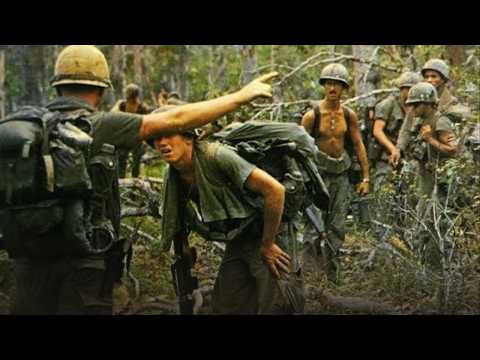
Captain Thomas Bradley had seen combat. He had led men through firefights, been decorated for bravery, and considered himself a competent, experienced officer. But nothing in his seven months in Vietnam had prepared him for the sight of four Australian SAS operators making his entire platoon look like clumsy amateurs.
The jungle was dense, unforgiving, and alive with enemy movement. Bradley’s 32 men sweated and struggled, making noise despite their best efforts. The four Australians moved like ghosts—silent, invisible, and infuriatingly calm. They found enemy sign that Bradley’s point man had walked right past. They communicated with hand signals so subtle that Bradley couldn’t even tell when they were giving orders.
When the platoon stopped for a security halt, Bradley confronted the Australian patrol leader, Sergeant Danny Clark. “You’re making my men look bad. If this is some kind of demonstration to show off Australian superiority, you can stop now. We get it. You’re very skilled.”
Clark’s expression was not quite pity, but close. “Captain, we’re not showing off. We’re just doing the job. If your men look bad, that’s not our fault. That’s their training.”
Bradley felt his face flush with anger. His men were trained to the highest American standards. They were professional soldiers. Clark nodded slowly. “They are professional soldiers. We’re not soldiers, Captain. We’re hunters. And if you keep watching, you might learn the difference.”
Before Bradley could respond, Clark dropped into a crouch, hand up in a freeze signal. The four Australians became statues. Bradley’s platoon, reacting to the signal, also stopped and took cover. For 60 seconds, nothing happened. Then Bradley heard it—voices speaking Vietnamese, very close. The enemy was moving on a trail 30 meters to their east, and Bradley’s platoon had walked right past them without detecting them. The Australians had known they were there for the last 200 meters. They just hadn’t bothered to tell Bradley because, as Clark later explained, “You learn better when you make mistakes.”
What happened over the next four hours would turn Bradley from an angry skeptic into a believer who would spend the rest of his military career trying to get American forces to learn from what he witnessed.
The patrol continued, and with each passing hour, Bradley’s frustration grew. The Australians found a concealed trail that his point man had missed. They spotted a tree marked with a machete cut indicating enemy direction of travel. They uncovered a small weapons cache buried in a disturbed area. Every discovery felt like a rebuke, a deliberate attempt to make American forces look incompetent.
Bradley’s platoon sergeant, a veteran named Mike Rodriguez with two previous tours in Vietnam, picked up on his commander’s mood. “Sir, they’re not trying to embarrass us. They’re just that good. Maybe we should be learning instead of getting pissed off.”
Rodriguez was right, but that didn’t make it easier to accept. Bradley had been taught at Fort Benning that American infantry tactics were the best in the world. He had internalized the idea that American military might was built not just on superior equipment, but on superior skill. And now, four Australians from a country with a military smaller than the New York Police Department were demonstrating skills that made his infantry training look inadequate.
The really infuriating part was how casual the Australians were about it. They weren’t arrogant or boastful. They just quietly, efficiently did things that American forces struggled with and acted like it was normal—like this was just how you operated in the jungle. No big deal.
When the patrol finally returned to base, Bradley was exhausted, frustrated, and deeply troubled. He submitted his after-action report and, for the first time, was honest about Australian capabilities. He wrote that Australian SAS operators demonstrated fieldcraft and tactical proficiency that exceeded American standards, that their methods produced superior results in jungle environments, and that American forces could benefit significantly from studying Australian techniques.
He expected the report to be well-received. Instead, he was called into his battalion commander’s office and told in no uncertain terms that reports criticizing American methods while praising foreign forces were not helpful and would not be forwarded up the chain of command. His battalion commander, a full colonel with 22 years of service, had built his career on executing American doctrine perfectly. The suggestion that a foreign military had better methods was not something he was prepared to accept.
But Bradley wasn’t the only American officer having this experience. Throughout 1967 and 1968, as more American units operated alongside Australian forces, similar observations were being made. American special forces operators who worked with Australian SAS filed reports noting their extraordinary capabilities. American infantry officers who observed Australian operations noted their effectiveness. American intelligence officers who analyzed the results noted that Australian forces achieved significantly higher kill ratios, gathered better intelligence, and suffered lower casualties than American forces operating in similar terrain.
The evidence was mounting that Australian methods were more effective for jungle warfare. But acknowledging that evidence required acknowledging that American doctrine had significant limitations—a bitter pill that American military culture struggled to swallow.
Some American units did learn. Special forces teams that operated alongside SAS patrols began adopting Australian techniques: smaller patrol sizes, longer duration operations, less reliance on firepower, and more emphasis on stealth and noise discipline. Some of these lessons filtered back into American special operations training. But the conventional forces—the infantry battalions that did most of the fighting—largely continued operating the way they always had. They had doctrine to follow, and doctrine didn’t change quickly, especially when changing it meant admitting that a smaller ally had figured out something you’d missed.
The institutional resistance came from multiple sources: professional pride, institutional inertia, cultural bias, and the practical reality that American forces operated under different constraints. American soldiers served 12-month tours, rotating constantly, which meant units lost institutional knowledge. Australians served longer tours with lower rotation rates, allowing SAS patrols to develop experience American units couldn’t match. American forces faced intense political pressure to produce body counts and visible results. Australians could afford to be patient, to spend weeks gathering intelligence before striking.
These structural differences meant that even if American forces wanted to adopt Australian methods completely, they might not be able to. But that didn’t make it less frustrating for officers like Bradley who recognized that Australian methods worked better and couldn’t get their own organizations to adapt.
The confrontation that gave this story its title happened in November 1968 during a joint planning session for a major operation in Phuoc Kai province. Bradley was present along with his battalion commander and several other American officers. The Australian contingent included the SAS squadron commander and several patrol leaders, including Sergeant Clark.
The operation being planned was a large-scale search and destroy mission targeting a suspected NVA battalion base camp. The American plan was conventional: air assault insertion of two infantry companies supported by artillery and helicopter gunships, sweep through the suspected area, destroy any enemy forces encountered, extract after 48 hours.
The Australians had a different suggestion. Insert a small reconnaissance element to locate the exact position of the enemy base before committing large forces. Once located, use precision air strikes and artillery to destroy the base without risking ground forces unnecessarily. Only commit infantry if high-value targets could be captured or intelligence materials needed to be recovered.
The American battalion commander rejected the Australian suggestion immediately. “We’re not going to sit around for weeks while a recon team wanders through the jungle. We have intelligence indicating the enemy is there. We have the force to destroy them. We insert. We find them. We kill them. That’s how infantry operations work.”
The Australian squadron commander, a major named Peter Williams, remained calm. “Sir, your intelligence indicates the enemy might be in a general area of approximately 10 square kilometers. That’s a lot of jungle to search with ground forces. If you insert without precise location, you’re likely to spend two days searching and find nothing. Or worse, you’ll walk into an ambush because the enemy will hear your helicopters coming and prepare defensive positions. Our way: you get exact location. You hit them with supporting fires when they’re not expecting it. You achieve better results with lower risk.”
The American colonel’s face reddened. “Major, I appreciate your input, but this is an American operation in an American tactical area of responsibility. We’ll conduct it according to American doctrine, not Australian hunches.”
Williams nodded slowly. “Understood, sir. But perhaps your Captain Bradley can speak to what he observed during his patrol with my men last month. Maybe he has insights on the effectiveness of different approaches.”
All eyes turned to Bradley. He could feel the weight of his battalion commander’s expectations: say the right thing, support American methods, don’t make waves. But he also remembered those four Australians calmly eliminating seven enemy soldiers with seven shots. He remembered how they’d found things his men missed. He remembered Rodriguez saying, “Maybe we should be learning instead of getting pissed off.”
Bradley took a breath. “Sir, I think the Australian suggestion has merit. From what I observed, their reconnaissance capabilities significantly exceed ours. If they say they can locate the exact enemy position, I believe them. And precision strikes would probably achieve better results than a ground sweep.”
The silence in the room was heavy. The colonel stared at Bradley like he had just committed treason. “Captain, are you seriously suggesting we defer to Australian methods for an American operation?”
Bradley met his eyes. “I’m suggesting we use the best methods available, sir. Regardless of whose doctrine they come from.”
That’s when Sergeant Clark made the mistake of smiling. It was a small smile, barely there, but the colonel saw it and something in him snapped. He turned to Clark, his voice sharp with anger. “Sergeant, is something funny?”
Clark’s smile disappeared immediately. “No, sir. Just appreciating the captain’s honesty, sir.”
The colonel stood up, his chair scraping loudly. “This is exactly the problem. You Australians come in here with your cowboy tactics and your four-man patrols and act like you’ve reinvented warfare. Well, you haven’t. You’re just taking unnecessary risks and getting lucky. And frankly, I’m tired of it. I’m tired of your showing off, your subtle implications that American forces don’t know what we’re doing.”
Clark stood as well, no longer smiling. “Sir, with respect, we’re not showing off. We’re doing the job the best way we know how. If that makes you uncomfortable, that’s not our problem.”
The colonel’s voice rose. “It damn well is your problem, Sergeant, because you’re undermining American credibility with this Rambo bullshit. Four men accomplishing what it takes us a company to do. Staying in the jungle for weeks without support. Ambushing enemy forces and making it look easy. Stop showing off. Just stop it. Operate like professionals, not like you’re trying to impress people.”
The room was dead silent. Major Williams stood slowly. “Colonel, I think we should take a break and cool down.”
But Clark wasn’t done. His voice was quiet but hard as steel. “Sir, we operate the way we do because it works. It keeps our men alive and it kills the enemy efficiently. If that looks like showing off to you, I suggest that says more about your standards than ours.”
The colonel looked like he was about to explode. Bradley actually thought he might physically attack Clark, but Williams stepped between them. “Sergeant, outside. Now.”
Clark snapped a perfect salute to the American colonel, about-faced, and walked out. The meeting broke up shortly after, mission plan unchanged. Americans and Australians going their separate ways.
The operation launched three days later, exactly as the American colonel had planned. Two companies inserted via helicopter into the suspected area. They found nothing. The enemy had heard the helicopters coming and dispersed. The American forces spent 48 hours sweeping through empty jungle, found no significant enemy contact, and extracted having accomplished nothing except confirming that the enemy had been in the area recently.
A week later, an Australian SAS patrol located the NVA battalion in a new position eight kilometers from where the Americans had searched. Precision air strikes destroyed their base camp, killing an estimated 40 enemy soldiers and destroying significant supplies. The Australians used four men on a three-week patrol. Zero Australian casualties.
The contrast was stark and humiliating. Captain Bradley requested transfer to a special forces unit shortly after, specifically so he could learn more about Australian methods and incorporate them into American special operations. His request was approved, and he spent the remainder of his tour working closely with Australian SAS, learning their techniques and becoming one of the most vocal advocates for adopting Australian fieldcraft and patrol tactics.
Sergeant Clark and Major Williams continued operating the way they always had, conducting mission after mission that proved the effectiveness of their approach. They never gloated. They never said, “We told you so.” They just kept doing the job with quiet professional competence, letting results speak for themselves.
The story of American anger at Australian SAS effectiveness is really a story about how hard it is to learn when learning requires admitting you were wrong. American forces in Vietnam weren’t bad soldiers. They were brave, dedicated, professional. But they were fighting using doctrine designed for a different war. And when confronted with evidence that different approaches worked better, institutional pride made it nearly impossible to adapt.
The Australians weren’t trying to show off. They were just trying to survive and complete their missions using methods that their experience had taught them were effective. The fact that those methods made American forces look less capable by comparison was an unfortunate side effect, not an intended outcome.
But perception mattered as much as intention. And the perception among many American officers was that the Australians were deliberately embarrassing American forces to promote their own reputation. That perception—rooted in wounded pride rather than reality—prevented many American units from learning lessons that could have saved lives.
Some American forces did learn. Special operations units absorbed Australian techniques and improved their own capabilities. But the conventional forces—the bulk of American combat power—largely continued fighting the way they’d always fought, using doctrine that was proven in other wars, applying methods that made sense within American military culture, achieving results that were respectable by any objective standard except one: comparison to what the Australians were achieving with a fraction of the resources.
The final irony is that the lessons American forces struggled to learn in Vietnam would have to be relearned in Iraq and Afghanistan 40 years later. Once again, American forces would discover that overwhelming firepower and large-unit tactics were less effective than small-unit operations with emphasis on intelligence and precision. Once again, special operations forces would lead the way in adapting to new realities, while conventional forces struggled with doctrine that didn’t fit the operational environment. And once again, smaller Allied forces—including Australian SAS—would demonstrate capabilities that exceeded what larger American forces could match.
History repeating. Different war, same lessons, same resistance to learning them.
Captain Bradley’s story had a happy ending. He became a colonel, commanded a special forces group, and spent his career advocating for the kind of flexible, adaptive tactics the Australians had shown him in that jungle in 1968. He never forgot Clark calmly eliminating seven enemy soldiers with seven shots, or Williams quietly explaining that Australian methods worked because they were designed for actual conditions rather than doctrinal preferences. And he never forgot his own anger at being shown that American methods weren’t always best—and how that anger had nearly prevented him from learning the most valuable lessons of his military career.
The angry colonel who had yelled “Stop showing off” retired shortly after Vietnam. His career was damaged by the perception that he was inflexible and unable to adapt to changing circumstances. Clark and Williams both survived the war, returned to Australia, and continued serving in the SAS, training the next generation of operators using the same methods that had worked so well in Vietnam.
The legacy of their effectiveness lives on today in how special operations forces worldwide think about small-unit tactics, long-range reconnaissance, and the balance between firepower and stealth. They weren’t showing off. They were just warriors who had figured out how to fight effectively in an environment where conventional doctrine failed. And sometimes being that good at your job makes people angry—especially when their pride depends on believing they’re the best.
Bradley never forgot the lesson Clark taught him that day. He carried it through every command, every training exercise, every after-action review. “The jungle doesn’t care about your rank or your doctrine,” he would tell young officers. “It only cares whether you can adapt.”
Years later, as a colonel, he watched a new generation of soldiers struggle with the same pride he once felt. He saw himself in their angry resistance. And he smiled, remembering four Australians who moved like ghosts.
So what do you think? Was the colonel’s anger justified, or was it the biggest obstacle to victory?
Report this article
Select a reason for reporting:






