In the shadow of the Cold War’s final years, a secret project took shape behind closed doors in Moscow. The MiG 1.44 was designed to be Russia’s answer to America’s advanced tactical fighter—a machine that would dominate the skies with stealth, speed, and agility. But as the Soviet Union crumbled, so too did the dream of this next-generation fighter. What emerged was a stunning prototype that flew only twice, then vanished into history. This is the story of an aircraft that could have changed the balance of air power—but never got the chance.
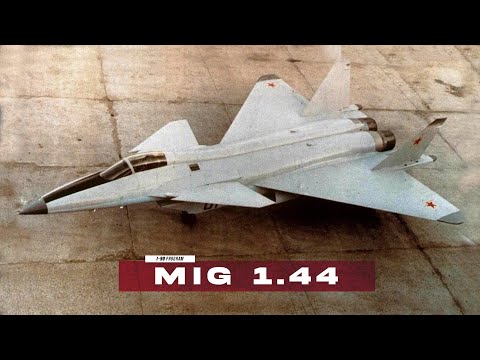
The early 1980s were a time of intense competition. The Soviet Union had just introduced the MiG-29 and Su-27, impressive fourth-generation fighters that matched their American counterparts. But Soviet planners were already looking ahead. They launched the I-90 project, a bold initiative to develop a fifth-generation fighter by the 1990s. The goal was clear: create a multirole aircraft that could outperform the F-22 Raptor and Europe’s Eurofighter. Unlike the American ATF project, which prioritized stealth above all, the Soviet design would emphasize agility, speed, and versatility.
Mikoyan, the legendary design bureau behind the MiG-29, took the lead. They proposed two concepts: a lightweight frontline fighter and a heavy multirole platform. Both would share components to save costs, but as the Soviet economy faltered, budget constraints forced tough choices. By 1987, the designs had evolved into something radical. The heavy multirole, known as Project 142, featured a delta wing with canards, thrust-vectoring engines, and an internal weapons bay. It was a bold leap forward, blending supermaneuverability with reduced radar cross-section.
“The canards, wing, and tail would allow sustained high AoA maneuvers up to 60° with minimal buffeting and good lift,” one engineer noted. Wind tunnel tests suggested the aircraft could supercruise at Mach 1.5, track 40 targets simultaneously, and reach speeds of Mach 2.35. On paper, it was a masterpiece.
But then history intervened. In 1991, the Soviet Union collapsed, plunging Russia into economic chaos. Military funding evaporated overnight. Mikoyan struggled to keep the project alive, building components with whatever resources remained. The lightweight fighter was scrapped, and the heavy multirole—now designated MiG 1.44—became the sole focus. Ground tests began in 1994, but high-speed taxi trials revealed troubling instability. The fly-by-wire system, essential for controlling the aircraft’s unstable design, was still unproven.
Mikoyan pleaded with the government for more money, but the coffers were empty. In 1995, a request to declassify the project was denied. The MiG 1.44 was a dead end—a technological marvel with no future. Meanwhile, rival Sukhoi had pivoted to export markets, selling Su-30s and Su-35s to keep afloat. Mikoyan, desperate, tried the same. Finally, in 1998, the project was revealed to the world. Photos emerged of a sleek, menacing fighter that looked every bit a fifth-generation predator.
On January 12, 1999, the MiG 1.44 was rolled out before journalists and military leaders. A year later, on February 29, 2000, it took to the skies for the first time. The flight lasted just 18 minutes, reaching an altitude of 3,000 feet. A second flight followed in April, lasting 22 minutes. Then—silence. No more flights were recorded. The MiG 1.44 was quietly shelved, superseded by the PAK FA program that would eventually produce the Su-57.
What could the MiG 1.44 have achieved? On paper, it boasted stealthy features, advanced avionics, and impressive performance. But financial reality doomed it. As one analyst put it, “The MiG 1.44 was more than vaporware—it was a testament to the creativity and ambition of its designers.” Yet its story remains a mystery, a tantalizing glimpse of what might have been.
The engineers who gathered at Mikoyan’s hangar in the winter of 2000 knew the odds were stacked against them. The first flight had proven the airframe could fly, but it had also exposed problems. The fly-by-wire system behaved erratically at low speeds, and the variable intake ramps—designed to maintain smooth airflow during aggressive maneuvers—had jammed during the second flight, forcing the test pilot to cut the sortie short.
“We were flying a machine that was twenty years ahead of its time, with twenty-year-old computers trying to keep it stable,” one flight control engineer later recalled. The irony was bitter: the aircraft’s instability, which gave it such potential agility, was exactly what made it dangerous to fly without flawless software.
Behind the scenes, Mikoyan’s leadership faced a harder truth. Even if the 1.44 could be perfected, the Russian Air Force had already shifted its gaze. The PAK FA program promised a cleaner slate, one backed by fresh government commitments and a mandate to produce a true fifth-generation fighter for the 21st century. The 1.44, for all its promise, was now a relic of a different era—a Soviet answer to a Soviet question.
Yet the demonstrator’s story did not end quietly in a corner of the hangar. In the years that followed, the MiG 1.44 became something of a legend among aviation enthusiasts. Its distinctive canards, its sleek delta wing, and its menacing twin-tail profile appeared in magazines and early internet forums, fueling endless speculation. Some claimed the aircraft had secretly flown dozens of missions; others insisted it had never left the ground after 2000. The truth, as usual, was less dramatic—but no less fascinating.
Mikoyan engineers continued to use the airframe as a testbed for technologies that would later appear elsewhere. Data from the 1.44’s brief flight campaign informed work on thrust-vectoring nozzles and composite materials, feeding indirectly into later Russian designs. The N014 radar, though never fully operational on the 1.44, contributed to the development of the Irbis-E and Byelka systems that equipped the Su-35 and Su-57.
In a sense, the MiG 1.44 became a ghost that haunted Russian aviation—a reminder of what the industry might have achieved if the Soviet Union had survived, and a cautionary tale about the cost of ambition without resources.
By the mid-2000s, the demonstrator sat in a darkened hangar at Zhukovsky, its engines drained of fluid, its canopy taped shut against the dust. Visiting delegations were occasionally shown the aircraft as a curiosity—a symbol of what Mikoyan had once dared to build. Few outsiders understood that the 1.44 had never been intended as a production fighter at all. It was a technology demonstrator, a flying laboratory meant to validate ideas that would later migrate to other platforms.
“The 1.44 was never the destination,” a former Mikoyan engineer explained years later. “It was the road. Everything we learned from it—the unstable airframe, the canards, the integrated flight control—went into the next generation of Russian aircraft, even if the aircraft itself never did.”
That distinction mattered. While Western analysts often dismissed the 1.44 as a failed competitor to the F-22, Russian engineers saw it differently. The aircraft had proven that a delta-canard configuration could work at high angles of attack. It had validated composite construction techniques and demonstrated that thrust-vectoring nozzles could be integrated into a fighter-sized airframe. These were not trivial achievements.
What the 1.44 could not do was survive the brutal arithmetic of the post-Soviet economy. By 2001, Mikoyan’s resources were stretched thin. The bureau’s primary revenue came from maintaining aging MiG-29s for foreign customers and upgrading them to modern standards. The 1.44 program, which consumed millions of dollars with no prospect of a production order, was quietly terminated. No formal cancellation announcement was ever made. The aircraft simply stopped appearing in budget documents.
Meanwhile, the PAK FA program pressed ahead under Sukhoi’s leadership. The T-50 prototype, which would eventually become the Su-57, took its first flight in January 2010—a full decade after the MiG 1.44 had briefly left the ground. The comparison was inevitable. Both aircraft shared a similar mission profile: stealthy, supermaneuverable, multirole fighters designed to challenge American air dominance. But the Su-57 benefited from a stronger economy, sustained government investment, and a clearer requirements document.
Yet even the Su-57 struggled with many of the same challenges that had plagued the 1.44. Engine development lagged. Stealth coatings proved difficult to maintain. Production numbers remained modest. In private conversations, some Russian engineers admitted that the 1.44 had actually been more ambitious in certain respects—particularly its integrated canard design, which the Su-57 abandoned in favor of a more conventional layout.
“The 1.44 was a fighter designed by engineers who believed they were building the future,” one aviation historian noted. “The Su-57 was designed by engineers who knew they were building for a market.”
The distinction was subtle but important. The MiG 1.44 represented the last gasp of Soviet-era thinking—a belief that technology could overcome any obstacle, that sheer engineering brilliance could compensate for economic weakness. The Su-57 represented the new Russia: pragmatic, export-oriented, and painfully aware of its limitations.
Today, the MiG 1.44 remains at Zhukovsky, occasionally dusted off for air shows or museum displays. Its engines will never roar again. Its radar will never track a target. But for those who understand its story, the aircraft remains a powerful symbol—not of failure, but of what might have been.
In the end, the MiG 1.44’s legacy was never about production numbers or combat records. It was about the engineers who dared to dream beyond their circumstances. “We knew we were building something special,” one of them said, decades later. “Even if no one else saw it, we did.”
That quiet pride lingers at Zhukovsky, where the prototype now rests under a layer of dust. Visitors sometimes ask why it was never finished. The answer is simple: the country that conceived it no longer existed. But the ideas it carried—unstable airframes, composite construction, integrated flight control—lived on in the Su-57 and beyond.
So the MiG 1.44 was not a failure. It was a bridge between eras, a final flash of Soviet ambition before pragmatism took hold. Its story reminds us that progress is rarely linear, and that even abandoned projects can shape the future.
What do you think—could the MiG 1.44 have changed air combat if history had been kinder? Share your thoughts below.
Report this article
Select a reason for reporting:






