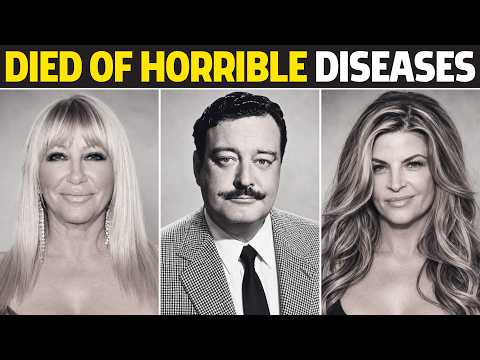
What if the funniest faces on television were fighting battles their audiences never saw? Behind the laughter, the applause, and the famous catchphrases, some of the most beloved sitcom legends faced devastating illnesses—often in private, sometimes for decades. A few received shocking diagnoses only months before the end. Others kept working while their health quietly collapsed, their smiles hiding the pain. If classic television still holds a place in your heart, you’re about to discover the untold stories of the stars who made you laugh, and the diseases that ultimately took them.
For millions, Suzanne Somers was the bright, carefree Chrissy Snow on Three’s Company, her comic misunderstandings and wide-eyed reactions making the sitcom a massive hit. Later, Step by Step introduced her to a new generation. But away from those cheerful sets, Somers endured a medical struggle lasting more than two decades. She was diagnosed with breast cancer in 2000, underwent surgery and radiation, and later revealed the disease had returned. She had also dealt with skin cancer earlier. What made her final chapter especially striking was the timing: Somers died at her Palm Springs home on October 15, 2023, just one day before what would have been her 77th birthday. Her long-time publicist said breast cancer had returned earlier that year after a battle stretching more than 20 years.
Few television entrances were as difficult as replacing a beloved character on a massive sitcom, yet Kirstie Alley managed it. When Rebecca Howe arrived at the Boston bar in Cheers, Alley created someone completely different from Diane Chambers—ambitious, emotional, unpredictable, and often hilariously overwhelmed. That performance brought her an Emmy and turned her into one of the most recognizable comedy stars of the late 1980s and early 1990s. Audiences later watched her in Veronica’s Closet and the enormously popular Look Who’s Talking films. Her final illness, however, developed with frightening speed. Alley’s children announced in December 2022 that their mother had died following a recently discovered cancer. Her representative later confirmed it was colon cancer. The diagnosis had apparently come only a short time before her death. She was 71.
Long before Dorothy’s born act became famous for silencing a room with one cutting look, Bea Arthur had already changed television through Maude. Her deep voice, perfect timing, and fearless delivery made her unlike almost anyone else in American sitcoms. Then came The Golden Girls. Alongside Betty White, Rue McClanahan, and Estelle Getty, Arthur helped turn four older women sharing a Miami home into one of television’s most enduring comedy ensembles. The illness that ended her life was kept relatively private. Arthur died at her Los Angeles home on April 25, 2009, surrounded by family. Her spokesman initially described the illness simply as cancer, while later accounts identified lung cancer and complications from the disease. She was 86.
Every week, Samantha Stephens could solve almost any problem with a twitch of her nose. That charming fantasy turned Elizabeth Montgomery into one of the defining television stars of the 1960s and made Bewitched an international favorite. The real world offered no magical solution when Montgomery became seriously ill. In the spring of 1995, doctors discovered colorectal cancer at an advanced stage. Reports indicate that the diagnosis came only about two months before her death. The speed was devastating. Montgomery had continued working and had completed the television movie Deadline for Murder shortly before her health dramatically worsened. She died at her Beverly Hills home on May 18, 1995, at only 62.
Television comedy might look completely different without the man who played Ricky Ricardo. Beyond performing opposite Lucille Ball, Desi Arnaz helped develop production methods through Desilu that influenced the way sitcoms were filmed and preserved for generations. Decades of success could not protect him from a serious diagnosis. Arnaz, a long-time smoker, was diagnosed with lung cancer in 1986. By the final months of that year, his condition had severely weakened him. One of the most emotional details came from daughter Lucie Arnaz: shortly before her father died, Lucille Ball telephoned him. Their conversation happened on November 30, the anniversary of the day they had married in 1940. Despite having divorced years earlier, the bond between them had never completely disappeared. Two days later, on December 2, Arnaz died at 69.
Few sitcom characters became as permanently connected to an actor as Ralph Kramden became to Jackie Gleason. Loud, frustrated, ambitious, and forever dreaming of a better life, Ralph helped make The Honeymooners one of early television’s most influential comedies. By the time Gleason made one of his final movies, Nothing in Common, his health had become much more serious than the public fully understood. During production, he was diagnosed with colon cancer. The disease had already spread to his liver. Gleason was also dealing with diabetes, circulatory problems, and a history of heart trouble. Yet he finished his work, delivering a performance far removed from the explosive Ralph Kramden. On June 24, 1987, Gleason died at his Florida home at 71.
Under heavy makeup, a flat-topped head, and oversized shoes, one of television’s strangest fathers became strangely lovable. Fred Gwynne’s Herman Munster looked frightening, but the joke was that Herman was usually sweeter and more innocent than the supposedly normal people around him. That role followed Gwynne for decades, even though his career extended far beyond The Munsters. He worked on stage, wrote and illustrated children’s books, and later delivered memorable film performances, including Judge Chamberlain Haller in My Cousin Vinny. His final illness was pancreatic cancer, one of the more aggressive forms of the disease. Gwynne spent his last period largely away from Hollywood at his Maryland home. He died on July 2, 1993, at 66, only days before his 67th birthday.
That famous hat toss represented optimism, independence, and the promise that Mary Richards was going to make it after all. Mary Tyler Moore became more than a sitcom star—she helped redefine what a female television lead could look like. Health problems followed her for much of adulthood. At 33, Moore was diagnosed with type 1 diabetes, and she later became a major advocate for diabetes research. Her vision also deteriorated significantly during her later years. In January 2017, Moore was hospitalized with pneumonia. Her official cause of death was cardiopulmonary arrest, while pneumonia, low oxygen levels, and diabetes were reported as contributing medical problems. She died on January 25 at 80.
Comedy rarely felt as fearless as it did when Bernie Mac looked directly into the camera and announced exactly what was on his mind. The Bernie Mac Show turned his fictionalized family life into one of the most distinctive sitcoms of the early 2000s. Long before most viewers knew anything was wrong, Mac had been living with sarcoidosis, an inflammatory disease that can affect the lungs and other organs. He publicly discussed the condition and reportedly dealt with it for many years. In 2008, pneumonia sent him to Northwestern Memorial Hospital in Chicago. His publicist emphasized that pneumonia caused his death rather than sarcoidosis itself, although his history of lung disease remained an important part of his medical story. Mac died on August 9, 2008, at only 50.
Nothing about Andy Kaufman was predictable. Even viewers of Taxi sometimes wondered where Latka Gravas ended and Kaufman’s strange performance experiments began. He deliberately confused audiences, staged elaborate jokes, and spent years making people question whether anything he did was completely real. That reputation created one of the strangest reactions to a celebrity illness in entertainment history. In late 1983, Kaufman was diagnosed with a rare form of lung cancer. He had reportedly never been a regular smoker, making the diagnosis even more startling. His appearance changed rapidly as treatment continued. Still, because Kaufman had built a career around fooling the public, some people initially wondered whether the illness itself was another performance. It was not. Kaufman died on May 16, 1984, at only 35.
Inside Frasier Crane’s elegant Seattle apartment, Martin Crane provided the perfect disruption. His old recliner, beloved dog Eddie, beer, and blunt common sense constantly collided with the refined tastes of Frasier and Niles. John Mahoney turned that conflict into 11 seasons of brilliant comedy. What audiences rarely saw was how much serious illness Mahoney had already experienced. Years before Frasier, he survived colon cancer and underwent major treatment. Later reports said he also dealt with other cancers during his lifetime. His final illness was throat cancer. By early 2018, Mahoney was receiving hospice care in Chicago, the city where he had built his respected stage career long before becoming an international television star. He died on February 4, 2018, at 77 from complications connected to throat cancer.
For almost a decade, one of comedy’s most recognizable voices was privately living with cancer while very few people outside his closest circle knew anything about it. Norm Macdonald was best known to many viewers from Saturday Night Live, but he also led his own sitcom, The Norm Show, playing a former hockey player forced into community service as a social worker. His dry delivery made even ordinary lines sound dangerous because audiences could never predict where the joke was going. Macdonald reportedly received a multiple myeloma diagnosis in 2013 and chose to keep the illness private. He underwent treatment, including stem cell transplants. The cancer went into remission, but his medical problems did not end there. Years later, he developed treatment-associated myelodysplastic syndrome, which eventually progressed into acute myeloid leukemia. He continued working while hiding the seriousness of his condition from the public. On September 14, 2021, Macdonald died at 61 from complications of acute leukemia.
Few supporting characters became popular enough to carry their own successful sitcom, but Rhoda Morgenstern did exactly that. Valerie Harper made Mary Richards’ best friend sarcastic, vulnerable, funny, and instantly relatable before taking the character into the hit spin-off Rhoda. Her medical story became almost as extraordinary as her television career. Harper was diagnosed with lung cancer in 2009 and underwent treatment. Then, in 2013, doctors discovered leptomeningeal carcinomatosis, a rare condition in which cancer cells spread into the membranes and fluids surrounding the brain and spinal cord. The initial outlook was devastating. Reports widely noted that Harper was given only a short amount of time to live. Instead, she kept going for more than six years. Rather than disappear completely from public life, Harper continued acting, gave interviews, and even competed on Dancing with the Stars. Her attitude transformed her into a highly visible cancer advocate. She died on August 30, 2019, at 80.
Before television audiences loved to hate J.R. Ewing on Dallas, Larry Hagman had already become a comedy star as astronaut Tony Nelson on I Dream of Jeannie. For five seasons, he tried desperately to maintain a normal military career while Barbara Eden’s magical genie turned his life upside down. His later health history was far less playful. Years of serious medical problems included liver disease severe enough to require a transplant in 1995. Hagman recovered and continued working, eventually returning to Dallas decades after the original series made him famous. Then another major illness appeared. Hagman died on November 23, 2012, at 81. His family said cancer complications caused his death, and biographical accounts identify acute myeloid leukemia among the conditions involved. Remarkably, he was still playing J.R. Ewing during the final year of his life.
Frank Barone could complain about almost anything. Food, money, marriage, his sons, the temperature of the room—nothing escaped his judgment. Yet Peter Boyle made Frank’s constant irritation so funny that the character became one of the essential ingredients of Everybody Loves Raymond. Behind the performance, Boyle faced multiple serious health problems. He had suffered a stroke in 1990 and later experienced a heart attack while working on the sitcom. By the final period of his life, he was living with both heart disease and multiple myeloma, a cancer affecting plasma cells in the bone marrow. Boyle died at New York Presbyterian Hospital on December 12, 2006. He was 71.
Late in his career, Louie Anderson surprised audiences with one of his most acclaimed performances. Playing Christine Baskets, the loving mother of Zach Galifianakis’s twin characters on Baskets, Anderson disappeared into a role inspired partly by memories of his own mother. The performance earned him an Emmy and showed a completely different side of a comedian many viewers associated with stand-up, Family Feud, and Life with Louie. Then came news that he was hospitalized in Las Vegas. Anderson had diffuse large B-cell lymphoma, an aggressive form of non-Hodgkin lymphoma. In January 2022, his publicist confirmed that he was receiving treatment. Only days later, the situation ended far more quickly than many fans expected. He died on January 21 at 68 from complications connected to the cancer.
For an entire generation, Samuel “Screech” Powers seemed permanently young. Dustin Diamond began playing the character as a child and continued through Saved by the Bell, The College Years, and The New Class. Few sitcom performers remained associated with one role for such a large portion of their lives. His final illness arrived with terrifying speed. In January 2021, Diamond entered a hospital after experiencing worrying symptoms. Doctors diagnosed stage four small cell carcinoma, an aggressive form of lung cancer. The diagnosis was already advanced. Only around three weeks later, on February 1, Diamond died at 44. His representative explained that the cancer had progressed extremely quickly. Diamond had reportedly said he was not a smoker, which also challenged the common misconception that lung cancer affects only people with a history of smoking.
He began as little more than a background employee at Central Perk. Somehow, Gunther grew into one of the most recognizable recurring sitcom characters of the 1990s. James Michael Tyler’s bleached hair, quiet obsession with Rachel, and permanent irritation toward Ross turned a small role into more than a decade of memorable comedy on Friends. Years later, viewers learned that Tyler had been facing an advanced illness. He was diagnosed with prostate cancer in 2018. The disease eventually spread to his bones and spine, dramatically affecting his mobility. By the time Tyler publicly revealed the diagnosis in 2021, he was using a wheelchair. That explained why his participation in Friends: The Reunion had been limited to a remote appearance. Tyler died at his Los Angeles home on October 24, 2021. He was only 59.
Standing beside a young Tom Hanks in Bosom Buddies could easily have turned Peter Scolari into a forgotten sidekick, once Hanks became a movie superstar. Instead, Scolari built a respected television career entirely his own. His finest sitcom work may have come later on Newhart. As television producer Michael Harris, he transformed vanity and security and ridiculous confidence into an Emmy-nominated comic character. Decades afterward, Scolari experienced another career high when his work on Girls earned him an Emmy. During his final two years, however, he was privately living with cancer. Scolari died in Manhattan on October 22, 2021, at 66. His manager confirmed that he had been dealing with the disease for approximately two years. The specific type of cancer was not widely disclosed, making it important not to invent details beyond what his representatives confirmed.
Before sitcom teenagers became sarcastic rebels, Wally Cleaver represented something very different. Tony Dow played Beaver’s dependable older brother as polite, protective, and occasionally embarrassed by whatever disaster his younger sibling had created. The role made Dow one of early television’s most familiar young stars. Life after childhood fame was not always simple, but Dow eventually found new creative outlets as a director and sculptor. Then, in May 2022, he and his wife announced that he had been diagnosed with cancer. Reports identified the disease as liver cancer. By July, Dow had entered hospice care. Confusion followed when his death was mistakenly announced while he was still alive. His management corrected the report, but only a short time later the actual announcement came. Dow died on July 27, 2022, at 77.
The apartment door would open, the voice would announce hello, and suddenly Lenny and Squiggy were in the middle of another ridiculous situation. David Lander’s Squiggy became such a distinctive sitcom character that his voice alone could trigger laughter. Far away from that exaggerated physical comedy, Lander was living with a serious neurological disease. He was diagnosed with multiple sclerosis in 1984, but he kept the diagnosis private for years because he feared it could damage his career. Eventually, Lander began speaking publicly about MS and became an ambassador for the National Multiple Sclerosis Society. His fight lasted an extraordinary 37 years. During that time, he continued acting, performed voice work, pursued his deep interest in baseball, and even worked as a scout. On December 4, 2020, Lander died at Cedars-Sinai Medical Center at 73 from complications related to multiple sclerosis.
One actress managed to become essential to two very different generations of sitcom television. On Soap, Katherine Helmond played Jessica Tate, the cheerful, wealthy matriarch surrounded by increasingly outrageous family disasters. Later, on Who’s the Boss, she reinvented herself as Mona Robinson, a glamorous grandmother who refused to behave according to anyone else’s expectations. Her timing could make the most absurd dialogue sound completely natural. The illness that ended her life was Alzheimer’s disease. Helmond died at her Los Angeles home on February 23, 2019, at 89. Her talent agency confirmed that complications from Alzheimer’s were responsible. For long-time viewers, the diagnosis carried an especially cruel contrast—Helmond’s comedy had depended so much on sharp reactions, verbal precision, and the ability to switch instantly between innocence and mischief.
Courtroom chaos needed someone capable of reacting like a reasonable human being, and Christine Sullivan often filled that role. Markie Post joined Night Court as the kind-hearted public defender and became one of the sitcom’s central stars. Her warmth balanced Harry Anderson’s eccentric judge and John Larroquette’s shameless Dan Fielding. Decades after the series ended, Post continued appearing regularly on television. What viewers did not necessarily realize was that she spent nearly four years working while dealing with cancer. Her family said acting became a kind of side job during treatment, yet she continued taking roles whenever possible. Post died on August 7, 2021, at 70. Public statements confirmed that cancer was responsible, although her family did not initially identify the exact type.
To generations of viewers, Mrs. Garrett seemed like the adult who would always know what to say. Charlotte Rae introduced Edna Garrett on Diff’rent Strokes before becoming the heart of The Facts of Life, guiding a group of girls through adolescence and adulthood. Her warm comic style made the character feel less like a standard sitcom authority figure and more like someone audiences genuinely trusted. Rae’s own life eventually included several frightening cancer diagnoses. In 2009, she revealed that pancreatic cancer had been discovered early. Surgery successfully treated that illness and she became involved in raising awareness. Then, at 91, she announced another devastating diagnosis: bone cancer. Rae spoke publicly about deciding how aggressively she wanted to pursue treatment, explaining that she intended to enjoy the life she still had. She died at her Los Angeles home on August 5, 2018, at 92.
A supporting character became so popular that television executives built an entire series around him. Robert Guillaume first played Benson DuBois on Soap, where his intelligent, sarcastic butler often appeared to be the only rational person in a completely irrational household. Benson then transformed him into the leading man, giving Guillaume one of the most important sitcom roles for a black actor during that era. His career extended into Broadway, drama, and voice acting, including the unforgettable voice of Rafiki in The Lion King. In later life, Guillaume faced prostate cancer. He died at his Los Angeles home on October 24, 2017, at 89. His wife confirmed that complications from prostate cancer were responsible. The disease had not completely removed him from entertainment. Guillaume continued working for years, even after suffering a stroke in 1999.
Every newsroom needs confidence, but Ted Baxter had enough for several newsrooms despite having very little reason for it. Ted Knight’s booming voice and perfectly controlled stupidity made the fictional anchorman one of The Mary Tyler Moore Show‘s greatest creations. Years after that series ended, Knight found another sitcom success with Too Close for Comfort. His medical problems, however, began surprisingly early. Knight was diagnosed with colon cancer not long after The Mary Tyler Moore Show ended. He received treatment and continued working, but the cancer later returned. By 1985, the disease had spread. Reports described cancer affecting his bladder and gastrointestinal system, followed by serious complications connected to surgery and treatment. Knight tried to continue with Too Close for Comfort, but his condition worsened. He died on August 26, 1986, at only 62.
A three-hour tour somehow became a lifetime identity. Bob Denver had already found sitcom fame playing beatnik Maynard G. Krebs on The Many Loves of Dobie Gillis. Then Gilligan arrived and television history permanently changed the way audiences saw him. The red shirt, white hat, nervous smile, and endless accidents made Denver one of the most recognizable sitcom stars of the 1960s. His later health problems were serious. Denver developed throat cancer and received treatment. In 2005, he also underwent major heart bypass surgery. After throat cancer surgery, complications including pneumonia developed. He died at Wake Forest University Baptist Medical Center on September 2, 2005, at 70. Contemporary reports described his death as resulting from complications associated with cancer treatment.
The radio station at the center of WKRP in Cincinnati was usually one mistake away from disaster, and station manager Arthur Carlson rarely knew how to stop it. Gordon Jump gave the character a wonderful mixture of confusion, kindness, and accidental wisdom. The infamous Thanksgiving turkey episode alone secured his place in sitcom history. Jump later became familiar to millions more through commercials as the lonely Maytag repairman, but television comedy remained the foundation of his career. His final illness involved pulmonary fibrosis. The condition causes progressive scarring within the lungs, making it increasingly difficult for oxygen to move normally into the bloodstream. Unlike many diseases on this list, it is not cancer, but its effects can still become severe and irreversible. Jump died at his home near Los Angeles on September 22, 2003. He was 71.
Nobody could turn fear into comedy quite like Don Knotts. Barney Fife wanted everyone in Mayberry to believe he was fearless, brilliant, and completely in control. The audience knew the opposite was usually true, and that gap produced some of television’s greatest comedy. Later, Knotts introduced himself to another generation as eccentric landlord Ralph Furley on Three’s Company. His final health struggle involved lung cancer. In February 2006, Knotts was hospitalized in Los Angeles as his condition became more serious. Reports described pulmonary and respiratory complications associated with the disease, while his long-time manager said lung cancer had caused his death. Knotts died on February 24 at 81. His friend and long-time co-star Andy Griffith reportedly visited him shortly before the end.
Joanie Cunningham grew up in front of America. Erin Moran joined Happy Days while still very young, playing Richie’s little sister before eventually becoming one of the show’s most recognizable characters. When she died suddenly on April 22, 2017, at 56, early online speculation turned ugly. The Harrison County Coroner concluded that Moran died from complications of stage four throat cancer, specifically squamous cell carcinoma. Toxicology testing found no illegal narcotics involved. Initial signs reportedly emerged only months before her death, and the cancer had already become extremely advanced.
Then there was Max Wright, who spent four seasons pretending a sarcastic alien puppet living in his house was completely normal. As Willie Tanner on Alf, he played the exhausted father constantly trying to prevent the title character from destroying the family’s home. In 1995, Wright was diagnosed with lymphoma. Treatment reportedly pushed the disease into remission for a period. Yet cancer remained part of his medical history. In June 2019, reports announced that Wright had died at his home at 75 following a long cancer battle.
For eight seasons, millions of people recognized a man whose entire face they almost never saw. That was the genius of Wilson. Whenever Tim Taylor created another disaster on Home Improvement, Earl Hindman appeared behind the backyard fence and calmly offered advice. Outside the show, Hindman’s final illness was lung cancer. He died on December 29, 2003, at a hospital in Stamford, Connecticut. He was only 61. His wife confirmed that lung cancer was the cause. The relatively young age surprised many viewers—Home Improvement had ended only four years earlier.
Florida Evans was not written merely as a source of jokes. Through Esther Rolle, she became the moral center of Good Times, trying to keep her family together while poverty, unemployment, and discrimination constantly threatened their stability. Rolle openly challenged story decisions when she believed the series was turning the Evans family into stereotypes. In later life, diabetes became a severe health problem. By the time of her death, Rolle was reportedly undergoing dialysis. She died on November 17, 1998, at 78, only days after her birthday. Reports identified complications of diabetes as the cause.
Before she became one of Hollywood’s most successful female directors, Penny Marshall was Laverne DeFazio. With Cindy Williams as Shirley, she created a blue-collar sitcom friendship that felt messy, physical, and completely unlike the polished television women audiences were accustomed to seeing. Marshall died in December 2018 at 75. Her death certificate listed heart failure with atherosclerotic cardiovascular disease and diabetes among the underlying medical causes. Marshall had lived with type 1 diabetes for years and had previously faced other major health challenges including cancer.
Major Charles Emerson Winchester III entered the 4077th as an arrogant surgeon who believed almost everyone around him was beneath his standards. David Ogden Stiers could have left the character as a simple snob. Instead, he gradually revealed intelligence, compassion, loneliness, and moral depth. His final illness was bladder cancer. On March 3, 2018, Stiers died at his home in Newport, Oregon. He was 75. His agent confirmed that he had been battling the disease. Stiers spent his later life largely away from Hollywood celebrity machinery, focusing on music, conducting, acting, and charitable work.
In a television series surrounded by war, chaos, sarcasm, and exhausted doctors, Father Mulcahy represented something gentler. William Christopher played the MASH chaplain with kindness rather than exaggerated holiness. Late in 2016, his health deteriorated rapidly. Christopher’s son said his father had non-small cell lung cancer. He died at his Pasadena home on December 31, 2016, at 84. Reports indicated that the diagnosis had come relatively recently and that hospice care had begun shortly before his death.
Long before his years kissing contestants on Family Feud, Richard Dawson was already a familiar comedy star. On Hogan’s Heroes, he played Corporal Peter Newkirk, the charming British member of Colonel Hogan’s secret operation inside a German prisoner of war camp. His final illness was esophageal cancer. Dawson’s son announced that his father died on June 2, 2012, at 79 from complications of the disease. He was surrounded by family. Dawson’s illness was not heavily publicized before his death, so many viewers were surprised when the announcement came.
Lucy Ricardo’s schemes might have been impossible without Ethel Mertz. Vivian Vance transformed what could have been a simple neighbor character into one half of one of television’s greatest female comedy partnerships. She was diagnosed with breast cancer during the 1970s and underwent treatment. The disease later spread, including to her bones. By 1979, Vance’s condition had become terminal. One especially emotional story concerns a final visit from Lucille Ball. Friends later recalled that the two women spent time laughing and remembering their lives together. Ball reportedly broke down afterward because she understood it would probably be their last meeting. Vance died on August 17, 1979, at 70 from metastatic breast cancer.
Ralph Kramden could shout as loudly as he wanted. Alice usually needed only one sentence to defeat him. That was Audrey Meadows’ special power on The Honeymooners. She played Ralph’s wife with patience, intelligence, and a deadly sense of timing. Decades later, lung cancer became the final crisis of her life. Meadows was diagnosed in 1995 and reportedly told that she might have about a year to live. She chose to focus largely on comfort-oriented care rather than aggressive treatment. On February 3, 1996, Meadows died at Cedars-Sinai Medical Center in Los Angeles after falling into a coma.
For years, Bea Benaderet was one of television comedy’s secret weapons. Her voice appeared throughout radio and animation, and she played memorable supporting characters on shows including The George Burns and Gracie Allen Show and The Beverly Hillbillies. Eventually, Petticoat Junction finally placed her at the center. As Kate Bradley, Benaderet became the warm owner of the Shady Rest Hotel. Benaderet was diagnosed with lung cancer. Treatment temporarily allowed her to return to work, but the disease eventually became too serious. She died on October 13, 1968, at 62. Contemporary accounts identified lung cancer, with pneumonia also involved in her final condition. Only days after Benaderet’s death, and shortly after her funeral, her husband Eugene Twombly suffered a fatal heart attack.
Everything about Lovey Howell suggested expensive hotels, servants, formal dinners, and absolutely no experience surviving on a deserted island. That was the joke. Natalie Schafer played Thurston Howell III’s elegant wife on Gilligan’s Island as though being shipwrecked were simply an inconvenient social engagement. She reportedly survived breast cancer earlier in life. Her final illness was liver cancer. Schafer died at her Beverly Hills home in April 1991 at the age of 90. Even people close to her had sometimes been surprised to learn her actual age because she had successfully hidden it for so long. She left a significant portion of her estate to support medical care for performers.
‘Little buddy’ became one of television’s most affectionate phrases because of Alan Hale Jr. As the Skipper, he could become furious with Gilligan one second and protective of him the next. Their relationship gave Gilligan’s Island much of its heart. Hale developed cancer of the thymus, a relatively uncommon disease affecting an organ located behind the breastbone. He underwent treatment for roughly a year. On January 2, 1990, Hale died at Saint Vincent Medical Center in Los Angeles. He was 68. His wife confirmed that he had been receiving treatment for thymus cancer.
Before illness visibly changed his life, Dick York had one of television’s most demanding comedy jobs. As the original Darrin Stephens on Bewitched, he reacted every week to magical disasters while playing the only major character who was supposed to remain ordinary. Unfortunately, York was already carrying a severe physical problem from an earlier film injury. Chronic back pain grew worse during the series and medication dependence complicated his health further. Eventually, an onset medical episode forced him to leave Bewitched in 1969. His later life became even more difficult. York had been a heavy smoker and severe emphysema gradually damaged his lungs. Despite his own condition and financial difficulties, he created a charity called Acting for Life to help people experiencing homelessness. York died on February 20, 1992, at 63.
The moment Endora appeared, Darrin Stephens knew his day was about to become terrible. Agnes Moorehead made Samantha’s glamorous, powerful mother one of Bewitched‘s greatest characters. Endora disliked Darrin, refused to pronounce his name consistently, and could transform him into almost anything whenever she felt insulted. Her final illness was uterine cancer. Moorehead died at the Mayo Clinic in Rochester, Minnesota, on April 30, 1974, at 73. Her death came only two years after Bewitched ended.
The saddest part of Alice Pearce’s story is that audiences were laughing with her while she already knew she was seriously ill. As Gladys Kravitz on Bewitched, Pearce played the endlessly suspicious neighbor who kept seeing impossible things through Samantha Stephens’ window. Behind those frantic reactions was an actress hiding ovarian cancer. Pearce had reportedly received a terminal diagnosis before Bewitched began. Rather than publicly announce her condition, she continued performing. Her final episode was filmed in January 1966. Less than two months later, on March 3, Pearce died from ovarian cancer at only 48. Later that year, she received the Emmy for outstanding supporting actress in a comedy—presented posthumously.
These stars gave television decades of laughter, but their final years remind us how little audiences usually know about the people behind famous characters. Some fought illness publicly, while others kept diagnoses hidden until almost the very end. Their courage off-screen was every bit as remarkable as the comedy they delivered on it. Which of these sitcom legends brought the most joy into your home—and did their hidden battles change the way you remember them?
Report this article
Select a reason for reporting:






