The spring air was thick with the smell of death and blooming flowers, an obscene contradiction that would haunt every soldier present. On a dusty road near Celle, Germany, in April 1945, a single Canadian officer stood alone, unarmed, facing fifteen SS guards whose fingers rested on the triggers of machine guns aimed at 162 skeletal women.
Behind him, the survivors of Bergen-Belsen—walking skeletons in striped rags, weighing barely 30 kilograms each—clung to each other, too broken to hope. Before him, well-fed SS officers in clean uniforms calculated their chances. The war was nearly over, but ‘nearly’ is not ‘over.’ And the orders were clear: leave no witnesses alive.
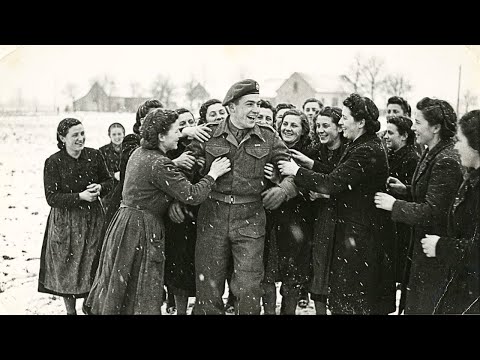
Major Ben Cockburn of the 5th Canadian Armoured Division had no weapon in his hands. He had three tanks behind him and twenty soldiers waiting for orders. But he knew that at the first shot, the women would die. “The war is over,” he said in German, his voice calm, almost gentle. “You know it. I know it. Everyone here knows it.”
The SS captain stared back, his face carved from stone, but his eyes moved—calculating, weighing years of Nazi indoctrination against the reality of three Canadian tanks aimed at his position.
Cockburn had not woken that morning expecting to confront the Holocaust. His unit was sweeping through Lower Saxony, accepting surrenders from exhausted German soldiers, liberating towns where white flags hung from windows. It was almost routine. Then his patrol turned a corner and found something that did not fit the script.
At first glance, it looked like a column of refugees—Germany was full of them. But then the details emerged. Armed guards. Striped uniforms. Walking corpses. The realization hit Cockburn like a punch to the gut: these were not refugees. These were prisoners. And the well-fed SS officers standing over them were not protecting them. They were preparing to kill them.
The contrast was shocking. Well-fed SS guards in neat uniforms carried machine guns and grenades. The women looked as if they had been dead for weeks, yet somehow kept walking. They were survivors of Bergen-Belsen, forced on a death march eastward as the Nazi empire collapsed. They should have been dead already. The SS had strict orders to execute every prisoner rather than let them fall into Allied hands.
Cockburn stepped off his tank, left his rifle behind, and walked forward alone, bridging the distance between his tanks and the SS guards. Every step took him further from the safety of armor and firepower. Every step brought him closer to men who had spent years murdering helpless people.
His boots crunched on the gravel road. His heart pounded hard enough that he heard it in his ears, but his face showed nothing. Just calm. Just control. He walked straight up to the SS captain, close enough to see the man’s blue eyes, close enough to smell the tobacco on his uniform, close enough that his own soldiers could not shoot without endangering him.
Then he spoke in German, the language he had learned during training and perfected through years of interrogating prisoners. His voice was calm, controlled, almost friendly—not threatening, simply stating facts.
“The war is over,” Cockburn said. “You know this. I know this. Everyone here knows this.” He let that sink in, watching the captain’s reaction. The truth of it hung in the air between them. Unmistakable. Germany was collapsing. Hitler’s Reich had days, maybe weeks left.
The SS captain knew this as well as anyone. He was not stupid. He had seen the endless retreats, the supply lines falling apart, the desperate orders from commanders who had lost control. He knew the war was lost.
Then Cockburn offered a choice, and he framed it carefully. Not surrender. Not morality. Pure self-interest. “If you fight,” he said, “we kill you. We have tanks. We have air support minutes away. We have overwhelming force. You will die here on this road. But before you die, you will kill these women, because that is what happens in a firefight. And when we report that, when we tell our commanders that SS guards slaughtered prisoners right in front of us, there will be no mercy shown to any SS man we encounter. Your fellow guards and other units will pay for your choice.”
Or, Cockburn continued, “you can hand over these prisoners now. You can walk away as soldiers following the rules of war. You can have a chance at survival when this is over. Maybe even a normal life someday.”
The SS captain did not answer immediately. He stood frozen, his face like chiseled stone, but his eyes moved—looking at the tanks, looking at his men, looking at the women behind him. Calculating. Weighing years of Nazi indoctrination against the immediate reality of three Canadian tanks with their guns aimed at his position.
Cockburn could see the internal struggle behind those blue eyes. Die for an empire that was already dead? Follow orders from leaders who would be hanging from gallows in a few months, or choose to live?
The moment stretched out. Witnesses later described it as lasting an eternity, but it was probably three minutes, maybe four. Cockburn stood perfectly still, waiting, his heart pounding but his face calm. The SS captain breathed slowly, thinking. The women behind them watched, not understanding the German conversation, too exhausted to hope. Cockburn’s soldiers kept their weapons trained on the SS guards, fingers on triggers, waiting for the order to fire.
Birds still sang in the trees. Somewhere in the distance, artillery rumbled—the sound of someone else’s battle.
Then the SS captain nodded. Just once. A small movement of his head. He turned to his men and gave orders in clipped German. “Lower your weapons. Form the prisoners for handover to Canadian custody. We are leaving.”
His voice contained no emotion—just cold military efficiency. The guards hesitated, looking at each other uncertainly. The captain repeated the order, louder this time. They obeyed. Rifles down. Machine guns pointed at the ground. The women were formed into a line, though most could barely stand.
And then, without a word, without a salute or formalities, the SS guards simply walked away. They marched east, into the chaos of collapsing Germany, and disappeared into the distance.
Cockburn watched them go. He did not arrest them, did not pursue them, did not order his men to shoot them in the back. He let them go—a decision that would later cause controversy, but for now, it saved 162 lives.
No shots fired. No bullets spent. Just words, timing, and nerve.
The SS guards vanished down the road, swallowed by the German landscape, fading into the chaos of a dying empire. For a moment, no one moved. The women stood frozen, unable to process what had just happened. Cockburn’s soldiers stared in disbelief. Then someone broke.
A woman in the front row collapsed—not from exhaustion this time, but from the sudden, overwhelming realization that she might actually survive. The collapse triggered a chain reaction. Other women fell to their knees, weeping, shaking, clutching the dirt road as if it were the most precious thing in the world. Some tried to speak but found no words. Others simply sobbed, tears cutting clean tracks through their filthy faces.
Cockburn’s medics rushed forward, their training taking over despite the shock of what they were seeing. They carried medical bags, blankets, and canteens of water. The unit’s medical officer, Captain Morris, arrived and made a quick visual assessment of the women. His face went white.
He was a combat doctor who had seen terrible wounds, amputations, and men bleeding out on operating tables. But this was different. This was not combat injury. This was systematic starvation, disease, and neglect on a scale he could barely comprehend.
He pulled Cockburn aside and spoke quietly but urgently. “These women are medical miracles simply because they are still alive,” he said. “Most have typhus, dysentery, tuberculosis, and severe malnutrition. We need to get them to a field hospital immediately. Even with help, some of them will not make it.”
The reactions of the women varied wildly. Some could not speak at all, their voices stolen by months of terror and abuse. Those who could form words called out in different languages. Polish, Hungarian, Dutch, Yiddish, German. They kissed the soldiers’ hands, clutched at the sleeves of the medics, touched the maple leaves on the Canadian uniforms with trembling fingers.
A Dutch woman named Rachel Kleinman stared at the maple leaf on Cockburn’s shoulder. She did not know what it meant. She had never seen this symbol before. All she knew was that the man wearing it had spoken with the SS, that the SS had somehow left, and that she was still breathing.
Years later, she would write in her memoirs about this moment. “We saw the maple leaf and did not know what country it stood for. We only knew that the man with the strange accent had spoken, the SS had left, and we were somehow, impossibly, still alive.”
Cockburn’s soldiers reacted with a raw emotion that combat veterans rarely displayed. Men who had fought in Italy and France, who had stormed German positions under machine-gun fire, who had watched their friends die in explosions and firefights—these hardened soldiers wept openly. Some turned away, unable to look at the women’s condition. Others vomited in the grass beside the road, their stomachs rebelling at the sight and smell of this suffering.
Tank crews pulled out their rations and offered food to the nearest women, until Captain Morris shouted at them to stop. “Too much food, too fast, will kill them,” he explained. “Their bodies cannot handle it. We need to feed them slowly and carefully, or we will lose them to refeeding syndrome.”
Sergeant William Morrison, a tank commander who had kept a diary throughout the war, sat on the ground and wrote with shaking hands. His entry for this day read simply: “We have seen terrible things in this war. Burned cities, dead soldiers, civilians caught in the crossfire. But this is different. This is evil in human form. This is what we have been fighting against, even when we did not fully understand it. Now we understand. Now we know.”
The medical situation became clear quickly and was grim. Captain Morris and his medics performed rapid triage, moving from woman to woman, checking vital signs and looking for the most critical cases. Seven women were in immediate danger of dying. Their bodies had been pushed past the point where medical care could save them. They would die within the next 24 hours, despite everything the doctors tried. The medics held their hands as they died, making sure they were not alone. Making sure their final moments contained human kindness instead of cruelty.
Twenty-three women needed immediate hospitalization for typhus, a disease spread by lice that caused high fever, rash, and—without treatment—often death. All 162 suffered from severe malnutrition. The average weight was around 30 to 35 kilograms for adult women who should have weighed at least twice that. Most had tuberculosis, a lung disease that would plague the survivors for years. Almost everyone had lice, dysentery causing constant diarrhea, and infected wounds that had never received proper treatment.
Cockburn began documenting everything immediately. He understood, even in this moment, that these women were evidence of crimes beyond imagination. He photographed the survivors with their permission, treating them with dignity rather than displaying them as specimens. He noted the unit numbers of abandoned SS equipment along the road. He took statements from women strong enough to speak, recording their testimonies in detail.
His official report read: “These women are evidence of systematic murder on an unimaginable scale. The preservation of their lives and testimonies is of strategic importance for documenting enemy war crimes.”
Within days, British troops liberated the main Bergen-Belsen camp. The photographs appeared in newspapers around the world, forcing people to confront the reality of the Nazi death camps. Cockburn’s survivors were refugees from this hell. Witnesses to crimes the world was only beginning to understand.
The controversy began almost immediately. Some of Cockburn’s fellow officers criticized his decision to let the SS guards go. The military police wanted them prosecuted for war crimes. “How can you let murderers escape?” they asked. “How can you allow men who led death marches to simply disappear into Germany?”
Cockburn’s answer was simple and without regret. “I could have arrested them and gotten the women killed in the crossfire,” he said. “Or I could let them go and save 162 lives. The choice was clear. Every moment I spent arguing or fighting was another moment those women were dying of starvation. I made the only choice that saved lives.”
But amid the horror and controversy, moments of pure humanity shone through. A young Canadian soldier named James Chen shared his chocolate ration with a Polish woman who looked barely 20 years old. She ate one small piece, savoring it as if it were the most precious thing she had ever tasted. Then she carefully wrapped the rest and tucked it into her prison uniform. She tried to explain through gestures that she had a sister somewhere. She wanted to save the chocolate to share with her sister when they were reunited.
Chen did not have the heart to tell her that the chances of her sister still being alive were almost zero. He just nodded and stayed with her, sitting in silence until exhaustion finally lulled her to sleep. The chocolate remained clutched in her skeletal hand, a small symbol of hope in a world that had tried to destroy all hope. Her sister was already dead, murdered in the gas chambers three months before liberation. But the woman did not know this yet. For now, she had chocolate and the dream of sharing it. For now, that was enough.
Cockburn’s rescue of 162 women did not change the outcome of World War II. The strategic impact was, in fact, zero. Germany still collapsed in May 1945. Hitler still died in his bunker. The Allies still won. Saving 162 people out of millions murdered did not shift the balance of armies or change the course of battles.
But strategy is not the only thing that matters in war. Sometimes a single action has unexpected consequences, creating ripples that reach far beyond the original moment. The testimonies of the women reached Allied intelligence within days. They told stories of Bergen-Belsen that confirmed the worst rumors intelligence officers had heard for months. Stories of gas chambers and crematoria. Stories of systematic murder on an industrial scale. Stories of selections where Nazi doctors decided with a casual wave of the hand who lived and who died.
Allied intelligence had received such reports before, but many officers dismissed them as exaggerated propaganda. “No one does such things,” they said. “The reports must be wrong.” But now the evidence was walking, talking, and breathing. Now the evidence arrived in the form of emaciated women with numbers tattooed on their arms. The 162 survivors became living witnesses to crimes the world was only beginning to understand.
The ripple spread outward. Canadian units began actively hunting for death marches, officers instructed to try Cockburn’s approach first: offer the guards a choice, use negotiation before bullets. In the war’s final weeks, an estimated 800 prisoners were liberated using similar tactics. Psychology, it turned out, could be stronger than firepower even in the darkest days of history.
Eisenhower, stunned by the photographs and testimonies, ordered everything documented. “Photograph it all,” he commanded. “Because someday people will claim this never happened.” The accounts of Cockburn’s 162 women became evidence at Nuremberg.
After the war, Cockburn returned to Toronto, traded his uniform for a classroom, and taught history for 37 years. He never told his students who he was. “I did what any officer would do,” he said. “I spared lives where I could.” He died in 1982, and only at his funeral did some finally learn what their quiet teacher had done.
Rachel Kleinman survived, emigrated to Canada, and became a Holocaust educator. At a 1965 reunion she took his hands and said, “You gave me life twice—once on that road, and once by letting me build a new one here.”
In 2025, eighty years on, the 162 women have some 800 descendants. At the Canadian War Museum hangs a photograph: an aging man surrounded by smiling women, captioned “Major Ben Cockburn, surrounded by 162 reasons why words sometimes matter more than weapons.”
Heroism does not always roar. Sometimes it speaks softly, offers an enemy a choice, and hopes that even in darkness, light is possible.
So here is the question I leave with you: if you stood on that road, unarmed, with only words between life and death—would you have found the courage to speak?
Report this article
Select a reason for reporting:






