The rain fell in sheets, turning the jungle into a suffocating steam bath. Under a moonless sky, the elite Japanese marines slipped into the dark waters of Milne Bay, confident they would catch the Allies sleeping. They expected a walkover—a quick seizure of the American airstrips and a triumphant march to Port Moresby. Instead, they sailed straight into a trap that would shatter their legend forever.
“The Japanese are coming.” The words spread like wildfire through the muddy Allied camp, where American engineers and Australian infantry waited in the gloom. For weeks, they had battled nature itself—torrential rain, bottomless mud, and clouds of malaria-carrying mosquitoes—to carve three vital airstrips out of the jungle. Now, they faced a far deadlier foe: the Kaigun Rikisentai, Japan’s elite naval landing force, undefeated and feared across the Pacific.
General Douglas MacArthur had gambled everything on this remote bay at the eastern tip of New Guinea. If it fell, Australia’s eastern flank would be wide open, and the road to the mainland would lie bare. The Americans built the base with steel and sweat; the Australians were the locks that held it shut. “They’ll have to come through us,” muttered a veteran of Tobruk, his hands steady on a Bren gun. The diggers—young militiamen and battle-hardened regulars—dug in among the coconut palms, their eyes straining against the rain.
The Japanese plan was simple: a lightning night assault, a bayonet charge through the runways, and total victory within 48 hours. Their intelligence was catastrophically wrong. They believed they faced a few hundred demoralized troops, not nearly 9,000 determined Allies. And they had no idea that the mud—the same mud that tormented the builders—would become their worst enemy, swallowing tanks and slowing their elite infantry to a crawl.
On the night of August 25th, 1942, the storm broke. Japanese landing barges ground onto the swampy shore—but poor navigation in the deluge had brought them kilometers off course, into a maze of mangroves far from the main airstrip. As the first boots hit the muck, an Australian outpost opened fire. Tracer rounds lit up the darkness, and the jungle erupted in a cacophony of explosions. The Japanese, realizing they were not facing a disorganized rabble, deployed light tanks. These steel monsters clattered through the mud, searchlights cutting through the rain, but the Australian militia held their ground, using sticky bombs and anti-tank rifles to halt the advance.
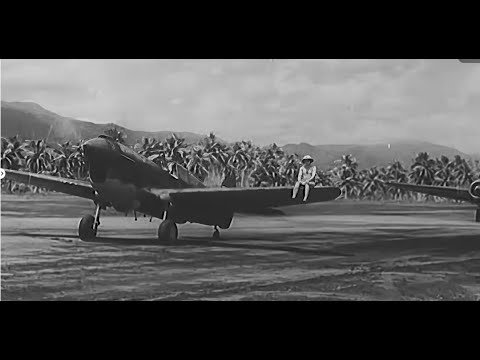
As dawn broke, the tactical advantage shifted dramatically. From the very runways the Americans had struggled to finish, RAAF Kittyhawks roared into the sky. The Japanese were trapped on a narrow coastal strip with nowhere to retreat. The pilots flew so low that their slipstream tossed palm fronds as they poured .50 caliber fire into the landing barges and supply dumps. On the ground, American anti-aircraft gunners lowered their barrels, providing a curtain of protective fire. Every time a Kittyhawk landed, it was refueled and rearmed within minutes, turning the airstrip into a high-speed assembly line of destruction.
By the end of the first day, the Japanese lightning strike had stalled in a pile of burning wreckage and blood-soaked mud. Their tanks were bogged down or destroyed, their supplies smoldering, and their elite marines pinned down by Australian grit and Allied air power. The myth of the invincible Japanese jungle warrior began to crack. For the first time, the Imperial Japanese Navy realized they were caught in a sophisticated, multi-domain trap—American engineering and Australian firepower working in lethal unison.
But the Japanese were not finished. In the final days of August, they gambled everything on a massive night assault against Strip Number Three, the last obstacle before the heart of the Allied base. If they broke through, the American engineers and logistical nerve center would be exposed to slaughter. Under a thick sulfurous mist, hundreds of elite marines surged across the open airfield, screaming their battle cries.
The Australians of the 2/12 and 61st Battalions waited until the Japanese were within point-blank range. “Fire!” The word cut through the chaos, and a wall of Vickers and Bren gun fire tore into the charging ranks. American mortars and anti-aircraft guns, repurposed for ground defense, added a continuous curtain of high explosives. The Japanese, masters of night infiltration, found themselves trapped on the flat, exposed runway, illuminated by flares and caught in a crossfire that left no room for retreat.
As the sun rose over the carnage, the battlefield revealed a scene that shocked even the most veteran soldiers. The runway was littered with the bodies of the Japanese elite—men who had never before known defeat. The invincible warriors of the emperor had been broken against the combined resolve of the Allies. For the American observers, it was a revelation. They saw the Australian soldiers stand their ground in the face of fanatical charges that would have shattered less disciplined units. The diggers didn’t just hold the line—they held it with a grim, professional ferocity that proved the Japanese could be outfought in the very environment they claimed to own.
The failure at Strip Number Three was the breaking point. The Japanese offensive spirit was shattered, their elite units decimated, and their confidence gone. The myth of the Japanese superman had been buried in the mud of a half-finished American airstrip. Sensing the enemy’s exhaustion, the Australian commander, Major General Cyril Clowes, ordered a full-scale counteroffensive. The veterans of the 18th Brigade pushed eastward through coconut plantations and stinking marshes, driving the Japanese back into the sea. The pursuit was brutal—clearing snipers lashed to palm trees, flushing out machine-gun nests hidden in banyan roots. American engineers worked feverishly to keep the roads passable, while mortar crews provided continuous fire support.
The Japanese retreat became a rout. For the first time in the Pacific War, they were not falling back to a secondary line—they were fleeing in disorganized panic toward their landing beaches. The once-feared marines left behind abandoned tanks bogged to their turrets, discarded equipment, and hundreds of dead in the mud. By early September, the Imperial Japanese Navy sent destroyers under cover of darkness—not to reinforce, but to evacuate the survivors. Thousands had been committed to the bay; only a fraction escaped.
The Battle of Milne Bay was over. The Australians had secured the eastern gate of New Guinea, and in doing so, they had provided the Allies with something more valuable than any airstrip: the absolute certainty that the Japanese empire could be defeated on the ground. It was the first Allied land victory over the Japanese in the Pacific War—a seismic shift in the global narrative. The myth of Japanese invincibility didn’t just crack at Milne Bay; it disintegrated.
In the weeks that followed, the mud of Milne Bay began to dry under a sun that seemed almost apologetic for its long absence. The American engineers, who had spent months cursing the rain, now found themselves cursing the dust. But the airstrips were finally finished—three long ribbons of steel matting gleaming in the tropical heat, ready to launch the counteroffensive that would roll back the Japanese tide.
“She’s all yours, General,” an exhausted engineering officer reported to MacArthur’s staff. The first P-38 Lightnings arrived within days, their twin tails casting long shadows across the freshly graded runways. Milne Bay was no longer a desperate defensive outpost. It was a spearhead.
But victory had come at a steep price. The Australians buried their dead in a small cemetery overlooking the bay, the white crosses stark against the green jungle. Young militiamen who had never fired a shot in anger before that August now stood as veterans, their faces hardened by weeks of rain, blood, and fear. The American engineers, too, had changed. They had arrived as builders and left as soldiers, their hands calloused not just from machinery but from rifles.
The Japanese, meanwhile, were forced to confront an uncomfortable truth. Their defeat at Milne Bay was not merely a tactical setback—it was a strategic humiliation. The Imperial Navy, which had dominated the Pacific since Pearl Harbor, had been forced to conduct a full-scale evacuation from a land objective. For the first time, the emperor’s elite marines had been driven from the field by a combined force of colonial militiamen and American technicians.
The news of Milne Bay rippled through the Allied world like an electric shock. In Washington, President Roosevelt seized upon the victory as proof that the Pacific was not a lost cause. In London, Churchill reportedly raised a glass to the Australian diggers. But it was in Australia itself that the impact was most profound. For a nation that had spent the first half of 1942 staring at the map in dread—watching the Japanese advance ever closer to its northern shores—Milne Bay was a deliverance.
“They said the Japanese could not be beaten in the jungle,” wrote one Australian war correspondent. “The men of Milne Bay have answered them in a language of lead and steel.” The newspapers ran banner headlines, and the diggers who returned to Brisbane and Sydney were mobbed as heroes. But the veterans themselves were quieter. They knew how close the battle had been—how a single mistake, a single failure of nerve, could have turned the bay into a graveyard.
MacArthur, ever the showman, wasted no time in exploiting the victory. He issued a communiqué praising the “magnificent fighting qualities of the Australian soldier”—a remarkable shift from his earlier private dismissals of Australian military competence. The general who had once doubted his allies now understood that the road to Tokyo would be built on Australian grit as much as American steel.
The strategic implications were immediate. With Milne Bay secure, the Allies could now threaten the Japanese stronghold at Rabaul from a second direction. The airstrips that had been carved out of the mud became the launch point for heavy bombers, their payloads hammering Japanese shipping lanes and supply depots across the Solomon Sea. The bay itself became a bustling port, its anchorages crowded with transports and warships, its warehouses bulging with the matériel of a growing offensive.
But perhaps the most enduring legacy of Milne Bay was the partnership it forged. The Australians and Americans who had fought side by side in the mud—the digger and the GI, the engineer and the infantryman—had discovered something rare in the chaos of war. They had found that trust was not given by treaty or command. It was earned in the shared terror of a night attack, in the relief of a dawn that found them still alive, in the simple knowledge that when the enemy came screaming out of the darkness, the man beside you would not run.
That bond would be tested again and again in the brutal campaigns to come—on the Kokoda Track, at Buna and Gona, in the killing fields of the Philippines. But it would never break. The mud of Milne Bay had sealed it forever.
As the calendar turned toward October 1942, the war in the Pacific was still far from won. Guadalcanal remained a bloody stalemate. The Japanese fleet still prowled the seas with deadly intent. But something had changed. The aura of invincibility that had surrounded the emperor’s forces was gone, buried in the black sludge of a New Guinea swamp. The men who had held the line at Milne Bay knew the truth that would carry the Allies through the long years ahead: the Japanese could be beaten.
The men who had held the line at Milne Bay knew the truth that would carry the Allies through the long years ahead: the Japanese could be beaten. That knowledge, hard-won in the mud and the rain, became the seed from which the great Pacific counteroffensive grew.
Today, the bay is quiet. The rusted hulks of Japanese tanks still lie half-buried among the palms, slowly reclaimed by the jungle. The airstrips that once thundered with Kittyhawks are now overgrown, but the memory of what happened there refuses to fade.
“The myth of the Japanese superman died in the mud of Milne Bay,” one historian later wrote. “What rose in its place was the confidence of an alliance that would not be broken.”
And so the road to Tokyo began—not with a grand fleet or a mighty army, but with a handful of diggers and engineers who stood together in the rain and refused to yield. The tide had turned.
What do you think was the most decisive factor at Milne Bay—the Australian infantry’s grit, American engineering, or Allied air power? Share your thoughts in the comments below.
Report this article
Select a reason for reporting:






