Elsa Kohler had believed every word. The recruiting officer in Nuremberg had painted a vivid picture: America was weak, its soldiers poorly trained, its people starving. “If captured, you will be treated brutally,” he warned. “The Americans show no mercy to women.” She carried those words like armor when Allied forces overran her radio bunker in northern France. She held them close during the cramped, cold journey across the Atlantic. And she clutched them tighter still when the gates of Camp Rosewood closed behind her.
But on a cold November evening in 1944, that armor began to crack.
The mess hall doors swung open, and the first thing that hit her was the smell. Rich, savory, impossible. Pork chops. Applesauce. Sweet potatoes glazed with real butter. The women stood frozen, their trays trembling in their hands, waiting for the cruelty they had been promised.
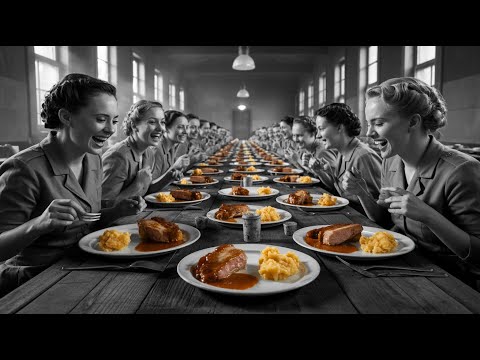
Staff Sergeant Frank Martinez piled the food high, his expression unreadable. Rosa Zimmerman stared at her tray as if it held a live grenade. “Is it poisoned?” someone whispered down the table. The question hung in the air like smoke. No one lifted a fork.
Across the room, Private Robert Clark caught Elsa’s eye. He smiled—not mockingly, but gently—and took a huge bite of his own pork chop, patting his stomach with exaggerated satisfaction. See? his gesture seemed to say. It’s just food.
Rosa was the first to break. Her hands shook as she cut a small piece of meat and brought it to her lips. When she chewed, her eyes closed involuntarily. The meat was tender, seasoned with thyme and garlic. A small sound escaped her throat—something between a sob and a sigh. The other women watched, waiting for something terrible to happen. When nothing did, they began to eat.
The meal progressed in near silence, broken only by the quiet clink of forks against metal trays. Elsa cut into her sweet potato and found it soft, buttery, with a sweetness that felt almost decadent. The applesauce was homemade, not the tasteless paste she remembered from military rations. The bread was fresh, still slightly warm, and when she spread butter on it, the butter actually melted. She hadn’t tasted real butter in over a year.
Across the table, Gertrude Meyer ate with methodical precision, but tears ran silently down her cheeks. She was twenty-five, the oldest among them, and had seen her city bombed, had watched rations shrink month by month, had heard the official reports about America’s weakness and impending collapse. Now she was eating better as a prisoner than she had as a free woman. The cognitive dissonance was unbearable.
That night, the barracks were restless. Elsa lay on her cot, staring at the ceiling, her mind replaying the evening meal over and over. If the Americans had lied about the food, what else had been a lie?
Morning brought a new test. At 0600 hours, they reported to the mess hall for breakfast. The smells that greeted them were even more impossible than the night before. Scrambled eggs—fluffy and yellow with real eggs. Thick slices of ham, pink and glistening. Toast with real butter and jam. Fresh milk and actual coffee. The aroma alone made Elsa dizzy with disbelief.
Gertrude was the one who finally broke. She had been holding herself together through sheer force of will, maintaining her dignity and composure despite the confusion of the past twenty-four hours. But when she tasted the scrambled eggs, something inside her cracked. She set down her fork carefully, placed her hands flat on the table, and began to cry. Not quiet tears like the night before, but deep, racking sobs that shook her entire body.
“I thought it was Christmas,” she managed to say between sobs. “I thought this was Christmas morning.”
Captain Helen Patterson, the experienced female officer who commanded the facility, watched from the doorway. She had overseen male prisoner camps before, but this assignment was different. These women were not hardened soldiers. They were clerks and nurses and radio operators, many barely out of their teenage years, and they were clearly overwhelmed by treatment they had never expected to receive.
Staff Sergeant Martinez approached the captain quietly. “Ma’am,” he said in his slight Texas drawl, “I think they thought we were going to starve them.”
Captain Patterson nodded slowly. “The propaganda they were fed was probably quite effective, Sergeant. We’re contradicting everything they were taught to believe about us.”
Martinez looked back at the crying women. “Maybe some of them could help in the kitchen. Give them something to do, something to focus on. Cooking is universal, ma’am. Doesn’t matter what language you speak.”
The captain considered this. It was irregular, allowing prisoners to work in food preparation. But these were unusual circumstances, and regular approaches weren’t working. “Make it voluntary,” she finally said. “If any of them want to help, let them.”
The offer was extended through the translator that afternoon. Any prisoner who wished to assist in kitchen duties could volunteer. They would not be forced, and it would not affect their treatment either way. Elsa was the first to raise her hand. She had been thinking about the meals, about the care that went into their preparation, and she wanted to understand. She wanted to see for herself if this abundance was real or somehow manufactured just for their benefit.
Rosa volunteered next, followed by Clara and three others. The next morning, the six German women reported to the kitchen an hour before breakfast service. Martinez greeted them with a nod and handed each of them an apron. He didn’t speak German and they spoke limited English, but he had been right about cooking being universal. He showed them where ingredients were stored, and their eyes widened at the sight. Sacks of flour and sugar, crates of fresh eggs, whole hams hanging in the cold storage, butter in quantities they hadn’t seen in years. This wasn’t a special supply for prisoners. This was simply what the camp had available.
Martinez demonstrated how he wanted the eggs prepared, and Elsa stepped forward to help. Her hands moved automatically, cracking eggs into a large bowl, whisking them with milk and a pinch of salt. It was something her mother had taught her. The kitchen work became a daily routine for the six volunteers. Each morning, they arrived early to help prepare breakfast, and gradually their presence became a natural part of the kitchen’s rhythm.
Staff Sergeant Martinez proved to be a patient teacher, demonstrating techniques with his hands when words failed, nodding approval when they did something correctly. The language barrier slowly began to crumble as simple food vocabulary became shared ground. Eggs, bread, butter, salt. These words needed no complex grammar, just repetition and context.
Private Bobby Clark often stopped by the kitchen during his breaks, curious about the German women who had chosen to work alongside their captors. He was twenty years old, from a small town in Pennsylvania, and his natural friendliness gradually drew out shy smiles from the volunteers. Rosa discovered that Martinez prepared meals the way her grandmother had—with patience and attention to seasoning. She watched him carefully measure spices for the pork chops, noticed how he tested the doneness of meat with practiced fingers, saw the care he took to make sure the food was not just adequate, but actually good.
One morning she gathered her courage and approached him with a soft question in her halting English. “Why you cook so good for prisoners?”
Martinez looked at her thoughtfully before answering. “My mother always said food is respect. You feed someone well, you show them they matter. Prisoner or not, you’re still people.”
Rosa translated this for the other German volunteers, and they fell silent, absorbing the implications of his words.
The turning point came in early December when the kitchen staff prepared for a celebration. It was Private Clark’s twenty-first birthday, and Martinez had decided to bake him a chocolate cake. Real chocolate, not the ersatz version the German women remembered from home. When Martinez brought out the ingredients, Elsa felt her breath catch in her throat. Chocolate, sugar, real butter, fresh eggs—all for a simple birthday celebration. In Germany, such ingredients would have been impossible to find at any price. Here, they were being used to celebrate a young soldier’s birthday, as if it were the most natural thing in the world.
Martinez noticed her expression and smiled slightly. “Want to help?” he asked. Elsa nodded, unable to speak. She helped mix the batter, the rich chocolate scent filling the kitchen and triggering memories of childhood birthdays before the war. When the cake came out of the oven perfectly risen and fragrant, Martinez frosted it with chocolate icing and let the German volunteers help decorate it with simple designs.
That afternoon, they carried the cake to the mess hall where Clark’s unit had gathered to surprise him. The young soldier’s face lit up with genuine joy, and his friends cheered. It was such an ordinary moment, such a normal celebration, and yet it shattered something inside the German women watching.
After the celebration ended and the mess hall had cleared, twenty-three-year-old Rosa Zimmerman sat at one of the empty tables, staring at the crumbs of chocolate cake that remained on a serving plate. Elsa sat beside her, waiting. Finally, Rosa spoke in German, her voice barely above a whisper but filled with anguish. “They told us Americans were starving. They told us their people were suffering, that their soldiers had no supplies, that we were winning.” She looked at Elsa with tears in her eyes. “They lied to us about everything.”
The realization that spread through the German prisoners after the chocolate cake incident was profound and unsettling. If the Reich had lied about America’s food situation, what else had been false? The women began questioning everything they had been told, every piece of propaganda they had accepted as truth. But their confusion was about to deepen even further.
Captain Patterson called an assembly on November 22nd, gathering all forty-three German prisoners in the main hall. Through the translator, she made an announcement that left the women stunned into silence. “Tomorrow is Thanksgiving, an important American holiday where we give thanks for our blessings and share a meal with others. We would like to invite you to join us for Thanksgiving dinner. You will eat the same food we eat, at tables alongside our staff. This is not required, but it is offered.”
The women looked at each other in confusion and disbelief. Invited to share a holiday meal—not as servants or observers, but as guests? It seemed impossible. Another contradiction in a growing list of things that made no sense according to what they had been taught.
That evening, the German women debated among themselves in their barracks. Some argued they should refuse, that accepting would somehow be a betrayal of their country or their captured comrades in other camps. Others, like Elsa, felt they had already crossed too many lines to pretend they could maintain pure opposition to their captors. “We have been eating their food for weeks,” Elsa said quietly. “We have been working in their kitchen, helping prepare meals. What difference does it make if we sit at their tables for one meal?”
Gertrude, who had broken down over breakfast weeks earlier, spoke with unusual firmness. “I want to understand them. I want to know who these people really are, not who we were told they were. I will go.”
In the end, all forty-three women agreed to attend.
The next day, November 23rd, 1944, they entered a mess hall transformed. Long tables were decorated with autumn leaves, and American soldiers talked in animated voices. When the German women entered, conversations paused—but Captain Patterson gestured for them to sit throughout the room, interspersed with the Americans rather than segregated.
Elsa found herself between Private Clark and a nurse named Dorothy. Across from her sat Rosa and Staff Sergeant Martinez. Then the food appeared: a whole roasted turkey, golden and enormous. Stuffing fragrant with sage. Mashed potatoes with gravy. Sweet potatoes topped with marshmallows. Cranberry sauce. Fresh rolls. Pumpkin and apple pies with real whipped cream.
Clara whispered in German, “How can they have all this? How is this possible?”
But it wasn’t just the food. It was being invited to share it. Private Clark passed the turkey platter to Elsa with a genuine smile. “First Thanksgiving?” he asked in simple English. She nodded, unable to find words. “It’s about being grateful,” he said, his boyish face earnest. “Even in hard times.”
That night, back in the barracks, Elsa sat with blank paper before her, trying to write home. How could she describe turkey and chocolate cake to a mother who might be going hungry? How could she explain kindness that contradicted everything they had been taught?
She finally wrote: Dear Mama, I am alive and safe. I am being treated fairly. I think of you constantly and pray you are well. Your loving daughter, Elsa. Some truths, she realized, were too complicated to fit in a letter home.
Winter turned to spring. On May 8th, 1945, Germany surrendered. At Camp Rosewood, Captain Patterson gathered the women. “Transportation will be arranged within the next three weeks. You will be processed and released to return to your homes.”
The word should have brought relief. Instead, the women sat in complicated silence. Six months of meals that defied everything they had been taught. Six months of unexpected kindness from people they had been told were enemies.
That night, Rosa whispered in the dark, “What kind of life waits for us there? We were captured. We worked with Americans. Some will see us as traitors already. And what will we eat?”
On May 20th, Elsa approached Captain Patterson. “May I ask you something that is very difficult?” she said, her voice shaking. “Is it possible for some of us to stay?”
Patterson’s face registered surprise, but not shock. “That’s a complicated request,” she said carefully. “But tell me why you’re asking.”
Elsa spoke of the lies, the reality they had discovered, the impossible choice between returning to devastation or staying where they had found unexpected dignity. “We were taught you were monsters,” she said quietly. “Instead, you fed us like family.”
Eventually a compromise emerged. Those who wished to return would be repatriated. Those who wished to stay could apply for displaced person status, though they would need American sponsors. Of the forty-three women, seventeen chose to stay. Elsa was among them, as were Rosa, Clara, and Gertrude.
The Henderson family, who had visited the camp through a church program, offered to sponsor Elsa. Dr. Margaret Walsh arranged for Clara’s continued medical training. Staff Sergeant Martinez himself vouched for Rosa, helping her find work in a restaurant kitchen.
Twenty-five years later, in 1970, Elsa Kohler Henderson stood in her kitchen in suburban Philadelphia, preparing Thanksgiving dinner for her American husband and their three children. On the counter sat a recipe card in her own handwriting: pork chops with applesauce and sweet potatoes. It was the meal that had changed her life, and she made it every year on the anniversary of her arrival in America.
Her daughter, sixteen-year-old Margaret, watched her mother glaze the sweet potatoes with butter. “Mom,” she asked, “why do you always make this specific meal on this day?”
Elsa set down the butter dish and looked at her daughter—this child who had never known war or hunger or propaganda. How could she explain that a simple Tuesday dinner had shattered an entire worldview?
“This meal taught me that everything I had been told was a lie,” Elsa said quietly. “The Americans were supposed to be starving, cruel, and hateful. Instead, they fed me better than I had ever been fed, and treated me with more kindness than I deserved.” She paused, her eyes distant with memory. “They told us America was our enemy. What they didn’t tell us was that America could also become our home.”
The pork chops sizzled in the pan, filling the kitchen with the same aroma that had greeted a terrified twenty-one-year-old German prisoner on a cold November evening twenty-five years before. Some meals, Elsa had learned, change more than your hunger. They change your entire life.
What would you have chosen—return to a ruined homeland, or stay with the enemy who fed you like family? Share your thoughts below.
Report this article
Select a reason for reporting:






