What if the most dangerous thing about evil is how ordinary it pretends to be? This is not a story of monsters hiding in shadows. It’s about men in suits, medals, and university degrees who smiled for the cameras while rewriting truth itself.
For decades, we believed their lies. Some still do. But behind every myth they sold the world was a blueprint for power dressed as propaganda. These are the 33 biggest lies Nazi leaders told—or let others tell for them. And no, they’re not just lies about the past. They’re warnings about the future.
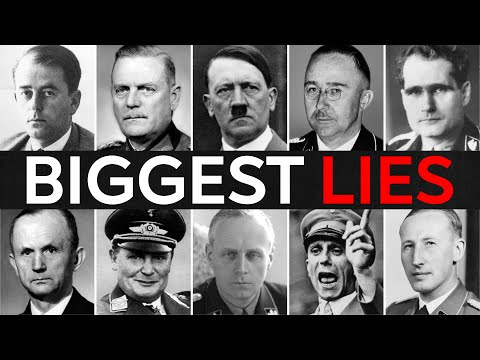
One. Hitler was an uneducated nobody who stumbled into power. It’s a comforting thought, isn’t it? That one of the most destructive figures in modern history just wandered into infamy. A drifter. A joke that went too far. History, as written by the relieved, likes to pretend Hitler was some accident of chaos theory, a failed artist who somehow tripped into tyranny.
But if you read between the bricks of the Beer Hall Putsch, you’ll find something worse than randomness: design. Hitler wasn’t academically educated, sure, but he was a voracious reader, a calculated manipulator, and a charismatic speaker who knew how to weaponize shame, loss, and nostalgia like a surgeon with a scalpel. The road to the Reich wasn’t stumbled upon. It was mapped, marketed, and sold with interest. And for a nation humiliated by war and debt, he was disturbingly persuasive—which makes the next lie even more perverse.
Two. Hitler never knew about the Holocaust. This one is almost tender in its delusion. A dictator at the helm of a genocidal machine, somehow unaware that the engine was running. As if trains moved themselves, as if paperwork signed itself, as if people vanished into ash clouds purely by logistical coincidence.
The idea that Hitler was in the dark about the Holocaust relies on imagining the Third Reich as a bureaucratic behemoth with no chain of command—a myth destroyed by hundreds of documents, firsthand testimonies, and Hitler’s own speeches. He didn’t just know; he demanded it, tracked it, and obsessively referred to it in euphemisms. The Final Solution wasn’t a rogue memo. It was policy from the top. And yet somehow the myth persists because people still want monsters to be separate from men. Which brings us to the next piece of historical fanfiction.
Three. Hitler was a military genius. If by genius you mean a man who invaded Russia in the dead of winter without proper coats, then sure, call him brilliant. The cult of Hitler’s military prowess began during the war, inflated by Nazi propaganda and later by Allied analysts trying to explain how they were losing to someone so clever.
But the record is clear. Hitler’s grasp of strategy was emotional, erratic, and increasingly self-destructive. He ignored his generals, micromanaged battles from maps he didn’t understand, and made decisions based on delusions of grandeur rather than facts on the ground. His infamous no-retreat orders turned battlefields into graveyards. In the end, it wasn’t Allied brilliance that ended the war—it was Hitler’s incompetence. And yet, inside the Nazi machine, some still saw him as a mastermind. Especially one man—addicted, ambitious, and grotesquely self-assured.
Four. Göring was the most competent Nazi administrator in the corporate hierarchy of evil. Hermann Göring liked to see himself as the CEO—streamlining terror, managing departments of destruction, and keeping the trains running on time. The myth of Göring’s administrative brilliance came wrapped in medals, stolen art, and a deep operatic voice that sold confidence.
But peel back the silk and morphine, and what you find is a man more interested in luxury than logistics. Göring’s ministries were disorganized, overlapping, and riddled with corruption. He hoarded wealth, played favorites, and let policy be dictated by personal whim. His infamous Four-Year Plan was less a plan than a budget bloated with wishful thinking. Colleagues called him lazy behind his back when they weren’t watching him fall asleep in meetings. The so-called architect of Nazi economics was more carnival barker than engineer—flamboyant, bloated, and always in costume. But when it came to brutality, Göring didn’t just endorse it. He institutionalized it.
Five. Göring opposed brutality. Ah yes, the compassionate Göring—a man who, according to some post-war myths, recoiled from the regime’s darkest crimes and sought a more civilized path. A claim about as stable as one of his jewel-encrusted uniforms.
Göring was one of the earliest architects of Nazi repression. He didn’t inherit the Gestapo; he created it. He green-lit the first concentration camps, not reluctantly, but with administrative pride. When violence served his political image, he embraced it. When it didn’t, he distanced himself—not out of conscience, but calculation. Later in the war, Göring projected a softer persona, hoping to curry favor with the West, but it was all theater. He understood the optics of appearing moderate, especially when the regime began to implode. Strip away the revisionism, and you see a man not haunted by cruelty, but deeply invested in its profitability. And speaking of profit, let’s talk about the coldest bureaucrat of them all.
Six. Himmler was a deskbound bureaucrat, not a killer. The wire-rimmed glasses, the awkward posture, the preference for files over front lines—Heinrich Himmler looked like a man better suited to running a post office than orchestrating atrocities. And that’s precisely what made the myth of his distance so durable.
To many, Himmler was the quiet paper pusher, signing memos, stamping documents, and letting the real monsters get their hands dirty. But this wasn’t some detached manager. Himmler didn’t just approve the SS’s crimes. He shaped its ideology, recruited its zealots, and visited its killing grounds. He gave speeches about racial purity with clinical conviction. He believed in the mission, systematized it, and elevated murder to ritual. This wasn’t detached administration. It was devotion. The desk was just a stage. Himmler wore the robes of control, not with guilt, but with purpose. And yet, even in this house of horrors, some figures were so wildly out of their depth that not even the Nazis took them seriously.
Seven. Ribbentrop was a skilled diplomat. To believe Joachim von Ribbentrop was a skilled diplomat is like calling a bull in a china shop an interior designer. Yes, he wore fine suits. Yes, he shook hands in foreign capitals. But beneath the polished exterior was a man so out of his depth that even other Nazis rolled their eyes behind his back.
Ribbentrop wasn’t chosen for his intellect. He was chosen for his loyalty and his willingness to echo Hitler’s fantasies without question. His diplomatic strategies often backfired, alienating potential allies and antagonizing neutrals. The infamous Nazi-Soviet Pact was less genius negotiation than temporary desperation, and it collapsed spectacularly. British officials who met him called him pompous, clueless, and irritatingly arrogant. Inside Nazi circles, he was mocked as a man who misunderstood both foreign cultures and basic nuance. But unlike Ribbentrop, the next figure didn’t just misunderstand truth—he obliterated it entirely.
Eight. Goebbels simply reported the news. Ah yes, Joseph Goebbels—that humble newsman, just a journalist with a government job telling the public what they needed to know. Carefully, responsibly, objectively. Or at least that’s the lie some tried to tell when the cameras were off and the consequences rolled in.
In reality, Goebbels didn’t report the news. He wrote the script. He built the stage. He locked the doors. His Ministry of Propaganda wasn’t a newsroom; it was a psychological war machine that blurred reality, rewrote facts, and turned fiction into patriotic gospel. Films, radio, schoolbooks, music—everything passed through his ideological filter. He didn’t just spin lies. He molded national consciousness around them. His greatest talent wasn’t communication. It was corrosion. He understood the emotional plumbing of a population and flooded it with poison. And when the world collapsed, he dragged his family with him. But the most haunting part—he wasn’t alone in this descent into fanaticism.
Nine. Goebbels and his wife killed their children out of mercy. This is one of those post-war myths that tries to wrap horror in a blanket of twisted compassion. The story goes that Joseph and Magda Goebbels ended their children’s lives because they couldn’t bear to let them live in a world without Nazism—as if it were a mercy, as if their actions came from some warped place of love.
But the truth, while less dramatic, is even more disturbing. The Goebbelses didn’t act out of despair. They acted out of belief. They were true believers to the very end, refusing to imagine a future without the regime they helped create. Their choice wasn’t a tragic act of parental sorrow. It was ideological purity taken to its logical, horrifying extreme. And while Goebbels poisoned the soul of a nation, others within the Nazi leadership lost their grip in entirely different ways. One of them even tried to fly peace across the Channel.
Ten. Hess flew to Scotland on a peace mission driven by sanity. Rudolf Hess’s solo flight to Scotland is often framed like a dramatic gamble by a calm, rational man seeking harmony—a lone dove breaking from the hawk’s nest. But peel back the myth, and you find a figure spiraling into his own mind long before takeoff.
Hess had grown increasingly paranoid, isolated, and obsessed with mystical ideas that made even other Nazis uncomfortable. His flight wasn’t a diplomatic mission. It was a last-ditch crusade born from delusion, not strategy. He believed he could charm the British into peace by sheer force of misplaced conviction, as if geopolitics hinged on enthusiasm alone. Instead, he crash-landed into history as a symbol of the regime’s unraveling mental landscape. And while Hess drifted into fantasy, another man crafted one of the most successful personal myths in post-war history.
Eleven. Albert Speer was the good Nazi. Albert Speer polished his reputation with the precision of a man designing a marble facade—smooth, elegant, and carefully hiding load-bearing guilt. After the war, he performed remorse like a well-rehearsed monologue, presenting himself as the cultured architect who simply didn’t know what the machine he built was doing. Many believed him. Some still do.
But documents, testimony, and his own correspondence reveal a far darker truth. Speer wasn’t a detached technocrat. He was a key engineer of exploitation. His armaments empire ran on forced labor, and he was far more aware of the human toll than he ever admitted publicly. The good Nazi myth survives because people love the idea of a villain with a conscience. It’s comforting. But Speer’s conscience was selective, strategic, and conveniently timed. And speaking of men who preferred obedience over integrity, the next figure practically turned agreement into a career.
Twelve. Keitel was a capable general. Wilhelm Keitel’s military reputation owes more to his uniform than his judgment. Nicknamed “Lakaitel”—a pun meaning “yes, Keitel”—he was known for agreeing with Hitler even when the room froze in disbelief. Keitel wasn’t a strategist. He was an amplifier. Orders came down, and he nodded. Changes were suggested, and he nodded. Catastrophic decisions rolled through high command like boulders, and he nodded again.
His loyalty wasn’t courage. It was compliance dressed in medals. He signed directives that violated military ethics and common sense, enabling policies he barely questioned. In meetings, generals groaned when he spoke, knowing his recommendations were usually whatever Hitler had said five minutes earlier. And yet, Keitel’s passivity paved the way for someone even more dangerous—another officer who didn’t just nod, but eagerly put pen to paper in the service of destruction.
Keitel’s signature was a rubber stamp; Jodl’s was a scalpel. He didn’t just follow orders—he drafted the Commissar Order, the Commando Order, and the Nacht und Nebel decree, each one a license to murder. At Nuremberg, his defense was a shrug dressed in paperwork. “I was a soldier,” he said. But soldiers don’t write death warrants for prisoners of war.
And so the lies end where they began: with ordinary men. Not monsters, not madmen—just bureaucrats, generals, and propagandists who made evil look like duty. The most dangerous lie wasn’t any single myth; it was the belief that they were all just following orders. They weren’t. They were building a world where orders meant annihilation.
Which of these 33 myths do you still see repeated today—and who benefits from keeping it alive?
Report this article
Select a reason for reporting:






