Imagine being sealed inside a metal tube, hundreds of meters beneath the ocean’s surface. The air is thick with diesel fumes, sweat, and the stench of mold. There are no windows, no privacy, and every creak of the hull could be your death sentence. This was the daily reality for the sailors of Germany’s U-boats during World War II—floating prisons where survival was measured in hours, not days.
For months on end, these men lived in a world of perpetual darkness and deafening noise. They shared bunks with strangers, wore the same clothes for half a year, and ate food crawling with mold. Yet, amid the terror and filth, they formed unbreakable bonds and found moments of humanity in the most inhuman conditions. This is the story of life—and death—aboard the U-boat.
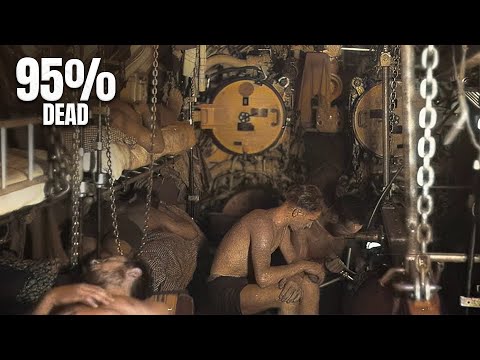
The U-boat was a weapon of war, not a home. Built to hunt and kill, it offered no comfort. A standard patrol could last up to six months, during which the crew of 40 to 50 men never bathed, never changed their clothes, and lived in a humid, oil-saturated environment that bred mold and disease. “Imagine wearing the same clothes for 180 days,” one survivor recalled. “Sleeping in a bunk shared with other sweating men, eating moldy food, and staying alert 24 hours a day.”
Space was a luxury none could afford. Each sailor had a single small locker, and the submarine was packed with engines, torpedoes, and cables. At the start of missions, even beds were removed to store extra torpedoes. Hot bunking was standard practice—while one man slept, another worked, and they shared the same bunk in shifts. There was no privacy, save for the captain’s corner, separated only by a curtain.
Hygiene was almost nonexistent. Each sailor was allowed one change of underwear and socks for the entire patrol. A special saltwater soap was provided, but it left a greasy film on the skin, so it was rarely used. “Deodorant was the only ally against the growing body odor,” one veteran joked. The stench of diesel, grease, and humidity created an almost unbreathable atmosphere, and mold spread freely on food and clothing.
Food started fresh—meat, bread, fruits, vegetables—but humidity and heat quickly spoiled everything. The refrigerator was far too small, and soon the bread began to grow mold, nicknamed “rabbits” by the crew because of its white fuzzy appearance. After that, the menu boiled down to canned goods and a soy paste called Brotaufstrich, which the crew called “diesel food” because of the flavor it absorbed from the submarine’s air. To make matters worse, one of the toilets was used as a food storage area during the first days, leaving only one for the entire crew.
Using the bathroom was a challenge in itself. The flushing was manual, done with a pump that dumped waste directly into the sea. But during moments of absolute silence—when the submarine was tracking an enemy ship—using the toilet was forbidden, as the noise could be detected by enemy sonar. More than 40 men sharing a single toilet for days, sometimes unable to use it for hours. It was a ticking time bomb of discomfort.
But perhaps the greatest enemy inside a U-boat was mental isolation. Spending weeks or months at sea without seeing land, trees, or new faces affected the sanity of many. The only distractions were a record player, a few decks of cards, and improvised games. Some commanders organized singing and lying competitions to keep morale high. “Imagine living with the constant fear of death, with the claustrophobia of metal walls around you, and without any contact with the outside world,” one sailor wrote. “The human mind can endure a lot. But everything has a limit.”
Living aboard a U-boat meant constantly existing between two extremes: the exhausting monotony of waiting and the absolute terror of combat. Silence that lasted for weeks was suddenly broken by a radar signal, a sonar reading, or the echo of a distant ship. The routine changed instantly. In seconds, every man knew what to do. The lights went out. Absolute silence took over. The engine was shut down, and the hunter became invisible, sliding through the dark like a metallic ghost.
The captain’s orders were short and sharp. Crewmen rushed to their posts. Torpedoes were armed, eyes fixed on instruments, and trained ears tried to catch every propeller sound. And then the launch. The torpedoes left the hull with a dry crack, followed by an even tenser silence—the wait for the explosion. Sometimes it came. Other times, it didn’t. And when it didn’t, the enemy responded.
If attacking was risky, being detected was a nightmare. Once located by an enemy ship, the U-boat became a literal depth target. Depth charges were dropped in sequence, exploding at different depths. These blasts caused brutal tremors. The submarine’s steel hull creaked like wood being twisted. Lights flickered, equipment shook. Sailors clung to whatever they could, trying not to panic. “Three depth charges. The submarine shook completely. 10 minutes later, a storm of depth charges. Then came the order: abandon ship,” one sailor recalled.
Beyond enemy ships, U-boats faced another lethal foe: patrol aircraft equipped with radar and anti-submarine bombs. They were the downfall of many submarines, especially during the passage along the coast of Great Britain or the North Atlantic. Even submerged, U-boats were not safe, and if forced to surface to breathe or recharge batteries, they became easy targets for air attacks. The Allies’ superiority in radar technology and air coverage made submarine life increasingly short as the war advanced. In the early years of the war, U-boats were the predators. But after 1943, they became the prey.
When a U-boat was struck, the chances of survival were minimal. Very few sailors escaped from sunken submarines. Water pressure at great depths prevented hatches from being opened. And even if they managed to reach the surface, the ocean’s cold killed within minutes. Therefore, the fight for survival took place inside the hull. If a compartment flooded, doors were sealed—even with men inside. This was the brutal reality of submarine warfare: saving as many lives as possible, even if it meant sacrificing some.
Constant tension, fear of death, isolation, and claustrophobia took a heavy toll. Many crew members developed severe stress symptoms: insomnia, paranoia, nervous breakdowns. In some situations, men panicked during attacks, refusing to follow orders or screaming uncontrollably. It was rare, but not impossible. Some U-boats carried a doctor on board, but most of the time the only therapy was military discipline and the solidarity among the men.
When the patrol ended—if the U-boat was still intact—the crew returned home. Arrival was marked by an emblematic scene: thin, bearded men with sunken eyes and uniforms stained with oil and mold. The stench clinging to their bodies was unmistakable. Yet for base officers, that smell was a symbol of bravery. The sailors were welcomed with ceremony and respect, for they knew they were lucky to be alive. Many of their comrades never returned. The mortality rate in U-boats was one of the highest of the entire war: about 75% of German submariners died in service.
Despite the ruthless war tactics adopted by Nazi Germany, there was something undeniably human in the stories of the submariners. Young men confined, fighting against immense forces: the sea, the enemy, time, and their own minds. Many of them were between 18 and 22 years old. They entered the war with promises of glory, but faced the frozen hell of the depths. Some never sank a single ship. Others watched helplessly as their own torpedoes caused destruction.
In the end, life on a U-boat was not about epic victories or cinematic heroism. It was about endurance—about enduring, about returning if possible. Today, some U-boats remain at the bottom of the ocean as silent tombs. Others have been turned into museums. Entering one is to relive a part of history that few people truly know, and even fewer have experienced. Every bolt, every narrow corridor, every panel with worn buttons holds the memories of young men who sweated, cried, and died there.
A crew member of U-505 wrote in April 1944: “The age of the boat is making itself felt. The door of one of the torpedo tubes doesn’t close properly. The tropical heat is unbearable. Inside the boat, it’s between 35 and 40° C, and we sleep drenched in sweat. Sometimes I wanted to tear off my skin.”
Another commander, aboard U-39, wrote in his diary around 1914: “Still in the same place, sailing for 48 hours, I felt the need to turn to my pen and notebook for relief and joy amid the discomfort of life here.” Upon unexpectedly hearing a beloved voice on the telephone, he overflowed: “It was Zoe. My voice was trembling with excitement. My blood was rushing through my veins. I’m usually calm, but I was shaking.”
A young sailor, Eberhard Herzk, 21 years old, wrote from Wilhelmshaven in December 1943, shortly before setting sail: “My dear Babette, Christmas is coming. We set up a small tree and placed candles. It feels like Christmas here. I write by candlelight, perhaps on the last Saturday on land. May the new year bring the peace we so long for soon after.” U-772 was sunk in 1944 with all 48 crew members losing their lives.
The captain of U-701, imprisoned in 1942, wrote to Admiral Dönitz: “It is extraordinarily depressing to be a prisoner while our comrades continue the mission. But I am grateful that life has still been spared even after we fought so hard in these hot, oily, salty waters.”
Captain Lieutenant Peter Zschech, commander of U-505, committed suicide during a deep depth charge attack. Stressed and trapped under extreme mental pressure, Zschech apparently suffered a severe mental collapse and shot himself in the head with a Walther PPK pistol in his control room in full view of his shocked crew.
A sailor from U-76 described the terror of the attack and the cold after surfacing: “Three depth charges. The submarine shook completely. 10 minutes later, a storm of depth charges. Then came the order: abandon ship. I was immediately taken below. Everyone here is very friendly. Afterwards, I had to hand over my personal belongings. They gave me something to eat.” He went from the submerged hell to unexpected relief from the enemy—a glimpse of humanity amid combat.
Matrosengefreiter Fritz Mauson was the sole survivor of U-512. He recounts the desperation and isolation: “He escaped the sinking vessel and swam for 1.5 hours to the surface. He survived 10 days in a fragile raft, catching seabirds to feed himself.” He and a petty officer opened the torpedo loading hatch. After leaving the submarine, his crewmate became disoriented. Mauson swam for about 1.5 hours. The raft provided his only shelter for the next 10 days. Attacked by seabirds, he decided to eat them.
Wolfgang Hirschfeld, senior telegrapher, described humor and camaraderie as shields against stress: “An account that encompasses emotions, immense courage, companionship, fleeting moments of triumph, humor without which resistance to stress would be virtually impossible.” Accounts like his show that despite the danger, the spirit of collective survival remained strong.
In conversations after the capture of U-701, sailors described the despair and compassion: “Everything was dark in the central station. I asked them to open the hatch, gasped for air. I looked around. I didn’t feel much. I reached the tower. He was hit and fell.”
Near the end of the war, only one submarine out of 10 returned home. Most had no idea that radar was detecting them. “Everyone thought it would be the other nine submarines that would be sunk. Young guys, 19 years old. Always thought it would be someone else.”
Those who did return carried the sea with them—in their lungs, in their nightmares, in the silences they kept for the rest of their lives. Some became teachers, bakers, mechanics; ordinary men hiding extraordinary memories behind tired eyes. “We were just boys who grew old in a metal tube,” one veteran said decades later, staring at the ocean as if it still owed him something.
The U-boats themselves tell the story now. Rusted hulls rest on the seabed like sleeping leviathans, while museum ships echo with the footsteps of curious visitors who cannot truly imagine the sweat, fear, and brotherhood that once filled them. Every cramped bunk and worn valve is a monument to endurance.
Perhaps that is the true legacy of the U-boat: not the tonnage sunk or the battles won, but the quiet proof that even in the darkest depths, humanity clings to hope, humor, and each other. “We fought the sea more than the enemy,” another survivor reflected. “And the sea always wins—but we held on as long as we could.”
What would you have done, sealed in that steel tomb, with only your comrades and the silence between you? Share your thoughts below—we’d love to hear from you.
Report this article
Select a reason for reporting:






