In the early 1930s, inside a General Motors research lab in Detroit, inventor Charles Kettering stood before a small single-cylinder engine, refusing to accept the way things were done. Kettering was not a diesel specialist. He had made his name years earlier by inventing the electric starter, which eliminated the hand crank and made automobiles safe for everyone to drive. He had also built the Delco empire in electrical systems. But by 1930, Kettering had turned his attention to a more complex problem—one most American engineers considered unworthy of solving.
Diesel engines, those built by German companies according to the principles of Rudolf Diesel, were heavy, slow-running, and complex—designed for ships and locomotives, not for trucks or buses, and certainly not for anything that needed to move quickly on American highways. The European four-stroke diesel was a masterpiece of thermal efficiency, but it was far too bulky, requiring massive castings and heavy moving parts to withstand the pressures of compression ignition. Kettering believed there was another way, and he was willing to spend years searching for it. This is the story of the engine that his obsession ultimately produced—a two-stroke diesel that would be nicknamed the “Screaming Jimmy.” An engine that powered the boats that stormed the beaches of Normandy, the tanks that broke through German lines, and eventually one-third of the heavy trucks on American highways—before its very success became a trap that nearly destroyed the company that built it.
The story begins with an acquisition, not an invention. In 1930, General Motors bought the Winton Engine Company, a manufacturer founded decades earlier alongside Winton. GM also purchased Electro-Motive, a Cleveland-based company that built gasoline-electric railcars and was Winton’s largest engine customer. It was an unlikely merger of two companies most people had never heard of, but it placed enormous engineering talent and manufacturing capacity directly under Kettering’s control.
Winton’s engineers had spent years working on fuel systems, speed governors, and blower designs, trying to reduce diesel engine weight without sacrificing the reliability that made diesel attractive in the first place. Kettering pushed them further, ordering single-cylinder test engines with 8-inch and 10-inch strokes, shipping one unit to the Electro-Motive plant in Cleveland and keeping the other in his own Detroit lab. These engines served as testbeds for an idea that directly contradicted the prevailing concepts of the era.
Every major diesel engine manufacturer in the world—from German shipyards to British locomotive builders—was building four-stroke engines, which fire once every two full revolutions of the crankshaft, the same basic cycle used in gasoline automobile engines. Kettering wanted to build a two-stroke diesel instead. An engine that fires once every revolution, theoretically doubling the power density for a given engine speed and displacement.
On paper, it seemed almost too good to be true. In practice, no one had figured out how to make a two-stroke diesel that could scavenge its cylinders efficiently enough to work in the real world.
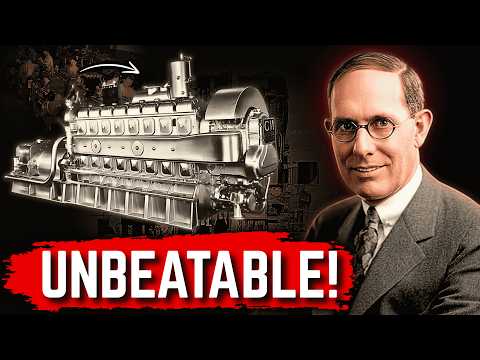
By 1934, General Motors had organized this research into a dedicated diesel division, allocated space within the Cadillac Motor complex. The team settled on a family of engines with a modular design, built around a single cylinder displacing just over 70 cubic inches—a figure rounded to 71, hence the engine family’s name. The genius of the design was not in any single cylinder, but in how these cylinders were combined. From the start, three-cylinder, four-cylinder, and six-cylinder versions were planned, all sharing the same bore, stroke, and largely the same internal components. An operator of a small generator could use a compact three-cylinder engine, while a heavy truck manufacturer could install the six-cylinder version, and a technician trained on one could service the other without learning an entirely new machine.
This was a radically different philosophy from the approach European diesel manufacturers took when building marine engines, where each application required its own custom design. Kettering’s team was thinking like automakers, not shipbuilders. And that mindset would define the engine’s success for decades.
The result, unveiled in 1938 as the flagship of the new engine family, was the inline six-cylinder known as the 671. It was small enough to fit under a truck hood, light enough to be practical, and powerful enough to seriously compete with gasoline engines in applications where fuel economy and torque mattered more than top speed.
Commercial reception was immediate but modest. Seven hundred of the new engines were delivered in its first production year to GM’s bus and truck division, powering city transit buses and heavy trucks in numbers small enough that the engine was considered a rare specialty product rather than an industry standard. Competing diesel manufacturers watched closely. In Columbus, Indiana, a company called Cummins Engine Company, founded by a former driver turned eccentric engineer, was building its own four-stroke diesels, betting that the conventional, heavier but more thermally efficient design would win out over time.
Everything changed in 1939 when war broke out in Europe, and American industry quietly began retooling factories to supply the nations fighting Nazi Germany. Detroit Diesel’s engines—compact, powerful for their weight, and simple enough to be maintained by soldiers with limited field training—were exactly what military planners needed. Even before the United States formally entered the war, 71-series engines were being shipped to Britain and the Soviet Union to power road-building equipment, backup generators, and early armored vehicles.
The Inline 671 was adapted to British requirements, used as a powerplant for Canadian Valentine tanks, then British-built versions, which were among the most widely used armored vehicles in the British Commonwealth during the war, with orders placed in the final months of 1940. When the United States formally declared war in 1941, demand for these engines surged beyond all of General Motors’ expectations. Production figures tell the story better than any description. Nearly 9,000 engines were built in 1941. By 1944, that number had risen to 62,000 engines in a single year—a massive expansion almost unprecedented for an engine family that had delivered only batches of 700 just six years earlier.
The engine’s most famous wartime use was in twin-engine configurations mounted in the M4 Sherman tank, America’s primary medium tank and the backbone of the U.S. Army’s armored forces on every front from the deserts of North Africa to Normandy. The variant designated M4A2 paired two 671 diesels into a single power unit, giving crews a tank less prone to catching fire under enemy fire than its gasoline-powered counterparts. This was a critical advantage, as a single well-placed hit could turn a fuel tank into an inferno. Nearly 22,000 of these twin diesel engines were installed in Sherman tanks, while another 11,000 went into the M10 tank destroyer, a fast, lightly armored vehicle designed to hunt German tanks.
Diesel-powered Shermans were particularly associated with the U.S. Marine Corps in the Pacific theater, as well as with British and Commonwealth forces who valued the reduced fire risk so much that they specifically requested diesel versions whenever available.
But it was on water, not land, that the “Screaming Jimmy” earned its immortal wartime legend. A New Orleans boat builder named Andrew Higgins designed a shallow-draft landing craft capable of reaching the beach directly and lowering its front ramp to discharge soldiers and vehicles. It was so effective that General Dwight Eisenhower later credited Higgins with winning the war for the Allies through his boats alone. Higgins boats, formerly known as Landing Craft, Vehicle, or Personnel (LCVP), needed an engine that was compact, reliable, and powerful enough to push a loaded boat through waves and onto sand under enemy fire. The 671 diesel met that requirement perfectly. Nearly 19,000 of these engines were installed in landing craft alone. That means on the morning of June 6, 1944, as thousands of landing craft approached the beaches of Normandy, most were propelled by the same engine family originally designed for city buses and construction generators.
Larger landing craft used a more distinctive design—four 671 engines coupled together in a quad arrangement driving two propeller shafts, allowing these larger vessels to deliver full companies of infantry directly onto contested beaches. Meanwhile, mechanized landing craft used thousands more of the same engines to carry tanks ashore.
By the time victory was declared in 1945, Detroit Diesel had produced nearly 100,000 engines during the war years, and its manufacturing workforce had grown to over 4,000 employees. When the guns fell silent, Detroit Diesel faced the question every wartime manufacturer confronts: an engine designed for tanks and landing craft needs a peacetime use, and the company found its answer almost immediately in America’s booming postwar economy.
Returning soldiers wanted automobiles, but the country also needed trucks, buses, and construction equipment to build the infrastructure of its most prosperous decade. The 671, along with its smaller and larger siblings in the 71-series family, found a place in nearly every corner of that boom.
Detroit Diesel began marketing the 71-series directly for marine applications in 1945, taking over a role previously filled by Gray Marine Motor Company, which had been assembling marine versions of the engine since 1938 for commercial fishermen and pleasure boaters alike. On the highway, the engine became the standard choice for Yellow Coach, a bus manufacturer GM had fully acquired in 1943, guaranteeing a captive market for Detroit Diesel engines in transit systems across the country.
During this period, truck drivers and mechanics gave the engine the nickname that would follow it throughout its service life. Because Detroit Diesel had been a GM subsidiary since its founding, and because GM vehicles were commonly called “Jimmys” after the GMC logo, the engine acquired the first half of its famous name almost automatically. The second half came from its distinctive acoustic signature. Because a two-stroke diesel fires once every revolution of the crankshaft, rather than once every two revolutions as in a four-stroke, the engine’s sound resembled a machine running at double speed, emitting a sharp mechanical scream audible from several buildings away—a sound unlike anything else on American roads. Add the constant whine of the cooling fan that kept the cylinders alive, and you had an engine sound that truckers either loved or hated, but never ignored. Thus the “Screaming Jimmy” was born—not in a marketing meeting, but in the ears of the men who drove it every day.
By the 1950s, the modular design advantage Kettering’s team had built in from the start began paying off enormously. One parts catalog and one trained service network supported engines ranging from a single-cylinder unit for small equipment up to a six-cylinder model, with experimental configurations reaching 12, 16, and even 24 cylinders by combining multiple engine blocks together. Detroit Diesel introduced the smaller 53-series in the mid-decade to serve applications needing less power than the 71 family, further expanding the range of interchangeable parts and making ownership of Detroit engines far easier than dealing with a fragmented collection of unrelated designs from competitors.
By then, one in every three heavy trucks on America’s growing highway network was powered by a Detroit Diesel—a remarkable market position for a design that had barely existed 20 years earlier. Detroit Diesel’s total horsepower production, calculated across all engines the company had ever built, surpassed 100 million horsepower by 1963 and climbed to 150 million by 1967. Cummins, still building four-stroke engines in Columbus, Indiana, remained a strong competitor in the long-haul trucking segment, where the superior fuel efficiency of its four-strokes at highway speeds gave it an advantage Detroit’s two-strokes could not match. Meanwhile, Caterpillar continued expanding its lineup of four-stroke engines for construction and off-road equipment, competing with Detroit in a segment where reliability under extreme loads mattered as much as raw power.
For nearly three decades, these three companies coexisted in a delicate balance. Each dominated different market segments, and each was convinced of the correctness of its fundamental engineering philosophy. But that balance collapsed in October 1973 when a coalition of oil-producing nations imposed an embargo that sent fuel prices soaring overnight. Prices rose from about 30 cents a gallon to nearly 80 cents within months. It was a shock that rattled the American economy, but it hit the trucking industry especially hard, since fuel was one of the largest ongoing operating costs for any commercial fleet. Overnight, the calculations that had governed engine choice for decades were turned upside down. Fuel economy, previously a secondary consideration after reliability and power, became the most important factor in any purchase decision.
And here, the design of the Detroit Diesel two-stroke revealed a weakness latent since Kettering’s first test engines. The Roots blower—the mechanical lung without which the engine could not scavenge exhaust from its cylinders—consumed a significant portion of engine power just to keep itself spinning. Engineers call this parasitic load. Four-stroke engines, with their separate intake and exhaust strokes controlled by the piston itself, needed no such mechanism. Suddenly, the designs from Cummins and Caterpillar looked far more attractive to fleet operators counting every gallon of diesel.
Detroit Diesel’s engineers understood the implications perfectly. The basic physics of uniflow scavenging—the achievement that had made the two-stroke design practical in the 1930s—now worked against the engine in a market suddenly obsessed with fuel efficiency. The correct response, so obvious in hindsight that business historians would later treat it as a textbook case study, was to pivot toward a four-stroke Detroit design, competing with Cummins and Caterpillar on their own terms. But changing course meant admitting that the engine on which the entire company had been built for nearly 40 years—the same engine that had pushed Sherman tanks onto the beaches of Sicily and Higgins boats onto the sands of Normandy—was not the right tool for the coming decades. That was a bitter pill for any institution to swallow, but GM’s leadership, having faced warnings from its own engineers, chose instead to double down.
In 1974, Detroit Diesel introduced the 92-series, a redesigned, larger-displacement version of the same two-stroke architecture, marketed under the name “Fuel Squeezers,” in a campaign that promoted a modest 10 to 20 percent efficiency gain as a real solution to the current crisis. It was not. It was the same blower, the same parasitic load, the same engine mechanism, wrapped in a larger cylinder and a more optimistic name. Cummins and Caterpillar, unburdened by any legacy two-stroke architecture, continued closing the fuel-efficiency gap with each new model. The following decade witnessed the slow-motion embodiment of what business analysts call the “sunk cost trap”—the tendency of an institution to keep pouring resources into a failed strategy simply because it has invested so much in it.
Through the late 1970s and early 1980s, Detroit Diesel’s market share eroded steadily as truck fleets, increasingly sophisticated in calculating total cost of ownership, gravitated toward the superior fuel efficiency of the competitors’ four-strokes. GM, facing broader financial pressures across its empire, did not respond with the investment the situation demanded. Of the nearly $50 billion GM spent modernizing its plants throughout the 1980s, only about $100 million reached the struggling Detroit Diesel Allison division—a paltry sum relative to the scale of the problem. Internal assessments from that period acknowledged plainly that the division was producing substandard engines, engines that no longer performed at the level that had made the Detroit name synonymous with reliability. Loyal customers who had used Detroit engines for decades began switching to Cummins, and by the mid-1980s, GM was quietly searching for a buyer willing to take the struggling division off its hands.
Detroit Diesel did not give up without one last attempt to reinvent itself. In 1987, the company finally introduced the Series 60, its first modern four-stroke heavy-duty engine, equipped with integrated electronic engine controls as standard—leapfrogging most competitors. It was a genuinely excellent engine, more fuel-efficient and cleaner-burning than anything Detroit had built before, and it would become the best-selling heavy-duty diesel in the entire North American Class 8 truck market over the following decade. But 1987 was 13 years after the oil embargo that had exposed the fatal weakness in the two-stroke designs—13 years during which Cummins and Caterpillar had cemented their positions in the segment that cared most about fuel efficiency.
In 1988, Penske acquired 60 percent ownership of the struggling division, while GM retained the remaining 40 percent, spinning the company off from direct GM control and creating the independent Detroit Diesel Corporation. Penske avoided the sweeping management purges that often accompany corporate restructurings, retaining experienced engineers and veteran managers who understood the product intimately, and focused instead on cutting excess costs and consolidating scattered manufacturing operations without compromising the engineering competencies that had developed the Series 60. The strategy worked with remarkable speed. Within two years, Detroit Diesel doubled its market share in the heavy truck segment. By 1993, that share had risen to about 26 percent, largely reclaiming its position at the expense of Cummins, the archrival whose four-stroke engines had spent two decades undermining Detroit’s dominance.
Mercedes-Benz, the German automaker whose parent company Daimler-Benz had built its reputation on precision diesel engineering, began exploring closer ties with the revived Penske-owned Detroit Diesel during this period, driven by the same mix of manufacturing capability and engineering credibility that had made the Screaming Jimmy the standard for American diesel power. And while the Series 60 restored Detroit Diesel’s standing, the original two-stroke architecture on which the company had been built was quietly approaching its end, as tightening federal emissions standards throughout the late 1980s and 1990s targeted the exhaust characteristics that two-stroke diesels struggled to control. The uniflow scavenging process Kettering’s engineers had perfected decades earlier inherently meant that some unburned fuel and lubricating oil ended up in the exhaust stream, contributing to particulate and hydrocarbon emissions that became increasingly difficult to reconcile with new regulatory limits. The scavenging process built around a blower, rather than a dedicated exhaust stroke, could never be fully overcome, no matter how much turbocharging, aftercooling, or electronic fuel control was applied.
Sales of the original 71-series—the engine that had powered Higgins boats onto the beaches of Normandy and Valentine tanks across North Africa—ceased entirely in the summer of 1995, with production of the 92-series, its larger two-stroke sibling from the failed 1974 project, ending the same year. Both were replaced entirely by Detroit Diesel four-stroke engines, designed according to the Series 60 philosophy rather than Kettering’s original uniflow design. The highway engine had remained in production for 57 continuous years—an extraordinarily long production run for any industrial machine. But the emissions regulations that finally ended it were not a problem clever engineering could overcome.
The company itself survived long after its original engine design faded. In 2000, DaimlerChrysler—the German-American conglomerate formed by the merger of Daimler-Benz and Chrysler—acquired Detroit Diesel outright, integrating it into a global heavy-duty engine development platform that eventually produced the modern DD engine series, still sold today under the Detroit name. The company Charles Kettering built from a locomotive engine manufacturer, and his unwavering faith in the physics of two-stroke combustion, became a wholly owned subsidiary of Daimler Trucks North America, still headquartered in Detroit, still building diesel engines—but now built entirely on the four-stroke design that had nearly destroyed the company that refused to adopt it in time.
The Screaming Jimmy never disappeared entirely. Its distinctive echo still resonates today in marine and off-road applications where emissions regulations remain less stringent, in the engine rooms of tugboats and fishing vessels, and in the memory of truck drivers who lived with that unmistakable sound on America’s old highways. Enthusiasts continue rebuilding these two-stroke engines, preserving a piece of engineering history that began with one stubborn inventor’s refusal to accept that a diesel engine had to be heavy, slow, and complex to be powerful—and that ended up, however briefly and incompletely, changing the very sound of American industry.
So here is the question that lingers long after the last Jimmy falls silent: when the machine that built your company becomes the machine that threatens to bury it, do you owe your loyalty to the past that made you—or to the future that might save you?
Report this article
Select a reason for reporting:






