They were the men whose names appeared in enemy intelligence reports—the pilots Japanese commanders warned their own airmen about. Between 1941 and 1945, five American fighter pilots shot 168 enemy aircraft out of the sky. Not damaged, not probable, but confirmed destroyed. Over 1,400 Americans became aces during World War II, yet only these five racked up kill counts so high they became legends. This is the story of the deadliest American fighter pilots of the war, ranked by confirmed aerial victories.
Number five was a drunk, a liar, and a mercenary—and one of the most lethal pilots who ever lived. Number three became an ace twice in a single day. Number two died trying to pass number one. And number one killed more enemy aircraft in a single mission than most aces did in their entire careers.
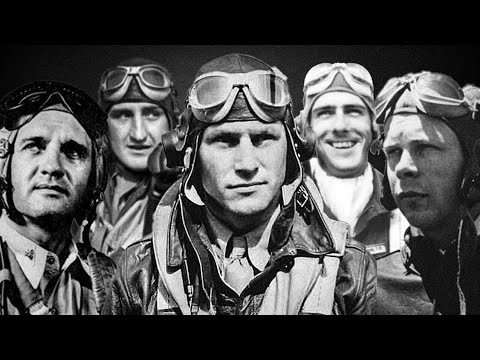
But this isn’t about Hollywood portrayals or dramatic speeches. It’s about documented mission reports, gun camera footage, and the cold mathematics of who put more enemy planes in the ground while keeping themselves in the air. These men were methodical, aggressive, and absolutely lethal in the sky. Their stories are not just about skill—they are about obsession, survival, and the high cost of victory.
We begin with the man who was perhaps the most complicated of them all. Gregory “Pappy” Boyington was not a good man. He was an alcoholic. He lied about his kill count. He abandoned his first wife and three children. The Marine Corps considered him a discipline problem. He was also one of the most lethal fighter pilots America ever produced.
Boyington earned 28 confirmed aerial victories across two wars and two air forces. Six of those kills came before America even entered the conflict, flying as a mercenary for the Chinese government against the Japanese. The remaining 22 came as a Marine Corps fighter pilot in the Solomon Islands.
In 1941, Boyington was a washed-up Marine pilot drowning in debt and alcohol. He resigned his commission and joined the American Volunteer Group—better known as the Flying Tigers—a mercenary unit fighting for China. They were paid $500 for every Japanese plane they shot down. It was legalized killing for money, and Boyington was good at it. He claimed six aerial victories with the AVG before the unit disbanded in July 1942.
When America entered the war, Boyington rejoined the Marine Corps. They needed experienced pilots, and despite his problems, Boyington had something most pilots didn’t: he had already killed Japanese aircraft. He knew how they flew, how they fought, and how they died.
In September 1943, Boyington took command of Marine Fighter Squadron 214—a collection of replacement pilots and misfits that nobody else wanted. Boyington called them the Black Sheep. The name stuck. At 31 years old, he was a decade older than most of his pilots. They called him “Pappy” because of his age. He called them idiots, but he taught them how to survive.
Between September 1943 and January 1944, Boyington shot down 22 Japanese aircraft in just 84 days of combat. On January 3rd, 1944, he tied Eddie Rickenbacker’s World War I record of 26 total victories. That same morning, Boyington was shot down over Rabaul. His wingman saw his Corsair hit the water. The Marines listed him as killed in action.
He wasn’t dead. Boyington had been pulled from the water by a Japanese submarine and spent the next 20 months as a prisoner of war. He was beaten, starved, and tortured. The Japanese never told the Americans he was alive. When the war ended in August 1945, Boyington walked out of a prison camp weighing 110 pounds. He returned home to discover he’d been awarded the Medal of Honor in absentia.
Boyington’s life after the war was troubled. The drinking continued, the marriages failed. He wrote an autobiography called Baa Baa Black Sheep that was turned into a television series in the 1970s. He died in 1988 at age 75. 28 confirmed aerial victories. A mercenary who became a Marine, a drunk who became a legend, a prisoner who came home. Gregory Boyington was not a hero in the traditional sense. He was something more complicated. He was effective.
But Boyington is just the beginning. The men who rank above him were even more deadly—and their stories are even more extraordinary. One became an ace in a single day, twice. Another died chasing the record. And the man at number one? He flew closer to the enemy than anyone else, and he paid the ultimate price for a forgotten switch.
Number four is the man who almost never made it into a cockpit at all. Francis “Gabby” Gabreski’s flight instructor told him he didn’t have the touch to be a pilot. The man who would become America’s leading ace in Europe was nearly washed out of flight training before it began.
Gabreski was the son of Polish immigrants from Oil City, Pennsylvania. When Germany invaded Poland in 1939, it wasn’t abstract news. It was personal. His parents’ homeland was being destroyed, and Gabreski wanted revenge.
In 1943, he did something no other American fighter pilot had done. He requested assignment to a Polish fighter squadron attached to the Royal Air Force. For months he flew Spitfires alongside Polish veterans who had already been fighting the Luftwaffe for years. He didn’t score any victories during this time. But he learned something more valuable than kills. He learned how experienced combat pilots stayed alive.
When Gabreski joined the 56th Fighter Group in February 1943, his fellow pilots resented him. He hadn’t trained with them. He hadn’t shipped with them. He was an outsider with opinions about how things should be done. His promotion to squadron commander over more senior pilots made things worse. Then he started killing Germans.
Gabreski’s technique became well known among American pilots. He called it the close kill. While other pilots opened fire at 400 yards, Gabreski held his fire until he was within 100 yards—sometimes 50. At that range, with eight .50 caliber machine guns, he didn’t need to be a good shot. He just needed to be close enough that he couldn’t miss.
On November 26th, 1943, Gabreski earned the Distinguished Service Cross for a mission that exemplified his aggressive style. Leading a bomber escort near Oldenburg, Germany, his squadron was attacked by Messerschmitt 110s. Gabreski singled out the lead aircraft and attacked from dead astern, firing short bursts until the enemy exploded. Large pieces of the Messerschmitt bounced off his canopy and smashed into his wing. Any sensible pilot would have headed home. Gabreski climbed back up and shot down a second 110.
By July 5th, 1944, Gabreski had scored 28 aerial victories, making him the highest-scoring American ace in Europe. He was scheduled to rotate home. His war was over. But Gabreski heard there was one more mission scheduled, and he couldn’t resist.
On July 20th, 1944, Gabreski led a strafing attack on a German airfield near Koblenz. Flying too low, his propeller clipped the ground. The P-47 cartwheeled across a German field. Gabreski survived, evaded capture for five days, then spent the rest of the war in Stalag Luft I on the Baltic Sea.
Here’s the number that defines Gabreski’s war: 28 aerial victories in 166 combat missions. But his story didn’t end there. In Korea, flying F-86 Sabers against MiG-15s, Gabreski shot down six and a half more enemy aircraft, becoming one of only seven American pilots to achieve ace status in two wars. The man who almost washed out of flight training retired as a colonel with 34 and a half total aerial victories across two conflicts. The instructor who said he didn’t have the touch was wrong.
If Gabreski was the methodical professional, number three was something else entirely—a man who ignored orders, climbed into a cockpit anyway, and rewrote the record books in the process. David McCampbell didn’t even start the war as a combat pilot. He was a landing signal officer, the man who stood on the deck waving paddles to guide planes onto aircraft carriers.
His war began in 1942 aboard the USS Wasp when a Japanese submarine put three torpedoes into her hull near Guadalcanal. McCampbell survived the sinking and was sent home to train other landing signal officers. Most men would have been grateful for the safe assignment. McCampbell wasn’t most men.
In September 1943, at age 33, he formed Fighter Squadron 15 and trained them for combat. In February 1944, he became commander of Air Group 15 aboard the USS Essex. His pilots called themselves the Fabled 15, and they would earn that name.
On June 19th, 1944, during the Battle of the Philippine Sea, McCampbell achieved what only a handful of pilots in history have done. He became an ace in a single day. In the chaos of what American pilots called the Great Marianas Turkey Shoot, McCampbell shot down five Japanese Judy dive bombers in the span of nine minutes. Later that afternoon, he went up again and shot down two more Zeros over Guam. Seven victories in one day. Most aces don’t achieve that in their entire careers. McCampbell did it before lunch.
But October 24th, 1944 is the day that made McCampbell legendary. It was the beginning of the Battle of Leyte Gulf, the largest naval battle in history. That morning, radar aboard the Essex detected an incoming Japanese strike force. Not 10 aircraft, not 20. Approximately 60 Japanese planes were inbound.
McCampbell had been forbidden from flying fighter missions by Rear Admiral Frederick Sherman, who thought the air group commander should focus on coordinating attacks rather than seeking personal glory. But that morning, with only seven Hellcats ready to launch against the incoming strike, McCampbell ignored his orders and climbed into his cockpit.
What happened next became one of the most remarkable aerial engagements of the Pacific War. McCampbell and his wingman, Lieutenant Junior Grade Roy Rushing, tore through the Japanese formation repeatedly. McCampbell shot down nine aircraft. His wingman downed another six. Together, two American pilots destroyed 15 enemy aircraft and helped break up the attack before it could reach the fleet.
When he finally landed, his six machine guns were nearly empty and his fuel tanks were critically low. He had to land on the USS Langley because Essex’s deck wasn’t clear. McCampbell became the only American airman to achieve undisputed ace-in-a-day status twice. His nine kills in a single mission set a United States record for aerial victories in one engagement.
McCampbell finished the war with 34 confirmed aerial victories, making him the United States Navy’s all-time leading ace. He’s also the highest-scoring American ace to survive the war. Bong and McGuire both died in 1945. McCampbell lived until 1996, reaching the rank of captain before retirement. The destroyer USS McCampbell was named in his honor. When you become the only pilot to become an ace twice in a single day, they name ships after you.
Number two is the man who wanted one thing more than anything else in the world. Tommy McGuire wanted to beat Richard Bong. He wanted to be America’s ace of aces. That obsession drove him to become the second-highest-scoring American pilot of the war. It also killed him.
McGuire grew up in Sebring, Florida, the son of divorced parents. He attended Georgia Institute of Technology to study aeronautical engineering before enlisting as an aviation cadet in 1941. By August 1943, he was in New Guinea flying P-38s with the 475th Fighter Group. On August 18th and 19th, 1943, McGuire achieved ace status over the course of two days of intense combat. Five kills in 48 hours. The kid from Florida had arrived.
From that point forward, McGuire hunted kills with single-minded intensity. He named his P-38 Pudgy after his wife Marilyn, and he flew it into combat with the kind of controlled aggression that impressed his superiors and worried his wingmen. In July 1944, Charles Lindbergh arrived in the Pacific as a civilian technical adviser. According to pilots who served alongside them, McGuire treated Lindbergh like any other new arrival, assigning him routine duties and wingman positions, regardless of his celebrity status. The civilian adviser wasn’t officially supposed to engage the enemy. He shot down a Japanese plane anyway.
By December 1944, McGuire had accumulated 38 aerial victories. Richard Bong had 40. The race was on. On Christmas Day 1944, McGuire earned the Medal of Honor, leading a squadron of 15 P-38s over Luzon. His formation was attacked by 20 aggressive Japanese fighters. In the swirling dogfight that followed, McGuire repeatedly flew to the aid of his embattled comrades, driving off enemy aircraft while himself under attack and at times outnumbered three to one. His guns jammed. He kept fighting anyway, forcing a Japanese plane into his wingman’s line of fire. The next day, he shot down four more aircraft in a single engagement, bringing his total to 38.
On January 7th, 1945, McGuire led a volunteer fighter sweep over Negros Island in the Philippines. It was supposed to be a routine patrol. They found a lone Japanese Oscar near Fabrica airfield. During the engagement, another Japanese aircraft entered the fight. McGuire attempted a hard turn at low altitude to help a squadron mate. His P-38 was still carrying external fuel tanks, which affected its handling. At low altitude, with limited room to recover, the aircraft stalled. McGuire’s plane flipped and crashed. America’s second-highest-scoring ace died instantly. He was 24 years old.
McGuire Air Force Base in New Jersey bears his name. The Medal of Honor was awarded posthumously. His widow Marilyn received the news that her husband, the man who had painted her name on his fighter, would never come home. 38 victories, two kills short of the record. The man who wanted to be number one died trying.
And that brings us to number one. Richard Bong killed more enemy aircraft than any American pilot in history. 40 confirmed aerial victories. That’s not opinion. That’s documented fact. Bong was candid about his limitations. He admitted he was a poor shot at long range. So he compensated by flying closer to the enemy than any textbook recommended. His technique was straightforward: get behind the target, close to point-blank range, and fire until the enemy stopped flying. What he lacked in marksmanship, he made up for in nerve.
Bong grew up on a farm near Poplar, Wisconsin, the eldest of nine children born to a Swedish immigrant father. By the time he enlisted in the Army Air Corps in 1941, he had accumulated 36 hours of flight time, mostly in a biplane at the local airport. At Hamilton Field, California, Bong demonstrated the daring that would define his career. In one infamous incident, he flew his P-38 under the Golden Gate Bridge, buzzed Market Street in San Francisco at low altitude, and blew laundry off a woman’s clothesline in Oakland.
General George Kenney, commander of the Fifth Air Force, called Bong into his office. Instead of court-martialing him, Kenney gave him a choice: report to the woman whose laundry he scattered, help her with her washing, hang it back on the line, and mow her lawn—or face formal charges. Bong did the laundry. Kenney later said, “If you didn’t want to fly down Market Street, I wouldn’t want you in my Air Force.”
When Kenney shipped out to the Pacific in September 1942, he handpicked Bong as one of 50 P-38 pilots to join his command. It was one of the best personnel decisions of the war. On December 27th, 1942, Bong scored his first two aerial victories over Buna, New Guinea. A Zero and an Oscar fell to his guns in the same engagement. He was awarded the Silver Star.
From that point forward, Bong accumulated victories at a remarkable pace. Ground crews painted rising sun flags on his fuselage as fast as he could earn them. By September 1943, he had 28 confirmed kills, making him the top American ace in any theater. On April 12th, 1944, Bong shot down his 26th and 27th Japanese aircraft, becoming the first American pilot to surpass Eddie Rickenbacker’s World War I record of 26 victories. He was promoted to major and sent home for a publicity tour. He couldn’t stay away.
In September 1944, Bong returned to the Pacific as a gunnery instructor. He wasn’t required to fly combat missions. General Kenney had expressly ordered him not to seek out the enemy. Bong flew anyway. During his final combat tour, he voluntarily participated in 30 more missions and destroyed 12 more Japanese aircraft. His Medal of Honor citation reads, in part: “Though assigned to duty as gunnery instructor and neither required nor expected to perform combat duty, Major Bong voluntarily and at his own urgent request engaged in repeated combat missions, including unusually hazardous sorties over Balikpapan, Borneo, and in the Leyte area of the Philippines.”
By December 1944, Bong had reached 40 victories. General Kenney finally grounded him for good. 200 combat missions, over 500 combat hours, 40 confirmed kills. America had its ace of aces. Bong went home to Wisconsin, married his sweetheart Marjorie, whom he had immortalized by painting her photo on the nose of his P-38, and took a job as a test pilot for Lockheed.
On August 6th, 1945, the same day the atomic bomb fell on Hiroshima, Major Richard Bong climbed into the cockpit of a P-80 Shooting Star jet fighter. It was a routine test flight. It would be his last. During the takeoff sequence, Bong failed to engage the aircraft’s auxiliary fuel pump. The P-80’s jet engine required this pump to maintain fuel pressure during climbout. Without it, the engine-driven pump couldn’t deliver enough fuel on its own. The engine flamed out at low altitude. Bong attempted to eject, but he was too low. The parachute didn’t have time to deploy. America’s greatest ace died from a procedural error on the same day the war effectively ended. He was 24 years old.
Newspapers the next morning ran his obituary alongside the headline announcing the bombing of Hiroshima. The man who had survived 200 combat missions against the Japanese was killed by a forgotten switch. The Richard I. Bong Veterans Historical Center in Superior, Wisconsin preserves his memory. The Bong Bridge connects Wisconsin and Minnesota across the St. Louis Bay. The man from the Wisconsin farm who wanted to fly became the deadliest American pilot who ever lived. 40 confirmed aerial victories. A record among American pilots that has never been broken.
Let’s add them up. Boyington 28, Gabreski 28, McCampbell 34, McGuire 38, Bong 40. Total: 168 enemy aircraft destroyed by five American pilots. Five men, 168 kills. And the Axis powers learned that American fighter pilots weren’t just brave. They were methodical, aggressive, and absolutely lethal in the sky.
Five men, 168 enemy aircraft, and a record that among American pilots still stands eight decades later. These pilots deserve to be remembered for what they actually did in the cockpit, not what Hollywood turned them into. So here’s the real question: did we get the ranking right? Should McCampbell be higher because he achieved more kills per mission? Should McGuire be number one because he died chasing the record? Drop a comment right now and tell us your ranking—and tell us who we missed.
Report this article
Select a reason for reporting:






