Imagine you are six years old. You still cling to your mother’s hand. You still fear the dark. And then one morning in the thick summer heat of August 1943, men in dark suits bow before you and tell you your father is dead, that his kingdom is now yours, and that Hitler, Stalin, and your own trembling ministers are waiting for your signature on things you cannot read.
This is not a fairy tale. This is the true story of Simeon II of Bulgaria—the last child to ever sit on a European throne. A boy who inherited a crown soaked in conspiracy, lost it to a Soviet-backed coup before his tenth birthday, and then, in a twist no historian saw coming, returned 55 years later to run the very country that had thrown him out.
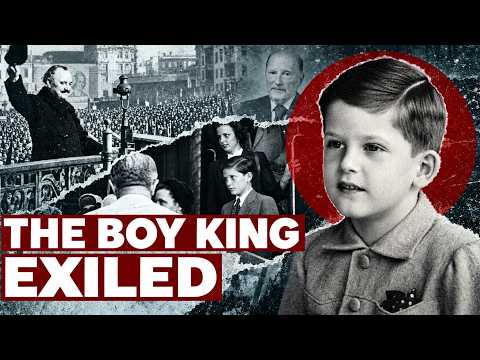
Our story begins not with Simeon, but with his father, Boris III—a reluctant monarch, a lover of trains and butterflies, a cautious man who inherited the throne in 1918 after Bulgaria’s catastrophic loss in World War I. For two decades, Boris walked a tightrope. Communists tried to assassinate him. Nationalists tried to control him. Somehow he survived every coup and every bomb.
By 1939, the storm over Europe was no longer a metaphor. Hitler had torn through Czechoslovakia. Mussolini—Simeon’s own grandfather by marriage—was now Hitler’s junior partner. Bulgaria, surrounded on every side, was being squeezed to pick a side.
In March 1941, after months of unbearable pressure, Bulgaria formally joined the Axis powers. But here is where Boris did something that would echo through history—and which almost certainly cost him his life.
In early 1943, Nazi officials demanded that Bulgaria hand over its roughly 50,000 Jewish citizens to be deported to the death camps. Boris refused. He allowed the deportation of around 11,000 Jews from occupied Thrace and Macedonia—a decision that remains a dark stain on his record—but he dug in his heels when it came to Bulgaria’s own Jewish population. Thanks to that refusal, backed by parliamentarians, Orthodox bishops, and ordinary citizens, nearly all of Bulgaria’s Jews survived the Holocaust.
Boris also refused to send Bulgarian troops to fight the Soviet Union, telling Hitler bluntly that his people were Russophile and that putting Bulgarians on the Eastern front would spark a mutiny. Hitler was furious.
On August 9th, 1943, Hitler summoned Boris to his Wolf’s Lair in East Prussia. The meeting was stormy. Boris refused again to send troops east. He refused again to deport the Jews. He flew home to Sofia on August 15th, exhausted and unwell. Within days, he was in bed with a fever, a rash, convulsions, and what doctors would later describe as liver dysfunction.
On August 28th, 1943, at the age of 49, Boris III of Bulgaria was dead. The official cause was coronary thrombosis. The whispered cause was poison. Conspiracy theories exploded almost before the body was cold—some pointed at the Nazis, others at the Soviet NKVD. The autopsy was inconclusive. His liver showed strange damage. No proof has ever surfaced.
What is undisputed is this: Boris was buried at the Rila Monastery, the streets of Sofia filled with weeping crowds, and his six-year-old son was now the Tsar of Bulgaria.
Imagine the scene inside the Vana Palace. Simeon, barely able to tie his own shoelaces, is dressed in a black suit. He is told gently that his father has gone to heaven. He is then told less gently that he must stand very still while elderly men in uniform swear oaths of loyalty to him. He is Tsar Simeon II by the grace of God, sovereign of a kingdom locked in a war he does not understand, allied to a dictator he has never met, with a Red Army already pushing toward his borders.
Because he was too young to rule, the constitution demanded a regency council. Three men were chosen: his own uncle, Prince Kiril; the sitting prime minister, Bogdan Filov; and Lieutenant General Nikola Mihov. These three men would now run Bulgaria in the little king’s name—and they would make catastrophic choices. Choices that would, within 18 months, see all three of them standing in front of a firing squad.
For the next year, Simeon’s life was deceptively normal. He went to lessons. He played in the gardens of Vana. He saw less of his mother than he wanted, because Queen Giovanna was now a widow managing a court, a nation, and two frightened children. But outside the palace walls, Bulgaria was unraveling.
The regents clung to the German alliance even as it became obvious that Hitler was going to lose. By mid-1944, Soviet troops were advancing through Romania and were about to crash into Bulgaria. In a desperate attempt to switch sides, the Bulgarian government declared war on Nazi Germany in early September 1944.
It did not matter. On September 5th, the Soviet Union declared war on Bulgaria anyway. On September 8th, Red Army units crossed the Danube. They met almost no resistance.
And then, in the early hours of September 9th, 1944, came the night that would reshape everything. A coalition called the Fatherland Front—dominated by the Bulgarian Communist Party—launched a coup backed by Soviet intelligence and the physical presence of the Red Army. The sitting government was overthrown without a shot. Soviet-aligned troops occupied the capital. A new prime minister, Kimon Georgiev, was installed as a front for the communists who held the real power behind the scenes.
The three regents—Prince Kiril, Bogdan Filov, and Nikola Mihov—were arrested within days. Many historians today describe September 9th, 1944 as the single greatest national catastrophe of twentieth-century Bulgaria. The entire political, military, and intellectual class of the country was about to be systematically destroyed. And at the center of it all was a seven-year-old boy who still, somehow, technically wore the crown.
The communist regime had a problem. It could not simply execute a child. International opinion still mattered, even to Stalin. The Western Allies were watching. The British and Americans were pressing for democratic elections in liberated Eastern Europe. Even the Red Army could not openly murder a seven-year-old monarch without consequences.
So the communists did something more clever and more cruel. They let Simeon keep the crown as a figurehead while they methodically dismantled every pillar that held the monarchy up—the courts, the parliament, the military leadership, the clergy, the free press. Every one of them was captured, purged, or liquidated.
And the main instrument of that destruction was the so-called People’s Court. Established by the Fatherland Front government on October 6th, 1944, it was an ad hoc tribunal modeled on Soviet revolutionary justice—no right of appeal, no proper defense, sentences carried out immediately. In four short months, it would try 135 cases with 11,122 accused. It would sentence 9,155 people. Of those, 2,618 were sentenced to death. Around 200 more were killed before trial even began.
And in the single most devastating session, on the night of February 1st, 1945, the People’s Court sentenced to death all three regents of young King Simeon—including his own uncle, Prince Kiril—along with 22 former cabinet ministers, 67 members of parliament, 47 generals and senior officers, and eight royal advisers. The sentences were carried out that same night at the Sofia Cemetery.
Simeon was seven years old when a firing squad killed his uncle. The man who had held his father’s hand at family dinners, who had taken him on walks in the garden, who had sworn before God to protect him as regent, was shot in the dark and buried in an unmarked trench. One of the executioners, a man named Ferdinand Kozovski, reportedly walked around central Sofia the next day wearing the dead prince’s boots.
The families of the condemned—4,325 households, nearly 12,000 people—were forcibly relocated. Their property was confiscated. Their names were erased from public records. The Bulgarian state had, in the words of one modern historian, been beheaded.
And standing in the ruins was a child king who could not fully process what was happening around him—except that his family was disappearing one by one, and his mother was growing quieter every day.
A second Regency council was installed—staffed entirely by communist appointees. Simeon’s role was now purely ceremonial. He signed nothing. He decided nothing. He was wheeled out for state occasions and photographed: a small, serious boy in a dark suit, flanked by the men who had killed his uncle.
The final blow came on September 8th, 1946. The communist-controlled government staged a referendum on the monarchy. The official result: 95.6% voted to abolish it. Historians today are nearly unanimous that the vote was manipulated through intimidation and fraud. On September 15th, Bulgaria was proclaimed a people’s republic. The nine-year-old king was no longer king.
Simeon, his sister Maria Louisa, and Queen Giovanna were given days to pack. They were not allowed to abdicate formally—which meant Simeon would carry his royal title for the rest of his life without a throne beneath it. They were put on a train with a few personal belongings. The palaces, the forests, the art collections—every scrap of royal property—were nationalized by the 1947 law that would torment Simeon’s lawyers for seven decades.
Their first stop was Alexandria, Egypt. And here fate showed its irony: Simeon’s maternal grandfather, King Victor Emmanuel III of Italy, was also living there in exile, having been forced out after Italy abolished its own monarchy that same year. Two deposed monarchs, grandfather and grandson, under the Egyptian sun.
Simeon enrolled at Victoria College, a British-style boarding school. He learned English. He learned to deal with being a curiosity—the deposed boy king pointed at in hallways. Egypt itself was unstable, moving toward its own revolution. Money was tight. Queen Giovanna wrote letters to every court in Europe asking for sanctuary.
In 1951, Francoist Spain granted the family asylum. They moved to Madrid, which would remain Simeon’s home for the next fifty years. He studied at the Lycée Français, growing into a quiet, polite teenager fluent in Bulgarian, Italian, French, English, Spanish, and German. He had no country, but he had a dense address book full of European aristocrats and distant royal cousins—including the British royal family, since the house of Saxe-Coburg and Gotha was a cousin branch of the same dynasty that sat on the throne in London.
In 1955, at eighteen, Simeon reached his legal majority. In a quiet ceremony surrounded by the small exiled Bulgarian royalist community, he swore an oath to the Bulgarian people as their monarch. He had never abdicated. He had never been formally deposed in his own view. He simply did not currently exercise his throne. It was a legal fiction—a kind of royal limbo—but it would matter enormously decades later.
He was shipped off to the United States, enrolling at Valley Forge Military Academy in Pennsylvania, then returned to Spain to study law and business. In 1962, at twenty-five, he married Doña Margarita Gómez-Acebo, a Spanish aristocrat from a family woven into the Spanish royal world. The marriage was warm and lasting. Together they would have five children.
Simeon settled into a life no one could have predicted. He became an international business consultant, advising companies on investments in Eastern Europe, the Middle East, and Latin America. He sat on boards. He traveled constantly. He made money. The exiled king had become a private businessman. His children grew up as Spanish aristocrats with Bulgarian passports they could not use.
Decades passed. But throughout those decades, Simeon never stopped thinking about Bulgaria. He followed every piece of news. He maintained contact with the exiled royalist community. He corresponded with dissidents inside the country. He politely declined invitations from Western intelligence services to become a propaganda figurehead against the regime—earning him a reputation as a cautious operator rather than a Cold War pawn. He waited. And he had plenty of time to wait, because the communist regime in Bulgaria would last for forty-five years.
In that time, the country was ruled almost entirely by one man, Todor Zhivkov, who held power from 1954 until the fall of the Berlin Wall. Zhivkov’s Bulgaria was one of the Soviet Union’s most loyal satellites—so loyal that there were jokes about it applying to become the sixteenth Soviet republic. Dissidents were jailed. The Turkish minority was persecuted. Any mention of the exiled royal family was forbidden.
Then, in 1989, the Soviet system collapsed. Zhivkov was pushed out. Bulgaria stumbled into a chaotic post-communist transition that was in many ways worse than what happened in Poland or Hungary. The economy cratered. Hyperinflation wiped out savings. Organized crime filled the vacuum left by the collapsing state. Pyramid schemes robbed millions. Energy shortages left cities freezing in winter. By the mid-1990s, Bulgaria was, in the memorable phrase of one Western correspondent, an economic basket case.
And it was into this bleakness—this hunger for anything that smelled of competence and dignity—that Simeon finally returned.
On May 25th, 1996, after fifty years in exile, Simeon landed at Sofia airport. He was fifty-eight years old. He had not stood on Bulgarian soil since he was a nine-year-old boy being pushed onto an exile train. The socialist government, still staffed by former communists, treated him with calculated coldness—refusing to send anyone to greet him, insisting on referring to him as a private citizen.
But the people poured into the streets by the hundreds of thousands. They waved flags. They threw flowers. They chanted his name. Church bells rang across Sofia. Up to half a million people lined his route through the capital. Grown men wept. Elderly women knelt. For a nation that had been told for half a century that the king was a historical embarrassment, the sight of him walking again through the streets of Sofia was electric.
Simeon, visibly moved, made careful public statements. He insisted that he had come as a private person. He thanked Bulgaria for being a democracy again. He respected its institutions and its laws. He did not demand anything.
He returned to Madrid and for a few years traveled back and forth. The 1998 ruling by Bulgaria’s constitutional court declared the 1947 communist nationalization of royal property unconstitutional. Properties began to flow back to Simeon and his sister—including the Vana Palace outside Sofia, the summer residence of Tsarska Bistritsa in the Rila Mountains, and vast tracts of forest. The royal family donated the park around Vana Palace to the city of Sofia in 1999, keeping only the palace itself. It was both a goodwill gesture and a political statement. Simeon was signaling that he was not back to loot, but to serve.
And then, in April 2001, came the move that stunned Europe.
On April 6th, 2001, Simeon announced the formation of a political party. He called it the National Movement Simeon II. He gave a famous speech promising to transform Bulgaria within 800 days. He pledged sustainable economic growth, swift accession to the European Union and NATO, an end to corruption, and a stable legal framework meeting European standards. The country, exhausted by a decade of post-communist chaos, latched on to him like a drowning man grabs a rope.
His party had been formed only two months before the general election. The courts initially blocked its registration on technical grounds, forcing it to run on the ticket of two minor parties. It did not matter. On June 17th, 2001, the National Movement Simeon II won a landslide victory, taking 120 of the 240 seats in the Bulgarian National Assembly. It was one of the fastest political ascents in modern European history.
On July 24th, 2001, Simeon was sworn in as prime minister of the Republic of Bulgaria. The former boy king, who had lost his throne to the communists before his tenth birthday, had now been elected to run the government of the republic that had replaced his kingdom. He became the first former Eastern European monarch to return to political power since the collapse of communism.
To govern, he formed a coalition with the Movement for Rights and Freedoms, the party representing Bulgaria’s Turkish and Muslim minorities. The move was politically shrewd and historically meaningful, binding together constituencies that had been enemies under both the monarchy and the communist regime. Upon taking office, he officially adopted the Bulgarian form of his family name, Sakskoburggotski, and swore allegiance not to a crown, but to the republican constitution.
He stacked his cabinet with professionals rather than career politicians. He prioritized macroeconomic stability, foreign investment, and above all, Western integration. On his watch, Bulgaria officially joined NATO in March 2004. In 2005, Bulgaria signed its treaty of accession to the European Union, with full membership coming in 2007. Those two achievements—membership in NATO and EU accession—were the strategic goals Bulgarian political elites had chased for a decade and a half. Simeon delivered both.
But his government was not universally beloved. The much-promised 800 days of transformation came and went, and many Bulgarians felt disappointed. Corruption was not eliminated. Wages did not rise fast enough. The privatization of state assets created new tycoons overnight while leaving pensioners in poverty. The media began mocking the former king’s business ties, his aristocratic distance from everyday Bulgarians, his lingering Spanish accent in Bulgarian.
In the 2005 elections, his party finished second to the Bulgarian Socialist Party under Sergey Stanishev. On August 17th, 2005, Simeon stepped down as prime minister. He had served exactly four years and twenty-four days. His party continued in government as a junior coalition partner for a few more years, but its political star faded quickly. By 2009, Simeon stepped away from party politics altogether and became an independent.
What happened next tells you a lot about the country he had come back to. In 2009, the Bulgarian Parliament passed a new law forbidding the royal family from using any returned properties for commercial purposes. In the following years, the state launched a series of lawsuits attempting to reverse the earlier restitution. Simeon lost the battle for the Krichim Palace in 2013. He fought in the Sofia Municipal Court, the Sofia Court of Appeals, and the Bulgarian Supreme Court. The man leading the political effort to strip Simeon of his properties was Boyko Borisov, who had once served as the former king’s personal bodyguard and whom Simeon himself had promoted into senior political roles. The betrayal was, if nothing else, perfectly Bulgarian in its baroque complexity.
Simeon filed a complaint with the European Court of Human Rights in Strasbourg. In April 2025, the European court ruled in his favor, finding that he had not received a fair trial over the confiscation of his royal properties. The Bulgarian government was ordered to pay €5,000 in legal expenses. On July 29th of that same year, the Sofia Court of Appeals finally returned the Vana Palace to him.
Today, in his late eighties, Simeon lives in that palace outside Sofia with his wife, Margarita. The man who was crowned in it as a six-year-old, who was ejected from it as a nine-year-old, who spent fifty years away from it, is now in it again—living out his final years in the same walls where his father, Boris III, once died under mysterious circumstances in August 1943.
So what are we supposed to make of all this? A boy who inherited a crown soaked in his father’s possibly poisoned blood. A seven-year-old who watched his uncle killed by a firing squad. A nine-year-old sent into exile by a referendum nearly every historian today regards as rigged. A teenager raised between Alexandria, Madrid, and Pennsylvania. A businessman who became prime minister of the republic that had deposed him. A former head of state who spent his final decades suing his own country in European courts over palaces.
There is no simple moral here. Simeon is not the hero of a fairy tale. His father, Boris, saved most of Bulgaria’s Jews but handed over 11,000 from occupied territories. The regents the communists executed were themselves implicated in deeply authoritarian wartime policies. The communist regime that followed was unquestionably brutal and killed thousands of the country’s elite without trial. The restitution laws Simeon benefited from are considered unjust by many ordinary Bulgarians, who received no such compensation for property stolen under communism. His time as prime minister brought Bulgaria into NATO and the EU—which was historic—but it also brought corruption scandals, economic disappointments, and the rise of the next generation of oligarchs.
What is undeniable is that Simeon II’s life is one of the most unlikely trajectories in modern European political history. There is no other figure quite like him. No other European child monarch deposed by communists has ever returned to govern. No other head of state has had their career bookended by a Nazi-era regency and a European Court of Human Rights ruling. His survival alone is a kind of monument to a vanished Europe—the Europe of multinational dynasties, of the Saxe-Coburg and Gotha family tree whose branches still reach into London, Brussels, and Madrid, and once reached into Sofia.
His story also reminds us how the great geopolitical currents of the twentieth century—Nazism, Stalinism, the Cold War, the collapse of communism, the integration of the European Union—flowed directly through the life of a single person who was handed a country at the age of six and was never allowed to let it go.
And there is one final layer worth sitting with. The communists who deposed Simeon in 1946 told their people that the age of kings was over, that history had moved past monarchy, that only republics could serve the working class. Fifty-five years later, the people of that republic—free to vote in genuine elections for the first time in generations—elected the deposed king to run their government. Not as a king, but as a prime minister. Not out of monarchist nostalgia alone, but out of exhaustion with the political parties that had emerged from the ruins of the system that had deposed him.
History, it turns out, has a long memory and a dry sense of humor. The communist regime that abolished the monarchy is now itself abolished. The boy king it exiled now lives again in his father’s palace. And the story of Bulgaria’s twentieth century—with all its violence, betrayal, and strange redemption—can be told almost entirely through the life of one man who happened to inherit the wrong crown at the wrong moment, and somehow lived long enough to tell it.
So here is the question I leave with you: if history handed you a crown at six, took it away at nine, and offered it back at sixty-four—would you have the courage to say yes? Tell me in the comments below. 👑
Report this article
Select a reason for reporting:






