What if I told you that in 1969, the United States Army successfully destroyed its own air base without the enemy firing a single shot? I’m talking about a disaster so expensive, so humiliating, and so avoidable that it makes modern military spending look like pocket change. Imagine a pile of money 80 feet high. Now imagine setting it on fire. That’s exactly what happened at Da Nang.
But that’s not the scandal. The real scandal isn’t about the millions of dollars that went up in smoke. It’s about the five men who were watching from the jungle while the Pentagon was losing a fortune in a single afternoon. A tiny team of Australian ghosts was dismantling the Viet Cong for free. Why did the US Army ignore the solution staring them in the face? Why did they choose to build targets instead of weapons? And why, for decades, has this specific comparison been treated like a dirty secret?
Stick with me, because in the next few minutes, we are going to open the files on the $20 million mistake. I’m going to show you the map that proves American logistics were a death trap. I’m going to show you the Australian method that embarrassed the generals. And I promise you, by the end, you will never look at the Vietnam War the same way again. The fuse is lit. Let’s watch it burn.
It was 10:00 in the morning on April 27th, 1969, and the air over Da Nang Air Base was already shimmering with a heat so oppressive it felt heavy in the lungs. This was not just a military outpost. It was a sprawling industrial city of war, a concrete behemoth carved out of the Vietnamese landscape that throbbed with the deafening roar of phantom jets and the constant rumble of supply trucks. To the thousands of American personnel stationed there, the sheer size of the base projected an aura of absolute invincibility, a feeling that nothing could possibly touch them behind miles of barbed wire and overlapping fields of fire.
Technicians with grease-stained hands wiped sweat from their foreheads as they serviced millions of dollars worth of aircraft, while logistics officers in air-conditioned trailers tallied endless columns of supplies that flowed into the base like a river of steel and explosives. It seemed like just another Sunday in the war machine, a day defined by the monotony of maintenance and the security of overwhelming firepower. No one paid the slightest attention to a small, insignificant patch of dry elephant grass near the perimeter of Ammunition Supply Point One, where a tiny wisp of white smoke had begun to curl lazily into the stagnant air.
That small curl of smoke was the only warning they would get before the world turned upside down. But at that moment, it looked as harmless as a cigarette butt flicked onto a sidewalk. The men working the supply dump were surrounded by the greatest concentration of conventional weaponry on the planet. Yet their eyes were focused on clipboards and schedules rather than the dry vegetation baking under the relentless tropical sun. They were guarding a stockpile of destruction so vast that its monetary value exceeded the gross national product of entire nations. Yet the most dangerous thing on the base that morning was not a Viet Cong sapper or a mortar team, but a simple chemical reaction happening in the dirt.
The irony was thick enough to choke on. The mightiest military force in human history had spent billions of dollars fortifying itself against external attack, but it had forgotten the most primal enemy of all. As the sun climbed higher and the temperature spiked past 100 degrees, that innocent fire began to creep toward the wooden pallets that held the fury of hell itself, unnoticed and unchecked by the thousands of soldiers who believed they were safe.
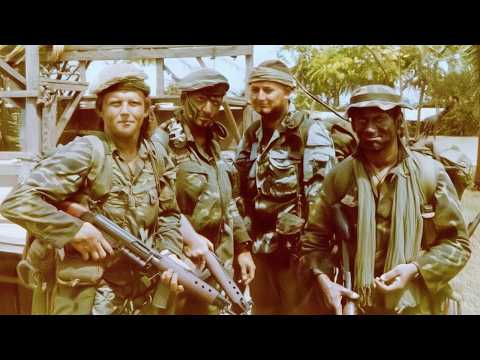
But while the American giant was dozing on a bed of high explosives, a completely different war was being fought 300 meters to the south in the suffocating humidity of Phuoc Tuy province. There were no air-conditioned trailers here, no ice-cold sodas, and certainly no illusion of safety for the five men moving through the dense bamboo with the silence of ghosts. This was a patrol of the Australian Special Air Service Regiment, and their reality was so far removed from the industrial comfort of Da Nang that they might as well have been on another planet.
These men did not smell of engine oil or aftershave. They reeked of rotting vegetation and stale sweat—a deliberate choice to mask their human scent from the keen noses of the enemy. They carried their entire world on their aching backs, surviving on meager rations and water purified with bitter-tasting iodine tablets that turned every sip into a test of will. While the Americans measured their strength in tonnage and decibels, these Australians measured theirs in silence and invisibility, moving so slowly that it could take them an hour to cover 100 yards of jungle floor.
The contrast between these two scenes could not have been more violent or more revealing of the disaster that was about to unfold. On one side, you had a logistical leviathan, a $50 million stockpile sitting vulnerable under the open sky, managed by an army that believed it could crush the rebellion simply by drowning it in supplies. On the other side, you had five men with painted faces and rotting boots, operating with a budget that wouldn’t buy a single spare tire for an American truck, yet achieving results that the Pentagon could barely comprehend.
The Australians had no massive walls to hide behind, which meant they had to rely on their senses, their discipline, and a terrifying level of professionalism that turned them into the most feared hunters in the region. They were not waiting for a supply drop. They were the weapon—honed to a razor’s edge and thrust deep into the enemy’s territory without a safety net.
This is not merely a story about a fire at an ammunition dump. Nor is it a simple recounting of a bad day at the office for the United States Air Force. If it were just an accident, we could write it off as a tragedy of war and move on. But the catastrophe at Da Nang was something far more sinister and significant. It was the inevitable explosive conclusion of a military philosophy that had fundamentally misunderstood the nature of the conflict it was fighting.
We are looking at a collision between two opposing doctrines: the American obsession with overwhelming mass and the Australian mastery of economy and precision. What happened on that sweltering April day was not a fluke. It was a systemic failure that exposed the fatal flaw in the American war machine—a flaw that cost taxpayers millions of dollars in a matter of hours and humiliated the top brass in front of the entire world.
Make no mistake, we are about to peel back the layers of a scandal that was buried under mountains of paperwork and classified reports for decades. This is the story of how the richest army in the world defeated itself without the enemy firing a single shot, while a handful of underfunded commandos showed them how the war should have been fought. We are going to expose the $20 million mistake that proved bigger isn’t always better—and in fact, can sometimes be a death sentence.
The smoke rising from that grass fire in Da Nang was not just burning gunpowder. It was the funeral pyre of an outdated strategy, a signal flare that should have warned the generals that their entire approach was doomed to fail. Yet, as we will see, the lesson was ignored. The warning was dismissed, and the machine kept grinding on, unaware that its greatest weakness was its own voracious appetite for destruction.
To understand why the United States Army allowed such a catastrophic vulnerability to exist, we must first suspend our disbelief and look at the war through the eyes of the Pentagon planners in Washington. It would be easy to dismiss the decision to stockpile millions of tons of explosives in open fields as simple incompetence. But the reality was driven by a cold industrial logic that viewed the conflict not as a guerrilla struggle, but as a massive engineering project.
The United States was attempting to fight a high-intensity war more than 10,000 miles from its own shores—a logistical nightmare that required a supply chain stretching across the vast emptiness of the Pacific Ocean to support an expeditionary force that eventually swelled to over 500,000 troops. The military could not simply rely on local resources. They had to import an entire civilization of war, from tank engines to toilet paper, and they had to do it on a schedule that never stopped moving.
General William Westmoreland had committed the nation to a strategy of attrition, a brutal mathematical equation that assumed victory would come by grinding the enemy down faster than they could replace their losses. But to operate such a colossal meat grinder, the machine required an endless river of fuel, ammunition, and steel to keep the gears turning without a moment’s pause. However, this reliance on overwhelming material superiority created a paradox that would haunt the American effort until the very last day of the war.
To manage this unprecedented flow of cargo, the engineers did not just build bases. They constructed fortified cities that rivaled major industrial ports back in the United States. These were not temporary camps with tents and foxholes. They were permanent installations with paved roads, power grids, deep-water harbors, and airfields capable of handling the heaviest transport planes in existence.
The logic was seductive in its simplicity. If you build walls high enough and pack them with enough firepower, you can create an island of absolute safety in the middle of a hostile jungle. The Americans believed they could tame the chaos of Vietnam by paving over it with concrete and burying it under mountains of supplies, transforming the unpredictable nature of guerrilla warfare into a predictable exercise in inventory management. They were trying to impose order on a chaotic world through sheer weight of tonnage, convinced that logistical supremacy was the ultimate trump card that no amount of communist zeal could ever overcome.
Nowhere was this philosophy of excess more visible than at the Long Binh Post, a sprawling complex that served as the central nervous system for the entire war effort in the southern zones. If you stood on the perimeter of Long Binh and looked inward, you would see a landscape that defied human comprehension—a horizon of wooden crates and olive-drab containers that seemed to stretch on forever. This was not just a supply depot. It was a warehouse for the apocalypse, containing enough ordnance to level the entire country of North Vietnam three times over.
We are talking about 90 massive storage bunkers, each one filled to the ceiling with high-explosive artillery shells, millions of rounds of rifle ammunition, and crates of grenades stacked like bricks in a wall. The sheer monetary value sitting in that one zip code was staggering—a sum that exceeded the annual gross domestic product of many developing nations in Southeast Asia.
But this display of limitless wealth and power was not the deterrent that the American generals hoped it would be. To the Viet Cong scouts watching from the tree line, Long Binh was not a symbol of American strength. It was the largest and most tempting target they had ever seen. The Americans looked at those mountains of ammunition and saw the ability to sustain a war for years. The enemy looked at the same piles and saw a unique opportunity to inflict billion-dollar losses with a $10 rocket.
By concentrating so much value in a single geographic location, the United States had inadvertently done the enemy’s work for them, gathering all their eggs into one gigantic explosive basket that was impossible to fully defend. It was a strategic gamble of the highest order, betting that the enemy would be too intimidated or too weak to strike at the heart of the beast—a bet that ignored the fundamental reality of the war they were actually fighting.
And this is where the calculation turned fatal, transforming a logistical challenge into an invitation for total disaster. The problem was not just that the bases were big, but that the supplies were arriving faster than the engineers could build safe places to put them. The cargo ships docked at Cam Ranh Bay and Da Nang were unloading thousands of tons of munitions every single day—a relentless conveyor belt that could not be switched off without paralyzing the troops in the field.
There simply was not enough concrete, not enough time, and not enough manpower to construct proper hardened bunkers for every single pallet of bombs that came off the ships. Faced with this impossible bottleneck, the commanders on the ground made a decision that prioritized speed over safety—a choice that would have catastrophic consequences for everyone involved.
They began to utilize what they euphemistically called open storage, which was a polite way of saying they simply stacked the overflow ammunition in open fields under the blazing tropical sun. This was the fatal shortcut that doomed Ammunition Supply Point One on that sweltering April morning. Instead of being protected by thick earth berms and reinforced concrete roofs, some of the most volatile explosives known to man were sitting on wooden pallets, exposed to the elements and separated only by thin layers of air.
The cynical calculus of the bureaucracy had decided that the risk of an accident was acceptable if it meant keeping the supply lines moving at maximum efficiency. And now they had created a perfect environment for a chain reaction, where a single spark could jump from one stack to another, turning a minor incident into a self-sustaining inferno that no fire crew on Earth could hope to extinguish. It was an act of breathtaking negligence born of arrogance—a belief that the rules of physics and probability could be suspended simply because the United States Army willed it to be so.
At 10:15 that morning, the inevitable happened. The grass fire reached the first stack of pallets, and inside those crates sat white phosphorus—a substance that burns at 5,000 degrees and laughs at water. The first blast shattered eardrums half a mile away, and burning chunks of phosphorus rained down like meteors, igniting everything they touched.
Then came the dominoes. Stack A cooked off and threw flaming shrapnel into Stack B, which erupted into Stack C. For twenty-four hours, Da Nang Air Base stopped being a military facility and became a volcano of its own making. Pilots scrambled to taxi their jets clear before the shockwaves shredded them on the tarmac.
And hidden in the path of that inferno sat the Daisy Cutters—15,000-pound bombs each, sleeping giants that could have erased the base from the map. The casings held. Barely. But the lesson didn’t.
Three hundred meters south, five Australians walked out of the jungle without firing a shot, carrying maps that were worth more than everything Da Nang burned that day. The giant kept building targets; the ghosts kept winning wars.
So here’s my question for you: if a five-man patrol could outperform a billion-dollar base, why do we still measure strength in tonnage instead of wisdom?
Report this article
Select a reason for reporting:






