December 18, 1845. The sun was setting over the dusty plains of Mudki, and the British army was exhausted. They had marched twenty miles that day, their throats parched, their uniforms caked with yellow dust. For the first time in days, they sat down to a decent meal. Then the cannons roared.
The Sikh army, hidden in the jungle, unleashed a devastating artillery barrage. The Battle of Mudki had begun—a battle that would prove to be one of the bloodiest and most chaotic engagements the British had ever fought in India.
Just six years earlier, the Punjab had been a stable, powerful kingdom under Maharaja Ranjit Singh. His army, the Khalsa, was the most formidable force in India, trained by European mercenaries and equipped with cannons as good as any in Britain. But Ranjit Singh died in 1839, and the Punjab descended into chaos. A series of assassinations, poisonings, and convenient accidents wiped out his heirs one by one. By 1845, the throne was occupied by a five-year-old boy, and the Khalsa, unpaid and restless, was spoiling for a fight.
The British, watching from across the Sutlej River, saw the instability as a threat. Governor-General Sir Henry Hardinge ordered troops to the border, and the Sikhs interpreted this as preparation for invasion. On December 3, 1845, the Khalsa crossed the river. The First Anglo-Sikh War had begun.
General Hugh Gough, the British commander, was a veteran of the Napoleonic Wars. His men called him “Tippooary Joe” for his love of the bayonet charge. When news of the Sikh crossing reached him, he marched his 11,000 men and 42 guns south from Ludhiana to Ferozepur, covering 114 miles in just five days. They arrived at Mudki on December 18, hungry and exhausted.
As they settled down for their first proper meal in days, the Sikh army under Lal Singh—some 10,000 cavalry, 2,000 infantry, and 22 guns—opened fire.
Gough ordered his horse artillery forward, and the British guns replied. The Sikh cavalry swept around the flanks, trying to encircle the British. Gough countered with his own cavalry, including the 3rd Light Dragoons, who charged with such ferocity that the Sikhs nicknamed them “the Devil’s Children.”
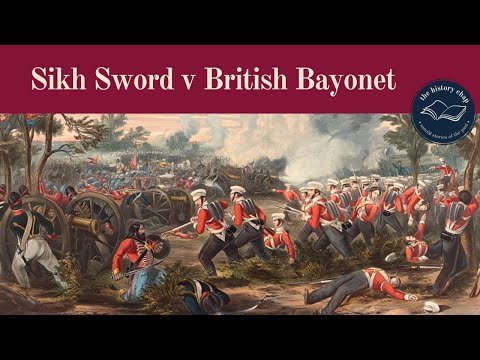
But it was the infantry charge that would define the battle. Gough formed his men up just as he had at Waterloo and ordered them to advance with fixed bayonets. The British and Bengal regiments surged forward—straight into a wall of Sikh fire. Muskets and grapeshot tore through their ranks. Behind them, the Bengal infantry fired wildly into the gloom, hitting their own men more often than the enemy.
In the confusion and darkness, the battle descended into a brutal melee. Soldiers fired at anything that moved, friend or foe. The British infantry, with their superior numbers, began to push the Sikhs back, but the cost was staggering. Of the 870 men of the 31st Regiment who charged, 414 were killed or wounded. The 50th lost 109 men. Two brigadiers and two generals were among the dead.
Gough had won the first battle of the war, but his “Tippooary Rush” had nearly broken his army. The Sikhs retreated in good order, losing 17 of their 22 guns but living to fight another day. Their commander, Lal Singh, had fled the field long before the fighting ended—a fact that raised dark questions about treachery.
As the British counted their dead and wounded, they knew this was only the beginning. The Sikh army was far from defeated, and an even bigger battle loomed at Ferozeshah. But that is a story for another day.
The news from Mudki reached London and Calcutta almost simultaneously, and neither city liked what it heard. Hardinge, who had ridden into battle alongside Gough, wrote a dispatch that praised the troops but pointedly criticized the commander. “The confusion of the attack created the feeling that the Army was not well in hand,” he wrote, a sentence he knew would be read carefully by the Duke of Wellington himself.
The Duke, for his part, was less diplomatic in private. He had warned the government for years that Gough lacked what he called “the grasp of mind and prudence essential to great military operations.” Now those warnings seemed prophetic. The 31st Regiment had lost nearly half its men in a single charge. The 50th had lost its colors in the dust and nearly lost its discipline with them.
Yet the men in the ranks told a different story. They had seen their general ride forward in his white coat, oblivious to the musket balls singing past his ears, shouting at them to take the guns. They had seen him bleed. Whatever the officers in Calcutta thought of Hugh Gough, the soldiers of the 31st and the 50th would have followed him into the mouth of hell.
On the Sikh side, the reckoning was darker. Lal Singh had ridden away from Mudki while his men were still fighting, and the Khalsa knew it. The soldiers who had stood their ground, who had served their guns until the British bayonets were upon them, had been abandoned by their own commander. They retreated in good order, but they retreated with a bitter question in their hearts: had they been sold?
Tej Singh, the other commander, had not even engaged at Ferozepur. He had sat before the British garrison with overwhelming numbers and done nothing, waiting while Gough’s army marched south. Some said he was incompetent. Others whispered that he had been bought. The truth, as so often in war, was likely a tangle of both—a courtier who valued his own survival more than the cause he was supposedly fighting for.
But the Khalsa had one thing left that their commanders could not squander: their guns. At Mudki, the Sikh artillery had fired faster and more accurately than anything the British had faced in India. The gunners had been trained by men like Alexander Gardner, an American adventurer who had thrown his lot in with the Punjab, and they had proved themselves every bit the equal of the Company’s vaunted horse artillery.
Seventeen of their twenty-two guns had been lost at Mudki, but the remaining five had been dragged away in the darkness, and the foundries of Lahore could cast more. The Khalsa had been bloodied, not broken.
Gough knew this. He had seen the Sikhs retreat in order, not in rout. He had seen the discipline of their infantry and the speed of their gunners. And he knew that somewhere to the south, at Ferozeshah, the main body of the Khalsa was waiting—entrenched, fortified, and spoiling for revenge.
On the morning after the battle, he walked among his wounded. The surgeons were already at work, saws in hand, and the cries from the field hospital carried across the dusty plain. Gough said little. He had won, but victory at Mudki had cost him a quarter of his infantry and two of his generals. He could not afford another such win.
That evening, a rider came in from the south. The Sikhs at Ferozeshah had been reinforced. Their entrenchments were complete. They had more guns than at Mudki, and this time their commander was not Lal Singh.
Gough looked at the dispatch, then at the faces of his exhausted men, and gave the only order he could give.
They would march at dawn.
The road to Ferozeshah was a hard one. The men marched through dust that rose in choking clouds, and the wounded who could still walk stumbled along with the column. Gough pushed them relentlessly, because he knew that every hour of delay gave the Khalsa more time to strengthen their works.
On the morning of December 21, the British reached the village of Ferozeshah. What they saw there made even the veterans of Mudki fall silent. The Sikhs had dug in along a mile-long front, their trenches bristling with cannon—nearly seventy guns, more than Gough had ever faced in a single battle.
Behind the earthworks stood the Khalsa infantry, their European-style uniforms barely visible through the haze. And in the center of the line, a new commander waited: Lal Singh had been replaced by Tej Singh, the man who had sat idle before Ferozepur. Whether he would fight this time, no one could say.
Gough did not wait for reinforcements. He had been promised the garrison from Ferozepur, but it had not yet arrived. Hardinge, riding beside him, urged caution. The Governor-General had seen enough at Mudki to fear another bloody frontal assault.
“If we wait, they will only grow stronger,” Gough replied. “We attack at once.”
The British formed up in three columns and surged forward across the open ground. The Sikh gunners held their fire until the red coats were within range, then unleashed a storm of iron that tore gaps in the advancing ranks. Men fell in windrows, but the survivors pressed on, closing ranks over the bodies of their comrades.
The 3rd Light Dragoons—the Devil’s Children—charged again, riding down a Sikh battery and sabering the gunners at their posts. But the infantry in the center was caught in a murderous crossfire, pinned down in the open with nowhere to hide.
As dusk fell, the battle hung in the balance. Gough ordered a general assault, and the British and Bengal regiments rose from the dust and charged into the Sikh trenches with the bayonet. The fighting became hand-to-hand—clubbed muskets, bayonets, and fists in the deepening dark.
By nightfall, the British had taken the Sikh line, but at a terrible cost. Over 700 men were killed or wounded, and the army was spent. They had no reserves, no fresh troops, and the Sikhs had not fled—they had simply pulled back to a second line of entrenchments and were regrouping.
That night, the British army slept on the battlefield among the dead, too exhausted to bury them. Hardinge, who had seen his own son wounded in the fighting, wrote later that he had never spent a worse night. And in the darkness, a rumor spread through the ranks that the Sikhs were preparing to attack again at dawn.
Gough knew the truth: if Tej Singh ordered a counterattack, the British army would be destroyed.
But Tej Singh did not attack. Whether from incompetence, fear, or the treachery that had shadowed the campaign from the start, he pulled the Khalsa back and let the moment pass. The British army, battered and broken, was given a night to breathe that it had no right to expect.
By morning, reinforcements from Ferozepur arrived, and Gough’s army lived to fight again. The First Anglo-Sikh War would grind on, through more battles and more blood, until the Punjab was finally annexed by the East India Company. Ranjit Singh’s empire was gone, and the Khalsa was broken—not by British bayonets alone, but by the knives in its own commanders’ hands.
Mudki and Ferozeshah were victories that felt like defeats. The British had won the battles, but they had learned a terrible lesson: the Sikhs were the most formidable enemy they had ever faced in India, and the only thing that had saved the British was the treachery of the men who led them.
And so the question remains, hanging over the dust and the dead of that December: if Lal Singh and Tej Singh had fought as their soldiers fought, would the British have ever set foot in Lahore?
What do you think—were the Sikh commanders incompetent, or were they bought? Let me know in the comments below.
Report this article
Select a reason for reporting:






