In the middle of 1966, the United States had more than a quarter of a million soldiers in South Vietnam. It had bombers launching from Guam and Thailand, fleets of helicopters, and artillery that could turn a hill into gravel from miles away. It was the richest and best-armed military force the world had ever seen on a battlefield. And that year, it handed over an entire province to another party. Not a base, not a zone—a province. With its roads and rubber plantations, fishing villages and rice paddies, its stretch along the South China Sea, and a cluster of rocky, cave-riddled hills on the coast that soldiers would learn to dread. That other party was Australia, a country with a population smaller than New York State.
There’s a phrase that has attached itself to this story over the years, usually said with a smile. One look from the Americans at the Australians, one look at that province, and they said: “Leave it to the psychos.” No order or report anyone can point to contains those words. But stories like this don’t last for decades by accident. There is something real buried inside this story, and something entirely wrong. By the end of this, you’ll know exactly which is which.
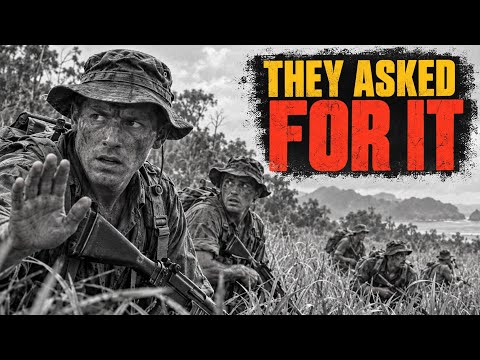
Here’s the part almost everyone gets wrong. The Americans didn’t foist that province on the Australians. The Australians asked for it themselves. They had spent half a year fighting alongside the Americans the American way, and they came to a quiet, stubborn conclusion. They preferred to be alone.
Over the next five years, they launched ambushes that lasted for days. They sent five-man patrols into enemy forests, and those patrols would vanish for a week at a time. They fought a battle in the middle of torrential monsoon rain with odds exceeding 10 to 1. They laid a line of landmines that backfired and maimed the very men who planted them. What they did to that land earned them a reputation that still follows them today. According to the men who served there, even the enemy gave some of them a name. Translated roughly, it meant “ghosts of the forest.”
To understand how that happened, you have to start somewhere else entirely—not in that province. In a patch of wooded ground northwest of Saigon in January 1966, with a young engineer lowering himself into a hole in the earth.
The first Australian infantry battalion arrived in Vietnam in mid-1965. The 1st Battalion, Royal Australian Regiment—about 800 men—was attached to the US 173rd Airborne Brigade at Bien Hoa, just outside Saigon. On paper, it was a perfect match. The 173rd were paratroopers, sky soldiers, the first US Army combat brigade in the country. They were aggressive and confident, with supply lines on a scale the Australians had never seen. The Australians were professionals, many of them veterans who had spent years in the jungles of Malaya and Borneo. Two proud units, one enemy.
Within weeks, both sides discovered they were not fighting the same war. American operations in 1965 tended to begin from the sky. Helicopters would beat across the plains and spill out troops. Artillery and airstrikes were ready at the push of a radio handset. The whole force would advance across the country with power, relying on firepower behind them to finish whatever they found. The noise was part of the plan. Speed and weight were the point.
The Australians had been trained to do the exact opposite. They moved on foot, slowly, with wide dispersion, and in near-total silence. They could spend an entire day covering ground a US company would cross in an hour, because every step was spent watching for a broken twig, a flattened grass blade, or the faint trace of a trail that shouldn’t be there. And when they found a trail the enemy was using, they didn’t sweep it. They lay down beside it and waited. Sometimes for a whole night, sometimes for days.
To the Americans, it looked painfully slow. To the Australians, the Americans looked like men announcing themselves with a brass band. Each side respected the other’s courage. But neither much liked the other’s methods. And deep down, Australian officers carried a worry they mostly kept to themselves. As the junior partner, their men could be shoved into large, costly American operations planned by someone else on someone else’s terms.
Then came Operation Crimp. In January 1966, the 173rd and the Australians swept into the Ho Bo Woods in the Cu Chi district. Everyone knew it was enemy country. What no one above ground realized was how much of that country was beneath their feet. As the Australians advanced, they kept taking fire from places that turned out to be empty. A burst would come from a patch of brush. They’d search the brush and find nothing there. Then they started finding the openings. Small square hatches hidden under piles of leaves and wooden covers. The standard response to a tunnel entrance was to throw in a grenade, pump in smoke, and seal it with explosives.
Captain Sandy MacGregor, commander of the Australian 3rd Field Engineer Squadron, decided that wasn’t enough. If the enemy was living down there, someone had to go down and see. So his engineers went in. They crawled into tunnels barely wide enough for a man’s shoulders, carrying a flashlight, a pistol, and a rope trailing up to the surface. Down there, it was pitch black and suffocating—the answer to the question in the title.
The US did not hand over Cu Chi province to the Australians because American soldiers were afraid to go there. In May 1966, the American paratroopers of the 173rd were the first to sweep into the province, paving the way for the Australians to enter. Control of the province shifted because a small, stubborn ally demanded a piece of ground of its own, and the Americans were happy to leave the job to someone else.
But that’s only part of the tale. The other part is why the arrangement lasted. Once the Australians had that province, why did no one seriously try to take it from them? To know that, you have to know where the Australian style of fighting came from. It wasn’t born in Vietnam. It was born a generation earlier on a muddy track over the mountains of New Guinea.
In 1942, Japanese forces landed on the north coast of Papua and pushed south over the Kokoda Track across the Owen Stanley Range toward Port Moresby. Many of the Australians sent to stop them had been trained for fighting in open deserts or had received little training at all. They found themselves in a world of vertical mud, dense rainforest, fog, and fever, where a man could lose sight of the soldier next to him ten paces away. They learned the jungle the way one learns anything that is trying to kill you: quickly and at a very high price. They learned that the side that moves quietly stays alive, and the side that gets sloppy on the trails dies there. Patience was a weapon, and so was silence.
By the end of that year, the army had turned those lessons into a school for training. At Canungra, in the hills behind the Queensland coast, soldiers trained in forests designed to be as brutal as possible, until moving silently became second nature. And unlike most armies, the Australian Army never stopped. After the war, their battalions spent years in Malaya hunting communist guerrillas on patrols that lasted for weeks, where their ambushes might yield no more than a single contact a month. Then came Borneo. Australian and British forces, including the fledgling Australian Special Air Service Regiment, crossed secretly into Indonesian territory to strike an enemy who thought himself safe.
By 1965, Australian sergeants and captains had spent years of their lives in forests. The Americans had fought in jungles too. At Guadalcanal, Buna, and island after island across the Pacific. But after 1945, the US Army’s attention turned to Europe, toward Soviet tank armies and nuclear battlefields. Then to the frozen hills of Korea. It went to Vietnam as the most powerful conventional army on earth. The Australians went as specialists in the kind of war Vietnam had become.
Kokoda is the part of that legacy people remember because it has a name. But the war that shaped those men was mostly made of things that never got a name at all. A patrol on a hill that no map bothered to name. A river crossing at night. A camp on the edge of a clearing where something terrible happened and no one wrote it down. It happened again and again in places no camera ever reached, and most of it has simply faded.
There are more of those stories than any single video can hold. Eleven of them, complete stories from the Second World War, previously existed on this channel. I removed them myself and put them into a work of art, where more than 20 Australians were wounded. Minutes later, the firing stopped and the attackers vanished.
The next day, a company went out to find the firing positions. At noon on the 18th, another company took over the search. Delta Company, 6th Battalion. One hundred and eight men, most barely in their twenties, many of them national servicemen. Their commander, Major Harry Smith, expected to find some abandoned mortar pits and maybe a small rear guard.
Shortly before four in the afternoon, in a rubber plantation near the abandoned village of Long Tan, the lead platoon bumped a small group of Viet Cong and shot one. The rest scattered. Then the entire plantation opened fire. Delta Company had walked into the forward edge of a force later estimated at 1,500 to 2,500 men—the 275th Regiment and D445 Battalion with reinforcements. Historians still argue about what that force was doing there. Some believe it was on its way to attack Nui Dat. Others think the mortar fire was bait designed to lure a small Australian force into exactly this kind of trap. Either way, 108 men were now alone in a rubber plantation facing an entire army.
Then the sky opened. The monsoon rain came down so hard it turned late afternoon into something like night. Visibility dropped to a few dozen meters. The ground turned to mud. Through that gray wall of water, waves of enemy soldiers rushed the Australians again and again to the sound of bugles. They fell, then came on again. 11 Platoon was cut off from the rest of the company and trapped in the open. Its commander, Second Lieutenant Gordon Sharp, was killed. The platoon sergeant, Bob Buick, took command and held with a dwindling handful of men.
What kept Delta Company alive that evening was artillery. From the base at Nui Dat, Australian and New Zealand guns, backed by a battery of American heavy howitzers, poured shells into the plantation. A New Zealand forward observer, Captain Murray Stanley, directed them so close to the Australian positions that the men felt the pressure of the blasts through the mud. By the end, the guns had fired thousands of rounds.
Then the company began to run out of ammunition. Two RAAF Iroquois helicopters lifted off from Nui Dat in weather unfit for flying, loaded with ammo boxes wrapped in blankets. The crews flew at treetop height, located the company by its smoke, and dropped the boxes among the rubber trees. As the light faded, the enemy began to mass for what looked like a final assault. At that moment, through the rain, came the armored personnel carriers of 1st APC Squadron, carrying A Company. With their machine guns firing, they slammed into the enemy flank. The attack broke. The enemy faded back into the trees.
In the morning, the Australians returned to the position. They found two of their wounded still alive—two men who had lain all night among the enemy. They found their dead: 18 Australians killed, 24 wounded. And across the plantation, they found the enemy dead: 245 bodies left on the field, with signs that many more had been dragged away.
Long Tan changed the face of the province. The enemy never again tried to meet the task force in a conventional battle of that size. The Australians’ reputation was set in the mud of that plantation, in the eyes of both their enemy and their allies. And the first official recognition of Delta Company as a whole did not come from Australia. It came from the United States, which awarded the company the Presidential Unit Citation.
At home, the arguments over how to honor the men of Long Tan went on for decades. But Long Tan was not the usual shape of the Australian war. Most of the time, nothing happened at all. It was a platoon of men lying in wet grass beside a track at two in the morning, not moving, not talking, for hours. Then another night. Then another. It was a platoon patrolling for weeks without firing a shot. And when contact did come, it lasted seconds. Bursts of fire, the crack of a Claymore, men running in the dark. Then silence again.
And at the heart of that grinding, exhausting war were the men of the Special Air Service. The SAS squadron arrived with the task force in 1966, one squadron at a time, as a very small part of the Australian force. They worked in five-man patrols. A helicopter would drop them at the edge of the jungle, sometimes after faking landings at two or three spots to confuse any observer. Then the patrol would step into the trees and vanish completely from sight. Everything about them was designed to leave no trace. No soap, because its smell might be detected. No cigarettes. Food eaten cold. Any metal taped down so it wouldn’t rattle. On careful days, a patrol might cover only a few hundred meters, parting branches instead of breaking them, reading the ground for footprints. Then they would stop for hours to watch and listen. They might stay out for a week or more, counting enemy soldiers, mapping camps and trails, calling in artillery, or setting an ambush for a small group walking a path they thought was safe.
When things went wrong, they went wrong fast. Five men against a full company. The plan was to hit whatever was in front of them with everything they had in one burst of fire, then withdraw while the enemy was still trying to work out how many they were. Then the race to the helicopter. And if there was no landing zone, ropes were dropped through the canopy, and the men would clip on and be pulled out of the jungle hanging beneath the aircraft, sometimes under fire.
The regiment is credited with killing roughly 500 enemy soldiers over about 1,200 patrols, while losing very few of their own. Numbers like that build legends, and the reputation grew. At some point, according to the regiment’s own history, the Viet Cong began to call them “Ma Rung”—ghosts of the forest.
You can understand how an American soldier might look at five Australians walking alone into enemy jungle for a week without even a cigarette and call them insane. But the men on those patrols would tell you that fighting was the smallest part of their job. Most of it was staying still. Hours of it. Days of it. Discipline was their real weapon. And the price, when it came due, was cruel in its own way.
In September 1969, an SAS patrol was being winched under a helicopter in contact. Private David Fisher was on one of those ropes. Somewhere above the jungle, he fell. The search began then, and went on for years.
The barrier that ran nearly 11 kilometers from a hill near Dat Do to the coast was sown with more than 20,000 American-made M-16 mines. The M-16 was a vicious weapon. Pressure on its prongs launched a small charge that threw the mine out of the ground to waist height, where it exploded and sent fragments in every direction. One mine could take out several men at once. In theory, these barriers were supposed to choke the enemy. In practice, they needed to be watched every hour of every night, and there were never enough soldiers to do it. Most of that job fell to local South Vietnamese militia who could not or would not secure them. So enemy sappers came at night and lay on their stomachs at the edge of the minefield. They learned to disarm the mines by hand, inserting a pin or a nail, then carried them away. Not dozens. Thousands.
Those mines turned up in Long Hai East and on tracks through the rice paddies and the edges of villages across the province, anywhere Australians might walk. Before long, Australian soldiers began to be blown apart by mines planted by their own side. Sometimes mines and booby traps wounded and killed more Australians than bullets did. Every operation in Long Hai East became a walk across ground that might explode at any step, into hills whose rocks the enemy knew one by one. And still the Australians kept going in. Battalion after battalion, year after year, they pushed into those hills and found the bunkers and caves and supply caches. They came out carrying men on stretchers who had lost limbs to mines that had once been theirs.
If there was ever a moment when “leave it to the psychos” seemed logical, it was this one. Look at it from the outside. Here was a small army that could have stayed behind its own wire. Instead, it went back again and again into a chain of hills sown with its own mines, because that was where the enemy lived. To an outsider, that looks like madness. To the men who did it, it was the job, and no one else was going to do it for them.
By 1971, the war had turned. The Americans were leaving, and so were the Australians. In November, the task force withdrew from Nui Dat and handed it to the South Vietnamese, and about a year later, the last Australian advisers left too. Some 60,000 Australians served in Vietnam. More than 500 never came home. Then the war turned into paper—after-action reports, unit diaries typed in tents and stored in archives, casualty records, medal recommendations, some approved and some quietly downgraded. For the families of the dead, it ended with a telegram or nothing at all. They were young men in their twenties, clerks and apprentices and farmers’ sons, chosen by the random lottery of conscription.
And this is the face of what was right about it. The Australians really did fight a war that looked strange to almost everyone around them. They walked more slowly. They waited longer. They went into places others avoided and stayed there. They let silence do work that other armies gave to bombs. The enemy was never sure whether a stretch of forest was empty or watching him. And that was more terrifying than any amount of noise. It wasn’t madness. It was patience carried to a point where it looked like madness from the outside.
And it wasn’t victory either. The villages that were cleared stayed cleared. The minefield built to protect the province spent years tearing apart the men who laid it. Long Hai was never taken. All of that is part of the story too. Anyone who tells it as a simple tale of tough men winning leaves half of it in the mud.
Today, in the rubber plantation near Long Tan, there is a white cross. It is a replica. The original, raised by Australian soldiers in 1969, is kept in a Vietnamese museum. Australian visitors still find their way to it every August. And on the coast, in the hills of Long Hai, there is a memorial too. Built by the side that never left. Two memorials, a short drive apart, for the same war. The Australians were sent into that province because they were better at waiting than almost anyone else in Vietnam. But the men in the hills of Long Hai have been waiting for nearly 30 years.
So here’s the question that won’t let go: when a small nation volunteers for the hardest ground, fights with patience instead of noise, and leaves two memorials on opposite sides of a war—was it madness, or was it the only kind of sanity that war allows? Tell us what you think in the comments.
Report this article
Select a reason for reporting:






