In the sweltering skies over Vietnam, a U.S. Navy F-4 Phantom locked onto an enemy MiG-17. The pilot squeezed the trigger, and an AIM-7 Sparrow streaked toward its target. It missed. The missile spiraled off course, another failure in a conflict that would expose the Sparrow’s crippling flaws. Yet, decades later, this same missile would achieve a 68% hit rate in the Gulf War, rewriting its own legacy and shaping the future of aerial warfare.
The story of the AIM-7 Sparrow is one of ambition, failure, and ultimate redemption—a Cold War weapon that bridged the gap between gun-armed dogfighters and today’s networked, missile-centric air forces.
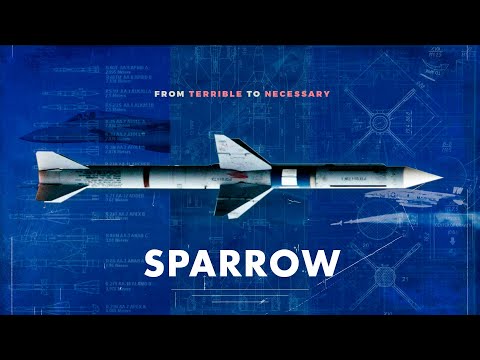
In the late 1940s, as the jet age dawned, the U.S. Navy embarked on Project Hotshot, a bold endeavor to create a beam-riding air-to-air rocket. Inspired by German wartime research, Douglas and Sperry engineered the first Sparrow, testing it in 1947 using a modified HVAR rocket. By 1952, the system achieved its first successful intercept, and in 1954, the AAM-N-2 Sparrow entered service—though it was notoriously difficult to operate.
Douglas, undeterred, proposed the Sparrow II, an active radar-guided missile with fire-and-forget capability. It was a revolutionary concept, but testing failures led to its cancellation by 1956. Meanwhile, Raytheon pursued a simpler path: the Sparrow III, a semi-active radar homing variant. This design proved far more achievable. By 1958, the Sparrow III (AAM-N-6) joined the fleet, and improved models—the AIM-7D and AIM-7E—followed in the early 1960s.
Equipped on the new F-4 Phantom, the Sparrow promised beyond-visual-range combat. The AIM-7E, with a range of 22 miles, was the most capable yet. But it had never been tested in war. That would change over the skies of Vietnam.
On June 17, 1965, Navy F-4Bs scored the first Sparrow kills, downing two MiG-17s. It was a historic moment—the first effective use of air-to-air missiles in the conflict. But success was fleeting. As engagements multiplied, the Sparrow’s weaknesses became glaring. Guidance glitches, fuse malfunctions, and motor failures plagued the missile. Against small, agile MiGs, it often failed. The probability of kill plummeted to a dismal 9%.
Restrictive rules of engagement forced pilots to visually identify targets before firing, negating the Sparrow’s long-range advantage. Pilots, frustrated by the missile’s unreliability, resorted to ripple-firing multiple Sparrows at a single target. Only about 16% of missiles fired hit their mark. The rest missed or failed entirely.
In 1969, the Navy introduced the AIM-7E2, the ‘Dogfight Sparrow,’ with clipped wings and improved fusing. But the improvements were modest. Reliability issues persisted, and the kill probability rose only to 13%. The Sparrow had proven the concept of radar-guided missiles, but its execution was deeply flawed.
Yet, the lessons of Vietnam would not be forgotten. In 1976, the AIM-7F entered service—a major redesign with solid-state electronics, a dual-stage motor, and a larger warhead. Its range nearly doubled to over 70 km. The Sparrow was reborn, and it would soon find its redemption.
By the 1980s, the AIM-7M became the definitive Sparrow. Built on digital electronics, it featured an inverse monopulse radar seeker that slashed its vulnerability to jamming. For the first time, the Sparrow could reliably engage low-altitude targets against ground clutter. An active radar proximity fuse and a reprogrammable guidance computer gave pilots a weapon they could finally trust.
When Operation Desert Storm erupted in 1991, the missile faced its reckoning. Over 44 AIM-7Ms were fired, and 30 struck their targets—19 of them at beyond-visual range. The hit rate climbed to 68%, a stunning reversal from Vietnam’s dismal 9%. The Sparrow had redeemed itself.
Late variants, the AIM-7P and P Block II, refined the design with updated software and a rear-facing data link for mid-course guidance. But these upgrades arrived just as the AIM-120 AMRAAM entered service. The Sparrow’s days as a front-line weapon were numbered.
The U.S. Air Force retired the Sparrow in the mid-1990s, while the Navy and Marine Corps kept it aboard F-14s and F/A-18s into the 2000s. Yet the missile refused to vanish. Its ship-launched cousin, the RIM-7, soldiered on with allied navies worldwide.
Then came an unexpected twist. In 2023, the United States supplied Ukraine with RIM-7 stocks, which Ukrainian engineers integrated into Soviet-era Buk launchers. A Cold War weapon was reborn as a hybrid air-defense system, downing cruise missiles and drones over modern battlefields.
The Sparrow’s true legacy, however, lies beyond its kill tally. Even in its flawed youth, it proved that guided missiles—not guns—would rule future air combat. It forced air forces to grapple with radar resolution, electronic countermeasures, and the daunting reality of firing at targets no pilot could see.
Those hard lessons shaped sensors, training, and the active radar missiles that followed. The Sparrow bridged the gap between the gun-armed jets of the 1950s and today’s stealthy, networked air forces. Its story is less about Vietnam’s failures or Desert Storm’s redemption, and more about the foundation it laid for modern aerial warfare.
As the missile’s final chapters unfolded, one truth remained: the Sparrow had changed the sky forever. And somewhere in Ukraine, a RIM-7 streaked upward—still fighting, still proving its worth.
But the story does not end with the Gulf War’s triumphant statistics or the quiet retirement of the AIM-7P. To understand why the Sparrow mattered, one must look beyond the kill ratios and into the cockpit, where pilots grappled with a weapon that demanded as much from them as it gave.
In Vietnam, the Sparrow’s failures were not merely mechanical. They were systemic. Pilots had been trained to fire the missile as if it were an extension of their guns—point, shoot, expect a kill. But semi-active radar homing required something far more demanding: the launch aircraft had to keep its radar locked on the target, illuminating it continuously while the missile flew. Any maneuver that broke the lock meant a wasted missile. In the chaotic, close-range dogfights that dominated Vietnam, maintaining that lock was nearly impossible.
The Navy’s Top Gun program, established in 1969, was a direct response to these failures. It taught pilots to fight with missiles and guns as a integrated system, not as separate tools. The results were dramatic—by the war’s end, Navy kill ratios had improved significantly. The Sparrow’s shortcomings had forced a revolution in air combat training that outlasted the missile itself.
Yet the technical fixes were equally crucial. The AIM-7F’s solid-state electronics were a quantum leap, but they also revealed a new problem: the missile’s seeker could be fooled by chaff and electronic jamming. The AIM-7M’s inverse monopulse seeker was the answer—it could distinguish a target from clutter and countermeasures with unprecedented clarity. In Desert Storm, Iraqi pilots discovered that their usual evasion tactics no longer worked. The Sparrow saw through the noise.
But even as the missile matured, its limitations remained. Semi-active guidance meant the launching fighter was still tethered to its target, vulnerable to counterattack. The AIM-120 AMRAAM, with its active radar seeker, finally cut that tether. A pilot could fire and turn away, leaving the missile to hunt on its own. The Sparrow, for all its improvements, could never match that freedom.
Yet the Sparrow’s influence persisted in unexpected ways. Its ship-launched variant, the RIM-7, became the backbone of naval air defense for decades. In the 1980s, the USS Stark tragedy—where an Iraqi Exocet missile killed 37 sailors—underscored the need for reliable point defense. The RIM-7 evolved into the Sea Sparrow, a system that could engage sea-skimming missiles at close range. Its legacy lived on in the Evolved Sea Sparrow Missile, still in service today.
And then there was Ukraine. The RIM-7’s integration onto Buk launchers was a stroke of battlefield ingenuity. Ukrainian engineers, working under fire, adapted a missile designed for ships to fire from land—a testament to the Sparrow’s enduring versatility. In a war where drones and cruise missiles fill the skies, the old missile found new purpose.
As the 21st century progressed, the Sparrow’s front-line days faded, but its DNA remained. Every active radar missile that followed—the AMRAAM, the Meteor, the R-77—owed something to the lessons the Sparrow taught. The need for reliable seekers, robust electronics, and realistic training all traced back to those hard years over Vietnam.
In the end, the Sparrow was never the best missile of its time. It was too fragile, too demanding, too often a disappointment. But it was the first. And in warfare, being first often matters more than being best. The Sparrow showed what was possible—and in doing so, it changed everything that came after.
Today, the missile sits in museums and reserve stockpiles, a relic of the Cold War. But its story echoes in every fighter cockpit, every radar lock, every missile launch. The sky it helped shape is still contested, still dangerous, still evolving. And somewhere, in a warehouse or a hangar, a Sparrow waits—not for glory, but for the call that might come again.
That call did come, though not in the way anyone expected. When Ukrainian crews first bolted RIM-7 rails onto their Buk launchers, Western analysts were skeptical—a 1970s ship missile mated to a Soviet chassis seemed like a junkyard experiment. Then the intercepts started. Cruise missiles fell. Shahed drones vanished from radar screens. The old Sparrow, written off as obsolete, was drawing blood again.
There was a strange symmetry to it. The missile that had failed over Vietnam because pilots couldn’t maintain a radar lock was now succeeding because ground crews had time, patience, and a steady launcher. The Sparrow had always demanded a stable platform; a truck-mounted Buk finally gave it one.
Veterans of the Phantom era might have smiled at the irony. The weapon they had cursed in frustration—the one that forced them to ripple-fire in desperation—was now a budget hero, cheap enough to expend and plentiful enough to matter.
Perhaps that is the truest measure of the Sparrow’s legacy. It was never a perfect weapon, but it was an adaptable one. From beam-riding experiments to digital seekers, from carrier decks to Ukrainian soil, it kept finding new ways to stay relevant.
Somewhere in a Kyiv warehouse, a technician checks the seals on another RIM-7. The stenciled markings are faded, the fins scuffed. But the missile is ready. The Cold War never really ended—it just changed uniforms.
And when the next Sparrow streaks skyward, chasing a drone through the dark, it will carry with it every lesson, every failure, every hard-won fix from seventy years of service.
What do you think—does a weapon’s worth lie in its kill record, or in the generations of technology it made possible?
Report this article
Select a reason for reporting:






