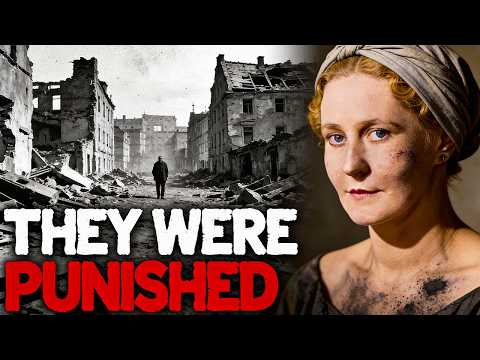
In the spring of 1945, as Allied tanks rolled into a shattered Germany, they didn’t arrive as liberators. They came as occupiers with a mandate that left no room for mercy. The cities were moonscapes of rubble, and the people—mostly women, children, and the elderly—were about to face a punishment that would test the limits of human endurance. This is the story of what happened when the winning side had to decide: do you save 70 million people, or do you punish them? For years, the Allies couldn’t make up their minds, and in that vacuum of indecision, a quiet catastrophe unfolded.
The blueprint for this controlled demolition was JCS 1067, a directive issued from Washington in April 1945. It spelled out in chilling detail that German living standards were not to be supported at any level higher than those of the poorest neighboring country. The policy wasn’t designed to rebuild—it was designed to cap suffering just above the point of collapse. Some, like Treasury Secretary Henry Morgenthau, wanted to go further: strip Germany of all industry and turn it into farmland. The Morgenthau Plan was never fully adopted, but its spirit permeated every early occupation policy. American soldiers were forbidden from shaking hands with German civilians, from sharing food, even from walking alongside them. Non-fraternization rules made basic human contact a punishable offense. This wasn’t reconstruction; it was the deliberate dismantling of an entire society, one directive at a time.
But on the ground, the directives paled against the reality. By May 1945, Allied bombing had destroyed 3.6 million homes across 62 cities, and another 4 million were badly damaged. 500 million cubic meters of rubble choked every street, every alley, every square. In some neighborhoods, the debris rose higher than the buildings that once stood there. Roads were impassable, water mains shattered, and entire districts existed only as jagged walls and collapsed roofs with the stench of decay buried underneath. The people tasked with clearing it all were mostly women—the Trümmerfrauen, the rubble women.
You can find photographs of them if you look: long lines of women in headscarves, standing in human chains that stretched across entire blocks, passing bricks from hand to hand, loading carts by the shovelful, swinging picks into concrete that used to be their own neighborhoods. Some were volunteers, others conscripted—women between 15 and 50 could be ordered to report for rubble duty regardless of their past. Former Nazi Party members worked side by side with women who wanted nothing to do with them. The work was brutal and went on for years. Dust coated their hair, their skin, the insides of their lungs. Many suffered injuries from falling masonry or collapsing walls. There were no safety inspections, no protective equipment, and no real medical care. They cleared the rubble because there was no one else left to do it. Most of Germany’s men were dead, captured, or still held in prisoner-of-war camps scattered across Europe and the Soviet Union. The women didn’t rebuild Germany in some metaphorical sense—they did it with their bare hands, one brick at a time.
But even if you could clear the rubble, you couldn’t eat it. Beneath the rubble crisis was something far worse: there was almost no food. And this wasn’t an accident. Allied policy deliberately restricted food imports into Germany during the occupation, following the logic of JCS 1067—Germany was not to be made comfortable. Comfort might breed defiance. By the winter of 1946–47, the consequences became impossible to ignore. In parts of the Ruhr Valley, official rations collapsed to roughly 700 calories per person per day. A human body needs at least 1,500 to survive without deterioration. At 700, muscles begin to waste, the immune system shuts down, children stop growing, and the elderly simply die. Germans called it the hunger winter.
Rivers froze solid. Temperatures plunged well below zero, and the coal supply had been stripped for Allied use or destroyed during the war. People burned furniture to stay warm—floorboards ripped from their own half-destroyed homes. Families huddled in basements and bombed-out shells, wrapped in whatever clothing they could find, eating turnip soup and black market scraps when they could get them. Hundreds of thousands died that winter from cold, malnutrition, and the diseases that always follow famine: typhus, tuberculosis, dysentery. Hospitals were overwhelmed and understaffed, their windows blown out, their supply rooms empty. Medicine was scarce when it existed at all. The weakest—the very old and the very young—went first. Infants born that winter had mortality rates that rivaled the developing world. Mothers who couldn’t produce breast milk had nothing to substitute.
In cities across the occupation zones, the black market became the only functioning economy. A single cigarette could buy a loaf of bread. A pound of butter cost more than a month’s wages. People traded heirlooms, wedding rings, anything they had left for food that wouldn’t have lasted a day before the war. Food rationing had been introduced in Germany back in 1939 at the start of the war; it would not fully end until the 1950s. Germany didn’t just lose a war—it entered a famine that lasted years while the nations that defeated it debated whether feeding its people was even a priority. And while Germans starved in the west, something far darker was happening in the east.
Between 1944 and 1950, approximately 12 to 14 million ethnic Germans were expelled from their homes in Poland, Czechoslovakia, Hungary, Romania, and Yugoslavia. This was not a chaotic byproduct of war; it was deliberate policy agreed upon by the Allied powers at the Potsdam Conference in the summer of 1945. The official term was “orderly and humane transfer.” The reality was anything but. Entire populations—families who had lived in these regions for generations, sometimes for centuries—were given hours or days to leave. They were herded onto trains and marching columns with whatever they could carry. At border crossings, armed guards stripped them of their remaining valuables: jewelry, money, sometimes even warm clothing. The journeys were long and the conditions brutal. Trains were overcrowded, unheated, and unsanitary. Marching columns stretched for miles with the elderly and children struggling to keep pace in freezing weather.
For decades, Cold War-era estimates placed the death toll at around 2 million. Modern demographic research has revised that figure downward to between 500,000 and 600,000. But even the lower number represents a catastrophe on a staggering scale. People died from violence, from disease, from starvation during transit, and from internment in camps where conditions mirrored the horrors that Germany itself had inflicted on others just years earlier. This was ethnic cleansing endorsed and facilitated by the victorious Allied powers. The people who carried it out justified it as a necessary consequence of German aggression. The people who endured it lost everything: their homes, their livelihoods, their communities, and in hundreds of thousands of cases, their lives. Families that had lived in the same village for 300 years were erased from the landscape in a matter of hours. Their houses were given to new occupants. Their cemeteries were plowed over. Their street names were changed. It was as if they had never existed at all.
And the 12 million who survived arrived in a Germany that had neither the housing, the food, nor the infrastructure to absorb them. They came with nothing—no savings, no property, no legal claim to anything in a country that was itself on the verge of collapse. Many spent years in temporary camps, sleeping on straw mattresses in converted barracks, waiting for a permanent home that never seemed to come. But the expulsions weren’t the only atrocity committed against German civilians during this period. As Soviet forces advanced through Eastern Germany in the final months of the war and into the early occupation, they committed sexual violence on a scale that remains difficult to process.
Historians estimate that between several hundred thousand and up to 2 million German women were raped during this period. Some victims reported being assaulted dozens of times. The violence was widespread, systematic, and largely unpunished. It happened in farmhouses, in cellars, in apartment buildings, and in the open streets of conquered cities. Women of all ages were targeted, from teenagers to the elderly. In Berlin alone, hospital records from the summer of 1945 documented tens of thousands of cases—and those were only the women who sought medical treatment. Many never did. The long-term consequences shaped an entire generation: unwanted pregnancies, sexually transmitted diseases, and severe psychological trauma became invisible epidemics in a country that had no functioning health care system.
But perhaps the deepest wound was the silence. German women did not speak about what had happened to them—not publicly, and often not even privately. In a society grappling with its own guilt for the horrors of the Nazi regime, there was no space to acknowledge German suffering without appearing to minimize German crimes. The silence lasted decades. For many women, it lasted a lifetime. But even those who survived the worst of it still had to answer for what Germany had done.
In the aftermath of the war, the Allies attempted something that had never been tried before: judging the guilt of an entire population. Every adult German in the Western occupation zones was required to fill out a detailed questionnaire about their activities during the Nazi era. Over 4 million cases were formally processed between 1946 and 1949. Up to 400,000 Germans were interned in camps while their cases were reviewed. The system divided people into categories ranging from major offenders down to mere followers—Mitläufer—and those deemed exonerated. In theory, it was supposed to separate the truly complicit from the merely obedient. In practice, it collapsed under its own weight. The tribunals were overwhelmed. Evidence was scarce. Witnesses had fled or died. And the sheer number of cases made thoroughness impossible. In roughly 95% of cases, individuals were classified as followers or cleared entirely. Germans had a word for this: Mitläuferfabrik. The follower factory. A system designed to deliver justice instead delivered a bureaucratic assembly line that stamped nearly everyone with the lightest possible verdict.
Former Nazi party members, former officials, even people with documented ties to the regime quietly returned to their old positions. Judges who had served under Hitler went back to the bench. Police officers who had enforced racial laws resumed their patrols. As Cold War tensions escalated and the Western allies grew more concerned about Soviet expansion than about punishing every last Nazi, the push for accountability gave way to the need for stability. And all of this was happening inside a country that had simultaneously become the world’s largest refugee camp—a country where everyone was a refugee.
When Allied forces arrived in 1945, they found between 6.5 and 7 million displaced persons already in the Western occupation zones. These were former forced laborers dragged to Germany from across Europe, concentration camp survivors with nowhere to return to, and prisoners of war from dozens of nations. Over 250,000 Jewish Holocaust survivors lived in displaced persons camps on German soil—camps that were, in some cases, set up inside former concentration camps because no other facilities existed. Now add 12 million expelled Germans flooding in from the East. Layer that on top of the millions of non-German refugees already inside the country. Place all of it on a destroyed infrastructure that couldn’t support any of them. No intact rail network, no functioning supply chains, cities that were half rubble and half ruin. Families slept in train stations, in barns, in the basements of bombed-out buildings already occupied by strangers. Refugee camps meant for hundreds held thousands. Disease spread fast in the overcrowding, and tensions between groups—expelled Germans, displaced foreigners, local residents with nothing left to share—sometimes erupted into violence. Germany became a bottleneck of human misery. Everyone was a refugee and nobody had anywhere to go.
But by 1947, something shifted—and it shifted fast. The Allies began to realize that a permanently broken Germany wasn’t just a humanitarian disaster; it was a strategic one. A starving, desperate population was a radicalized population, and the communists knew it. Soviet propaganda was already flooding the western zones promising bread, work, and dignity to anyone willing to listen. The Iron Curtain was falling across Europe, and a destabilized Germany sitting in the center of the continent was an open invitation for Soviet influence to spread westward. The punitive approach that had defined the first two years of occupation was abandoned almost overnight. In 1948, the western allies introduced currency reform, replacing the worthless Reichsmark with the Deutsche Mark and giving the economy a foundation it hadn’t had since before the war. Then came the Marshall Plan. Billions of dollars in American aid poured into Western Europe, with Germany as a primary recipient. The same powers that had kept German living standards low and debated turning the country into farmland were now spending enormous sums to rebuild it. The country that was supposed to be dismantled became the front line of the Cold War, and the way that pivot played out created not one Germany, but two.
In 1949, Germany officially split into two nations with two opposing systems for processing the same trauma. In the West, the Federal Republic pursued what would later be called the Wirtschaftswunder, the economic miracle—rapid reconstruction, NATO membership, consumer prosperity, and beneath it all, a collective silence about individual guilt. West Germans rebuilt their cities, rebuilt their industries, and quietly agreed not to ask too many questions about what their neighbors had done between 1933 and 1945. In the East, the German Democratic Republic built a socialist state on the claim that it represented the anti-fascist Germany. The Nazis had been capitalists, the argument went, and since East Germany had rejected capitalism, its citizens bore no responsibility for what had happened. It was a convenient fiction, one that absolved an entire population of any need for self-examination. Both approaches were, in their own way, evasions.
The civilians who had survived the hunger winter, the expulsions, the sexual violence, and the rubble were now sorted into ideological camps and told to move forward. Fathers who had served in the Wehrmacht came home to families that didn’t ask where they’d been or what they’d done. Mothers who had endured unspeakable violence kept it locked behind closed doors. Children grew up in households where the years between 1933 and 1945 were treated like a blank page—something that happened to other people in some other country. The question of what ordinary Germans actually owed and what had been done to them was buried under concrete on both sides of the wall. An entire generation learned to build their future on a foundation of silence.
The real legacy of what happened to German civilians after World War II isn’t a set of facts. It’s an unresolved tension. Were they victims or perpetrators? The honest answer is that millions of them were both—sometimes simultaneously, sometimes at different moments in the same life. Can you punish 70 million people for the crimes of a regime? And does the answer change when you realize that the punishment itself created suffering on a scale that echoed the very crimes it was meant to address? These debates aren’t settled. They still shape German politics, European memory laws, and how we think about collective guilt in conflicts happening right now around the world. The doors the Allies opened in 1945 have never fully closed. Every generation of Germans has had to decide what to do with them. And every generation has come up with a different answer.
In the end, the silence itself became a kind of inheritance—passed down not through words but through the absence of them. Children who asked too many questions learned to stop asking. An entire nation rebuilt its cities while leaving the most important rooms of its memory locked and dark.
When the wall finally fell in 1989, those doors cracked open again. Historians, filmmakers, and grandchildren began the painful work of asking what had been done—and what had been endured. The Trümmerfrauen were honored, the expellees were acknowledged, and the silence was finally named for what it was.
But naming a wound is not the same as healing it. The question of victim and perpetrator never resolved—it simply became a permanent part of the German soul. Perhaps that is the truest legacy: not an answer, but a responsibility to keep asking.
So here is the question that remains for all of us: when a nation commits unspeakable crimes, how much suffering must its ordinary people endure before we call it justice—and who gets to decide?
Report this article
Select a reason for reporting:






