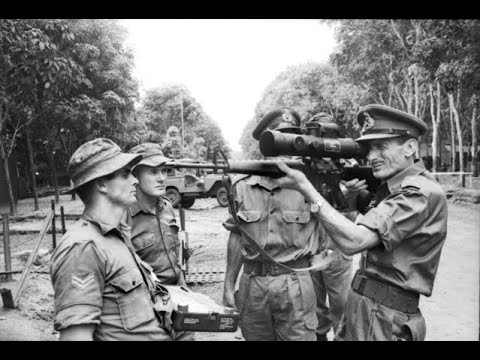
The jungle didn’t scream. It held its breath—and then it exploded.
In the sweltering heat of South Vietnam, 1969, a four-man SAS patrol slipped into the green void, their footsteps swallowed by the damp earth. They were shadows, trained to observe, strike, and vanish. But deep in enemy territory, shadows can be seen.
Corporal Mitch Lanford was the team’s eyes and trigger. His scoped M14 had ended lives before, but nothing prepared him for the boy.
By the third day, they’d tracked an NVA logistics unit to a camouflaged base. Hidden in a banyan tree, Mitch watched through his scope as a young soldier—no older than eighteen—stepped into the brush. Their eyes met. The boy turned to shout.
Mitch didn’t hesitate. One shot. The boy dropped.
Then the jungle erupted. Tracers lit the treetops. Shouts in Vietnamese. The hunters had become the hunted.
Sergeant Buick’s voice cut through the chaos: “Fall back! We’re made.”
The team scattered, claymores roaring behind them. But the enemy was fast, and the jungle was thick with pursuit.
Mitch took the rear, his rifle now slung, pistol drawn. Every step was a gamble. They moved through a stream to erase their scent, leeches clinging to their arms. At a ridge, Mitch climbed for overwatch and spotted four NVA soldiers with dogs, less than 150 meters back.
“Contact left,” someone hissed. Mitch fired. Two shots, two men down. A grenade took a third. The fourth ran, but the barking had already alerted others.
“Go loud!” Buick ordered.
Automatic fire drove the pursuers into cover, but ammunition was limited. They pushed hard, every step a gamble between exhaustion and survival.
At last, the trees thinned. Orange smoke marked the extraction zone. A Huey swooped low, door gunner blazing. They piled in, one man hit in the leg, but alive.
As the chopper lifted, the jungle receded. They had made it out—barely.
But the war was far from over.
Back at Nui Dat, the debriefing room smelled of stale coffee and sweat. A lazy fan stirred the humid air while two intelligence officers—one Australian, one American—leaned over the table.
Sergeant Buick recounted the mission in clipped, professional tones. The tracking. The confirmed logistics site. The sniper engagement that forced the abort.
Then Mitch added his part. The radio operator. The satchel.
The American officer’s eyes lit up as the weathered leather case opened. Inside lay hand-drawn supply routes, delivery timetables, and circled grid references along the Cambodian border.
“This could change the tempo of operations across the entire southern corridor,” the American said, tapping the map. “You boys just bought us weeks of breathing room.”
But the team barely nodded. There were no cheers in the SAS. Only the quiet weight of what had been done.
Later, Mitch sat alone on his cot, his M14 stripped and drying beside him. He stared at nothing, replaying the moment the young soldier spotted them. The way the boy turned to shout. The way Mitch pulled the trigger without hesitation.
One shot. One life. One decision.
Buick entered quietly and tossed him a canteen. “You did your job,” he said, sitting across from him.
Mitch nodded once. “I know.”
They fell into silence again. Outside, the base was waking—engines coughing to life, boots pounding red dirt, a distant chopper lifting off. The war moved on, indifferent to the men who fought it.
But the jungle wasn’t finished with them yet.
Two days later, a signals intercept changed everything. The NVA unit they’d hit wasn’t just a logistics column. It was a courier route for a senior commander—a man known only as the Architect, who had been directing supply operations across three provinces.
And he was now moving south, personally.
The intelligence officer slid a grainy photograph across the table. A thin man in a pith helmet, standing beside a bicycle on a jungle trail.
“We believe he’s relocating his command post,” the officer said. “If he reaches the Cambodian border, he’s gone. We lose him.”
Buick studied the photo, then looked at his team. The wounded man was still in the med bay. That left three.
“We’ll need to move within twenty-four hours,” the officer added. “Before he slips the net.”
Mitch met Buick’s eyes across the room. No words were exchanged. None were needed.
The shadows would go back in.
The rain came that night, a soft monsoon drumming that turned the red dirt to mud and muffled every sound. It was perfect cover, and Buick knew it. “Wheels up at 0300,” he told them in the hut. “Two teams. Ours, and a second patrol from 2 Squadron to cut the trail south. We pinch him between us.”
Mitch spent the hours before dawn re-zeroing his M14 in the dark, checking each round with his thumb, feeling the brass like a prayer bead. The boy’s face still flickered behind his eyes. He blinked it away. There was no room for it now.
The insertion was by foot, off a river bend nine kilometers north of the last contact. The second team peeled away east. Buick’s three moved west, into country no patrol had touched in months.
Dawn broke gray and dripping. They found the trail by noon—a narrow ribbon of packed earth, too clean, too recently swept. The Architect’s people were disciplined. They erased their tracks.
But not their smell. Mitch caught it first: diesel, faint and chemical, drifting through the wet green. A generator. Somewhere close.
They moved like water around stones, silent, patient. Then Buick’s hand came up. Frozen.
Through the trees, a clearing. A bunker complex half-buried in the hillside, antenna wires strung through the canopy, two bicycles leaning against a lean-to. And there—a figure in a pith helmet, bent over a map table, three officers gathered around him.
The Architect.
Mitch found his perch in a strangler fig, thirty meters up, the scope steady on the pith helmet. Range: two hundred ten meters. Wind: negligible. He breathed out, finger taking up the slack.
Then the radio crackled in Buick’s ear. The second team. “We’re compromised. Taking fire. They’re running east—toward you.”
The clearing erupted. The Architect straightened, barked an order, and his officers scattered for their weapons. He was moving—not toward the trail, but toward the bunker’s rear entrance, a tunnel mouth swallowed by ferns.
Buick’s voice, flat and final: “Mitch. Take him.”
Mitch exhaled. The world narrowed to a circle of green and a pith helmet. He tracked the figure through the scope, leading him slightly, feeling the rhythm of the man’s stride.
The Architect paused at the tunnel mouth. Turned, as if sensing the crosshairs on his back.
Mitch squeezed.
The shot cracked flat across the clearing. The pith helmet spun off into the ferns. The Architect crumpled at the tunnel’s edge, one arm flung out, motionless.
Then the jungle answered—a wall of fire from the bunker, tracers chewing the fig tree’s branches to splinters. Mitch dropped, slid down the trunk, and hit the ground running.
Buick was already moving, the team folding back into the green as the second patrol’s gunfire echoed from the east. The trap had sprung both ways. Now it was a race to the river.
They ran for the river like men chased by the dead—because they were. The second patrol’s gunfire faded behind them, swallowed by the rain and the green. Buick led, compass in hand, counting paces between breaths. Mitch brought up the rear, rifle up, eyes sweeping the trail behind them for the first sign of pursuit.
They reached the river bend at dusk, chest-deep in brown water, the current pulling at their legs. No words. No signals. They simply sank to their necks and waited, rifles held above the surface, breathing through their noses.
Ten minutes. Twenty. The jungle stayed silent. Then, distant shouts—Vietnamese, angry, confused. The pursuit had lost their trail at the water’s edge. The Architect’s men were searching the wrong bank.
Buick gave the signal. They slipped downstream, letting the current carry them, until the voices faded to nothing.
The extraction was clean. No orange smoke this time, no Huey thundering into a firefight—just a quiet clearing at first light and a chopper that came in low and fast, skids barely touching the grass before it lifted again. Mitch sat with his back against the bulkhead, M14 across his knees, and watched the jungle shrink beneath them.
Back at Nui Dat, the debrief was short. Buick laid out the coordinates of the bunker complex, the tunnel entrance, the confirmation of the kill. The intelligence officers exchanged glances. “The Architect is dead,” the Australian said slowly, as if testing the words. “That’s going to ripple all the way to Hanoi.”
Mitch said nothing. He signed his report, stood, and walked out into the red dust and the morning heat.
He found a quiet spot behind the motor pool and sat on an empty ammunition crate, rifle across his lap. The sun climbed. The base woke around him—engines, voices, the clatter of a field kitchen. He pulled the cleaning kit from his pouch and began to strip the M14, methodically, the way Buick had taught him years ago.
Buick found him there an hour later, two tin mugs of coffee in his hands. He sat down without a word and handed one over.
“The boy,” Mitch said finally, not looking up. “The one at the trail. He was the first shot. The Architect was the last. Doesn’t feel any different.”
Buick drank his coffee. “It never does. That’s not a flaw in you, Mitch. That’s just what it costs to keep the others alive.”
They sat in silence, watching a pair of choppers lift off toward the north. Somewhere out there, the war was still grinding on—new trails, new couriers, new men in pith helmets. The shadows would be needed again. They always were.
Mitch finished his coffee, set the mug down, and slid the bolt back into his rifle. The click was soft, final, familiar.
“Same time tomorrow?” Buick asked.
Mitch looked at him, and for the first time in days, something almost like a smile crossed his face. “I’ll be ready.”
The jungle held its breath. The shadows rested—but only for a moment.
What do you think stayed with Mitch longer: the boy’s face, or the Architect’s? And does it matter, in the end, which kill a soldier carries—or only that he carries them all?
Report this article
Select a reason for reporting:






