The sun had barely cleared the ridge when the ground crews began pulling camouflage nets off the twin-tailed silhouettes lined along the steel matting of the airstrip. The tropical air already carried the smell of aviation fuel and wet, rotting jungle—the kind of damp morning heat that soaks through flight suits before a pilot even leaves the ground.
Twelve Lockheed P-38 Lightnings of the 39th Fighter Squadron, 35th Fighter Group, stood fueled and armed, dew still beading on their wings, props ticking softly as they cooled from final engine checks. Coastwatchers hidden in the hills above the coast had sent a warning crackling over the radio before dawn. A large Japanese air raid was forming up, multiple formations converging on the Allied position at Buna. An estimated forty aircraft with fighter cover. Time to intercept: thirty minutes.
Around the field, ground crews worked with a desperate urgency, men who understood exactly what forty enemy aircraft meant for the soldiers bogged down in the mud of Buna below. Radio static crackled. Mechanics topped off oxygen bottles and checked ammunition belts one last time. There were no ceremonies for any of it, just the steady rhythm of a war that had dragged on far longer than anyone in Washington had promised the men in the Pacific.
Captain Thomas Lynch walked the flight line, inspecting his aircraft one final time before climbing into the cockpit and signaling his pilots to start engines. Among them sat Second Lieutenant Richard Bong, a farm boy from Poplar, Wisconsin, who had learned to fly through the Civilian Pilot Training Program before the war swallowed his ordinary life whole.
Bong didn’t belong to the 39th. He was on temporary loan, attached from the 9th Fighter Squadron of the 49th Fighter Group, whose own Lightnings hadn’t yet reached the theater. He was flying another squadron’s plane in another squadron’s formation under another squadron’s commander, simply because he was available and the Army needed every P-38 pilot it could get airborne that morning.
There was something almost eerie about the arrangement. A young man strapped into a cockpit surrounded by faces he barely knew, about to fly into combat for the first time without a single familiar voice on the radio beside him. He kept his hands steady on the controls anyway, running through his checklist the way he’d been taught, refusing to let the strangeness of the morning show in anything he did.
None of the twelve men walking toward the runway knew that the next ten minutes would mark the beginning of a radical shift in the air war over the Pacific.
For thirteen straight months, the pilots of the Imperial Japanese Navy had dominated the sky. Their Mitsubishi Zero was a marvel of lightness and agility. It could turn inside a circle less than a thousand feet across. It could climb to 6,000 feet in under eight minutes. It could outmaneuver almost anything the Allies had managed to put into the air against it.
American pilots who had flown the Bell P-39 Airacobra and the Curtiss P-40 Warhawk in the early days of the Pacific War had learned, through blood and burning wreckage, that turning with a Zero was a decision that usually ended in death. That lesson had been carved into the mind of every surviving pilot in the theater. Never turn with a Zero. Ever.
It had been an expensive lesson. Squadrons that had crossed the Pacific full of confidence in the months after Pearl Harbor were shot down again and again by pilots who seemed to sense every hesitation, every wrong turn, every half-second of doubt. The men who survived those early encounters carried the memory into every briefing room in the theater. A quiet, unspoken awe colored the way an entire generation of American fighter pilots approached the war in the Pacific. The Zero wasn’t just a good airplane. It had become something closer to a legend, and legends are far harder to kill than machines.
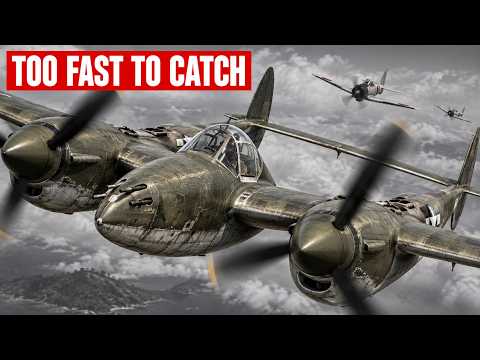
The Lightning was something else entirely, and the Japanese pilots approaching Buna that morning barely knew what they were looking at. They had noticed the strange twin-tailed aircraft hovering at the edges of recent engagements, but their intelligence hadn’t yet grasped the scale of the threat. Some thought it was a reconnaissance plane. Others guessed it might be a light bomber, too heavy and slow to be a real fighter. The idea that American engineers had designed a fighter specifically to strip the Zero of every advantage it possessed had not occurred to the men planning the escort mission that morning.
The P-38 carried two Allison engines, each producing over 1,100 horsepower, fitted with turbochargers that let the aircraft cruise easily at altitudes where other engines gasped and lost half their power. It could reach speeds over 400 miles per hour in a dive, a number no Japanese fighter in the theater could safely match without risking its wings tearing off. Its armament was concentrated in the nose rather than spread across the wings—a 20mm cannon and four .50-caliber machine guns firing in a single straight line without the convergence problems that forced wing-mounted weapons to sacrifice accuracy outside one narrow range. A Lightning pilot could open fire from 400 yards, outside the range of the Zero’s lighter, shorter-ranged guns, and simply wait for the enemy to fly into a wall of concentrated fire.
Bong had studied all those numbers at Hamilton Field in California, memorizing them the way other young men memorized baseball batting averages. But numbers on a training chart are different from a battlefield, and no one knew for certain whether the Lightning’s theoretical advantages would hold up against pilots who had never tasted defeat.
At 18,000 feet, the twelve Lightnings held the most important advantage of all before a single shot was fired. Altitude. Below them, the Japanese formation of Zeros, Nakajima fighters, and Aichi dive bombers sailed toward Buna in a confident, relaxed escort formation, the kind that had allowed Japanese air power to dominate unchallenged from Pearl Harbor to the Dutch East Indies. Nothing in their recent experience suggested this day would be any different.
Lynch rolled his Lightning first and pushed the nose down. The airspeed indicator climbed past 400 miles per hour as the jungle canopy rushed up to meet him. Behind him, Bong and the rest of the squadron picked their targets and followed him down. Lynch fired first, and a Japanese fighter simply came apart in the air. The 20mm cannon shells struck the wing root and the fuel tank in the same half-second. There was no time for the pilot inside to realize what had happened to him.
As Lynch pulled his nose back up, climbing to regain the altitude he’d spent, several Zero pilots tried to follow him. Their aircraft began to shudder violently as they exceeded the speed their airframes were designed to withstand, warning every pilot in the cockpit that the dive had reached its limit. They pulled away, unable to match a maneuver the Lightning performed without effort.
Bong spotted a Zero closing on Lynch’s tail and turned to cut it off, leading his target the way his instructors had drilled him for months. His first bursts of the war hit home. The Zero fell toward the jungle trailing fire, its pilot never regaining control.
As Bong climbed out of the maneuver, three more Zeros crossed his position, confident they had cornered the American. Bong pushed the throttles forward instead of engaging, and the Lightning accelerated past 450 miles per hour, pulling away from the pursuing Zeros as if they were standing still. The Japanese pilots could only watch the twin-tailed shape fade into the haze, utterly unable to close the gap.
Flying low over the treetops to shake any pursuit, Bong spotted an Aichi dive bomber recovering from its attack below him. A short burst from 100 yards turned it into a fireball before its crew ever saw him coming. Two confirmed kills in his first combat engagement, with a squadron that wasn’t his, in a machine that had barely proven itself in the field.
The entire fight lasted less than ten minutes. When the 39th regrouped and turned for home, the pilots counted twelve Japanese aircraft destroyed between Lynch, Bong, and Second Lieutenant Carl Planck. Not a single Lightning was lost, and none had suffered serious damage.
At Rabaul, the post-battle reports reaching Japanese naval aviation headquarters described something intelligence officers couldn’t explain. Pilots spoke of an enemy aircraft with fantastic speed and impossible climbing power, one that opened fire from distances no Japanese fighter could reach. The Zero pilots who filed those reports had been the most feared men in the Pacific for thirteen months. They had never needed to describe an enemy they couldn’t catch, because until that morning over Buna, no such enemy had existed.
Intelligence officers at Rabaul classified the P-38 as a heavy fighter unsuitable for close air combat, designed for bombing and reconnaissance rather than the art of aerial fighting. That classification had just been proven fatally wrong, and no one at headquarters yet understood how wrong, or how far the consequences would reach.
Somewhere over the jungles of New Guinea, a twenty-two-year-old farm boy from Wisconsin, who had borrowed a squadron that wasn’t his for the morning, was flying home with two aerial victories. They were the first two entries in a combat record that no one, not even Bong himself, could have imagined that day.
Back at the airstrip, ground crews swarmed around the returning Lightnings, counting the bullet holes that mostly weren’t there, patting the airframes the way men pat a friend’s shoulder when he’s come back safe against all odds. Lynch climbed down from his cockpit in silence, already thinking about the next mission. Bong was quieter still, replaying the last ten minutes in his mind, trying to absorb how quickly the war had changed for him between takeoff and landing.
The sky that the Zero had ruled for thirteen months had just changed hands, and the men who had ruled it didn’t yet realize how complete that change would become.
Eleven days into the new year, on the morning of January 7, 1943, the men of the 39th learned that Buna had not been a fluke. Nine Lightnings launched to escort a bomber formation over Lae and ran into roughly twenty Japanese fighters—more than double their number.
By every rule written in the fighter-tactics manuals on both sides of the Pacific, the nine trapped aircraft should have formed a defensive circle and held on until help arrived or fuel ran out. Instead, the Lightnings climbed.
They rose to 25,000 feet, far above the Japanese formation, and waited there like men standing at the top of a staircase the enemy could not climb. In that thin, bitter slice of sky, the Lightning pilots had learned to feel safe—because it was the one place in the theater a Zero could not follow them.
Bong, still flying with the 39th while his own squadron waited for its aircraft, picked out a Nakajima below and rolled into his dive. His cannon fire caught it with a deflection shot at 300 yards, the kind of aim that required a pilot to shoot not where the enemy was, but where he would be half a second later.
Two more Zeros turned to chase him. Bong pulled his stick back and hauled the Lightning through a chandelle, trading dive speed for altitude and changing direction in the same motion. By the time the pursuing fighters understood what had happened, he was already above them at 20,000 feet, choosing his next target.
It was aerial geometry the Japanese pilots had never trained to face. The Zero could out-turn anything in the sky, but it could not dive with a Lightning, could not climb with one, and could not catch one that simply decided to leave.
The horizontal battlefield where Japan’s naval aviators had built their reputation—the sharp turns, the fast reflexes, the sudden courage—was quietly replaced by something three-dimensional, where altitude and raw speed mattered more than any turning radius at all.
Veterans who had trained for years in the art of close maneuvering combat found their entire skill set suddenly obsolete. A pilot could execute a perfect turn onto an enemy’s tail and still lose the fight, because by the time he settled into firing position, the Lightning he was chasing had pulled away a mile and was climbing through altitude bands his own aircraft could never reach.
The psychological effect cut far deeper than the loss of a single aircraft. Japanese pilots who had enjoyed a year of near-total air superiority now found themselves scanning the sky above them, knowing full well that death might drop from an altitude their fighters could not touch.
Some of the men who had flown with total confidence in 1942 began to show signs of the exhaustion and dread their commanders had rarely seen before in Japanese naval aviation. A psychological pressure that had no name yet, but was unmistakably real to the pilots who lived it.
What began as thirteen months of absolute Japanese dominance over the Pacific—a period in which Allied pilots learned to survive rather than to win—ended in little more than two years with the near-total collapse of a force that had once seemed destined to rule those skies for the rest of the war.
They were not beaten by a single battle or a single brilliant tactic, but by an aircraft designed around an unconventional idea, a doctrine that demanded discipline over instinct, and an elite of young men—farmers’ sons and engineers from places like Poplar, Wisconsin—who learned at real and lasting cost the best way to fly it into the history books they had been sent to write.
And yet the question remains: was it the machine that won the Pacific sky, or the men who refused to fight on the enemy’s terms?
Report this article
Select a reason for reporting:






