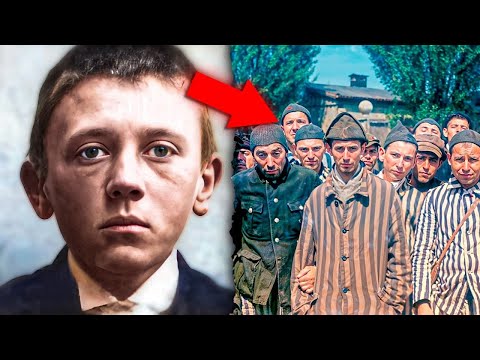
He was born on April 20th, 1889, in a small Austrian village, the fourth child of a customs agent and his third wife—who was also his cousin. The boy was baptized Adolf, meaning “noble wolf,” a name he would later embrace as his own nickname, a premonition of the predator he would become. His childhood was not happy. His father, Alois, was brutal, and young Adolf learned early to suppress his tears, to hide his vulnerability behind a mask of defiance. In school, he performed well at first, but soon rebelled, deliberately failing exams to spite his father’s dream of him becoming a civil servant. He wanted to be an artist, a painter—a dream that would be crushed, and with it, any remaining faith in the world.
But the seeds of something far darker were already being sown. His history teacher, Leopold Poetsch, filled his young mind with nationalist fervor, and the boy who dreamed of absolute power began to see the world in terms of struggle and betrayal. When his father died in 1903, Hitler drifted, dropping out of school at sixteen without a diploma. He was a self-proclaimed misunderstood artist, obsessed with the arts, yet rejected by the Vienna Academy of Fine Arts. “The academy rejected me,” he would later write, “but I will not be defeated.” It was in Vienna, the city that ignited his hate, that Hitler’s anti-Semitism began to crystallize. He devoured the anti-Semitic newspapers and listened to the speeches of Mayor Karl Lueger, who cunningly blamed Jews for everything from capitalism to Marxism. “The Jew is the enemy of the German people,” Lueger thundered, and Hitler listened, captivated.
But his hatred was not yet absolute. In a strange twist, Hitler had a Jewish doctor, Eduard Bloch, who treated his dying mother and later became one of the few Jews Hitler personally protected. “If all Jews were like him, there would be no Jewish question,” Hitler once remarked. This contradiction—a man capable of gratitude yet consumed by irrational loathing—would come to define him. In 1913, he fled to Munich to avoid military service in the Austro-Hungarian Empire, a place he despised for its ethnic diversity. “I left Austria because of the racial mixing in Vienna,” he later claimed. When World War I erupted, Hitler found his purpose. He enlisted in the Bavarian army, fighting for a Germany he believed was destined for greatness. The war was a turning point: he was promoted, decorated, and wounded. But the defeat of Germany in 1918 shattered him. “Everything went black before my eyes,” he wrote. The armistice, the revolution, the abdication of the Kaiser—it was all too much. And then came the stab-in-the-back theory: the idea that Germany had not been defeated on the battlefield but betrayed by Jews and socialists at home. “No, no, it was not the enemy that defeated us,” Hitler raged. “It was the Jew!”
In the chaos of post-war Munich, Hitler found his voice. He joined the German Workers’ Party (DAP) and quickly discovered his talent for public speaking. “I could speak!” he later recalled. “And they listened!” His first anti-Semitic speeches were delivered to soldiers, and his superiors were impressed. “Hitler is a born orator,” one wrote. In September 1919, he attended a DAP meeting and gave an impromptu speech that left the leaders stunned. They offered him membership on the spot. “I had found my home,” Hitler said. He rose rapidly, becoming the party’s chief propagandist. By 1920, the DAP had been renamed the National Socialist German Workers’ Party—the Nazi Party. “We will sweep away the old order,” Hitler declared. “And the Jews will be the first to go.”
But it was the Gemlich letter that sealed his ideology. In 1919, Hitler wrote a manuscript in response to a colleague’s question about the Jewish question. In it, he stated that Judaism is a race, not a religion, and that Jews were “accumulators of wealth” seeking world domination. “Anti-Semitism based on reason must lead to the systematic suspension of Jewish privileges,” he wrote. “Its ultimate goal must be the uncompromising removal of all Jews.” This letter, according to historians, is the first political writing in which Hitler set out his plans for the Jews. “There is hardly a document more relevant to understanding World War II,” said Marvin Hier, dean of the Simon Wiesenthal Center. The stage was set. The wolf had found its prey.
The Treaty of Versailles, signed in 1919, became the perfect weapon for Hitler’s rhetoric. Germany was forced to accept blame for the war, pay crushing reparations, and surrender territory. “The treaty was made to bring twenty million Germans to their deaths and ruin the German nation,” Hitler thundered in a 1923 speech. For him, the humiliation was proof of a conspiracy—and the Jews, he claimed, were the architects of both the treaty and the Bolshevik revolution that had torn Russia apart. The Balfour Declaration of 1917, which promised a Jewish homeland in Palestine, only fed his paranoia. “The Jews are negotiating their own state while stabbing Germany in the back,” he declared.
But why, then, did Hitler never seriously pursue the idea of expelling Europe’s Jews to Palestine? The question haunted Nazi officials themselves. The answer lay in his twisted logic: “The Jew is not a guest to be relocated,” he told his inner circle. “He is a parasite to be destroyed.” Expulsion would only strengthen the Jewish state, he argued, giving his enemies a base of power. And so, instead of emigration, he chose annihilation. The Grand Mufti of Jerusalem, Amin al-Husseini, later met with Hitler and shared his opposition to Jewish immigration—a meeting that delighted the Führer. “The Arabs understand the Jewish danger better than our own diplomats,” he remarked.
By 1923, the Nazi Party had grown to over fifty thousand members, hungry for action. The Weimar Republic was drowning in economic crisis and hyperinflation. Hitler saw his moment. On the night of November 8th, he launched his attempted coup at the Bürgerbräukeller beer hall in Munich. “The national revolution has begun!” he shouted, firing a pistol into the ceiling. He intimidated the Bavarian leaders at gunpoint, but they escaped and ordered the police to crush the putsch. Hitler was arrested and sentenced to five years in Landsberg prison—but he served only eight months. “The defeat only made me stronger,” he later wrote.
In prison, Hitler began dictating Mein Kampf—My Struggle—a rambling, repetitive manifesto that would become the bible of Nazism. Originally titled Four and a Half Years of Struggle Against Lies, Stupidity, and Cowardice, it was shortened by his publisher. “The book is chaos,” one critic wrote. “But its hatred is crystal clear.” In its pages, Hitler called the Jew “the personification of the devil” and invoked the Protocols of the Elders of Zion as proof of a global Jewish conspiracy. “If the Jew triumphs over the other peoples of the world,” he wrote, “his crown will be the funeral wreath of humanity.” The book sold poorly at first, but after 1933, sales exploded—over a million copies in a single year. Newlyweds received it as a wedding gift; soldiers carried it in their packs.
Yet even as his ideology hardened, a strange contradiction persisted. In 1933, a six-year-old girl with Jewish ancestry, Bernile Nienau, became Hitler’s unlikely friend. She called him “Uncle Adolf,” and he called her “darling.” They shared the same birthday—April 20th—and celebrated together at his mountain retreat. “She has the most beautiful eyes,” Hitler remarked. But when Martin Bormann, his ruthless chief of staff, learned of Bernile’s background, he banned her from the Berghof. “The Führer is too soft-hearted,” Bormann fumed. Hitler never saw her again. She died in 1943 at seventeen, of polio.
The philosophy of hate that consumed Hitler was built on a foundation of pseudo-scientific racism. The Nazis believed that blood determined everything—that Aryans were a master race and Jews, Roma, homosexuals, and the disabled were biological threats. In 1935, the Nuremberg Laws codified this madness, stripping Jews of their citizenship and forbidding marriage between Jews and Germans. “Only a German can be a citizen,” the laws declared. “Only those of German blood, whatever their creed, may be a citizen.” The SS established a Race and Settlement Office to investigate ancestry, and doctors began euthanizing the mentally ill, calling it “a mercy death.” The machinery of genocide was being assembled, piece by piece.
Hitler’s hatred of Jews was not born in a vacuum. It was fed by a toxic mix of personal grievance, national humiliation, and conspiracy theory. He blamed Jews for Germany’s defeat in World War I. He blamed them for the economic chaos of the 1920s. He blamed them for communism and capitalism alike. “They are too rich, depriving us of wealth,” he said. “Or too poor, becoming criminals.” They were accused of destroying morality, of undermining religion, of plotting world domination. But the root of it all, the single justification that encompassed every other reason, was race. “The Jew is racially inferior,” Hitler declared. “And thus, he must be eliminated.”
At the Wannsee Conference in January 1942, Nazi leaders formalized the Final Solution—the systematic extermination of the Jewish people. The numbers are staggering: nearly 2.7 million Jews murdered in extermination camps like Auschwitz, Treblinka, and Sobibor; some 2 million killed in mass executions across Eastern Europe; between 800,000 and 1 million dead in ghettos and labor camps; at least 250,000 more in riots, forced marches, and individual killings. Six million men, women, and children. The Holocaust was the culmination of Hitler’s hate—a hate that began in a small Austrian village, was nursed in the streets of Vienna, and was unleashed upon the world with devastating precision.
But even as the death camps burned, questions remained. Why did Hitler protect his Jewish doctor, Eduard Bloch, while sending millions to their deaths? Why did he befriend a Jewish girl while preaching extermination? Historians have puzzled over these contradictions for decades. Some argue that Hitler’s anti-Semitism was not fully formed until after World War I, that his time in Vienna merely planted the seeds. Others insist that the hatred was always there, a dark undercurrent that only needed the right conditions to erupt. “Hitler was a man of contradictions,” one biographer wrote. “But his hatred was absolute.”
In the end, the contradictions that riddled Hitler’s life—the gratitude toward a Jewish doctor, the affection for a Jewish girl—were not signs of humanity but exceptions that proved the rule. His hatred was not a logical conclusion but a consuming fire that needed no consistency. He could spare individuals while condemning millions, because his anti-Semitism was never about facts; it was about a worldview that demanded a scapegoat.
The Holocaust stands as the ultimate expression of that worldview—a genocide so vast, so systematic, that it defies comprehension. Six million lives extinguished, not on a battlefield, but in gas chambers, in mass graves, in the streets of cities that had once been home. “The Jew is the enemy,” Hitler had repeated, and millions believed him.
Today, the name Adolf Hitler is synonymous with evil. His book, Mein Kampf, remains a warning, a testament to how far hatred can go when it is given power. The boy who dreamed of being an artist became the architect of the greatest atrocity in human history. “I am acting according to the will of the Almighty,” he once wrote. But no god would claim such deeds.
So we are left with the question that has haunted generations: how could one man’s hatred become the blueprint for a continent’s destruction? And what does it say about us that we still struggle to answer it? Share your thoughts in the comments below.
Report this article
Select a reason for reporting:






