Dr. Rachel Morrison had seen thousands of historical photographs, but none had ever made her blood run cold like this one. The image, a pristine portrait of an Edwardian wedding, radiated joy and prosperity—until her eyes locked on the father of the bride. His smile was a mask, and in his hand, half-hidden by his coat, was a small glass vial. In that moment, Rachel knew she was not looking at a celebration, but at a prelude to murder.
The photograph, dated June 15, 1911, captured the wedding of Margaret Ashford to Thomas Bennett at St. Mark’s Episcopal Church in Richmond, Virginia. Margaret was a vision in Chantilly lace, her veil framed by a tiara of pearls and diamonds. Thomas stood beside her, the picture of a successful young lawyer. The bridesmaids in pale pink silk and the groomsmen in morning coats completed the idyllic scene. But it was Henry Ashford, Margaret’s father, who drew Rachel’s attention. While every other face beamed with genuine happiness, Henry’s expression was strained, his eyes distant. And his right hand, partially concealed, gripped something small and cylindrical.
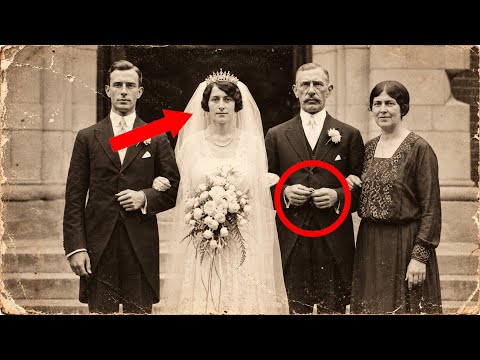
Rachel, a researcher into historical cases of familial psychological disorders at Virginia Commonwealth University, had learned to read the subtle clues in old photographs. She scanned the image at ultra-high resolution, enhancing every detail. The object in Henry’s hand resolved into a delicate glass vial, the kind used for medicines or chemicals. His thumb rested on a cork stopper, his fingers curved around it in a way that allowed quick access while keeping it hidden. “Small glass vials were commonly used for poisons,” Rachel murmured, her heart quickening. She zoomed in further, adjusting contrast and brightness. The vial was unmistakable—and deliberately concealed.
Her training in historical crime research raised immediate alarms. Why would a father bring a poison vial to his daughter’s wedding? Rachel delved into the archives, pulling business records, personal letters, and newspaper clippings. Henry Ashford owned Ashford Chemical Works, a profitable manufacturer of industrial cleaning solutions, metal treatments, and photographic chemicals. His factory handled cyanide compounds—deadly poisons. “He had access to lethal substances,” Rachel noted. But access alone wasn’t enough. She needed to understand the man.
Contemporary accounts painted a troubling picture. A 1909 article in the Richmond Social Register mentioned that Margaret, then nineteen, had been absent from the debutante season. Friends whispered that Henry was extraordinarily protective, discouraging suitors. Letters between Dorothy Ashford, Margaret’s mother, and her sister in Baltimore revealed deeper concerns. In March 1910, Dorothy wrote, “My Henry continues to find fault with every young man who shows interest in Margaret. His criticism grows more intense and unreasonable with each passing month. I fear his attachment to our daughter has become unhealthy.” Another letter from October 1910 confessed, “Margaret has again been forbidden to attend social functions where she might encounter eligible young men. Henry claims he is protecting her from fortune hunters, but I suspect his motives are more complex and troubling.”
Rachel felt a chill. This was not ordinary paternal concern—it was obsessive control. And it was about to escalate.
Margaret’s diary, preserved in the family archives, documented her father’s campaign against Thomas Bennett. They had met at a church social in September 1910. Thomas was an ambitious lawyer from a respected family—exactly the sort of suitor any father would welcome. But Henry was immediately hostile. “Father forbade Thomas from calling on me again,” Margaret wrote in November 1910. “He claims Thomas is unsuitable, though he cannot provide any reasonable explanation.” Henry spread rumors about Thomas’s financial stability and professional competence, even approaching his clients to urge them to seek other counsel. He hired private detectives to follow Thomas, hoping to uncover scandals. The reports, covering six months of surveillance, found nothing more damaging than occasional poker games and moderate drinking.
When these tactics failed, Henry resorted to threats. In February 1911, Thomas wrote to his law partner about a confrontation outside his office. “Mr. Ashford made it clear that he would use any means necessary to prevent my marriage to Margaret. His manner was so threatening that I have taken the precaution of varying my daily routines.” Despite the intimidation, Margaret and Thomas announced their engagement in April 1911. Dorothy’s letters described Henry’s response as “a rage unlike anything I have witnessed in our 23 years of marriage.”
By the wedding day, Henry had exhausted all conventional means of stopping the marriage. Rachel realized he had decided on a final, desperate solution. She reconstructed his preparation through business records and witness statements. In late May 1911, Henry ordered unusual quantities of sodium cyanide, ostensibly for a new metal cleaning process. But factory production records showed no corresponding increase in output. The excess cyanide was diverted to his personal use. Library records revealed he had borrowed toxicology books from the Richmond Medical Society, focusing on rapid-acting poisons. Most chilling was a draft letter found in his desk, never sent, dated early June 1911: “Young man, you underestimate the lengths to which a father will go to protect his daughter from making a terrible mistake. What appears to be celebration may become tragedy for those who refuse to heed reasonable warnings.”
The wedding reception at the Ashford mansion included a formal champagne toast where Henry, as father of the bride, would offer the traditional blessing. The seating chart showed he had specifically requested to be positioned next to Thomas during the toast—perfect access to his glass. Servants later testified that Henry insisted on personally preparing the champagne service, dismissing staff who normally handled such duties.
Rachel’s hands trembled as she pieced together the final moments before the toast. Henry had brought the vial of cyanide to the church, concealed in his coat, planning to transfer the poison during the reception. The photograph had captured him in the moments before executing his deadly plan. But what happened next? Rachel turned to the police reports and witness statements, her heart pounding. The story was about to take an unexpected turn.
The reception began normally, with guests enjoying an elaborate dinner in the Ashford Mansion’s grand ballroom. Henry maintained his composure throughout the meal, though several guests later reported that he seemed unusually tense and distracted. He ate little, and his eyes kept drifting toward Margaret and Thomas at the head table. Witnesses described his hands trembling whenever he reached for his champagne glass.
The crucial moment arrived during the traditional champagne toast. As father of the bride, Henry rose to offer the ceremonial blessing to the newlyweds. According to multiple witness accounts, he approached Thomas’s place at the head table, champagne glass in hand, the small vial concealed in his palm. His voice was steady as he began the formal words of blessing, but his fingers were already working the stopper loose.
Then the plan unraveled. In a spontaneous gesture of affection, Margaret rose from her seat and embraced her father just as he was positioning the poisoned glass near Thomas. The unexpected movement caused Henry to fumble. Several guests noticed a small glass container slip from his hand and shatter on the polished floor.
Dr. James Whitfield, a family friend and physician, was among the guests. He recognized the fallen object immediately as a chemical vial—and something about Henry’s frantic attempt to retrieve it alarmed him. Whitfield later told police, “The vial appeared to contain a crystalline substance. Given Mr. Ashford’s profession, I was concerned about potential dangers.”
When Whitfield knelt to examine the spilled contents, he caught the distinctive bitter almond scent characteristic of cyanide compounds. His quick thinking prevented a disaster. He quietly alerted the other guests and ensured no one came into contact with the chemical. Then he confronted Henry directly.
The revelation that Henry had brought a lethal poison to his daughter’s wedding created immediate chaos. Thomas, initially confused by the commotion, was horrified to learn that his new father-in-law had apparently planned to murder him during the celebration. Margaret’s reaction, according to witness accounts, was one of complete shock and devastation. The realization that her father had been willing to commit murder rather than accept her marriage shattered her understanding of their relationship.
Confronted by the wedding guests, Henry broke down completely. He confessed his obsessive love for Margaret and his inability to bear losing her to another man. The confession was so raw, so utterly unhinged, that several guests later described feeling not just horror but a strange, uncomfortable pity. Here was a man destroyed by his own twisted devotion.
Rachel paused, staring at the screen. The photograph had captured the calm before the storm—the final moments of a man who believed he could control his daughter’s life forever. But the story didn’t end at the reception. There was the trial, the imprisonment, and the long, dark aftermath that consumed the Ashford family for decades.
She pulled up the court records from September 1911, when Henry’s trial became one of the most sensational criminal cases in Virginia history. Newspapers across the country covered the story of the prominent businessman who had tried to poison his daughter’s husband during their wedding celebration. The proceedings revealed the full extent of Henry’s obsession: the private investigator’s reports, the threatening letters, and the journal entries describing his inappropriate feelings for Margaret.
Margaret’s testimony had been particularly heartbreaking. “I never suspected that father’s protectiveness had become something so twisted and dangerous,” she had testified. “The man who tried to murder my husband was not the father I thought I knew.”
Henry was convicted of attempted murder and sentenced to fifteen years in the Virginia State Penitentiary. But his imprisonment was complicated by his rapidly deteriorating mental condition. Prison medical files showed that separation from Margaret had triggered a complete psychological breakdown. The prison psychiatrist diagnosed him with obsessional neurosis with paranoid features and pathological attachment disorder.
Most disturbing were the hundreds of letters Henry wrote to Margaret during his imprisonment—letters prison officials intercepted and preserved. They revealed a man completely detached from reality, convinced that Margaret was being held prisoner by her husband and desperately needed rescue. “When I am released, I will take you away from this terrible situation and we will begin our life together as it was always meant to be.”
Rachel scrolled further, her throat tight. Henry had attempted escape three times, each timed to coincide with significant events in Margaret’s life he had learned about through newspaper accounts. His first attempt came when he learned of Margaret’s first pregnancy in 1914. Guards reported he often spoke to himself, carrying on imaginary conversations with his daughter.
The prison chaplain’s reports offered the most chilling insight. “The prisoner shows no remorse for his attempted murder. He continues to believe that his actions were justified by his love for his daughter and his duty to protect her from an unsuitable marriage.” Henry Ashford died in prison in 1924, never having achieved the reconciliation with Margaret that dominated his thoughts for thirteen years.
Rachel leaned back in her chair, the weight of the story pressing down on her. But something still nagged at her—a detail she had overlooked. She returned to the photograph, zooming in on Dorothy Ashford, the mother of the bride. Dorothy was beaming with maternal pride, her expression radiating pure joy. But Rachel noticed something now that she hadn’t seen before: Dorothy’s left hand, resting lightly on her husband’s arm, was not a gesture of affection. It was a grip—firm, restraining, almost desperate.
Rachel’s eyes widened. Dorothy knew. She had known what her husband was planning, and she had been trying to stop him all along.
Rachel’s discovery reframed everything. Dorothy’s letters weren’t merely confessions of worry—they were a paper trail of a woman trying to save her daughter from a man she could no longer control. She had warned her sister, she had documented the obsession, and on the wedding day, she had gripped Henry’s arm to hold him back. But the vial still fell.
The photograph, once a portrait of joy, was now a record of a family’s quiet unraveling: a father’s lethal obsession, a mother’s desperate vigilance, and a daughter’s shattered innocence. Rachel closed the file, her mind lingering on the vial hidden in plain sight for over a century.
How many other smiles in old photographs are hiding a hand that grips too tightly—and what would we see if we looked closer?
Report this article
Select a reason for reporting:






