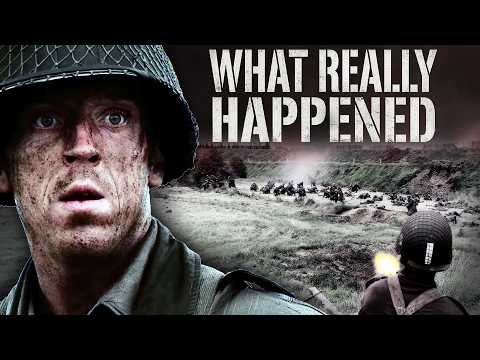
Dawn was breaking over the Dutch countryside on October 5, 1944, when 35 men with bayonets fixed raced headlong across an open field toward more than 250 heavily armed SS soldiers. In the minutes that followed, Captain Dick Winters and the men of Easy Company unleashed chaos on a now peaceful landscape—an episode immortalized in Band of Brothers. But how exactly did that desperate charge come about? What really happened on that day? And do the events around this crossroads match what was shown on screen?
Just two weeks earlier, Field Marshal Montgomery’s bold plan to cross the Rhine at Arnhem and end the war by Christmas had failed. Among the newly won territory was a patch of land known as the Island, bordered by the Rhine and Waal rivers. The Allies worked desperately to expand the narrow corridor, while the Germans were equally determined to retake the vital bridge at Nijmegen. By early October, the scene was set for a bloody encounter that would decide control of the Island.
The men tasked with consolidating this area came from the US 101st Airborne Division—the Screaming Eagles. Among them was the 506th Parachute Infantry Regiment, and within that, Captain Richard Winters’ Easy Company. Winters was already a legend, having led an assault on a German gun battery on D-Day that earned him the Distinguished Service Cross. Now, at just 26 years old, he and his men were holding a 2-kilometer stretch of line near the village of Randwijk, with outposts overlooking the Rhine.
Little did they know, the Germans had their own plans. On the night of October 4-5, two full companies of SS silently crossed the river and moved into the fields, preparing a diversionary assault to draw Allied attention away from a larger attack. Winters, unaware of the enemy’s presence, ordered a patrol to push northeast and report on enemy movement. That patrol, led by Sergeant Artum, set off at 3:30 a.m. and soon stumbled upon a heavily manned German machine gun. A shower of grenades wounded every man, with Private Alli Lesneski receiving 32 wounds to his face, neck, and arm. Incredibly, all reached safety and reported to Winters at 4:20 a.m.
Knowing there should be no Germans south of the river, Winters immediately called forward a squad to investigate. They found the machine gun crew firing southwards in error—there were no Allied troops in that area. Winters tried to call in artillery support but had no luck. He would have to take on the gun himself. Crawling over the roadway unseen, he assembled his men in a shallow ditch and advanced alone to spot the gun and its seven-man crew. Returning to his patrol, he whispered instructions: each man was to target a specific German. On his command, they fired. Three Germans ran for the other side of the dyke, but Winters and his men accounted for all seven.
They had poked the hornet’s nest. Moments later, heavy rifle fire erupted from the road ahead, forcing a rushed withdrawal. It was during this fallback that 23-year-old William Jukeman was hit and killed by a rifle grenade. Winters now faced a desperate situation: enemies to his front behind a solid embankment, and an open flank that could be outflanked at any moment. He had to act.
Calling up the rest of First Platoon and a light machine gun section, Winters assembled 35 men. His plan was simple: using machine guns for covering fire, three squads would fix bayonets and charge directly across 265 meters of open field to the roadway. It was incredibly risky. Winters later recalled, “I’d never been so pumped up in my life.” On the smoke signal, the base of fire commenced, and the three columns dashed across the field. Winters, a good athlete in school, ran faster than he ever had.
Reaching the roadway alone, he encountered a German sentry. Both hurled grenades—neither went off. Winters had forgotten to remove the tape from his grenade. He mounted the roadway, saw the sentry taking cover, and fired from the hip, killing the man. Turning right, he was shocked to find more than 100 SS men sheltering less than 20 yards away, unaware of his presence. He fired 15 rounds into the mass before his men arrived and added their fire. Dozens fell as the Germans fled back toward the river.
At the same time, the machine guns redeployed and caught another panicked mass of about 100 SS men streaming across the embankment. It was a bloodbath. In just a handful of minutes, 35 men had bested two full companies of SS. But unlike in the series, the fight wasn’t over. With support from a platoon of Fox Company, Winters and his men pursued the fleeing Germans, advancing along a track until they were struck by fire from about 75 Germans concealed in a field. At risk of being cut off, Winters ordered a withdrawal back to the embankment. Just as the last men arrived, a heavy barrage of German mortars slammed into the rear ranks, wounding 18 men, including Sergeant Bole.
It had been a clear victory, but not a free one. One man was killed and 22 wounded. The Germans suffered far more heavily: perhaps 50 killed and at least twice as many wounded, along with seven prisoners. The actions of Captain Winters and his men played a significant role in stopping the planned German assault to recapture the Island, which remained in Allied hands for the rest of the war. Today, a small memorial stands close to where the German machine gun position once did—a place those men would never forget.
Yet for all the clarity of that victory, the story of the charge at Heteren Crossroads is not simply one of numbers and tactics. It is a story of small decisions made under enormous pressure—decisions that, had they gone differently, might have ended the engagement in disaster. Consider the moment Winters stood alone on the roadway, his grenade failing to detonate, a German sentry scrambling for cover just yards away. Had his M1 jammed, or had the sentry reached his weapon first, the entire charge might have stalled at its very outset.
Consider, too, the men who ran across that open field. Don Hubler, swallowing hard as he fixed his bayonet. Floyd Talbert, driving his squad forward on the right. Lieutenant Peacock on the left, matching the pace. These were not superhuman soldiers. They were young men—many still in their early twenties—who had already survived Normandy and Market Garden and knew exactly what a frontal assault against a prepared enemy could cost.
“All I could think was, keep running, don’t stop, don’t look back,” one veteran later recalled of that dash. The field offered no cover. The dyke ahead offered only the promise of close-quarters chaos. And yet they ran.
What the television series captures well is the shock of the encounter—the sudden appearance of over 100 SS men sheltering behind the embankment, totally unaware that a handful of American paratroopers had just sprinted into their flank. What the series compresses, however, is the sheer duration and confusion of the fight. The initial charge lasted only minutes, but the pursuit, the exposure to fire from concealed Germans in the fields, and the mortar barrage that wounded eighteen men stretched the engagement into a brutal afternoon.
Sergeant Bole’s wounding was particularly keenly felt. He had been with Easy Company since training, a steady presence whose radio work had kept Winters connected to the larger battle. When the mortars came in, he was struck down alongside seventeen others—men who had survived the charge only to fall in its aftermath.
And then there was Private Joe Liebgott, escorting seven prisoners back to the rear with just one round in his rifle. In the series, this detail is played almost for dark humor. In reality, it was a measure of how thoroughly the German force had been broken—and how thin the American line truly was.
The German plan to retake the Island hinged on speed and surprise. The diversionary assault at the crossroads was meant to draw Allied attention away from the main thrust from the northwest. Instead, Winters’ men had shattered two companies of SS in a matter of minutes, eliminating any hope of a coordinated diversion. The main attack, when it came, found the Allied line alerted and prepared.
Historians have since debated the exact numbers—how many Germans were truly present, how many fell, how many escaped across the river. Wartime records are fragmentary, and memories fade. But what is not in dispute is the outcome: a small force of paratroopers, outnumbered perhaps seven to one, had routed a far larger enemy force and held the ground.
Today, the fields around the crossroads look much as they did in 1944. The drainage ditches still run in the same lines. The dyke still rises above the flat farmland. A small memorial stands near where the German machine gun once fired southwards into the empty darkness. Few tourists find their way here. There are no grand museums, no reconstructed trenches. Just a quiet patch of Dutch countryside where, for a few hours on an October morning, the fate of the Island was decided by thirty-five men with bayonets fixed.
For those who fought there, the memories never faded. Winters himself would later say that the charge at the crossroads was one of the defining moments of his military career—not because of the medals or the recognition, but because of what it revealed about the men beside him. “They were the best soldiers I ever served with,” he wrote. “And I would go anywhere with them.”
The memorial today bears no names—just a simple stone marker at the edge of a field. But those who visit often pause and look north, toward the dyke and the river beyond, imagining the sound of boots on wet grass and the crack of rifle fire breaking the morning stillness.
What remains most striking about the charge at Heteren Crossroads is not the lopsided casualty count or the tactical brilliance of a 26-year-old captain. It is the human texture of the moment—the dry mouth, the racing heart, the bayonet fixed with trembling hands. “I was a good athlete in school,” Winters recalled, “but I’m sure I ran that 200 yards faster than I’d ever run 200 yards in my life.” That admission, so ordinary and so honest, captures what the histories and the miniseries often smooth over: these were not mythic figures. They were frightened young men who chose to run forward anyway.
The fields around the crossroads remain quiet now. The ditches still drain the same flat land. The dyke still rises against the sky. And the small memorial still stands where the German machine gun once fired into the darkness—a modest reminder of a morning when thirty-five men decided the fate of an island.
Winters wrote that he would go anywhere with those men. They went to Heteren Crossroads first. What do you think—does the true story of that charge deserve more recognition than it receives today?
Report this article
Select a reason for reporting:






