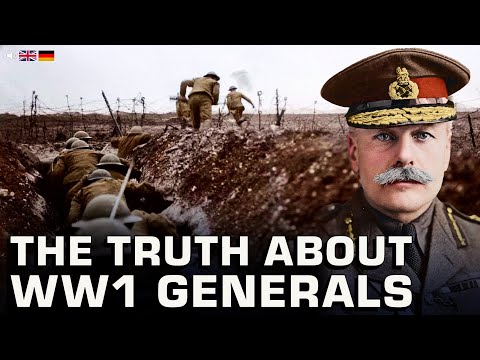
They were the men who sent millions to their deaths, or so the story goes. A century after the guns fell silent, the popular image of the First World War general remains one of a callous aristocrat, safely sipping wine in a chateau miles behind the front, while ordering wave after wave of soldiers to walk into machine-gun fire. It’s a narrative that has stuck—catchy, convenient, and seemingly confirmed by the horrific casualty lists from the Somme, Passchendaele, and Verdun. But is it true? Or have we been wrong about the generals all along?
The scale of the Great War was unprecedented: 8.7 million men served in the British Army alone, with 5.4 million on the Western Front and nearly a million dead. Behind these staggering numbers stood a complex hierarchy of ranks, each with specific duties and responsibilities. Understanding this structure is key to separating myth from reality. So let’s begin by asking: what exactly was a general, and what did he actually do?
At the bottom was the private soldier—usually working-class, average age 26, average height 5’5″, with responsibility only for himself. Promotion brought stripes and chevrons: lance corporal, corporal, sergeant, each with added duties and pay. The sergeant major, a veteran of 20 years, was a terrifying figure to young recruits, responsible for discipline and welfare of hundreds of men. Then came the officers—commissioned ranks filled largely by the middle and upper classes. The second lieutenant, often just 20 years old, was there to learn. The captain, in his mid-to-late 20s, led from the front: “It wasn’t ‘go on, boys, off you go.’ It was ‘come on, boys, follow me.'” Proportionally, captains were the most likely to die.
Higher up, the lieutenant colonel commanded a battalion of 1,000 men and was the most senior officer habitually found in the front line. Some were as young as their mid-20s, promoted on merit. “Officers, particularly senior officers, were in their role based on performance.” A lieutenant colonel knew every job below him because he had done it himself. The same principle applied to generals. The first general rank was brigadier general, commanding a brigade of 4,000 men. By 1918, the idea of incompetent generals making stupid decisions was rare—the early war amateurs had been replaced by battle-hardened professionals. The average age of a divisional commander dropped by ten years between 1914 and 1918, and the youngest brigadier was just 25. Casualties among generals were high: of 1,257 British general officers on the Western Front, 224 were killed or wounded—17.8%, almost as likely as a private soldier.
So why the chateau? A major general commanded a division of 12,000 men spread over a wide area. His role was to maintain an overview, and information was key. A central location behind the lines, often a chateau with existing landlines, was the most practical and efficient headquarters. “A senior officer represented a huge amount of experience acquired in decades of military service.” If he got himself killed, the division would have to be restructured, costing more lives. Major generals did visit the front, and some were killed doing so, but they relied on junior officers for information. Above them, lieutenant generals commanded corps of 30,000 to 50,000 men, and full generals commanded armies of over 100,000. Their war was fought from behind a desk, formulating strategy and coordinating massive logistics.
Critics often claim generals repeated the same failed attacks mindlessly. “The truth is this simply didn’t happen.” Strategies evolved, new tactics were tried, and even attacks over the same ground were never identical. “People 100 years ago… were not, regardless of what popular culture tells us, unintelligent or worse, simply sadistic.” They knew that nothing changes if nothing changes, and they didn’t want to throw lives away needlessly. Many had sons on the front. The problem was that the First World War was a massive technological watershed fought with unprecedented numbers and cutting-edge weaponry. There was no rulebook—lessons had to be learned, and the cost was counted in lives. But lessons were learned: the army of 1918 was a completely different beast from that of 1914, with tanks, aircraft, and improved tactics.
When things went wrong, they went very wrong—the opening day of the Somme, the closing stages of Passchendaele. But there were successes too, like the Battle of Amiens in 1918, arguably the greatest feat in British military history. “These successes… were not by pure chance.” They were the result of evolving strategy and the experience of junior ranks. At the very top, Field Marshal Sir Douglas Haig commanded the entire British Expeditionary Force—5.4 million men. He had to sustain the largest British Army in history, providing food, ammunition, and equipment daily for four years while the enemy tried to disrupt him. It was a task on a scale never before attempted.
This isn’t about whitewashing the generals. Things were sometimes done badly—criminally so—but rarely through incompetence and never through lack of care. The phrase “lions led by donkeys” was popularized in the 1960s, more than 50 years after the war. It’s catchy, but it doesn’t reflect how the men on the ground felt at the time. They knew the challenges and generally acknowledged that the right people were in the right positions. When Haig died in 1928, hundreds of thousands attended his state funeral, many of them veterans. The passage of time and the desire to find blame have certainly shaped how we remember today. The Allies won in 1918, largely thanks to lessons learned earlier—at a cost no one had hoped for. The countless graves and memorials stand testament to that. And while the argument about why the war was fought is a much bigger one, we can at least acknowledge the dedication of those men and women across all ranks who fought it.
But the story doesn’t end with Haig’s funeral procession winding through the streets of London. The very men who served under those generals carried their own versions of the war home with them, and those versions did not always agree. Some veterans, like the poet Siegfried Sassoon, returned bitter and outspoken, convinced the staff had been callous and remote. Others, like the future historian Basil Liddell Hart, spent decades dissecting the failures of the high command with surgical precision. And yet, walk into any British Legion hall in the 1930s and you would just as likely hear a different tune—old soldiers defending their officers, insisting that the men at the top had done the best they could with the tools they had.
The truth, as ever, lies somewhere in the mud and the blood of the trenches. What the popular narrative misses is how the war actually changed the men who fought it. The British Army of 1916 was not the army of 1918, and the generals who learned on the job were not the same men who had started the war. By the final year of the conflict, the BEF had become one of the most formidable fighting forces in history—and it had been built in the crucible of failure.
Consider the Battle of Amiens in August 1918. In a single day, the Allies advanced seven miles and captured 13,000 prisoners, at a cost of fewer than 2,000 casualties. It was a stunning achievement, one that German General Erich Ludendorff would later call “the black day of the German Army.” And it was no accident. It was the culmination of years of trial and error: the creeping barrage, the use of tanks in mass, the coordination of infantry and artillery, the integration of aircraft for reconnaissance and ground attack. All of it had been learned the hard way.
But here is where the story takes a darker turn. For all the tactical brilliance of 1918, the war had already exacted a price that no victory could ever repay. The generation that marched off in 1914 was, in many ways, a different breed from the one that came home. And the generals who had overseen the slaughter—Haig, Foch, Pétain, Plumer—were left to carry the weight of it. Haig himself, in the years after the war, threw himself into the welfare of veterans, founding the Earl Haig Fund and devoting his remaining years to the men who had served under him.
Yet the myth of the donkey general refused to die. It was too useful, too simple, and too emotionally satisfying. In the 1960s, a generation that had never seen the trenches latched onto the narrative with a fervor that bordered on religious. The phrase “lions led by donkeys” became a kind of shorthand for everything that seemed wrong with the war—the waste, the futility, the sense that ordinary men had been sacrificed for nothing. And once that idea took root, it was almost impossible to dislodge.
But history is rarely so neat. The men who commanded armies in the First World War were not monsters, nor were they fools. They were professionals, trained in the art of war, who found themselves facing a conflict for which no training could fully prepare them. They made mistakes—terrible ones—but they also learned, adapted, and ultimately prevailed. And the men who served under them, for all their suffering, understood this better than we often give them credit for.
Perhaps the most telling evidence comes from the veterans themselves. In the 1960s, when the BBC interviewed survivors for The Great War documentary series, many spoke with respect for their officers. One old soldier put it simply: ‘We knew our colonel. He was in the mud with us. He got wounded twice. Don’t tell me he didn’t care.’ Such voices were not isolated, yet they were often drowned out by the louder, more fashionable cynicism of the anti-war movement.
So what are we to make of the chateau generals? The image persists because it contains a grain of truth—headquarters were behind the lines, and staff officers did enjoy better conditions than the men in the trenches. But to equate that with callous indifference is a leap the evidence does not support. The generals of the First World War were not perfect, but they were not the cartoon villains we have made them. They were men of their time, grappling with a war that defied all expectations, and they bore burdens we can scarcely imagine.
When the war ended, the reckoning began. Haig was made an earl, but he never escaped the shadow of the Somme. Foch was hailed as a hero in France, yet his own memoirs reveal a man haunted by the decisions he had made. The generals who survived walked away with their reputations tarnished, their achievements overshadowed by the sheer scale of the tragedy.
And yet, as we stand a century later, perhaps we owe them a more nuanced judgment. Not absolution, but understanding. Not whitewash, but perspective. The men who led the armies of 1914–1918 were neither lions nor donkeys—they were human beings, flawed and fallible, doing their best in an impossible situation.
So the next time you hear the phrase ‘lions led by donkeys,’ ask yourself: who is really being served by that myth? Is it the men who fought and died? Or is it our own need for a simple story, with clear villains and clear victims? The truth, as always, is messier—and far more interesting.
What do you think? Were the generals of the First World War incompetent butchers, or dedicated professionals doing an impossible job? Let us know in the comments below.
Report this article
Select a reason for reporting:






