Dr. Rebecca Torres had seen thousands of old photographs in her 15 years as a digital genealogist. But something about this one made her pause. It was a Tuesday afternoon in February 2024, and she was working from her small office in Boston, Massachusetts, scanning through a collection of images submitted by the Hendrickx family, descendants of a once prominent Richmond, Virginia household from the late 1800s.
The photograph before her was a formal family portrait dated 1898. The Hendrickx family sat rigidly in a photographer’s studio, dressed in their Sunday best. Thomas Hendrickx, the father, stood behind his seated wife, Elizabeth, his hand resting protectively on her shoulder. Three children surrounded them. Two girls in white lace dresses and a boy in a dark suit with a stiff collar. The sepia tones had faded over the decades, giving the image a dreamlike quality.
Rebecca leaned closer to her monitor, adjusting her glasses. She had been hired to trace the Hendrickx lineage for a client planning a family reunion. And this photograph was supposed to be straightforward documentation. But as she began applying digital enhancement techniques, adjusting contrast, sharpening details, removing
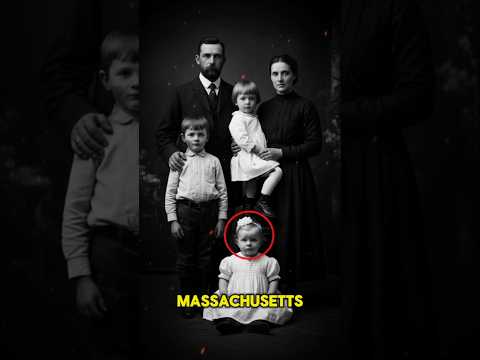
…the noise and scratches, a shape emerged that made her breath catch. There, in the background, partially obscured by the heavy drapery, was a figure she hadn’t noticed before. A baby girl, no more than two years old, standing alone in the shadows. Her tiny hands were clasped in front of her, and her eyes—even through the grain of the old film—seemed to stare directly at Rebecca.
“That’s impossible,” she whispered. According to every record she had, the Hendrickx family had only three children in 1898. No baby girl. No fourth child. Yet here she was, clearly part of the portrait, yet somehow overlooked for over a century.
Rebecca’s mind raced. Who was this child? Why had she been erased from the family history? And why did her presence in the photograph feel less like an accident and more like a message?
She saved the enhanced image and opened a new search window. The mystery of the Hendrickx baby had just begun.
She started with the obvious sources: census records, birth registries, church baptismal logs from Richmond between 1895 and 1898. The Hendrickx name pulled up dozens of entries, but none of them mentioned a fourth child. Thomas and Elizabeth appeared with their three known children—Margaret, Eleanor, and William—in the 1900 census, and the household staff was listed separately at the bottom.
No baby girl. Not even a servant’s child who might have been photographed alongside the family.
Rebecca leaned back in her chair and rubbed her eyes. “Okay, think,” she muttered. Photographers in the 1890s didn’t just let random toddlers wander into formal portraits. Every person in that frame was placed deliberately. The baby had to belong to someone.
She pulled up the original high-resolution scan again and zoomed in on the shadowed corner. The girl’s dress was plain, almost coarse compared to the lace worn by Margaret and Eleanor. Her hair was cropped short, and her feet were bare—visible just beneath the hem of the drapery. Bare feet in a formal studio portrait? That wasn’t a family member. That was a servant’s child.
Or something else entirely.
Rebecca opened a folder of correspondence the Hendrickx family had sent her—letters, diary fragments, a few receipts. Most of it was tedious, but one item caught her attention: a handwritten note from Elizabeth Hendrickx dated March 1898, just weeks after the photograph was taken. The ink was faded, but the words were clear enough.
“The arrangement has been made. She will be taken to the Sisters at St. Joseph’s before the month is out. Thomas will not speak of it again.”
Rebecca read the line three times. “She will be taken.” Not “the child” or a name. Just she. As if the girl had already been reduced to a pronoun, a problem to be solved.
She cross-referenced St. Joseph’s Orphanage in Richmond and found a ledger entry from April 1898. A female child, approximately two years old, admitted under the name “Agnes.” No surname listed. No parents recorded. The intake note simply read: “Delivered by private arrangement. Sponsor: T. Hendrickx.”
Her heart thudded. Thomas Hendrickx had paid to have this child hidden away. But why? An illegitimate daughter? A relative’s orphan they couldn’t acknowledge? Or something darker that the family had spent a century burying?
Rebecca glanced at the clock. It was nearly seven in the evening, and she hadn’t eaten since breakfast. But she couldn’t stop now. She typed “Agnes Hendrickx” into the search bar and hit enter, expecting nothing.
What came back made her blood run cold. A single result: a death certificate from 1901. Agnes, aged five, cause of death listed as “accidental drowning.” The informant’s name on the certificate was Elizabeth Hendrickx.
Elizabeth had reported the death herself. The same woman who had written that cold, clinical note about “the arrangement.” Rebecca stared at the screen, the baby girl’s eyes still fixed on her from the corner of the photograph.
She wasn’t just a hidden child. She was a buried one. And someone in the Hendrickx family had made sure she stayed that way.
Rebecca reached for her phone. The client—a great-grandson of William Hendrickx—deserved to know what she’d found. But as her finger hovered over the contact, she hesitated. What if the family already knew? What if the erasure had been deliberate, generation after generation?
She put the phone down and turned back to the photograph. The baby’s eyes seemed to follow her, patient and unblinking, as if she had waited a hundred and twenty-six years for someone to finally ask the right question.
The next morning, Rebecca arrived at her office before sunrise with two cups of coffee and a plan. She printed the death certificate and pinned it to her corkboard beside the enhanced photograph, drawing a red line between them. Five years old. Accidental drowning. Reported by the woman who sent her away. The timeline bothered her more than anything else—Agnes had been hidden in an orphanage for three years before she died. Three years of silence, then a death that no one in the family had ever mentioned.
She pulled up the Richmond newspaper archives and searched for drownings in the spring of 1901. The first few results were routine—a dock worker, an elderly man who fell from a ferry. Then she found it: a brief notice buried on page six of the Richmond Dispatch, dated April 17, 1901.
“A child named Agnes, an inmate of St. Joseph’s Orphanage, was found in the James River near the Manchester docks. Foul play is not suspected.”
Rebecca read the words twice. Foul play is not suspected. A five-year-old girl, alone, near the docks at the river’s edge—and no one thought to ask how she got there? St. Joseph’s sat nearly two miles inland. A child that small didn’t wander that far unnoticed.
She opened a second window and began searching for the orphanage’s records. Most of St. Joseph’s files had been transferred to the diocesan archive in the 1970s, but a digitized index listed the names of children admitted between 1895 and 1905. Agnes appeared again—same intake date, same sponsor. But this time, a handwritten margin note caught her eye: “Recovered to family, 1900.”
Recovered to family. Someone had taken Agnes out of the orphanage a year before she died. Someone had brought her back into the Hendrickx household—or somewhere close to it—and then she had ended up in the river.
Rebecca’s phone buzzed. A reply from her client, David Hendrickx, who had responded to her late-night email with three words: “Call me. Now.”
She dialed, and he picked up on the first ring. His voice was hoarse, as if he hadn’t slept. “You found her,” he said. It wasn’t a question. “The baby in the corner. My grandmother mentioned her once, when I was a boy. She called her the little ghost. I thought it was a story.”
Rebecca gripped the phone tighter. “Your grandmother knew about Agnes?”
There was a long pause on the line, the kind that meant someone was deciding how much to say. “She told me the family had a secret they kept in the cellar,” David said finally. “I always assumed she meant old furniture. But now—”
He stopped himself. Rebecca heard him exhale slowly, steadying his voice. “Dr. Torres, there’s something I didn’t tell you when I hired you. The reunion next month isn’t just a family gathering. We’re selling the old Hendrickx house. The new owners want a full history of the property before they close. Every room. Every record.”
Rebecca looked at the photograph again, at the baby girl standing in the shadows of the drapery, her bare feet just visible beneath the hem. “Then I think we need to talk about what’s in that cellar,” she said.
The line went quiet. When David spoke again, his voice was barely a whisper. “I’ll be in Richmond by Friday. Bring the photograph.”
Friday came fast. David Hendrickx met Rebecca at the old house on Grace Street, a three-story brick relic with peeling shutters and a cellar door that hadn’t been opened in decades. He was fifty-something, gray at the temples, with the same heavy jaw as the man in the 1898 portrait.
“My grandmother said the secret was never meant to leave this house,” he said, fitting an old brass key into the lock. “She made me promise never to sell it without looking first.”
The cellar smelled of damp earth and old paper. Boxes lined the walls, and in the far corner sat a child-sized trunk, its lid carved with a single word: Agnes.
Inside lay a small woolen dress, a wooden doll, and a bundle of letters tied with ribbon. Rebecca’s hands trembled as she untied them. The first was in Elizabeth’s hand, dated 1900: “She has come home. Thomas says she must stay out of sight until the matter is settled.”
The last letter was dated April 1901, the week Agnes died. “She saw too much. God forgive us.”
David sank onto a crate, his face pale. “They didn’t just hide her,” he whispered. “They silenced her.”
Rebecca looked at the little dress, then back at the photograph in her bag. The baby’s eyes no longer seemed patient. They seemed to be waiting for someone to finally say her name out loud.
“What do you want to do with the truth?” she asked.
David stared at the trunk for a long moment. Then he reached for his phone. “I’m calling the historical society. And the police. If there’s a case to be made, a hundred and twenty-three years late or not, Agnes deserves it.”
Rebecca nodded and pulled out the photograph, laying it gently inside the trunk beside the dress. For the first time, the shadowed corner looked less like a hiding place and more like a grave finally marked.
But as she turned to leave, one question still gnawed at her: how many other family portraits hide a child the world was told to forget?
Report this article
Select a reason for reporting:






