October 1942. Off Guadalcanal, Marine pilot Jack Conger reaches into the water to pull a downed Japanese airman out alive. He has him close enough to see his face. Then the airman’s hand rises from the sea, holding a small 8mm pistol already pointed at the American’s own head.
He pulled the trigger. The seawater had soaked the cartridges and the gun misfired. He turned it on himself and it misfired again. A single wet round was all that stood between that moment and a dead American.
To the man who carried it, the pistol had never been a souvenir. It was the last word he meant to have.
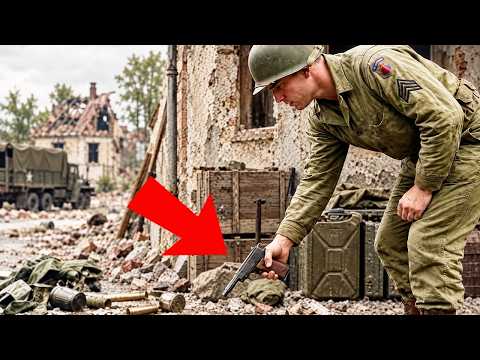
By the autumn of 1942, the men fighting on Guadalcanal had already turned the enemy dead into a marketplace. A Japanese flag, a helmet, an officer’s pistol, a pair of chopsticks, a photograph of someone’s family. These things went home in letters and seabags, or were sold to sailors and pilots in the rear who never saw the enemy up close. A frontline Marine could make real money off a good Nambu.
Robert Leckie, a machine gunner with the First Marine Division, watched the souvenir hunters work a field of Japanese dead after the fight at the Tenaru. He described them moving among the bodies carefully, almost delicately, as if they already suspected the corpses might be rigged. They were stripping insignia, slipping rings off fingers, lifting pistols off belts.
Even that early in the war, the fear was there. That fear had been earned.
Far to the north, on the frozen island of Attu, the United States Army learned the same lesson in blood. In the spring of 1943, soldiers there were killed and attacks were slowed around them because men stopped under fire to grab useless trinkets off the ground. The War Department wrote it up afterward in an intelligence bulletin and the warning it printed was blunt. The enemy, it said, would frequently booby trap items he figures you will want as souvenirs.
One army private on Attu stuffed a captured flag and a sheath of sketches into his jacket. The papers turned out to be Japanese battle orders and they marked the position of an artillery piece. A shell from that same gun later put him in the aid station. His trophy had been trying to warn him the whole time.
By the time the Marines were bleeding their way across the central Pacific, the pattern was set. The enemy would take the thing you wanted most and turn your own greed into a fuse. And the thing you wanted most very often was a pistol.
Japanese officers carried handguns the way they carried their swords as marks of rank, and an officer’s pistol was compact, portable, easy to slip into a pack and carry home. The most prized was the Type 14 Nambu, a long, elegant sidearm that looked a little like the German Luger every soldier in Europe was chasing. Hundreds of thousands of Nambu-pattern pistols were built. And a Marine who pulled one off a dead lieutenant held something worth bragging about.
But there was another Nambu, smaller and uglier and far more dangerous to the man who owned it. It was the Type 94, adopted by the Japanese army in 1934 and built under the eye of the arsenal at Nagoya. The man behind it was Kijiro Nambu, the designer whose name sat on nearly every Japanese service pistol of the era. He built it to be cheap and small, a sidearm for tank crews and pilots and paratroopers who needed something that would not snag in a cramped cockpit or a turret.
It fired a weak 8mm round and it held only six of them. The grip was awkward and the sights were often useless. And on the left side of its frame, in plain view, sat the flaw that would make it infamous.
Most pistols hide their firing mechanism deep inside the frame where nothing can touch it by accident. But the Nambu did not. Its sear, the small bar that holds the striker back until the trigger is pulled, ran along the outside of the left side of the gun, exposed to the open air. On a cocked, loaded pistol with the safety off, a hard press on the front end of that bar over a distance about the width of two stacked coins would release the striker and fire a round with no finger anywhere near the trigger.
That is why American troops gave it the names it still carries. The suicide special. The suicide gun. A pistol that handled wrong might go off in your grip while you were still admiring it.
The central Pacific is where the souvenir war turned industrial. On Saipan, in June of 1944, the Second Marine Division stopped treating the problem as common sense and started treating it as policy. The division handed its men a printed guide to the island. It told them plainly that a flag or a scrap of gear found on the battlefield was theirs to keep, but only after the intelligence section had cleared it, and that nothing captured was leaving that island unless division intelligence passed it first.
Then it spelled out how the enemy baited his traps. Trip wires strung across trails and tied to doors and windows. Rifles left lying in the open. Corpses, theirs and ours, rigged to the men who came to move them. The guide named the exact weakness the Japanese were counting on. The natural human urge to pick up a souvenir.
Across the strait on Tinian, the warning turned concrete. On the 24th of July, 1944, as the 25th Marines came ashore, engineers moving up from the beach found the Japanese had been busy. Among the defenses was a scattering of booby traps, and the bait had been chosen with a grim understanding of the American soldier. Wrist watches. Cases of beer stacked where a thirsty man would see them. All of it quietly wired to explode in the hands of whoever reached for it first.
The official Marine Corps account of the landing records it in a single dry line, almost offhand, as though rigged beer had become an ordinary hazard of the job. By that summer, it had.
The methods behind those traps were cataloged by American intelligence in the handbook on Japanese military forces printed in the autumn of that same year. The Japanese soldier carried a deep toolkit. He could drop a grenade upside down into a length of bamboo or a spent shell casing so that a tug on a wire let it fall nose first onto its own fuse. He could bury a grenade under a floorboard with its delay element removed so it fired the instant a boot came down. His pull-friction grenades needed only a few pounds of force and were made to be tied to a door, a helmet, or a piece of abandoned kit.
And again and again, the accounts come back to the body on the ground. The dead man left his bait, a grenade tucked beneath him with the pin already gone, waiting for someone to roll him over for his flag or his watch or his pistol.
On Peleliu that autumn, a young mortarman named Eugene Sledge watched his own side do what every side does when the fighting pauses for a moment. The living went through the dead. Helmets were checked for flags. Packs and pockets were emptied. Sabers and pistols and knives were prized above almost anything, cleaned and guarded and set aside to be mailed home or sold to a pilot for a fair price.
Sledge kept relics from that campaign himself. And a friend once stopped him, with a few quiet words, from prying the gold teeth out of a Japanese corpse, not out of pity for the dead, but to keep Sledge from becoming something he would not want to recognize later. That was the other cost of the souvenir. A cost that had nothing to do with wire or powder.
The most common prize of all was not a pistol or a sword, but a flag. Almost every Japanese soldier carried a personal good luck flag. A white silk square with the red sun at its center and a border of handwritten names. And to a Marine, it was the perfect souvenir. Light, flat, easy to fold into a pocket or seal inside a letter home.
Which is exactly why the enemy learned to tuck a grenade into the folds of one or to leave it draped across a body with the pin already drawn. It was the thing almost every man wanted, which made it the perfect place to hide the thing that would kill him.
By now, you have seen the flaw hidden in that pistol’s design and what the enemy could do with a body and a grenade. But the two questions you came here with are still sitting unanswered. Were these Marines ever really ordered to leave the enemy’s guns where they lay? And did that ugly little sidearm, the one they called the suicide gun, ever actually kill the man who picked it up?
Stay with me, because both answers are stranger than the story everyone tells.
By the middle of the war, the problem had outgrown the front line. A War Department study of souvenir hunting in the Pacific complained that the worst offenders were not even the assault troops but the men who came ashore behind them. The construction battalions, the shore parties, the ship’s crews picking over positions that riflemen had paid for in blood. On more than one island, intelligence officers reported that enemy material of real value had already been stripped and carried off by the middle of the first afternoon. The hunt was emptying the battlefield of exactly the documents and equipment the Americans most needed to read.
Some units found a way to turn the hunger into a tool. The counterintelligence men ran what amounted to a trade. A soldier who brought in a captured document or a bit of equipment could reach into a grab bag of harmless trinkets, enemy postcards, stationery, odd scraps of clothing, and walk away with a legal souvenir in exchange for the one thing the interrogators actually wanted. It was a quiet bribe against a deadly habit, and it worked better than any threat.
The warnings were not only about staying alive. Souvenir hunting also robbed the Americans of intelligence because the flags and name plates and documents men carried off were often worth more to an interrogator than to a mantelpiece. On Rennell, a senior officer kept it simple. A man could keep his souvenir, but only after his company commander, his intelligence officer, and his ordnance officer had each cleared it. It was through those cleared trophies, he said, that the Americans knew the enemy’s strength and layout within two hours of coming ashore. The dead man’s effects could save your life twice. Once by not killing you, and once by telling your side where the next gun was.
On Iwo Jima in the late winter of 1945, the traps stopped being a scattering and became the ground itself. The Marine Corps history of the fighting in the islands north describes mines and booby traps that seemed to be everywhere, encountered on a scale the Pacific had not seen before. Japanese infiltrators slipped toward the softer targets in the rear, and the men back there learned to treat every abandoned object as a question. Army troops mopping up found food and water left as bait. Sometimes ringed with trip wires, sometimes wired to blow.
Then came Okinawa, the last and the worst of them. In the spring and summer of 1945, photographers there recorded a single cabbage still growing in the dirt with a grenade hidden inside it. Veterans came home describing trip wires run to parasols and flashlights and tin cans, to radios and bottles, to nearly anything a souvenir-hungry American might bend down and lift. The whole island had been turned into a question with a lethal answer. And the question was always the same. How much do you want it?
So after all of that, were the Marines actually ordered never to pick up a Japanese pistol? The honest answer matters. There was no single command, no one line in a field manual that said leave the enemy’s handgun where it lies. What there was ran heavier than that.
There was Article of War 80, which made captured property government property and turned pocketing it into a court-martial offense. There were division rules that put an intelligence officer between a man and his trophy. And underneath it all ran a constant current of warnings in bulletins and briefings.
Which brings us to the pistol itself. I could not find a single documented case of a named Marine killed by a Type 94 firing through its own sear. But the danger was not invented. The mechanism is real. The loaded pistols were real.
The trophy always went home. The question was what it carried with it. Have you ever brought home something you later wished you had left where it lay?
Report this article
Select a reason for reporting:






