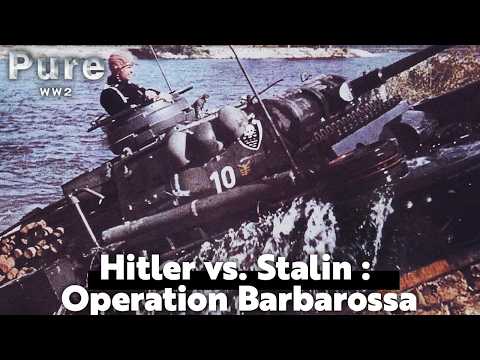
On the morning of June 22, 1941, the largest invasion in history began. Over three million Axis soldiers, supported by thousands of tanks and aircraft, surged across a 2,000-mile front. The world held its breath as Hitler’s war machine turned east.
But this was no ordinary military campaign. From the very beginning, it was designed as a war of annihilation.
“The goal is to destroy the vital strength of Russia,” declared General Halder.
The seeds of this cataclysm were sown nearly two years earlier. In August 1939, the world was stunned when Nazi Germany and the Soviet Union signed a non-aggression pact. The two ideological arch-enemies suddenly stood shoulder to shoulder. For Hitler, it was a tactical masterstroke, buying him time to conquer Western Europe without the threat of a two-front war.
For Stalin, it was a chance to rearm and rebuild an army still reeling from the purges. Both dictators knew the friendship was temporary. It was a pact between thieves, each planning to rob the other.
The agreement carved up Eastern Europe. Hitler got a free hand to invade Poland, and before that campaign even ended, Soviet troops moved in from the east. The German Wehrmacht and the Red Army met at Brest-Litovsk, shaking hands over the corpse of a nation.
With his eastern flank secure, Hitler turned west. In May 1940, the Wehrmacht unleashed its blitzkrieg on France and the Low Countries. Within weeks, France was forced to sue for an armistice. Hitler saw himself as a military genius, the architect of a new kind of warfare.
But Hitler was not a fool. He had clawed his way up from nothing, and he understood people, crowds, and the mechanics of power. His ideology was detached from reality, yet he wielded it tactically, bending it to his purposes. By 1940, the formula was working.
On July 6, 1940, the dictator returned to Berlin in triumph. His next step, he had decided, was the invasion of the British Isles. Then, finally, war against the Soviet Union.
That same day, General Franz Halder noted in his war diary that the time had come to find a military-political basis for future operations. But Hitler had already made his intentions clear. Lebensraum in the East—a war of conquest—was the plan all along.
By late July 1940, detailed planning had begun. Different branches of the Wehrmacht High Command started to think through the campaign. On July 31, 1940, in the presence of his military chiefs, Hitler announced his decision to invade the Soviet Union the following spring.
By then, the authority of the Supreme Commander was sacred, even to skeptical officers. Halder was tasked with coordinating the plans for the Wehrmacht. The detailed preparation for the operation fell to Major General Friedrich Paulus.
Halder and Paulus were executors of Hitler’s ideological vision—or rather, his delusions. They had to make those fantasies feasible. That was their essential role. The tragic and terrifying truth is that, for professional military reasons, they failed to see it.
Paulus was one of the senior staff officers who participated in the planning of what was not yet called Barbarossa. Multiple military sectors independently drafted their own plans. The Army High Command was just one of them. The Navy prepared its own, as did the Armed Forces High Command.
These plans were then assembled and presented to Hitler on December 5, 1940. A week earlier, Paulus had presented a preliminary plan for the attack. He wanted to convince the dictator of the need for rapid armored advances to prevent the Red Army from retreating into the vast spaces behind it.
Initially, this was one of many options. The German military elite was determined to finish the war with Britain and its empire. There were three issues: the air war against the British Isles, the war in the Atlantic, and the war in the Mediterranean—alongside Operation Barbarossa, which ran somewhat parallel.
Six months later, Hitler noticed that Barbarossa was slowing down. So he pressed the accelerator. From December 1940, concrete plans for the invasion were put in place. Before that, it had been merely an option, and Hitler himself had hesitated for a long time.
He had proudly declared that Germany, unlike in the First World War, was not involved in a two-front war. “We will not make the same mistake this time,” he had said.
But now, fully conscious, he was heading toward exactly the same situation. The policy behind Directive No. 21, Operation Barbarossa, was clearly the destruction of the Soviet Union and the occupation of territory up to a line running roughly from Arkhangelsk, east of Moscow, to Astrakhan on the Caspian Sea.
After the defeat of the Red Army, the remnants were to be pushed beyond the Ural Mountains and the resulting space given to German settlers. That was essentially Hitler’s plan. And on this plan, the Wehrmacht commanders designed their operations.
The invasion of the Soviet Union seemed reckless, but the Wehrmacht saw the USSR as a military colossus with feet of clay—one that would collapse quickly after the first setbacks. Halder said the operation only made sense if they crushed the state in a single blow. “Our goal is to destroy the vital strength of Russia.”
German military leaders loved planning battles of annihilation. Ideally, this meant engaging the enemy frontally, enveloping them from one or both flanks, then encircling and forcing surrender. With the enemy’s fighting power eliminated, the deployment of Red Army forces along the western border was assessed on the same basis—and that assessment suited German plans perfectly.
Once again, success was to be achieved through blitzkrieg. German strategists knew the Soviet armed forces had rearmed extensively after the invasion of Poland. They must have known their soldiers would face one of the strongest armies in the world.
But they made a fatal mistake. They underestimated the Red Army. We must try to picture the situation at the time. The pitiful performance of the Red Army in the Winter War with Finland played a decisive role.
In November 1939, the Soviet Union attacked Finland without a declaration of war. The goal was to force the country into the Soviet sphere of influence. The Red Army fought bravely but suffered devastating losses. Its forces lacked automatic weapons and winter clothing, and the conflict cost 120,000 Russian soldiers their lives.
Wehrmacht commanders saw this as confirmation of their assessment. There were certainly military figures shaped by long-standing German military doctrine, including arrogance toward Eastern Europe. But once they looked at a map and saw the size of the Soviet Union, they should have realized that defeating this opponent would not be easy.
Fundamentally, even in 1941, the Germans still did not know what operational or strategic objective they should pursue to win the war. In 1940, relations with the Kremlin appeared unchanged. Stalin believed the German-Soviet friendship had been sealed in blood.
But Hitler had other plans, and he knew the Wehrmacht staff supported him. At the time, they could not see the Soviet Union as a serious military opponent. Thus, its military potential was astonishingly underestimated.
In January 1941, Halder wrote in his diary: “They are still unclear about Barbarossa, but they are still going ahead with it.” That was, so to speak, the military’s traditional understanding of obedience. The political leadership set the strategic guidelines, and the military translated them into practice—and that is exactly what happened.
In early June 1941, a Wehrmacht supply unit was stationed in Paderborn under Lieutenant Gath Bogelmann. The 28-year-old officer from Cologne was a passionate amateur photographer. He took these photos of his unit as it set off toward a criminal war—a war whose scale many soldiers could not yet imagine.
The issue of Lebensraum in the East had been raised in Germany since the days of the Kaiser. So it was not really new when the German people heard Hitler say that this living space in the East must be secured. But the fact that he had planned it from the beginning in a criminal manner was an entirely new dimension.
At first, to those who listened to his ideas, it was perhaps unimaginable. Yet throughout the 1930s, he repeatedly spoke of how he planned to wage war and what his actual goal was—not merely securing territory, but eliminating the peoples who lived there.
By 1941, it was entirely clear how this war would be waged. The propaganda film “The Soviet Paradise,” shown in German cinemas in 1942, revealed the ideological justification for the Nazis’ racial war. The final battle against the Slavic race was to cost thirty million souls.
The Second World War on the Eastern Front was certainly planned as a war of annihilation. It was designed specifically to exterminate the Soviet population, subjugate it, and create living space in the East for Germans—because the German race, according to the Nazis, needed more living space. This living space in Soviet Russia was seen as profitable and fertile.
In Nazi ideology, the Soviet people were subhuman and had no right to decide their own life or death.
Lieutenant Bogelmann’s photographs show a unit moving through a landscape that seemed to swallow them whole. The roads stretched endlessly, the villages passed in a blur of dust and destruction. What the camera could not capture was the moral abyss into which the Wehrmacht had descended.
By autumn 1941, the blitzkrieg was faltering. The rains came, turning roads into rivers of mud. Then came the frost. German soldiers, still in summer uniforms, huddled in frozen trenches. “The Russians are not twelve divisions,” Halder wrote grimly. “They are a hydra.”
The war of annihilation had a price. The Red Army, battered but unbroken, learned to fight. Factories beyond the Urals churned out tanks and guns. The Soviet people, brutalized by occupation, turned from resignation to resistance. Behind the front, partisans struck at supply lines, and the German rear became a killing ground.
In Berlin, Hitler raged at his generals. Moscow was so close, yet impossibly distant. On December 5, 1941, the Red Army counterattacked. The myth of the invincible Wehrmacht shattered in the snow before Moscow.
Bogelmann’s unit, like so many others, was caught in the retreat. His photographs from those weeks show exhaustion, frostbite, and fear. The camera lens could not lie. The war of annihilation had become a war of survival—for both sides.
Years later, in a dusty archive, Bogelmann’s photographs were discovered. They show smiling soldiers, burning villages, and frozen corpses. They are evidence of a crime that ideology tried to erase. The war on the Eastern Front was not a myth. It was a slaughter, and the camera recorded it all.
What do you think—can photographs like these serve as a warning, or do they simply become historical curiosities, stripped of their horror by time?
Report this article
Select a reason for reporting:






