The mist was thick, the clouds hung low, and the roar of jet engines tore through the quiet Scottish highlands. Inside the cockpit of Vulcan XH477, five men fought to keep the massive bomber steady, their eyes glued to instruments as they navigated blind at 500 feet. It was June 12, 1963, and this routine training mission would soon become a desperate race against rising terrain.
They never saw the hillside coming.
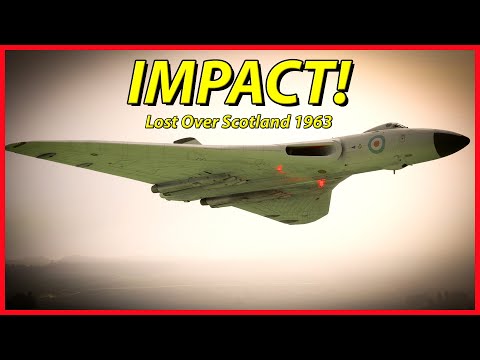
The Avro Vulcan was Britain’s Cold War shield, a delta-winged giant designed to carry nuclear payloads deep into Soviet territory. But as Soviet missiles grew more deadly, the Vulcan’s high-altitude strategy became suicidal. The downing of Gary Powers’ U-2 in 1960 proved that even the stratosphere was no longer safe. So the RAF adapted, sending its bombers screaming through valleys at 300 to 500 feet, using terrain to mask them from radar.
It was a dangerous game, and the crews knew it.
XH477, a B1A variant, was modified for this new low-level role, equipped with radar altimeters and electronic countermeasures. Based at RAF Waddington, it was part of 44 Rhodesia Squadron, a unit at the forefront of the transition. On that fateful day, the crew—Captain David Allen Blackmore, Co-pilot Derek George Faulk, Navigator Radar Gerald Barkley Ross, Navigator Plotter Arthur David Roer, and Air Electronics Officer John Rodney Chapman—departed in the afternoon, heading north along the east coast before turning inland over Scotland.
The planned route took them through the Scottish Highlands, with turning points near Glen Tana, a region notorious for its rapidly changing weather. Reports indicated low cloud, drizzle, and poor visibility, with hilltops shrouded in mist. Despite the conditions, the crew pressed on, maintaining their training profile at a few hundred feet above ground.
As they flew through valleys and across rising terrain, the visibility worsened. Turbulence buffeted the bomber as it followed the valley contours, flying blind in the thick mist. The radar altimeter, their only reliable guide, might have been affected by the steep, uneven terrain, giving inaccurate readings. They descended further than intended.
Ahead, the slopes of the Hill of St. Congan climbed sharply out of the valley floor. The Vulcan, hurtling at nearly 400 knots, had no time to react.
The impact was catastrophic. The Vulcan struck the western slopes of the Hill of St. Congan at tremendous speed, tearing into the hillside and disintegrating instantly. The explosion shook nearby farmhouses, scattering wreckage across a wide area and setting small fires in the heather and grass. All five crew members were killed instantly, the force of the impact leaving no possibility of survival. The debris field stretched several hundred yards down the slope, pieces of the delta wing and fuselage embedded in the peat.
When XH477 failed to report its next checkpoint, a search and rescue operation was launched involving the RAF Kinloss mountain rescue team. According to the Kinloss MRT report, the team was called out at approximately 16:35, shortly after contact with the aircraft was lost and local authorities began receiving reports of a loud explosion over Deeside.
The rescue party set out from RAF Kinloss by road, covering nearly 70 miles to reach the Glen Tanar estate in deteriorating weather conditions. Darkness and driving rain hindered progress, and it was not until around 8:00 p.m. that searchers located the first fragments of wreckage on the hill. The main crash site was confirmed later that evening. Poor visibility, rough terrain, and continuing rain slowed recovery operations, which took several days to complete under challenging circumstances.
Contemporary records indicate the crash resulted from controlled flight into rising terrain during poor visibility in the Deeside hills. There was no evidence of mechanical failure or crew negligence, but investigators noted the demanding conditions and low-level operational profile as significant contributing factors. The crew had been flying in low cloud, drizzle, and poor visibility with limited visual reference to the ground and extremely poor forward visibility.
It was likely that low-level radar altimeter readings were affected by the steep and uneven terrain profile, giving inaccurate height indications that caused the aircraft to descend further than intended. The official inquiry expanded on these findings, noting that the rapid rise of the terrain and the crew’s reliance on instruments at such a low altitude left little margin for reaction.
Following the accident, RAF Bomber Command reviewed its low-level training procedures and navigation aids in depth, emphasizing improved terrain awareness, more rigorous weather assessments before such missions, and clearer operational guidance for pilots flying in marginal meteorological conditions. These lessons contributed to future refinements in Vulcan crew training and to the gradual integration of enhanced radar systems such as terrain-following radar designed to assist safe low-level flight.
The loss of XH477 sent ripples through the tight-knit Vulcan community. Crews who had flown the same valleys, trusted the same instruments, and accepted the same risks now faced the stark truth of their profession. Five men had gone to work that morning and never returned. Their names—Blackmore, Faulk, Ross, Roer, and Chapman—became a quiet reminder of the price paid for readiness in an age of nuclear standoff.
For the families, there was no closure in the official findings. The inquiry’s careful language of “controlled flight into terrain” and “inaccurate height indications” could not soften the blow. What remained was the silence of the Highlands, the scattered fragments on the hillside, and the memory of men who flew into the mist without hesitation.
The crash of Avro Vulcan XH477 stands as a solemn testament to the dangers faced by RAF crews during the Cold War—men who trained daily to ensure Britain’s nuclear deterrent remained credible and ready. Their commitment and sacrifice underpinned an era of tension and technological innovation that defined a generation of military aviation.
Today, a small memorial near the Hill of St. Congan marks the spot where the delta-winged bomber met its end. It is a quiet place, often shrouded in the same mist that claimed the crew. Those who visit speak of the stillness, broken only by the wind and the distant cry of birds. The lessons learned from that day helped shape safer procedures and better technology, but they came at a cost that no training manual can fully capture.
Have you ever stood at a memorial like this, or known someone who served in the V-Force? Share your thoughts and stories in the comments below—let’s remember the crews who never made it home.
Report this article
Select a reason for reporting:






