Anzio, spring 1944. Captain William H. McKay of the Fifth Army peered through the Plexiglas of his fabric-covered Piper L-4, a $2,400 civilian trainer with no guns, no bombs, no armor. Below, 2,400 German troops with armor advanced toward the Allied beachhead. He picked up his radio and called a fire mission. Within minutes, 5,000 rounds of American artillery rained down on the column. A captured German officer later estimated 50% casualties—roughly 1,200 men killed or wounded. One airplane, one radio, and a standing Wehrmacht order that every German soldier on the Western Front had already learned the hard way: When you see that airplane overhead, do not fire. Do not move. Do not reveal your position. Because the next sound you hear will be the last one that matters.
That order was born of a system no other army on Earth had built. By summer 1944, the United States was the only major combatant with centralized fire direction above battery level—a brain that could take a single voice on a radio and mass battalion, group, or corps artillery onto one point within minutes. The seed was planted at Fort Sill in 1931, when gunnery instructor Carlos Brewer demonstrated massing an entire battalion by firing chart. All by hand, all on slide rules and plotting boards. What that system produced was time on target: dozens of firing units timing their salvos so every shell arrived within three seconds of every other, all hitting the same patch of ground at the same instant. Conventional artillery gave men seconds of warning—the first ranging round. TOT eliminated it. The first sound was everything arriving at once.
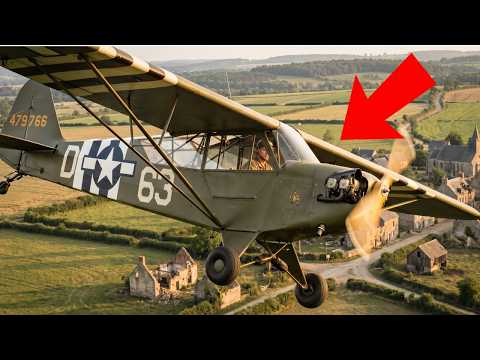
But the FDC was a brain. It needed eyes. And on the ground, a forward observer’s eyes died fast. Every steeple, every ridge, every brick chimney the Americans used as an observation post was the first thing German gunners targeted. Hedgerows blocked sight lines. Reverse slopes hid entire formations. The solution was overhead, and it cost $2,400. The Piper L-4 Grasshopper—a 65-horsepower, fabric-skinned trainer with a cruise speed of 75 mph—carried no armor, no armament. The standard pilot defense was a Colt .45 stuffed under the seat. What it could do was see. From a thousand feet at 60 mph, the observer looked over hedgerows, behind tree lines, into the rear areas where German guns hid. Linked by FM radio to the fire direction center, a single L-4 crew could call a mission, watch the spotting rounds, walk them onto the target, and bring the full weight of American artillery to bear in minutes.
The 1941 Louisiana Maneuvers proved the concept so decisively that umpires banned the Cubs mid-exercise for giving the Third Army an unfair advantage. By 1944, every US field artillery battalion in Europe had two L-4s and two pilots—artillerymen first, aviators second. At Anzio, McKay’s L-4 was the only way to see back. He called the fire mission. Roughly 5,000 rounds came down. One airplane, one radio, and one observer leaning out of a Plexiglas greenhouse at a thousand feet. In those same weeks, Lieutenants Peaney O. Lysney and Richard W. Blake flew 50 pints of blood plasma into the besieged beachhead within 24 hours. Normandy proved the L-4 indispensable—and lethal to its own crews. In June and July 1944, General Bradley’s First Army lost 49 spotter aircraft and 33 pilots. One in three killed in two months. These men flew from farm fields within range of German guns in fabric airplanes with nothing between them and a machine gun burst but doped cotton and a prayer.
Then came Arracourt, September 20, 1944. Heavy fog had grounded every fighter-bomber. Around noon, the fog began to lift over Lorraine. Major Charles Carpenter, a former history teacher from Moline, Illinois, took off in his L-4H, Rosie the Rocketer. Strapped under the wings were six bazooka tubes, rigged to a panel of toggle switches. He spotted a company of Panthers and armored cars advancing on Arracourt. He dove. Through ground fire, he came in again and again, returned twice to reload, and fired at least 16 rockets. Two Panthers immobilized, several armored cars destroyed. After his fifth confirmed tank kill, Carpenter told a Stars and Stripes correspondent, “Word must be getting around to watch out for Cubs with bazookas on them. Every time I show up now, they shoot with everything they have. They never used to bother Cubs.”
That last sentence is the key. Before Carpenter, Wehrmacht troops ignored the Cubs overhead. After Carpenter, they faced a choice with no good answer. Shoot and reveal your position to the American FDC, guaranteeing a time-on-target barrage within minutes—or hold fire and hope the fabric airplane circling above isn’t carrying bazookas. Either way, you lost.
Standing Wehrmacht instructions reflected exactly that logic. Unit-level postwar recollections consistently describe orders to maintain camouflage discipline and refrain from small-arms fire when an L-4 appeared overhead. German ground commanders repeatedly urged the Luftwaffe to sweep the Cubs from the sky, but by 1944 the Luftwaffe could not contest American airspace in any sustained way. Where they managed it—three Bf 109s hunting Lieutenant Darwin Garrard over Nijmegen, four more catching Lieutenant John Garglietti on approach—these were fighter sweeps of opportunity, not systematic defense.
And when the L-4 couldn’t fly, the consequences were immediate. The Bulge proved it. Heavy overcast, fog, and snow grounded most spotters for the first critical days of the German offensive in December 1944. Only the 42nd Field Artillery Battalion’s pair of Cubs got aloft on the 16th. The 99th and Second Division airfields were overrun; pilots abandoned their planes and escaped on foot. Without the eyes overhead, American artillery effectiveness collapsed back to ground-observed accuracy—limited, slow, blind behind the next ridge. Captain John Johnson, 12th Corps Artillery, said it flatly: “The Air Force stood down during the German advance at the Bulge, but we were out there flying every day at 500 to 600 feet. Weather be damned.”
The Cessna L-19 Bird Dog replaced the Grasshopper after the war. All metal, 213 horsepower, the iconic forward air controller of Korea and Vietnam. The institutional fight the L-4 had won—organic Army Aviation, owned by artillerymen, not the Air Corps—became the seedbed for the Army’s adoption of the helicopter after the Air Force split off in 1947. Without the bureaucratic precedent the Cub established, the Army arguably never owns the rotary-wing fleet.
What the pilots remembered was not the airplane. It was the sound. The thin clatter of a 65-horsepower Continental, audible on the ground, easy to mistake for a tractor. And what came after the sound stopped circling. Captain John Johnson’s summation: “These Cubs did more damage to the German Army than our bombers and fighters.” He overstated the case, but the men who heard that engine overhead—on both sides of the line—knew exactly what he meant.
So here is the question that lingers over every hedgerow and hilltop where that little fabric airplane once circled: if a $2,400 trainer with a .45 under the seat could break the Wehrmacht’s will to shoot, what does that say about the weapons we spend billions on today—and the ones we overlook? What would you have done, crouched in that foxhole, hearing the engine fade and waiting for the first shell to arrive?
Report this article
Select a reason for reporting:






