Imagine staring up at a living skyscraper 250 feet tall, 10 feet wide, older than the United States itself, and knowing your job is to bring it crashing down with nothing but steel, sweat, and a saw called the misery whip. Before chainsaws, men gambled their lives on each cut, fueling America’s relentless hunger for timber. But what drove them to risk everything to fell these forest giants? And how did they pull it off when a single mistake could mean disaster?
Douglas fir, western red cedar, Sitka spruce. These are the giants that once ruled the Pacific Northwest. Some stood more than 300 feet tall with trunks over 12 feet thick at the base. Their crowns rose so high that the first branches might begin 60 feet above the forest floor. Under the canopy, sunlight barely reached the ground. Moss draped from limbs, ferns crowded the roots, and the air hung heavy and cool, muffled by a wall of living wood.
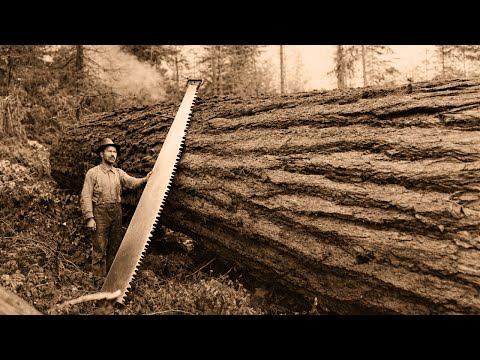
The bases of these trees didn’t just meet the soil. They swelled outward, forming buttresses as wide as a small cabin. A single Douglas fir could have begun its life before the first European ships ever sighted the coast. Red cedars in these stands sometimes measured 1,000 years old with fire scars and storm wounds hidden beneath thick fibrous bark. The forest itself felt ancient, a place where every step was cushioned by centuries of fallen needles. Among these pillars, a logger was dwarfed, just a flicker of movement at the foot of a living skyscraper. To bring one down meant confronting not just height or girth, but the weight of time itself.
The stakes were enormous. A tree this size could crush a team, flatten horses or equipment, or hang up in its neighbors and become a suspended hazard. Every cut was a calculation. Every fall was a gamble with gravity and history. In these woods, the scale of the task was measured not in board feet, but in awe.
Railroads chewed through timber like fire through grass. Every mile of new track demanded up to 3,000 wooden ties, each one hewn from old-growth trees. With the nation laying down thousands of miles of rail in the late 19th and early 20th centuries, the appetite for lumber was insatiable. It wasn’t just the rails. Steel needed timber for trestles, bridges, and snowsheds. Mines in the West called for thick beams to hold up tunnels, and coastal cities stretched outward, hungry for wharves, warehouses, and new homes.
Disasters only deepened the need. When the great Seattle fire burned more than 100 acres downtown in 1889, the city’s sawmills and their rivals across Puget Sound worked around the clock. Mills like Yesler’s and Stetson and Post turned ancient Douglas fir and red cedar into beams, joists, and shingles as fast as crews could stack them. In the first two years after the flames, a torrent of lumber measured in hundreds of millions of board feet poured into Seattle streets, rebuilding block after block. This wasn’t a local story. From San Francisco to Chicago, cities rebuilt with wood from the Pacific forests. The entire industrial pipeline—logging camps, river drives, rail spurs, sawmills—relied on one thing: the men who could bring down the forest giants.
Before any board could be milled, before any spike was driven, someone had to face the tree and cut. And with trees this size, only hand tools and human muscle stood between the timber and the waiting world.
A logger’s day began with the misery whip. A crosscut saw stretching six, sometimes 12 feet, its blade lined with sharp alternating teeth and rakers. Two men, one at each end, would grip the removable handles and settle into a rhythm. Steady pull, easy return. The saw only cut on the pull, never the push, and every stroke demanded control. Pushing too hard buckled the blade, wasted strength, and wristbinding deep in the trunk. Resin and pitch gummed the teeth. Sawdust clogged the kerf, and the work left hands blistered and shoulders aching. Each saw weighed several pounds per foot. And the job wasn’t just about muscle. It was about precision and patience.
Fellers earned a quarter more than most men in camp, not for brute strength, but for their skill. One mistake could bring down a tree the wrong way, ruin valuable timber, or worse. John Red Miller, a Czech immigrant whose careful notes survive in old camp ledgers, wrote out his checklist before every cut. Read the lean of the tree. Watch the wind. Tap the trunk for rot. Scan the canopy for dead limbs—widow makers—ready to drop at the wrong moment. Plot the escape path. Only then did the real work begin.
The first step was chopping springboard notches into the butt swell, a flared base too wide and twisted for efficient sawing. Axe in hand, Miller would carve a pocket 6 or 8 feet up, then jam in a plank shod with a metal shoe. The board flexed underfoot, but held steady, letting fallers stand above the worst of the flare, eye to eye with the clean, straight wood. Both men would mount their boards level with each other and set the saw for the first cut. Every move was calculated: where to stand, where to cut, how to retreat if the tree began to go. The preparation was slow, methodical, and unforgiving. Only when every detail lined up did the misery whip bite into the wood.
A barber chair isn’t just a technical term. It’s a logger’s nightmare. The tree splits up the back, the trunk explodes, and the base rockets backward with lethal force. In 1914, on a rain-soaked slope above Grace Harbor, a felling crew faced a western red cedar that towered 260 feet. The sawyers had read the lean and set their springboards high, working the misery whip through hours of resin and fiber. William Reigns, a seasoned faller, stood balanced six feet above the ground, boots planted on a plank, eyes on the cut. The undercut was clean, the back cut steady. But deep inside the cedar, tension wood waited. As the saw neared the hinge, a sharp crack rang out. Too soon, too high. The trunk split upward in a flash. The butt end, weighing thousands of pounds, shot backward off the stump, snapping the springboard from the pocket. Reigns had no time to run. The force pinned him against the roots, the saw still trapped in the wood. In the aftermath, the crew pulled him free, but the damage was done. The camp ledger listed the cause as barber chair, vertical split, fatal. There was no compensation for the widow, no insurance for the children, just another name in the long roll of men lost to the forest.
The stump still stands, scarred by the split, a silent warning. For every tree that fell clean, there were others that fought back. In these woods, skill and caution offered no guarantees. Each cut was a gamble, and sometimes the forest won.
A skilled team with misery whips and axes could bring down maybe two or three giants in a single day. Each tree demanding hours of sweat, planning, and risk. Then came the first gasoline chainsaws in 1929. Awkward two-man machines weighing nearly 200 pounds. Even so, a tree that once took half a shift to fell could be dropped in minutes. Today, a modern harvester can cut, limb, and buck a big tree in less than five minutes. The change wasn’t just about speed. It redefined what muscle meant in the woods. The old rhythm of steel and muscle gave way to the roar of engines.
Logging camps were rough outposts thrown together deep in the woods where men from Finland, Norway, Japan, and the Midwest crowded into long bunkhouses. Nights echoed with coughs and snores, the air thick with damp wool and wood smoke. Pay was better for the fallers, but every man knew someone who’d been crushed or crippled by a falling log. Few spoke of it. Out in the forest, the only lasting trace of their labor are the stumps scarred with square notches where springboards once perched, silent markers of skill and risk. Each notch is a memory carved in wood.
But the story of the old-growth fallers isn’t just one of timber and toil. It’s also a tale of the forest itself, and what remains. Less than 10 percent of Pacific Northwest old-growth forests still stand. As debates rage over what should be preserved, the stumps and scars left by hand fallers remind us every beam and board costs sweat, risk, and irreplaceable time. What will we choose to leave standing?
Yet the legacy of the misery whip and the men who wielded it lives on in more than stumps. In the early 1900s, as logging camps pushed deeper into the woods, the work grew even more dangerous. Timber companies demanded more output, and fallers were pressured to take greater risks. Some camps began using high-lead logging, where massive spar trees were rigged with cables to haul logs out of the forest. These spar trees, often the tallest and straightest firs, were climbed by high riggers—men who scaled 200 feet with nothing but climbing spurs and a rope. They topped the trees and rigged the cables, dangling in the wind while the ground crew watched in silence. A single misstep meant a fall of terrifying height. The high riggers were the elite, paid top wages, but their lives hung by a thread.
One such rigger, a Norwegian immigrant named Lars Hansen, worked the camps around Grays Harbor in the 1920s. His specialty was topping spar trees, and he was known for his calm in the face of dizzying heights. On a foggy morning in 1923, Hansen climbed a 220-foot Douglas fir that was to serve as the spar for a new high-lead setup. He wore caulked boots and a rope belt, carrying a small handsaw and a hatchet. At the top, he would cut the crown off and rig the block and tackle. The crew below watched as he disappeared into the mist. Minutes passed, then an hour. Suddenly, a sharp crack echoed down, and the top of the tree crashed through the canopy, trailing branches. But Hansen didn’t signal. When they finally climbed to check, they found him unconscious, struck by a widow maker—a dead branch that had fallen from a neighboring tree. He survived, but never climbed again. The camp ledger noted: ‘Lars Hansen, injured by falling limb, lucky to be alive.’
Such accidents were common, yet the work continued. The demand for timber was relentless, and the men who fell the giants were both revered and expendable. Their stories, etched in the grain of old stumps and the memories of their families, form a forgotten chapter of American industry. Today, as we walk through the few remaining old-growth forests, the silence is profound, but if you listen closely, you can almost hear the rhythmic pull of the misery whip and the distant shout of ‘Timber!’ echoing through the trees.
Those echoes fade, but the choice remains. “We can’t bring back a 1,000-year-old cedar,” a modern forester once said, “but we can decide what the next thousand years look like.” Less than a tenth of the old growth still stands—a fraction of what men like Miller and Hansen once faced.
Their notched stumps are monuments now, teaching hikers and historians alike that every board carried a price paid in sweat and sometimes blood. The misery whip hangs silent in museums, yet its lesson endures: progress always asks what we’re willing to sacrifice.
So when you run your hand along a weathered beam or stand beneath a surviving giant, ask yourself—what will we choose to leave standing for those who come after us? Tell us in the comments: preservation or progress—where do you draw the line?
Report this article
Select a reason for reporting:






