September 1, 1939, 4:45 AM. The thunderous boom of the German battleship SMS Schleswig-Holstein shattered the dawn over Danzig, signaling the start of World War II. But as the world held its breath, a group of 43 Polish postmen and clerks huddled inside the city’s Polish Post Office, armed with little more than rifles, grenades, and an unyielding determination to defend their sovereign soil. They were about to face the full wrath of the Nazi war machine—and embarrass it in ways no one could have predicted.
This is the story of an unlikely last stand that would become a symbol of defiance, a tale where ordinary men stood against the SS, police, and artillery, holding out for 19 hours against overwhelming odds. It’s a story of courage, sacrifice, and the incredible power of conviction in the face of tyranny.
The free city of Danzig was a political anomaly, a semi-autonomous city-state squeezed between Poland and Germany, created by the Treaty of Versailles as a compromise that left no one truly satisfied. With a population that was 98% German, Danzig was a tinderbox waiting to ignite. By the 1930s, the Nazi Party had tightened its grip on the city, and the local police and SS units were fully integrated into Hitler’s intimidation machine.
As war loomed, Polish officials recognized the vulnerability of their institutions in Danzig. The Polish Post Office, technically sovereign Polish territory, became a focal point. Sub-Lieutenant Konrad Guderski, a combat engineer, was dispatched to fortify the building and transform its staff into a fighting force. He armed 43 postmen and clerks with a handful of rifles, grenades, and three Browning automatic rifles—hardly a match for the German war machine. Yet, under his leadership, they prepared for the worst.
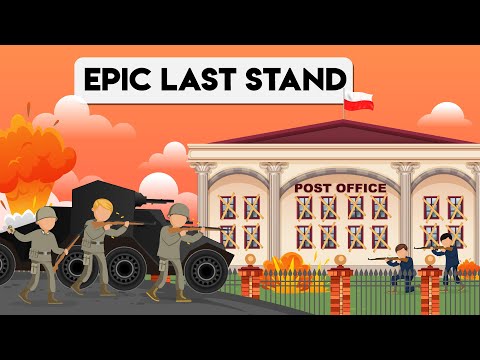
When the attack came, it was swift and brutal. The city police, supported by an armored car and the local SS unit, launched a frontal assault. A demolition charge blew a gaping hole in the building’s wall, and the Germans poured in—only to be met with a hail of grenades and pistol fire. Two Germans were killed and six wounded in the first assault, forcing a retreat. The postmen had drawn first blood.
The Germans, humiliated by the resistance, escalated their efforts. They brought in artillery, including 75mm field guns and a 105mm howitzer, and pounded the post office relentlessly. Still, the postmen held. They repelled a second assault, and Sub-Lieutenant Guderski, though fatally wounded, took several attackers with him by detonating grenades. The siege dragged on, and the watching German civilians, who had expected an easy victory, grew increasingly embarrassed.
As the hours ticked by, the German commander resorted to medieval tactics. A sapping tunnel was dug beneath the post office walls, and a 600kg bomb was detonated, bringing down the last of the defenses. The Germans captured the ground floor, but the postmen retreated to the basement, refusing to surrender. In a final, desperate move, the Germans pumped gasoline into the basement and ignited it, burning several defenders alive. The remaining postmen, with no other choice, finally surrendered.
But the horror was not over. The postmaster, Jan Michon, was shot dead under a white flag, and others were executed or burned alive. The Nazis, furious at the embarrassment caused by the postmen, convened a kangaroo court and sentenced many to death. Yet, four managed to escape and survive the war, their story a testament to the indomitable spirit of resistance.
The defense of the Danzig Post Office lasted 19 hours—far longer than the six hours the postmen had hoped to hold out. They killed 10 Germans and wounded 22, while losing only 8 of their own during the siege. Their stand delayed the German advance and became a symbol of Polish heroism. But the story doesn’t end here; the aftermath and the fate of the survivors would echo through history, a reminder that even in the darkest times, ordinary people can achieve extraordinary things.
The four men who escaped the makeshift prison on September 8 did not run far at first. They slipped into the narrow alleys of the Old Town, shedding their postal uniforms and disappearing among the dockworkers and shipyard laborers who still remembered the Free City before the swastika. One of them, a clerk named Brunon, later recalled hiding in a coal cellar for three days, listening to German boots clatter overhead. The men were not soldiers—they were mail sorters, telegraph operators, and a bookkeeper—yet they had become the most hunted fugitives in Danzig.
Their survival depended on a network of Polish railway workers and sympathetic dockhands who smuggled them out of the city in stages. Disguised as merchant sailors, two of them boarded a freighter bound for neutral Sweden, carrying nothing but forged papers and the memory of their comrades’ faces. The other two, including Brunon, chose to stay in the region, moving between farms on the outskirts of the Free City, where Polish families risked execution to hide them.
Back in Danzig, the Germans moved quickly to erase the post office from memory. The ruined building was demolished, its site cleared, and the surviving prisoners were paraded before a military tribunal that had already written its verdict. The prosecutor called them “bandits in postal uniforms,” a phrase designed to strip them of any legal protection under the Geneva Convention. The kangaroo court obliged, and the executions were carried out in a sandy clearing outside the city, the men refusing blindfolds and reportedly singing the Polish national anthem as the rifles were raised.
Yet the story refused to die. Word of the siege spread through the Polish underground, carried in whispered conversations and smuggled leaflets. In Warsaw, the defense of the post office became a rallying cry, proof that the German war machine could be slowed, even humiliated, by ordinary citizens with nothing but rifles and resolve. The timing mattered: the Polish army had hoped to relieve the post office within six hours, but the collapse of the Pomeranian front meant no rescue ever came. The postmen had held out for nineteen hours knowing, by the end, that no one was coming.
What the Germans never understood was that the post office was never really about the building. It was about the principle that a letter posted in Polish territory belonged to Poland, that a postal clerk in a foreign city was still a servant of the Polish state, and that sovereignty could be defended with a stamp as surely as with a sword. When the SS commander demanded their surrender, the defenders’ reply was said to be simple: “We are not soldiers. We are postmen. And the mail does not surrender.”
After the war, the survivors returned to a Danzig that had become Gdańsk, its German population expelled and its Polish identity restored. The four escapees testified at war crimes trials, their accounts helping to convict several SS officers who had participated in the siege. A monument was eventually raised near the site of the old post office, its inscription listing the names of the fallen—men who sorted letters, delivered parcels, and, for one long day in September, held the line against an empire.
But the story had one more twist. In the 1960s, a German historian researching the opening day of the war stumbled across the SS after-action report on the post office siege. The report, written by a furious commander, admitted that the defenders had fought “with a fanaticism that bordered on the insane” and recommended that the incident never be publicly discussed again. The Nazis had understood, even then, that the postmen’s stand was a propaganda disaster in the making—a story that could not be spun, only buried.
They failed. Today, the postmen of Danzig are remembered not for the letters they delivered but for the stand they made, a reminder that resistance can come from the most unexpected places—a sorting room, a basement, a handful of clerks with rifles and grenades. The mail, it turns out, can be a matter of life and death.
Yet the siege’s echoes carried further than anyone in that basement could have imagined. In Berlin, Hitler’s propagandists had planned to film the post office’s capture as a triumphant newsreel, proof that Polish resistance would crumble under German steel. Instead, the footage was seized and locked away, deemed too humiliating for public consumption. For a regime obsessed with the image of invincibility, a gang of postmen holding out for nineteen hours was a wound that would not heal.
The military lessons were not lost on the German high command either. The siege revealed how costly it could be to assault fortified positions in urban terrain, even against lightly armed defenders. Some historians argue that the Danzig post office was an early, overlooked warning of the brutal street fighting that would later consume Warsaw, Stalingrad, and Berlin itself. The Germans had won the building, but they had learned nothing from the price.
For the Poles, the memory hardened into something almost sacred. During the occupation, the story of the postmen was passed from mouth to mouth, a secret inheritance that no decree could confiscate. Scouts and schoolchildren in the underground were taught the names of Guderski and Michon the way other children learned their prayers. To speak of the post office was to insist that Poland still existed, even when its map had been torn away.
When the war finally ended and the survivors emerged from hiding, they found themselves transformed into living monuments. Some struggled with the weight of it. One escapee reportedly refused to speak of the siege for years, insisting that the real heroes were the men who never came out of the basement. He would only say that the mail had to move, and so had they.
The site itself became a pilgrimage of sorts. School groups came, veterans laid flowers, and postal workers from across Poland made the journey to stand where their predecessors had made their stand. In a quiet ceremony, a brass plaque was affixed to a nearby wall, its letters simple and unadorned: they defended the Polish post to the end.
But history, as it always does, kept moving. The Cold War divided Europe anew, and the story of the postmen was folded into the official narratives of the People’s Republic, celebrated but somewhat sanitized, stripped of its rougher edges. It was only after 1989, when Poland was free once more, that the full account could be told—the gasoline, the flamethrower, the white flag and the bullet that followed it.
And yet, one question lingered in the archives, a thread that researchers kept pulling at. The German after-action report mentioned a single defender who had been captured alive on the ground floor, separated from the others, and interrogated through the night. His name was never recorded in the trial documents, and no survivor remembered him among the prisoners. Some said he had been a courier who arrived the night before the attack, carrying orders that never reached the men in the basement.
Others believed he was a myth, a ghost invented by the SS to explain how a handful of clerks had fought so well. But in 1998, a researcher in Gdańsk found a handwritten note in a private collection, signed with initials that matched no known survivor. The note read simply: “The mail got through. Tell them the mail got through.”
No one ever identified the courier. Some mysteries, like some stands, are better left unbroken. The post office site now hosts a small museum, its glass cases holding rusted rifles, a burned postbag, and a single brass button from a postal uniform.
Visitors often pause there, wondering what they would have done with a rifle and a handful of letters. What would you have done, when the guns began—would you have stayed at your post?
Report this article
Select a reason for reporting:






