The world held its breath. Somewhere over the Mediterranean, a B-52 Stratofortress—carrying four thermonuclear weapons, each over 1,700 times more powerful than the bomb dropped on Hiroshima—was preparing to refuel when a KC-135 tanker slammed into its fuselage. The year was 1966. The bomber, a flying fortress of American deterrence, was suddenly spiraling toward the Spanish coast, its nuclear payload still armed and primed. On the ground, no one knew if this was a training exercise or the spark that would ignite World War III. This was the reality of the Cold War: a single mistake, a single mid-air collision, could end civilization.
For nearly half a century, the B-52 has dominated the skies, a symbol not just of American military might, but of the terrifying responsibility of holding the world’s most destructive weapons. It has dropped more conventional bombs than any other aircraft in history, yet its most critical mission was one it never executed: the delivery of nuclear annihilation. When the President of the United States needed to wield his “big stick,” he sent the B-52. When America wanted to punish an enemy, it sent the heavy bombers. But the B-52 became more than a bomber—it became the embodiment of American resolve, a flying deterrent that kept the peace through the sheer threat of unimaginable retaliation.
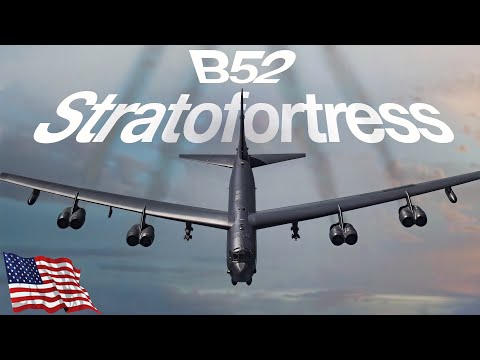
The story of the B-52 begins not in the skies over Europe or Asia, but in the ashes of World War II. The world had just witnessed the devastating power of the atomic bomb, and the United States was already preparing for a new conflict with the Soviet Union. The Strategic Air Command (SAC) was formed, tasked with maintaining a force capable of delivering nuclear weapons anywhere on the globe. But America lacked an aircraft powerful enough to meet these demands. Boeing began work on various long-range bomber designs, including radical swept wings and jet-powered aircraft. Yet it was a single meeting on October 21, 1948, that would change everything.
Colonel Henry “Pete” Warden of the Wright Air Development Center met with Boeing engineers and demanded a prototype using jet engines—and he wanted the plans in just two days. It was a daunting request, but the team refused to disappoint him. “We were the ones who had to do it, and we knew what we had to do,” one engineer recalled. Working out of a hotel room in downtown Dayton, Ohio, the team transferred data from the B-55 bomber into a larger design. They cut balsa wood models, sketched performance documents, and by Monday morning, presented their work to Warden. He was stunned. The jet-powered plans were approved, and production began in Seattle in January 1949.
For two years, Boeing tested and refined the aircraft in wind tunnels, perfecting the placement of eight Pratt & Whitney engines on a radically redesigned wing with a 185-foot span. On April 15, 1951, the YB-52 was ready for its first flight. “We knew we had a winner before we flew it,” said one test pilot. The flight lasted two hours and 51 minutes, ending in a perfect landing at Moses Lake. But the aircraft wasn’t done evolving. General Curtis E. LeMay, the head of SAC, demanded a side-by-side cockpit instead of the tandem seating, and the first few B-52s were modified accordingly. By 1955, the new B-52 was revealed to the public, ready for active service.
The timing was critical. The Soviet Union had already developed its own atomic and hydrogen bombs, and America desperately needed a heavy bomber capable of retaliating if necessary. The B-52 fit the role perfectly. With a crew of six—pilot, co-pilot, electronic warfare officer, radar navigator-bombardier, navigator, and tail gunner—the bomber was packed with fuel tanks along its wings and fuselage, and massive bomb bays along its belly. For the elite crews selected by SAC, seeing the B-52 for the first time was unforgettable. “I walked around the B-52 and thought, wow, this is really great,” one pilot remembered. “And then I looked at the skin on this B-52, and it was all wrinkled, like mine, and I thought, this thing can’t fly. This is not going to be good.” But it did fly—and it flew very well.
Flying the B-52 was like driving an 18-wheel Mack truck compared to a fighter jet. “You push the throttles forward on all eight engines, the whole aircraft shakes, there’s this noise, and it sits there at the end of the runway, everything vibrating,” a pilot described. “It’s almost like a sprinter ready to start. And then you start moving, and it begins to slowly accelerate. And it goes a little faster and a little faster and a little faster. And then you finally take off and you’re climbing. But the first time is a really exciting experience.” Yet the B-52 was not just a machine of brute force—it was a machine of immense responsibility.
As the Cold War intensified, the greatest fear was a sudden, preemptive Soviet strike. SAC ensured that 12 B-52s, fully armed with nuclear weapons, were airborne 24 hours a day, 365 days a year. The plan was known as Chrome Dome. “We initiated, developed, planned, and wrote the first nuclear war plan,” a SAC officer recalled. “It was a war plan, but it became the national war plan.” B-52s flew three primary routes: a northern path across North America and Canada, over Newfoundland and Iceland, around Greenland and the Arctic Circle, across Alaska, and back down the western side of the U.S.; a southern path across the Atlantic, orbiting the Mediterranean, and returning to the U.S. Each patrol was designed to keep critical targets in the Soviet Union under constant surveillance. A B-52 on patrol was never more than two hours of flight time from its target.
But these missions, some lasting up to 26 hours, demanded incredible endurance from the crews. “You sat in an ejection seat and had a 40-pound parachute on your back,” a crew member remembered. “You had a helmet, relatively heavy, and thermal underwear. Maybe heavy boots. You had a winter suit or a summer suit. It was mostly cold, minus 55 degrees. And then you add your high altitude, low ambient humidity, and you lose a lot of moisture. Many times I lost 5 to 10 pounds, usually just in water, from a long stressful mission.” The crew compartment was cramped, with inflatable mattresses for rest and a small oven for heating food. But the physical strain was nothing compared to the psychological weight of the mission.
Every B-52 was armed with up to four thermonuclear weapons, and only the President could order their use. “There was a story that was told,” a SAC officer said. “There was a diary, and you would go to the Russian premier and the question was, is today the day we can take on the United States and come out ahead? The general would say, not today, sir. And our job was to make sure that was his answer every day.” To maintain this state of high alert, SAC required B-52 crews to endure long, stressful tours of duty. Crews were expected to be ready to launch within 15 minutes and hit their targets if ordered. “It’s a little scary to think about,” one crew member admitted. “You know, I saw an A-bomb explode in a bikini. Many didn’t see it. And I knew how scary it was that we were carrying things much, much stronger.”
The training was brutal, and only the best survived. Crews underwent psychological profiling—“You’re talking about taking a nuclear weapon and throwing it on the ground, and a lot of people can’t handle that,” a SAC instructor explained—along with physical endurance tests for missions lasting more than 20 hours. But the driving force behind this pursuit of perfection was General Curtis E. LeMay. “He was the big daddy,” one officer recalled. “He was the one who founded SAC. And of course, the impression conveyed was that there was nobody tougher than Curtis E. LeMay.”
If an attack on America was ever launched, a series of defensive steps would unfold. Incoming missiles or bombers would be detected by radar early-warning stations. Once verified, the warning that the U.S. was under attack would be passed to SAC headquarters in Omaha, Nebraska. The entire B-52 fleet would be scrambled. SAC would then consult with the White House. The President was never more than a few feet from the war plan. If—and only if—it was necessary, the President gave the final order to go.
B-52s already airborne would receive coded instructions, known as go codes, to fly to their targets. “There was a coded message you would receive, and it required you and another crew member, called positive control, to authenticate that message,” a radar navigator-bombardier recalled. “The code was a letter code. If both your cards matched the message, then it meant this was an authentic message and authorized you to strike your target.” Most B-52 crews had already made arrangements with their families for what to do in the event of a nuclear attack. “I took the opportunity to instruct my wife on what she had to do,” one pilot said. “That included assembling the things she would need to take care of the children, packing the car, and being ready to leave the immediate target area. All of our SAC bases were targeted.”
Every mission carried an awesome responsibility. “It’s a bit of a scary thought,” a crew member admitted. “I saw an A-bomb explode in a bikini. Many didn’t. And I knew how scary it was that we were carrying things much, much stronger. We all understood the significance of the Cold War and the threat posed by the Soviet Union and the Warsaw Pact nations. And we were committed to taking them out if necessary. But we also knew we had never committed to a first or preemptive strike.”
Each B-52 was on its own, heading toward its target. “They can’t pull you back,” a pilot said. “Once you have it, you’re committed to the target. You just orbit there and wait for one of two things to happen. Either you get the message telling you to proceed to the target, or if you don’t get it, you have to determine how long you can stay in that orbit before you have to turn back to make it back to base and land without running out of fuel.” If enemy bombers or missiles penetrated and destroyed SAC headquarters, an alternative plan existed to guide the airborne B-52s to their targets. It was called Looking Glass. “We had Looking Glass on board too, a SAC general officer with a full battle staff,” an officer recalled. “It was an eight-and-a-half-hour mission. They flew three missions a day. And of course, this system was designed so that if SAC headquarters was lost due to an attack, then this general officer would find himself running the war and talking to the President of the United States and the Secretary of Defense.”
For ten years, one SAC officer had the honor of flying 358 of these missions. This flying command center was a crucial pillar in the doomsday scenario. But thankfully, it was never needed, because a single misdirected bomb would lead to nuclear catastrophe, and not a single living creature would remain alive on the planet. But accidents with all these nuclear bombers did happen. And when a B-52 crashed with four 50-megaton bombs, the world held its breath.
During the Cold War, nuclear-armed B-52s patrolled the skies 24 hours a day, 7 days a week, ready to deliver the most powerful bombs in the world. These bombs were never dropped in combat, but on more than one occasion they were nearly detonated by accident. On January 17, 1966, a B-52 was refueling on a routine Mediterranean patrol at 30,500 feet off the coast of Spain. “We had a mid-air collision over Spain between a B-52 and a KC-135 jet tanker,” a crew member recalled. “The KC-135 crew was lost. Many of the B-52 crew survived. The weapons were deployed, so to speak, and had to be pulled out of the sea, which caused quite a sensation.”
They were successful in recovering the weapons, and thanks to the safety features built into them, there was never any concern about nuclear detonation. After another incident in Greenland, neutral governments began to object to B-52s armed with nuclear weapons flying over their territory. The risk of catastrophe was too great. And the introduction of intercontinental ballistic missiles and nuclear submarines provided the United States with an alternative retaliatory arsenal. These events caused such an uproar on the world stage that SAC and the U.S. civilian leadership decided to stop and curtail the operation. In September 1968, the Chrome Dome airborne alert system was taken out of service.
For the men who flew these missions, the B-52 fulfilled its role as a world peacekeeper. “Looking back, I don’t regret the 17 years I spent in SAC,” one veteran said. “I think we did a lot for our country. I think one of the things we talk about is that most people think the Cold War just ended. It didn’t. We say SAC won the Cold War.” For more than 10 years, the B-52 patrolled the sky, waiting for go codes that thankfully never came. But its days as a bomber were not over. It was about to undertake a new mission over Southeast Asia.
When the need for massive firepower arose in Vietnam, the Air Force looked around and realized the best delivery platform was the B-52. Modified B-52Ds with “Big Belly” bomb bays could carry 108 750-pound bombs between their internal and external racks. “We were committed to taking them out if necessary,” one crew member said of the enemy. From 1965 to 1968, B-52s flew over 2,000 combat sorties in Rolling Thunder, dropping more than 630,000 tons of bombs.
But the most famous display of American air power came in December 1972. Operation Linebacker II. “Some of us probably won’t be alive,” John Yule remembered thinking during the briefing. “Some of us will die in four or five hours.” On the third night, Yule’s B-52 was hit by two surface-to-air missiles. “I looked out and saw the huge fire right in front of the plane’s nose,” he recalled. “I told the crew to eject.” All six survived—but Yule was captured and taken to the Hanoi Hilton, where he found himself on the receiving end of B-52 strikes.
Over 11 days, 15 B-52s were shot down, and 61 crew members fell over North Vietnam. Hanoi could not take more punishment, and a ceasefire was signed. The B-52 had proven its worth in a new kind of war.
Decades later, after 9/11, the B-52 was called back to action over Afghanistan. “Just the sight of a B-52 overhead sends a signal to those on the ground that we are here to stay,” one officer said. Nearly half a century after its first flight, the B-52 remains in service, projected to fly until 2045—nearly 100 years of active duty. “Give them an attaboy from me,” one veteran said of the original designers. “They did a very good job.”
What do you think—is the B-52 the greatest bomber ever built, or is it time for something new? Let us know in the comments below.
Report this article
Select a reason for reporting:






